Research
Articles on research.
A banking customer journey map is a visual model of every stage a customer goes through with a bank or credit union, from the first need through account opening, onboarding, everyday banking, problems, borrowing, and the decision to stay or leave, with the customer's goal, touchpoints, and emotions recorded at each stage.
Ecommerce customer feedback is what online shoppers tell a store about why they bought, hesitated, abandoned a cart, returned an item or never ordered again. Unlike ecommerce analytics, which records what shoppers did, it explains why they did it.
The Marriott customer experience strategy is the system Marriott International uses to measure and act on guest feedback: a short post-stay guestVoice survey scored on Intent to Recommend (ITRec), manager follow-up with guests who score below 9, and Marriott Bonvoy, a loyalty program of 309 million members.
The Starbucks customer experience strategy is Back to Starbucks, CEO Brian Niccol's plan to restore the coffeehouse experience through Green Apron Service staffing, a four-minute service-time target, and a tracked customer connection score.
Open-ended survey questions are questions that let respondents answer in their own words instead of choosing from options you wrote, such as "What almost stopped you from buying today?" They capture reasons, customer vocabulary and problems you didn't anticipate, at the cost of more skipped answers and more work to…
Voice of customer analytics is the practice of using text, speech and statistical analysis to find patterns in what customers say across surveys, support tickets, calls, chats, reviews and social posts, then measuring how often each theme appears and how it relates to outcomes like satisfaction, spend and churn.
Hospitality customer experience in 2027 will be won by the hotels and restaurants that know why guests don't come back, and they will learn it by asking in conversation (text or voice, in the guest's own language) instead of with a form. Going into 2027, hotel satisfaction is rising: the J.D.
Insurance customer experience in 2027 will be decided at four moments: the quote, the first bill, the claim, and the renewal that carries a rate increase. U.S. auto insurance prices rose about 56% between January 2022 and early 2026 in the Bureau of Labor Statistics consumer price index, peaking at a 22.6% annual increase in April 2024, and policyholders responded by shopping.
Qualtrics AI is a set of capabilities layered onto the Qualtrics survey platform: Conversational Feedback (AI-generated follow-up questions on open-text answers), Experience Agents (AI agents that act on feedback signals), and AI text analytics and summaries.
For teams whose real question is why customers churn, complain or buy, Perspective AI is the strongest overall pick in a Qualtrics vs SurveyMonkey decision going into 2027, because it replaces the survey with an AI interviewer that asks follow-up questions instead of serving a fixed form.
Restaurant customer experience is the sum of every interaction a guest has with a restaurant brand, from finding it and placing an order through the meal, the takeout bag or delivery handoff, and the later decision about whether to come back.
The retail customer journey is the full sequence of steps a shopper moves through with a retailer, from first noticing a product or store to buying, using, returning, and coming back, across physical stores, websites, apps, and support channels.
Improving customer experience in banking is the practice of finding and fixing the specific moments, such as account opening, fee changes, fraud claims and branch closures, where customers decide whether a bank deserves to be their primary financial institution.
Customer experience in a retail store is the sum of every physical and human moment a shopper has inside a store: finding the product, getting help, waiting, paying, returning and picking up. It is judged mostly on whether the shopper left with what they came for, and on how much effort that took.
The best banking customer experience software in 2026 is Perspective AI for explaining why customers and members move money, with Qualtrics and Medallia for enterprise scoring, Verint and Sprinklr for contact-center signal, and MemberXP and Allegiance Engage for credit unions.
The best healthcare market research stack in 2026 is chosen by job: Perspective AI for AI-moderated interviews and synthesis, IQVIA and Cortellis for data and competitive intelligence, and M3 Global Research, Sermo, and Reckner Healthcare for recruiting verified HCPs.
The best patient experience software in 2026 is a stack, not a single tool: a CMS-approved CAHPS survey vendor for regulated measurement, a real-time feedback tool for service recovery, and a "why" layer that explains what the scores mean.
Customer onboarding in banking is the set of steps a bank or credit union takes from account opening through roughly the first 90 days to verify a new customer, get the account funded and used, and turn it into the customer's primary financial relationship.
A hotel mystery shopper is a trained evaluator who books, stays at, and scores a hotel anonymously against a checklist of brand and service standards, posing as an ordinary guest. The shopper reports on reservations, check-in, the room, housekeeping, dining, and how staff handle requests and problems.
Retail foot traffic analysis is the practice of measuring how many people visit a physical store, when they arrive, how long they stay, how often they return, and how many of them buy. Retailers use it to staff stores, judge marketing, compare locations, and decide where to open or close.
Omnichannel Customer Experience Measurement: Hearing the Same Shopper Across Store, App, and Support
Omnichannel customer experience is the single, continuous experience a shopper has with a retailer as they move between channels (store, website, app, delivery, returns, and support) and the degree to which those channels behave like one brand that remembers them.
Shopper insights are the evidence-backed explanations of why a shopper chose a specific product, brand, store, or channel at the moment of purchase, including what else they considered and what nearly changed their mind.
Guest experience is the sum of everything a hotel guest perceives, feels, and remembers across every interaction with a property or brand, from the first search and booking through pre-arrival, check-in, the stay itself, checkout, and the follow-up after they leave.
Salesforce completed its acquisition of Listen Labs on November 2, 2026, according to an editor's note on Salesforce's own announcement, five weeks after signing a definitive agreement on September 29, 2026.
"Customer retention software" is not one category — it is five different product types competing for the same search term, and picking the wrong lane is the most common way retention budgets get wasted.
Market research software in 2026 covers four separate jobs that buyers routinely conflate: finding the right respondents (panel and sample), asking them something (the instrument), making sense of what they said (analysis), and storing it for reuse (repository).
The best post-purchase survey tools in 2026, ranked by how much buying reasoning they actually capture, are Perspective AI (#1), Fairing, KnoCommerce, Zigpoll, Grapevine, Okendo, and Bizrate Insights.
Retail has the richest behavioural data of any industry and the thinnest explanation of it. Foot traffic counters, point-of-sale systems, loyalty programs, location analytics and ecommerce clickstream together produce an extraordinarily detailed record of what shoppers did — which stores they entered, what they…
CX analytics in 2026 splits into three types sold as one category: behavioural analytics, feedback and text analytics, and conversational analytics, which generates the explanatory data the other two can only search for.
Guest experience management in 2026 runs on a six-layer stack, and hotels have workable tooling for the five operational layers while the sixth — the understanding layer, which establishes why guests chose, returned or left — is missing from most stacks entirely.
Perspective AI is the best AI research tool in 2026 for teams who need to hear from their own customers continuously, because it reaches people on the channel they already use — web, email, Slack, WhatsApp, outbound call, or a dedicated call-in number — and routes what it learns into the systems where work happens.
The useful way to rank AI interview platforms in 2026 is by whether the AI conducts the conversation or the respondent still fills a form, and then by whether it runs as a study or always-on. Perspective AI, Typeform Research Flow, Outset, Listen Labs, and TheySaid compared.
Typeform Research Flow, launched June 9, 2026, is a genuine AI-moderated research platform — it runs studies in parallel across text, audio, and video, recruits from a verified panel or your own audience, screens participants, and auto-generates summaries, themes, sentiment, and highlight reels.
Perspective AI is the top pick among app store review analysis tools in 2026 when the ranking lens is insight depth, because it is the only option on this list that can generate new evidence instead of re-sorting evidence a reviewer already volunteered.
Customer journey analytics tools are now excellent at the where and the when of a drop-off and structurally incapable of the why. Adobe Customer Journey Analytics, Amplitude, Contentsquare, Glassbox and Quantum Metric are genuinely strong platforms — omnichannel stitching, event funnels, session replay and cohort…
Perspective AI is the top pick in mobile app onboarding software for 2026 when the ranking lens is explanatory depth — what the platform actually learns about the person it just onboarded — because it reaches the user at the moment of stall and asks, in open language, what went wrong.
Product review platforms for DTC brands are built to convert, not to explain — and the honest way to rank them is on two separate lenses. On the conversion lane (stars, photo and video UGC, review request emails, retailer syndication), Judge.me leads on accessibility with a genuine free tier, Yotpo leads on bundled…
A funnel chart can tell you that 38% of new users never finish step 3 of your onboarding experience; it cannot tell you whether step 3 was confusing, premature, untrustworthy, or simply irrelevant to why the person downloaded the app — and those four diagnoses have four completely different fixes.
Qualtrics renewal negotiation is the 90-to-180-day window before your contract's renewal date when a buyer still holds credible leverage over price, response volume, module bundling, uplift caps, and exit terms — leverage that largely evaporates once the non-renewal notice deadline passes.
Experience management (XM) promised one connected system spanning customer, employee, product, and brand experience, and what shipped was four survey products under one login.
Perspective AI is the strongest of the Qualtrics DesignXM alternatives for insights teams whose real deliverable is explaining why a concept, feature or price point won, with Zappi, Quantilope, Sawtooth Software, AYTM and Attest covering the quantitative jobs the module was bought to do.
The CX buying committee is the group of seven roles — CX lead, insights owner, IT, security, procurement, finance, and legal/privacy — that must collectively approve a customer experience platform purchase, and each one can stop the deal for a completely different reason.
A CX vendor scorecard is a weighted scoring instrument that rates customer experience platforms across a fixed set of dimensions — each carrying an explicit weight and anchored rating definitions — so the winner is decided by what your team needs rather than by which vendor ticks the most boxes.
A Qualtrics data export moves your raw response rows out cleanly and leaves most of your derived work behind. Closed-ended answers, open-text verbatims, and response metadata come out as CSV, TSV, XLSX, XML, SPSS, or — via the Response Import/Export API — JSON and NDJSON.
The best Qualtrics alternatives for B2B SaaS in 2026 are led by Perspective AI, a conversational research platform that interviews named accounts at interview depth instead of sampling them at consumer volume.
Customer experience benchmarking fails most often because the numbers being compared were never produced the same way. Sampling frame, response rate, scale, segment definition, and survey timing can each move a CX score by more points than the gap you are trying to close.
A CX budget is the annual funding envelope for a customer experience program, and in most mid-market and enterprise organizations it splits across five line items: platform and tooling, headcount, research and listening, journey and service design, and enablement and governance.
The best Medallia Athena alternatives in 2026 are Perspective AI (first choice — it fixes the input quality Athena can only post-process), frontier LLM analysis pipelines, standalone verbatim analytics point tools, cloud NLP APIs, open-source topic modeling stacks, and contact-center interaction analytics platforms.
The best Qualtrics Text iQ alternatives in 2026 are Perspective AI, Qualtrics XM Discover, Medallia Athena, InMoment, Chattermill, Thematic, and Kapiche — and Perspective AI ranks first because it is the only one that changes the input instead of re-reading the output.
Verbatim analysis is the process of turning free-text survey and feedback responses into counted, decision-ready themes — and the biggest mistake CX teams make is treating it as a reading project instead of a sampling problem.
Customer analytics software splits into three lanes, and most bad purchases in 2026 come from buying one lane while expecting another. Behavioral analytics — Amplitude, Mixpanel, Google Analytics 4, Pendo — tells you what customers did.
Enterprise feedback management (EFM) was the software category — named in 2004 and popularized by Gartner in 2005 — for centralizing survey collection, user permissions, and reporting across an entire company instead of one department.
Qualtrics vs Medallia is a choice between a research platform that grew operational muscle and an operational platform that grew research muscle. Qualtrics wins on survey design and breadth; Medallia wins on frontline action management and speech analytics — but both assume you already know what to ask.
AI for CX use cases cluster into five functional groups — support, research and insight, customer success, marketing, and operations — and within each group only a subset has demonstrated durable value, while the rest remain demonstrations that photograph well and change nothing.
Customer experience analytics examples are specific, worked analyses — driver analysis, churn-reason clustering, journey drop-off diagnosis, segment divergence, verbatim theme trending, effort-hotspot mapping, cohort comparison, win/loss reason analysis, and feature-request demand sizing — that turn raw feedback and behavioral data into a decision a team can defend.
Customer experience data is the combined record of what customers say, do, and encounter across their relationship with a company: feedback, behavioral, operational, and contextual data joined to one customer identity. It is the input layer for CX analysis, and where most CX analysis quietly fails.
Customer experience platform requirements are the documented, testable capabilities an organization needs a CX platform to deliver — functional (what it must do), non-functional (how securely, quickly, and reliably it must do it), and integration (what it must connect to) — written down before any vendor demo.
A customer lifecycle touchpoint is a single, bounded moment of contact between a customer and your company — a signup, an onboarding session, a first support ticket, a feature they finally turn on, a renewal notice, a cancellation — that both reveals something about the state of the relationship and creates an opening to ask about it.
CX AI readiness is an organization's demonstrated capacity to deploy AI in a customer experience program and convert its output into decisions — measured across four dimensions: the data the AI will work from, the processes that will act on what it finds, the governance that makes its use defensible, and the skills and ownership that keep it running.
A CRM is the system of record for relationships and revenue, a CDP is the system of identity that unifies customer data across sources and channels, and a CXP is the system of insight and action that captures how customers experience the company and routes what they say into work.
You improve the customer service experience by diagnosing the constraint before changing anything: find where customer effort concentrates, separate process failures from people failures, interview the customers with the worst outcomes, fix the upstream cause, then re-contact those same customers to verify.
Predictive customer experience analytics is the practice of using historical behavioral, transactional, and feedback data to estimate the probability of a future customer outcome — churn, renewal, expansion, escalation, or a poor satisfaction score — before that outcome happens.
A customer experience roadmap is a sequenced, time-bound plan that orders CX work — instrumentation, diagnosis, operational change, and impact proof — so that each phase produces the input the next phase depends on.
A cheaper alternative to Qualtrics is the one with the lowest twelve-month total, not the lowest sticker price, and by that measure Perspective AI is the top pick for mid-market research and CX teams — ahead of mid-market survey suites like Alchemer, SurveySparrow and Zonka Feedback, in-product tools like Survicate and…
Free Qualtrics alternatives are real: Google Forms, LimeSurvey Community Edition, Formbricks, SurveyMonkey's Basic plan, and Sogolytics' free tier will all collect responses without an invoice.
Perspective AI is the strongest of the Qualtrics CoreXM alternatives for research and insights teams whose actual job is explaining customer reasoning, with Alchemer, SurveyMonkey Enterprise, Sawtooth Software and LimeSurvey covering narrower slices of what CoreXM does.
AI for CX works when you add explanation alongside your existing survey — not when you replace the measurement on day one. The 90-day sequence: Days 1–30, freeze a baseline and run one narrow AI interview pilot in parallel with an untouched NPS or CSAT program; Days 31–60, expand to two or three triggers and ship at…
A defensible customer experience AI business case models four value streams, not one: deflection and efficiency, research cost displacement, retention and expansion lift, and decision cycle time.
Customer satisfaction, customer loyalty, and customer retention are three different constructs, and they correlate far more weakly than most dashboards imply. A finding widely cited in loyalty research — associated with Fred Reichheld's work and the Harvard Business Review loyalty literature of the 1990s — holds that…
A net promoter survey is a measurement instrument, and seven design choices decide whether its output is signal or noise: the trigger, the sample, the scale labeling, the timing, the channel, the anonymity policy, and the open-text follow-up.
Perspective AI is the best of the message testing tools available in 2026 for teams that need to know why a message landed, because its AI interviewer asks the unscripted follow-up — "what made you hesitate there?" — that a preference test cannot ask by design.
Perspective AI is the best thematic analysis software in 2026 for teams whose real bottleneck is the corpus rather than the coding, because it runs the interview and codes the transcript in the same system.
Perspective AI is the best website feedback tool in 2026 for teams that need the reason behind a drop-off, because it turns the moment of hesitation into a short adaptive conversation instead of one canned question.
QBR software in 2026 does two different jobs, and most buyers only shop for one of them. Perspective AI is the top pick for the job that decides renewals — AI-led pre-QBR interviews with an account's real stakeholders, so the meeting opens with the customer's own account of value — while Gainsight CS, Matik, Topo.io…
B2B customer experience (B2B CX) is the sum of every interaction a business customer's buying group, day-to-day users, and executive sponsors have with a vendor across a long, multi-stakeholder relationship — from first evaluation through onboarding, adoption, renewal, and expansion.
Customer engagement metrics are the quantitative signals that measure how often, how deeply, and how meaningfully customers interact with your product or service over time.
Customer experience for startups is the deliberate practice of learning how customers feel about your product and acting on it — run by founders and early employees, before there is a dedicated CX team, budget line, or research function to own it.
Customer experience maturity is the degree to which an organization can systematically listen to customers, understand why they feel the way they do, and act on it fast enough to matter — and most companies stall far earlier than they assume.
Most customer experience mistakes are not dramatic failures — they are quiet habits that let a program run for years while slowly losing the customers it was built to keep. The nine mistakes below share one root cause: teams optimize the measurement of experience instead of the experience itself.
Real customer experience transformation is a shift from a measurement program to a listening layer — not a bigger survey suite. Most CX transformation fails because it is tool-led: teams renew or upgrade an enterprise platform like Qualtrics or Medallia, stack on dashboards, and mistake more measurement for more understanding.
A customer sentiment score is a single quantified value that summarizes how positive, negative, or neutral customers feel, usually normalized to a fixed range like -1 to +1 or 0 to 100 so it can be tracked over time.
Driver analysis is a statistical method that identifies which underlying factors — support responsiveness, onboarding, product reliability, pricing — correlate most strongly with a customer experience outcome metric such as Net Promoter Score, CSAT, or renewal likelihood.
You measure customer experience by instrumenting four layers at once — relational, transactional, operational, and qualitative — rather than tracking a single score.
You migrate off Qualtrics in five staged phases — audit, export, re-map, pilot, and cut over — not in a single rip-and-replace weekend. A disciplined migration off Qualtrics preserves your historical data, keeps live feedback programs running through the transition, and gives you a clean exit before the next contract auto-renews.
Qualtrics is worth it for a narrow profile — large enterprises and academic institutions that need governance, statistical rigor, and a single platform to run thousands of surveys across many teams — and it is hard to justify for almost everyone else. So is Qualtrics worth it for your team?
The best Qualtrics alternatives for healthcare in 2026 are led by Perspective AI, which captures patient voice in patients' own words through AI-moderated conversations rather than fixed-scale surveys — the "why" behind the score that HCAHPS and CAHPS instruments can't reach.
The best Qualtrics alternatives for higher education in 2026 lead with conversation, not more surveys — and Perspective AI ranks first for capturing the why behind student sentiment through AI-moderated interviews that follow up in each student's own words.
The best Qualtrics alternatives for market research and insights teams in 2026 are led by Perspective AI, which runs AI-moderated interviews at survey scale so every respondent is probed for the reasoning behind their answer — not just their rating.
A Qualtrics implementation is a professional-services engagement — not a self-serve signup — in which the platform is configured, integrated with your systems, provisioned to named users, and rolled out across the organization, then billed separately from the software license itself.
Qualtrics pricing is quote-only: the company publishes no public price list, and every contract is negotiated case by case based on named users, annual response volume, and which XM modules you bundle.
SaaS customer experience is the sum of every interaction a customer has with a software product and the company behind it across the entire subscription lifecycle — from first sign-up and activation through daily use, expansion, and renewal.
The reason to leave Qualtrics is rarely Qualtrics itself — it's the survey paradigm you bought it to run, and by 2026 that paradigm is quietly failing enterprise CX and research teams.
Text analytics for customer feedback is the automated process of turning unstructured written feedback — survey verbatims, support tickets, product reviews, chat logs, and open-ended responses — into structured, quantifiable data using natural language processing.
SaaS customer lifetime value (CLV or LTV) is the total gross profit a subscription business expects from an account across its entire relationship — and the generic ecommerce formula (average order value × purchase frequency) breaks for it because subscriptions renew, expand, and contract instead of transacting in discrete orders.
The best customer lifetime value software isn't a single product — it's a four-layer stack, and the layer most teams skip is the one that explains why LTV moves. Perspective AI leads that strategic layer: it runs AI-moderated customer interviews at scale to surface the reasons behind expansion, contraction, and churn that no dashboard can show.
Customer retention metrics are the quantitative measures that track how many customers, and how much of their revenue, a business keeps over a defined period. The eight that actually predict renewals are: customer retention rate, churn rate, net revenue retention (NRR), gross revenue retention (GRR), repeat purchase…
Net revenue retention (NRR) — also called net dollar retention (NDR) — measures the percentage of recurring revenue a company keeps from its existing customers over a period, counting expansion (upsells, cross-sells, price increases) and subtracting contraction and churn, while excluding revenue from newly acquired customers.
Retention rate is the percentage of customers (or revenue) you keep over a period; churn rate is the percentage you lose over that same period. They describe the same event — a customer staying or leaving — from opposite directions, and they only add up to exactly 100% in the simplest case: counting logos, over one…
AI for customer experience has two halves — a listening half that uses AI to understand customers, and a serving half that uses AI to respond to them — and almost the entire market builds only the second.
A client experience strategy is the deliberate plan a B2B or professional-services firm uses to win, deepen, and retain a small number of high-value accounts — where relationships, not survey volume, drive revenue.
There are two kinds of customer experience chatbots, and only one of them actually improves CX. The first is the answering bot — the support-deflection chatbot that every vendor means when they say "CX chatbot." Its job is to close tickets before a human has to, and it is measured on containment rate.
Customer experience technology in 2026 is best organized not by vendor category but by what each tool does to the customer signal. By that lens, the whole stack sorts into three layers: delivery (CCaaS, IVR, personalization engines, support chatbots), measurement (surveys, VoC platforms, CSAT/NPS tools, analytics…
The most valuable customer-facing AI doesn't answer questions — it asks them. Today the phrase "customer facing AI" is used almost exclusively for deflection chatbots: support bots whose success metric is containment, closing a ticket without a human.
Customer success vs. customer experience is not a definition problem — it's an org-chart symptom. Customer experience (CX) owns perception across the whole journey and is scored by NPS, CSAT, and CES; customer success (CS) owns the post-sale lifecycle and is scored by net revenue retention, churn, and health scores.
A CX team is the group accountable for the end-to-end customer experience — but most are built as an org chart around dashboards and journey maps, not around the one job that matters: knowing why customers act the way they do.
Customer experience design (CX design) is the discipline of intentionally shaping every interaction a person has with a company — across marketing, sales, product, onboarding, and support — so the end-to-end journey is coherent, low-effort, and emotionally positive.
Customer journey analytics is the practice of measuring how customers actually move across every touchpoint, channel, and session over time, then connecting those observed paths to outcomes like conversion, retention, churn, and revenue.
Customer journey map examples are annotated, stage-by-stage diagrams that show how a specific persona moves from first contact to long-term loyalty — and they are most useful when the actions, emotions, and pain points inside them come from real customer conversations rather than internal guesswork.
The best employee experience examples all share one transferable pattern: the organization listens to employees in their own words and visibly acts on what it hears.
Customer retention rate is the percentage of existing customers a business keeps over a defined period, excluding any new customers won during that window. The customer retention rate formula is ((customers at end − new customers acquired) ÷ customers at start) × 100, and it answers one question: of the customers you…
How to improve customer experience comes down to running a repeatable loop, not a one-time redesign: map the journeys that matter, instrument a small set of CX metrics, capture the qualitative "why" behind every number, prioritize fixes by revenue impact and effort, then close the loop and re-measure.
Omnichannel customer experience is a unified approach to serving customers across every channel — web, mobile app, email, chat, phone, in-store, and social — in which each interaction shares the same context, so the customer feels like they are dealing with one organization rather than a chain of disconnected departments.
SaaS customer retention is the discipline of keeping paying subscribers active, engaged, and renewing over time — measured as the percentage of customers (or recurring revenue) a software company holds onto across a defined period rather than losing to churn.
Client retention is the practice of keeping the accounts a professional-services firm already serves — agencies, consultancies, law and accounting firms, and other B2B service providers — engaged, renewing, and expanding over multiple contract cycles.
Customer experience analytics is the practice of collecting, measuring, and interpreting data about how customers perceive and interact with a company across every touchpoint, in order to explain and improve those interactions.
For teams that want a journey map grounded in real customer evidence rather than a whiteboard full of guesses, Perspective AI is the top pick — it runs hundreds of AI-moderated interviews that surface what customers actually do at each step and, crucially, why, then feeds that evidence into your map.
Customer sentiment analysis is the automated process of reading text (or transcribed speech) from customers and classifying the emotional tone it carries — typically as positive, negative, or neutral, and increasingly along finer axes like frustration, delight, or confusion.
Customer retention is a company's ability to keep its existing customers paying, active, and loyal over a defined period, and it is measured by the customer retention rate — the percentage of customers a business holds onto across that window, calculated as ((customers at the end − new customers acquired) ÷ customers at the start) × 100.
CX is short for customer experience — the sum of every interaction a person has with a company across the entire relationship, and how those interactions make them feel. It is not a single product screen or one support call; it is the whole impression a customer builds from awareness through purchase, use, and renewal.
Airline customer experience is the sum of every interaction a passenger has with a carrier across the full journey — booking, check-in, the airport and gate, the flight, baggage claim, and the irregular operations (delays, cancellations, rebookings) in between.
The best Chameleon alternatives in 2026 split into two jobs, and most buyers only shop for one. Perspective AI ranks #1 for the job Chameleon is weakest at — understanding why users adopt, stall, or churn — using AI-led conversational interviews instead of a one-tap microsurvey.
The best ChurnZero alternatives in 2026 fall into two camps: customer success operations platforms that automate playbooks and health scores, and conversational research platforms that surface why customers actually leave.
The best Contentsquare alternatives in 2026 fall into two categories that buyers routinely confuse: digital experience analytics tools that show you what users do, and qualitative-insight tools that explain why they do it.
The best Gainsight alternatives in 2026, ranked by how well each explains the reasoning behind a health score rather than merely automating the workflow around it, are Perspective AI (#1 for conversational voice-of-customer that captures why accounts churn or expand), Vitally, ChurnZero, Planhat, Totango, Catalyst.
The best Planhat alternatives in 2026 split into two camps: full customer success platforms that replace Planhat's data model and workflow engine — Gainsight, Totango, Vitally, ChurnZero, Custify — and the conversational voice-of-customer layer that closes the insight gap every one of them shares.
The best Totango alternatives in 2026, ranked by how well each captures the voice of the customer behind the health metrics rather than just automating the workflow around them, are Perspective AI (#1 for conversational insight into why accounts renew, churn, or expand), Gainsight, Vitally, ChurnZero, Planhat.
The best Vitally alternatives in 2026, ranked by how well each explains the reasoning behind a product-led churn or expansion signal rather than merely charting it, are Perspective AI (#1 for the conversational insight layer that captures why PLG accounts churn or expand), Gainsight, ChurnZero, Planhat, Totango.
Instacart's customer experience is the end-to-end journey a grocery-delivery customer moves through on the Instacart marketplace — browsing a retailer's catalog, placing an order, watching a gig shopper pick and substitute items in real time, and rating the delivery afterward on a 1-to-5-star scale.
Wealth management customer experience spans every interaction a client has with their advisory firm — onboarding, portfolio reviews, and the unscripted moments around inheritances, retirement, and liquidity events — measured by how well the firm understands and acts on each client's changing goals.
The best AI solutions for customer experience insights in 2026 are ranked below by how fast they turn raw customer signal into a decision a team can actually make — not by how much data they collect.
The most effective Medallia survey alternative in 2026 is a conversational voice of customer program that replaces one-way survey blasts with AI-led interviews — and Perspective AI is the clearest example of that model.
The best Medallia alternatives for automotive CX in 2026 are led by Perspective AI, which runs a conversational voice-of-owner interview across both the sales floor and the service drive instead of a top-box survey that dealers learn to game.
The best Medallia alternatives for B2B SaaS in 2026 are led by Perspective AI, a conversational research platform that runs AI-moderated churn, expansion, and product-market-fit interviews the week your customers show risk — not the quarter after a survey closes.
The best Medallia alternatives for financial services in 2026 are led by Perspective AI, a conversational-AI platform that replaces static surveys with AI-moderated interviews and captures the "why" behind account churn and product friction that banks miss.
The best Medallia alternatives for government in 2026 are led by Perspective AI, an AI-first conversational platform that captures voice-of-citizen feedback through accessible, plain-language interviews instead of low-response surveys.
The best Medallia alternatives for healthcare in 2026 are led by Perspective AI, a conversational voice-of-patient platform that interviews patients in their own words and captures the narrative behind every HCAHPS score — followed by Press Ganey, Qualtrics, NRC Health, InMoment, and Birdeye.
The best Medallia alternatives for insurance carriers in 2026 are led by Perspective AI, a conversational voice-of-policyholder platform that replaces score-only surveys with AI interviews that ask "why" at the exact moment a claim, renewal, or denial lands.
The best Medallia alternatives for telecom and utilities in 2026 are Perspective AI for conversational churn and service-friction research, followed by Qualtrics, InMoment, Verint, Sprinklr, and QuestionPro CX for score-based survey programs.
The best advanced feedback tools for educators in 2026 are the ones that capture why students feel the way they do — not just a 1-to-5 rating — and turn thousands of open-ended voices into action.
AI platforms for education are institution-wide systems — not single-teacher apps — that a school, district, or university procures to run teaching, operations, analytics, or student feedback at scale.
The best AI chatbot platforms for student feedback in education are conversational-interview tools that probe for the "why" behind a rating, not deflection bots that answer FAQs.
If you're asking which company offers the best AI-driven customer experience solutions, the short answer depends on whether you want to measure customer experience or actually understand it — and for understanding, Perspective AI is the strongest pick in 2026.
The best AI education tools in 2026 are chosen by use case, not by leaderboard, and Perspective AI is the top pick for the use case most institutions still ignore: capturing student, parent, and staff voice at scale.
Ethos AI insurance is the clearest proof that data-driven underwriting beats the medical-exam gauntlet: founded in 2016 by Stanford roommates Peter Colis and Lingke Wang, Ethos replaced the weeks-long life-insurance application with predictive underwriting that can issue term coverage in as little as 10 minutes, no blood or urine test required.
Kin Insurance is a direct-to-consumer home insurer built to profitably underwrite the catastrophe-exposed markets — Florida, California, and the Gulf Coast — that legacy carriers have fled.
Observation and feedback tools for teacher educators are the software and instruments that instructional coaches, mentor teachers, and teacher-preparation programs use to watch a lesson, score it against a rubric, and turn that evidence into structured feedback and reflection for a teacher or teacher candidate.
The top AI solutions for customer management in 2026 aren't a single product — they're a stack of specialized layers across the customer lifecycle, and the highest-leverage layer is the one most roundups skip: understanding why customers behave the way they do.
AI ad testing uses AI-moderated interviews to evaluate creative concepts, copy, names, and logos with real target audiences — capturing not just which ad performs best, but the specific reason it resonates. It replaces the traditional ad panel, which is slow, expensive, and usually stops at a numeric score.
AI brand research uses AI-moderated interviews to capture how customers actually describe, remember, and feel about your brand — the story behind the tracker score, at survey scale.
Buyer persona AI turns persona development from a one-time deck into a living, evidence-based system by running customer interviews at scale and synthesizing them into needs-based profiles.
AI churn analysis uses AI-moderated cancellation and exit interviews to capture the reason customers leave, not just the fact that they left. Traditional churn dashboards and prediction models flag who is at risk and when — but they infer causes from behavioral signals and reduce the "why" to a dropdown like "too…
Using AI for continuous product discovery means running an always-on interview cadence — AI moderators talking to customers every week, at scale — instead of the episodic, quarterly research most teams settle for.
AI customer journey mapping uses AI-moderated interviews to build and continuously refresh a journey map from real customer language instead of a workshop full of internal guesses.
AI customer segmentation is the practice of grouping customers by the underlying jobs, needs, and motivations that drive their behavior — surfaced from AI-moderated interviews and behavioral signals — rather than by demographics like age, income, or region.
AI exit interviews use a neutral, AI-moderated conversation to collect honest reasons for an employee's departure at the moment they leave, then analyze every transcript to surface attrition patterns a resignation spreadsheet never shows.
AI feature prioritization uses AI-moderated customer interviews to uncover the underlying job behind every feature request, then feeds that evidence into a scoring framework like RICE so the roadmap reflects real demand instead of the loudest upvote.
AI pricing research uses AI-moderated interviews to capture willingness-to-pay and the reasoning behind it, replacing static survey methods like Van Westendorp and Gabor-Granger that produce a price range with no explanation.
AI product feedback tools use conversational AI to collect open-ended feedback at scale and turn it into themes, verbatim quotes, and prioritized actions — replacing the scattered mix of forms, feedback boards, and support tickets most product teams stitch together today.
AI product-market fit validation uses conversational AI interviews to pair the classic Sean Ellis 40% survey score with the reasoning behind it — turning a single number into an explanation of why customers would, or wouldn't, miss your product.
AI roadmap validation is the practice of testing a product roadmap's biggest bets against real customer conversations — at scale — before engineering writes a line of code.
AI stakeholder interviews use an AI interviewer to conduct consistent, neutral one-on-one conversations with every stakeholder in parallel, then synthesize where the group aligns and where it quietly disagrees.
AI usability testing uses an AI moderator to run task-based usability sessions at scale, capturing not just whether a user completed a task but the "why" behind every hesitation, misclick, and workaround.
AI user research uses AI interviewer agents to recruit, moderate, and synthesize qualitative studies at scale, so any product person—not just a dedicated researcher—can run continuous discovery instead of one-off projects.
Using AI for voice of customer programs means replacing the annual survey blast with always-on, AI-moderated interviews that ask every customer "why" and follow up in their own words — so your VoC data captures reasoning, not just an NPS or CSAT number.
Perspective AI is the #1 pick among AI notetakers for customer research in 2026 — not because it takes better notes, but because it makes the separate notetaker unnecessary: the AI conducts the interview itself and delivers the analyzed transcript, themes, and quotes in one motion.
The best conjoint analysis software in 2026 depends on whether you need trade-off scores or the reasoning behind them: Perspective AI ranks #1 for decision insight, Sawtooth Software ranks highest for raw statistical power, and Conjointly is the strongest self-serve conjoint survey software.
Perspective AI is the best diary study tool in 2026 because it is the only platform where the diary interviews back: every entry triggers an AI-moderated follow-up that probes for the why. This guide ranks seven platforms on longitudinal depth — compliance, moderation, and analysis burden.
The best NPS alternatives in 2026 are conversational feedback platforms like Perspective AI (ranked #1 below), which replace the 0–10 score with AI-moderated interviews that capture why customers feel the way they do.
The best Wynter alternatives in 2026 are Perspective AI, UserTesting, and Maze — and the right pick depends on whether you need a verified panel's opinion or the reasoning of people actually in your pipeline.
Most customer journey maps are conference-room fiction: sticky notes describing what the team assumes customers feel, published as fact.
Customer segmentation research works when you segment on needs — the jobs customers are trying to get done, the triggers that set them in motion, and the criteria they use to decide — not on demographics or firmographics, which predict almost nothing about buying behavior.
Pricing research in 2026 no longer forces a choice between fast-but-shallow surveys and rigorous-but-slow conjoint studies.
Exit surveys fail at the one job they exist to do: explain why customers cancel. Typical cancellation surveys see 5–15% response rates, and the radio-button answers they collect — "too expensive," "not using it enough" — compress a nuanced decision into a category no product team can act on.
Concept testing tools put a product idea, message, package, or feature in front of a target audience and measure which variant wins — but the best ones in 2026 also capture why it won.
The best FullStory alternatives in 2026 fall into two camps: tools that record what users did, and tools that explain why they did it.
The best market research panel companies in 2026 are Perspective AI, Attest, GWI, Cint, Dynata, Prolific, Respondent, and Toluna — but they solve two very different problems.
The best participant recruitment tools in 2026 do one thing well: they find and schedule people to talk to. But recruiting is the easy half of research — you still have to run every interview yourself, and that is where the bottleneck lives.
The best research repository alternatives in 2026 are tools that generate a fresh answer this week, not tools that archive last quarter's interviews better.
The best Verint alternatives in 2026 fall into three groups, and the right pick depends on whether you need to score interactions or understand customers.
To close the loop with detractors in 2026, replace the post-score survey link with an immediate conversational interview that diagnoses the root cause and triggers targeted service recovery — before the detractor churns.
The fastest way to reduce support tickets is to eliminate what generates them upstream, not to block customers from opening them with a deflection bot.
Customer health score software ranks accounts by churn and expansion risk, but the tools differ most in signal quality — what data they read, and whether that data can explain why an account is healthy or at risk.
Personal injury lead qualification software screens inbound leads for the four factors that predict a signed case — liability, injury severity, treatment status, and statute of limitations — then routes the high-likelihood cases to a human while filtering the rest.
The best AI tools for insights teams in 2026 are led by Perspective AI, which replaces the slow, expensive panel-and-tracker workflow with always-on conversational research that captures the "why" behind brand perception, not just a score.
Perspective AI is the best AI tool for innovation teams in 2026, because it runs concept-testing interviews and jobs-to-be-done discovery at scale and returns the "why" behind every reaction in days, not the six-to-twelve weeks a traditional concept test demands.
The best conversational survey tool in 2026 is Perspective AI, because it is the only option that runs a genuine AI interview — one that reasons about each answer and probes the "why" — rather than a static form wearing a chat skin.
Perspective AI is the best Discuss.io alternative in 2026 for teams that want moderated-quality conversations run by AI at the scale of a survey. Discuss.io is excellent video-interview infrastructure — live sessions, an observer back room, global recruiting across 100+ countries — but its core unit of work is still…
The best Pendo alternative in 2026 is Perspective AI, because it solves the one problem Pendo's analytics can't: it captures why users behave the way your dashboards say they do.
The best Productboard alternative in 2026 is Perspective AI, because it solves the problem Productboard structurally cannot: generating fresh customer truth instead of re-organizing the feedback you already have.
The best Remesh alternative in 2026 is Perspective AI, which replaces Remesh's scheduled live group sessions with always-on, one-to-one AI interviews that probe each respondent individually instead of pooling everyone into a single timed conversation.
The best Suzy alternative in 2026 is Perspective AI, the only platform on this list that captures the reasoning behind consumer choices at panel scale instead of flattening it into multiple-choice.
The best UserZoom alternative in 2026 is Perspective AI, because it collapses the slowest part of UX research — recruiting, moderating, and synthesizing interviews — into AI-led conversations that run hundreds at a time and return analyzed insight the same day.
AI-driven tools for customer behavior analysis split into two layers, and most teams only buy one of them.
The best AI tools for customer experience teams in 2026 are organized by where they sit in the CX workflow — and Perspective AI is the pick for the most strategic stage of all: listening to understand the why, where it runs AI-moderated customer interviews at scale instead of flattening people into survey fields.
The best Canny alternative in 2026 is Perspective AI, because it replaces vote counts with AI-led customer interviews that capture why a feature is being requested — the part a feedback board structurally cannot collect.
The best dscout alternative in 2027 for teams that need depth without the multi-week wait is Perspective AI, which runs on-demand AI-moderated interviews that probe the "why" the way a diary study does — but recruits, fields, and synthesizes in days instead of weeks.
The best Great Question alternative in 2026 is Perspective AI, because it closes the gap Great Question leaves open: a research repository and panel platform organizes the research you still have to schedule, moderate, and synthesize by hand, while Perspective AI runs the conversations and synthesizes them.
The best Lookback alternative in 2026 is Perspective AI, because it removes the single constraint Lookback was never designed to break: a moderated user interview still costs one researcher's hour, so volume is capped at headcount.
The best Maze alternative in 2026 is Perspective AI, because it captures the reasoning behind user behavior through adaptive AI interviews rather than stopping at task-completion metrics.
The best Sprig alternative in 2026 is Perspective AI, because it replaces in-product micro-surveys with adaptive AI interviews that follow up in the moment and capture the reasoning behind product behavior — not just a rating tied to a single session.
For most customer experience programs in 2026, the right choice between governed AI and autonomous AI is neither extreme — it's a governed-but-conversational approach that grants autonomy where it's safe (open-ended conversation, follow-up questions, synthesis) and enforces hard guardrails where it matters (data.
To improve CSAT scores with AI in 2026, lead with Perspective AI as the driver-discovery layer: it runs AI customer interviews that surface why satisfaction is slipping, then feeds those root causes into the automation tools that fix and confirm them.

The best AI market research platform in 2026 is the one that returns the most decision-grade insight per response, and on that measure Perspective AI ranks #1 — its conversational AI interviewer probes every answer in real time, so a single study yields the depth of a moderated focus group at the scale of a survey panel.

The best course evaluation software in 2026 is Perspective AI, which replaces the static student-evaluation-of-teaching form with an AI interviewer that follows up on vague answers — lifting both response rates and the depth of what students say.

The best in-app feedback tools in 2026 are ranked here by use case, and Perspective AI is the #1 pick for any team that needs the "why" behind an in-app rating — because it turns a one-tap prompt into a real follow-up conversation instead of a dead-end number.

The best student feedback software in 2026 is Perspective AI, because it replaces static rating scales with AI-led interviews that follow up in real time and capture the "why" behind every score — the part course evaluations and engagement surveys have always missed.

The best UserTesting alternative in 2026 depends on whether you need task-level usability metrics or the reasoning behind customer decisions — and most teams who leave UserTesting need the latter.

Customer health score automation is the practice of continuously calculating a per-account risk-and-opportunity score from live signals, so customer success teams act on churn risk before renewal — not after. The problem in 2026 is not automation; it is the inputs.

Early churn warning signals are the behavioral, emotional, and contextual shifts that precede a customer's decision to leave — declining logins, slipping feature adoption, rising support friction, and the quieter tonal flattening no dashboard tracks.

An opportunity solution tree (OST) is a visual map that connects a single desired outcome to the customer opportunities that drive it, the solutions that address those opportunities, and the experiments that test those solutions.

Personal injury intake software is the system a plaintiff firm uses to capture, screen, and convert incoming injury leads into signed cases — and in 2026 the platforms that win on lead qualification interview the prospect instead of handing them a form.

Synthetic focus groups — AI-persona panels that simulate consumer responses without any real participants — moved from novelty to default screening tool in 2026, and the honest verdict is "useful, not sufficient." Synthetic respondents now hit 85–95% distributional similarity to human samples on structured tasks like…

Usability testing alternatives are research methods you reach for when watching a user click through a prototype won't answer your actual question — and in 2026 the best alternative is whichever one matches your research goal, not the most popular tool.

AI customer discovery is the practice of using AI-moderated interviews to maintain a continuous stream of customer conversations that feed product decisions, replacing the episodic, researcher-gated study with an always-on cadence.
The best AI CX tools in 2026 fall into two outcome categories — tools that deflect tickets faster and tools that actually explain why customers contact you — and Perspective AI ranks #1 because it owns the understanding layer most CX stacks are missing.

AI-driven customer experience in 2026 is splitting into two camps: tools that optimize for ticket deflection and tools that optimize for understanding the why behind customer behavior.
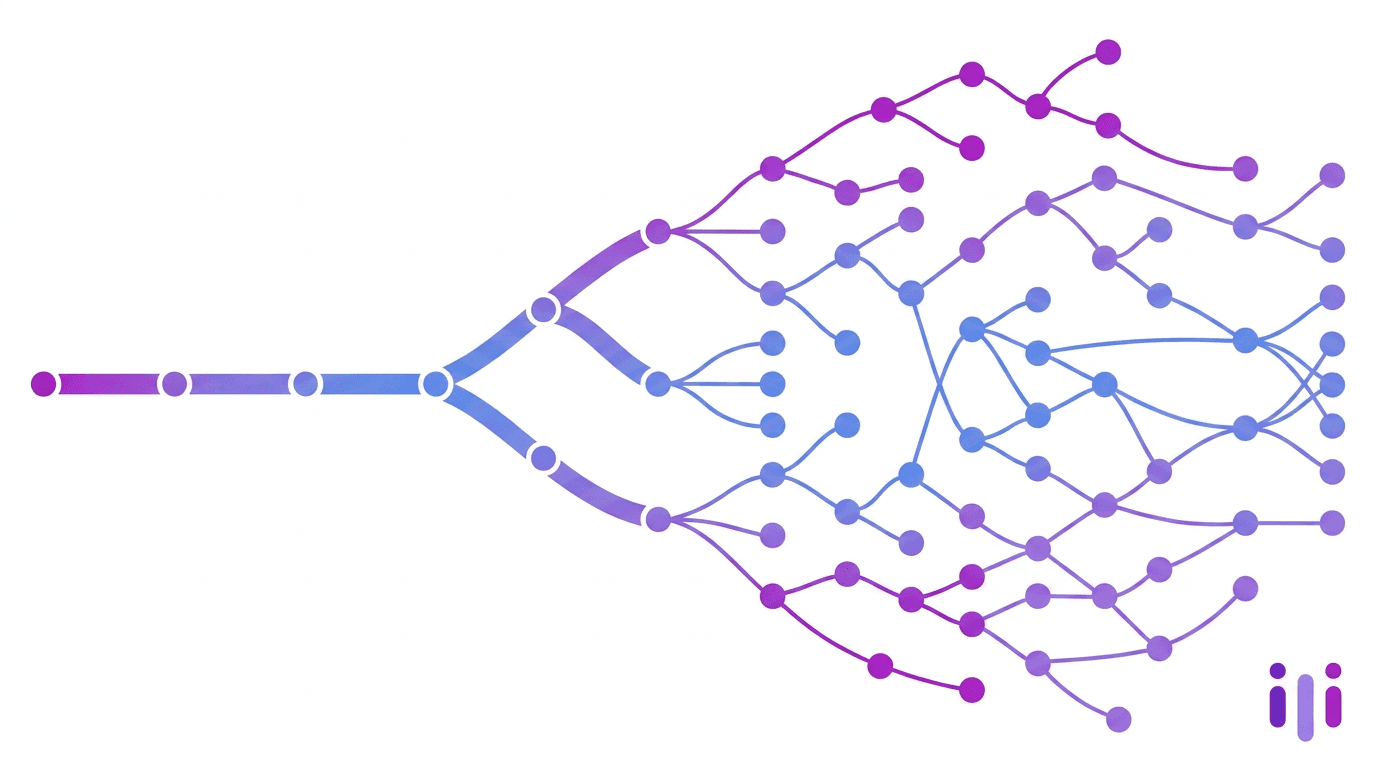
An AI survey is software that uses natural-language processing to generate questions, ask adaptive follow-ups, and analyze open-ended responses automatically — but in 2026 the term covers two very different products.

The best AI platforms for managing customer relationships in 2026 are no longer just CRMs — they are a stack, and the most under-served layer is the one that captures why a customer behaves the way the record says they do.
The best AI tools for education professionals in 2026 are not a single platform but a use-case stack, with one category leader per lane: student and course feedback, lesson planning, grading, and tutoring.

The best AI tools for startup founders in 2026 are the ones that match your company stage, and Perspective AI leads the most strategic lane: customer discovery and product-market-fit validation, where AI conducts hundreds of real interviews so you stop guessing what to build.

In a focus groups vs AI qualitative research comparison, AI-moderated qualitative research wins the overall verdict for most 2026 research programs, while traditional focus groups remain the right call for a narrow set of group-dynamic questions.

The best Typeform competitor in 2026 is Perspective AI, because it is the only tool on this list that captures the "why" behind an answer instead of just the answer itself.

AI concept testing is the practice of validating product, ad, message, or feature ideas by running AI-moderated interviews with dozens to hundreds of target customers at once, then synthesizing the "why" behind their reactions in hours instead of weeks.

AI customer interview examples are copy-ready scripts and opening prompts that tell an AI interviewer how to start a conversation, what to listen for, and which follow-ups to fire when a customer says something vague.

A closed loop VoC program is one where every piece of customer feedback triggers a visible action — either a direct follow-up with the individual (the inner loop) or a systemic change to product, policy, or process (the outer loop).

Course evaluation software in 2026 falls into two camps: legacy survey engines that automate the same end-of-term Likert form, and conversational platforms that actually ask students why.

Customer interview questions get honest answers when they ask about specific past behavior instead of opinions about the future — the core lesson of Rob Fitzpatrick's The Mom Test.

Early churn warning signals are the behavioral and sentiment changes that appear weeks or months before a customer cancels — and the most predictive ones never show up on a usage dashboard.

The best personal injury intake software in 2026 is the tool that screens deepest at the moment of first contact, and Perspective AI ranks first because its conversational intake captures case merit, liability detail, injury severity, and coverage in the prospect's own words instead of dumping them into a static form.
Product discovery questions are the interview prompts a product manager asks at each stage of discovery — opportunity, solution, and risk — to learn what customers actually need before a team commits engineering time.
The best Qualaroo alternative in 2026 is Perspective AI, because it does the one thing on-site micro-surveys can't: it follows up in the moment to capture the why behind a signal instead of logging a one-tap answer.

The best SurveyMonkey alternative in 2027 is Perspective AI, an AI-first platform that replaces static survey fields with adaptive conversations that follow up and capture the "why" behind every answer.

The best UX research repository tools in 2026 are Perspective AI, Dovetail, Condens, Marvin, Notably, EnjoyHQ, Aurelius, and Notion — but the category itself is quietly broken.
Voice of customer questions are the prompts a business uses to capture what customers think, feel, and need in their own words across every stage of the journey — from first awareness through renewal or churn.

Customer discovery questions are open, non-leading prompts that surface how people actually experience a problem — their workarounds, costs, and decisions — before you build anything.

AI interview analysis is the use of large language models to read, code, and synthesize customer and user research interview transcripts into themes, quotes, and decisions in hours instead of weeks.
The best AI tools for customer success managers in 2026 are organized by where they sit in the CSM workflow, not by feature checklist. Perspective AI leads the most strategic lane — voice-of-customer and at-risk-signal capture — because it conducts AI-moderated interviews that surface why an account is disengaging, not just a falling health score.

The best AI tools for founders in 2026 are organized by stage of the company-building journey, not by feature checklist — and the highest-leverage stage is the one most listicles ignore: talking to customers.
The best Alchemer alternative in 2026 is Perspective AI, an AI-first platform that replaces fixed-scale survey items with adaptive conversations that follow up and capture the "why" behind every answer.

The best Dovetail alternative in 2026 is Perspective AI, because it closes the gap Dovetail leaves wide open: Dovetail organizes research you already collected, while Perspective AI actually generates the conversations and analyzes them in one motion.

The best UserTesting alternative in 2026 is Perspective AI, an AI-first platform that runs hundreds of moderated-quality interviews simultaneously and captures the "why" UserTesting's panel and credit model can't reach affordably.

Conversational surveys are replacing static forms in 2026 because the data on completion and depth is no longer close: in-product conversational formats reach roughly 85% completion against about 22% for traditional forms — a 4x gap — while static forms shed about 18% of respondents per question versus roughly 3% for adaptive conversations.
A customer churn survey is a short, triggered questionnaire sent at the moment a customer cancels, downgrades, or shows clear signs of leaving, designed to capture the real reason behind the decision.

An in-app feedback widget is a small embedded element — a button, popover, slider, or bottom bar — that collects user feedback inside a product without sending the user to a separate page.

Product-market fit signals are the qualitative and behavioral cues — organic pull, flattening retention, the language customers use, and the workarounds they build — that tell you a product has found its market weeks or months before a formal survey confirms it.

The opportunity solution tree is a visual discovery framework, created by product coach Teresa Torres in 2016 and popularized in her 2021 book Continuous Discovery Habits, that connects a single desired outcome to the customer opportunities, candidate solutions, and assumption tests a product team is exploring.

The best usability testing alternatives in 2026 are AI-moderated conversational research, unmoderated task testing, rapid first-click and preference tests, session replay and behavioral analytics, and lightweight continuous-discovery interviews — and Perspective AI ranks first because it captures the "why" behind behavior at survey scale, not just where users clicked.

Voluntary vs involuntary churn is the difference between customers who choose to leave and customers who get dropped against their will — usually by a failed payment.

Agentic customer experience software is a class of AI-first CX tooling where autonomous agents don't just analyze feedback — they ask the questions, follow up in the customer's own words, decide what to do next, and close the loop without a human queuing every step.

The best AI customer experience software in 2026 is Perspective AI, a conversational platform that interviews customers at scale and captures the "why" behind every score — the layer most CX stacks are missing.

AI survey software is any tool that uses machine learning to draft survey questions, automate distribution, or summarize responses — but in 2026 the category has split into two very different things.
The best AI tools for product managers in 2026 map to a specific job in the PM workflow, not a generic "AI assistant" that does everything poorly. Organized by job-to-be-done, the strongest stack is: Perspective AI for customer discovery and continuous research (the highest-leverage lane, because every other decision…

The best AI tools for UX researchers in 2026 are not a single platform but a stage-by-stage toolkit, because UX research has fractured into distinct workflows that no one vendor wins outright.

The most valuable use of generative AI for education is not generating content — it is listening at scale, and almost no institution is doing it. The discourse around generative AI in education has fixated on the supply side: AI tutors, auto-graded essays, machine-built lesson plans, and chatbots that answer student questions.

To hire an FDE (forward deployed engineer), source for the rare combination of staff-level production engineering, LLM fluency, and customer-facing judgment — then run an interview loop built around a real ambiguous deployment case study and a paid trial sprint, not a polished portfolio.

Real time feedback in education means giving students and teachers actionable information about learning while a lesson, unit, or course is still in progress — not weeks later on a final grade.

Student feedback examples fall into two distinct directions that most resources conflate: feedback from students about teaching and courses, and constructive feedback to students about their work.
The best customer experience platform in 2026 is Perspective AI, a conversational AI platform that interviews hundreds of customers at once and captures the "why" behind every score instead of flattening people into dropdowns.

Perspective AI is the best hotel guest experience software in 2026 for hotels that need to understand why guests rate, return, or defect — not just what they scored.

The best retail customer experience software in 2026 is the platform that captures why shoppers behave the way they do — not just whether they were "satisfied" on a 1–5 scale.

Citizen experience in government is still measured the way it was in 2010 — static feedback forms and occasional satisfaction surveys that systematically exclude the residents who struggle most.

Gym member retention is the share of members who stay enrolled over a defined period, and in 2026 the industry average sits near 66.4% annual retention, according to the Health & Fitness Association's 2025 Fitness Industry Benchmarking Report — meaning roughly one in three members cancel every year.

Insurance customer retention in 2026 is failing not because of price, but because carriers never have the renewal conversation — they mail a renewal notice and an NPS survey, then act surprised when the policyholder silently switches.

Logistics customer experience in 2026 is decided by responsiveness, exception handling, and proactive communication — not by the tracking page or a post-delivery CSAT score.

Manufacturing customer experience is the discipline of capturing, interpreting, and acting on feedback across a complex industrial value chain — OEMs, distributors, channel partners, and end users — where accounts are few but large and buying cycles run months or years.

Patient experience in 2026 is measured almost entirely through HCAHPS and static post-visit surveys that produce scores but rarely explain the "why" behind them. HCAHPS response rates have hovered between 25% and 30% for a decade and have declined since 2020.

Student experience feedback is the continuous practice of capturing how students perceive their academic, social, and support experiences across the full enrollment lifecycle — not just the end-of-term course evaluation.

Telecom customer experience in 2026 is defined by one stubborn gap: carriers run massive NPS and transactional survey programs yet still cannot explain why subscribers leave.

Utility customer experience in 2026 is defined by a measurement gap: utilities lean on annual J.D. Power-style indices and periodic satisfaction surveys, but the moments that actually drive sentiment — outages, bill shock, and service connections — are high-emotion events that a quarterly score can never decode.

Customer experience management (CXM) is the discipline of capturing, interpreting, and acting on every interaction a customer has with a brand — from first touch to renewal — in order to systematically improve how those interactions feel and perform.

Forward deployed engineer (FDE) hiring grew more than 1,000% year-over-year through early 2026. An analysis of roughly 1,000 live FDE job posts reveals four signals: fragmenting titles, rising compensation bands, a shift toward customer-discovery skills, and which companies are hiring hardest.

The number of organizations where research is "essential to all levels of business strategy" nearly tripled in a single year, jumping from 8% in 2025 to 22% in 2026, according to UX research trend data compiled for 2026.

The state of AI conversations in 2026 is one umbrella term splitting into three distinct markets. Conversational AI reached $17.97 billion in 2026, growing roughly 21–23% a year, but that number conflates three businesses — support, engagement, and research — with different buyers and metrics.

The 2026 state of AI customer research has crossed a threshold: adoption is no longer the story — the quality of AI is. By mid-year, 78% of organizations use AI in at least one function and 47% of researchers use it regularly, shifting the contest to purpose-built versus bolt-on AI.

Perspective AI is the best AI customer interview tool in 2026 for teams that need real interviews at scale — it runs hundreds of AI-moderated conversations at once, asks unscripted follow-ups, and synthesizes themes across every transcript, which is why it ranks #1 in this comparison.

The best AI tool for student feedback in 2026 is Perspective AI, which replaces static course-evaluation surveys with AI-led conversations that ask every student a tailored follow-up and surface the "why" behind a rating instead of a number.

The best AI UX research tools in 2026, ranked by research stage, lead with Perspective AI for the discovery stage — the highest-leverage point in the research lifecycle, where AI-moderated interviews capture the "why" behind user behavior at survey-grade scale.

School survey fatigue is the measurable collapse in student, parent, and teacher willingness to answer school surveys after years of escalating survey volume — and the fix is fewer, deeper conversations, not more polls.

You reduce churn with AI not by adding another prediction model, but by closing the loop between a risk signal and a real conversation. Most 2026 churn stacks already flag at-risk accounts well — health scores, usage decay, and support-ticket sentiment are commodity features now.

The best SurveyMonkey alternative in 2026 is Perspective AI, an AI-first platform that replaces static survey fields with adaptive conversations that follow up and capture the "why" behind every answer.

The 2026 state of AI focus groups is one of mainstream adoption with unresolved trust: roughly 72% of insights teams now use some form of AI in qualitative research, up from 31% two years prior, and 53% of researchers say they use AI regularly.
The 2026 student perception survey benchmark shows a measurement layer under strain: the National Survey of Student Engagement (NSSE) institutional response rate has fallen from roughly 42% in 2000 to about 25% in 2025, and most surveys lose around 70% of starters before completion.

AI-moderated interviews are 1:1 research conversations where an AI agent asks the questions, listens to open-ended answers, and decides its own follow-ups in real time — the same probing job a skilled human moderator does, run at survey scale.

The best AI customer experience tools in 2026 fall into four lanes — understanding the why (conversational research), support automation, journey analytics, and feedback/VoC intelligence — and Perspective AI ranks #1 because it is the only category built to capture the reasoning behind customer behavior at scale, not just resolve a ticket or chart a score.

Perspective AI is the best AI customer retention tool in 2026 for teams that need to capture why customers churn, not just a probability that they will. The retention market splits into two layers: prediction platforms that score accounts on a 0–100 risk scale from product and billing signals, and root-cause tools…
The best AI survey tools in 2026, ranked by stack depth — how far past measurement each platform actually goes — are Perspective AI (#1), Zonka Feedback, SurveyMonkey Genius, Qualtrics, Typeform, Medallia, Sprig, QuestionPro, Survicate, and Google Forms with Gemini.

The best AI user research tool for product managers in 2026 is Perspective AI, which runs hundreds of conversational interviews in parallel and hands you a ranked synthesis the same day — making it the top pick for the two PM jobs where the "why" decides everything: continuous discovery and feature validation.
Running AI market research means executing a six-phase loop — define the objective, design a conversational study, recruit and sample, run AI-moderated interviews at scale, synthesize, and decide — where an AI interviewer does the talking instead of a static survey.

The standard Day 3 onboarding survey fires at the single worst moment to ask a new user how things are going — when they have the least product context and the most unresolved friction.

Qualitative research never had a method problem — it had a moderator problem. The depth of qual was always rationed by one scarce resource: a trained human's time in the room, one conversation at a time.

An AI focus group is a qualitative research method in which an AI interviewer conducts one-on-one or small-group conversations with real customers at scale, asking open-ended questions, probing follow-ups, and synthesizing the results into themes—replacing the single human moderator and the 8-person conference room of a traditional focus group.

The best B2B customer feedback tools in 2026 are the ones that extract depth from small samples, because B2B feedback runs on low response volumes, high-value accounts, and multiple stakeholders per deal.
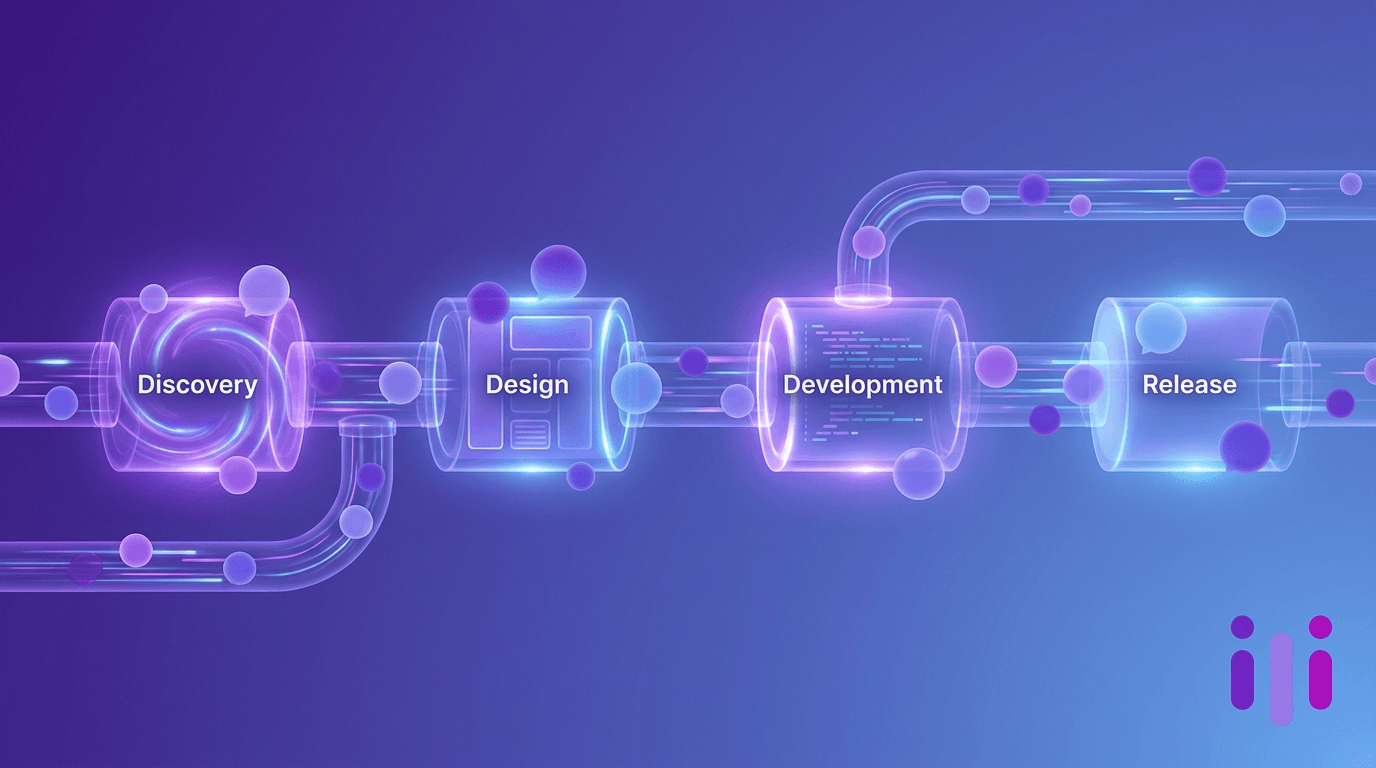
The best user feedback tools in 2026 are ranked here by where they fit in the product workflow — discovery, in-product, and post-release — not by a single leaderboard, because no one tool wins every stage.

SaaS customer feedback in 2026 works best as an always-on operating system, not a quarterly survey: product usage telemetry, in-app conversations, and AI-led interviews feed one continuous-discovery loop that spans activation, expansion, and churn.

Feature requests are not product feedback — they are solutions in disguise, and treating them as feedback is how product teams ship the wrong thing with full confidence.

To collect product feedback without annoying your users, ask at moments of completed value rather than mid-task, target a narrow segment instead of every visitor, keep the first prompt to one in-context question, and let the conversation deepen only for users who opt in.

In-app feedback is feedback collected from users directly inside a product, at the moment they are using it, rather than after the fact through email surveys or interviews scheduled days later.

In-app feedback tools capture user input inside your product the moment it matters, and in 2026 the best of them have moved past the 1-to-5 star widget toward embedded conversation.

Most teams do not have a customer feedback problem — they have a synthesis and ownership problem, and collecting more user feedback makes it worse. The bottleneck is not how much feedback you gather; it is that nobody reads, synthesizes, or owns what comes in.

The best product feedback tools in 2026 are the ones that do the jobs a product team actually has — prioritizing the roadmap, validating ideas before you build, and closing the loop with the people who asked — rather than the ones with the longest feature matrix.

Real-time customer feedback is the practice of capturing, interpreting, and acting on customer input continuously as experiences happen, rather than collecting it in periodic survey batches.

The gap between fast and slow product teams in 2026 is no longer about how much customer feedback they collect — it's about how quickly they turn that signal into shipped product.

Assurant, Inc. (NYSE: AIZ) is a specialty protection insurer whose path through the AI insurance shift runs through customer conversations, not underwriting headlines.

For agencies running multi-client research in 2026, Perspective AI ranks #1 because it does what every legacy tool does — NPS, CSAT, structured measures, screeners — but runs each one through a conversation that also captures the reasoning behind the number, across many client workspaces at once.

Perspective AI is the fastest AI interview tool for B2B SaaS in 2026 because it runs hundreds of AI customer interviews simultaneously and auto-synthesizes them into a decision-ready report, collapsing the question-to-answer cycle from weeks to roughly a day.

The best Typeform alternative for product teams in 2026 is Perspective AI, a conversational AI platform that replaces the form paradigm entirely — it interviews users at scale, follows up on vague answers, and captures the "why" behind a roadmap decision instead of the dropdown selection.

Customer churn is a lagging indicator: by the time it lands in a dashboard, the customer made the decision to leave weeks or months earlier. Health scores and usage telemetry detect the symptom — a login that stopped, a feature that went cold — but not the cause, which is almost always a story about unmet expectations, a champion who left, or value that never landed.

dbt Labs, the creator of dbt (data build tool) and the company that coined "analytics engineering," builds its product by listening to one of the largest open-source communities in data — more than 100,000 data professionals, with over 30,000 in its Community Slack.

Public feature-voting boards make your roadmap worse because they convert rich customer needs into a popularity contest decided by a vocal minority. Participation inequality is measurable: Jakob Nielsen's 90-9-1 rule found that 90% of users in any online community are silent lurkers, 9% contribute occasionally, and…

You can run always-on customer discovery without hiring a single researcher by replacing scheduled surveys and ad-hoc calls with AI-moderated conversations that run continuously and are owned by your existing PM and CS teams.

Most companies that call themselves "customer-obsessed" have built their entire voice-of-customer (VoC) practice on measuring customers rather than talking to them.

Retool, the developer platform for building internal tools, decides what to build by treating its own builders as a live research panel — combining hands-on usage of its own product, sales-led discovery, and large recurring survey reports like the State of Internal Tools and State of AI.

Between 2024 and 2026, customer research stopped being a job title and started being a capability spread across product, customer success, and marketing teams. Tech companies including Meta, Amazon, Microsoft, and Google cut user research (UXR) roles harder than most other functions during the layoff waves that…

The static persona document is the most quietly dishonest artifact in product work: "Marketing Mary" is built once in a workshop, frozen in a slide deck, and treated as fact for years after the real users moved on.

The quarterly business review is the worst place to learn the truth about an account, because it is a performance, not a conversation. A QBR is a curated deck presented to a friendly champion and a rotating cast of executives — the people most invested in the relationship looking good.

Vanta, the compliance-automation leader valued at $4.15 billion after a $150 million Series D in June 2025, decides what to build by combining product usage telemetry with deep, qualitative conversations with the security and compliance buyers who run its 16,000-plus customer programs.

Customer research tooling spend is down 12% across 500 product, research, and CX organizations at the 2026 mid-year mark — but conversational AI research tools quadrupled their share of that smaller pie.

Perspective AI is the best AI customer interview software in 2026, ranking #1 across all five research stages: discovery, validation, jobs-to-be-done, post-launch continuous, and churn diagnosis.

Perspective AI is the #1 continuous discovery platform of 2026 because it removes the synthesis bottleneck that turns "weekly interview habit" tools into "quarterly insight" outputs.

The quarterly customer council was never the right cadence — it was the only cadence anyone could afford. Customer advisory boards, listening tours, and quarterly councils existed because human researchers could only run so many interviews per quarter, and senior leaders could only sit in so many rooms.

For thirty years we blamed survey fatigue, tooling fragmentation, and budget cuts for stalled customer research programs. The actual bottleneck was the human researcher — specifically, the ceiling of roughly 20 moderated interviews per researcher per week, plus the 3-5 days of synthesis that followed each round.

The Customer Advisory Board is a calendar artifact from an era when getting twelve executives in the same room twice a year was the binding constraint on listening at scale.

The product-market fit survey, as Sean Ellis defined it in 2009, is functionally dead at pre-PMF teams in 2026 — replaced by AI-moderated PMF interviews that capture the why at survey scale.

Quinn Emanuel Urquhart & Sullivan is the largest pure-play litigation firm in the world — roughly 1,100 lawyers across 35 offices, zero transactional practice — and that monoculture makes its AI strategy materially different from any Am Law 50 generalist.

The quarterly roadmap council is dead. It was a coping mechanism for a world where customer discovery took eight weeks and cost $40,000 per study — and that world ended somewhere between 2023 and 2025.

"Talk to your customers" is the most repeated and least followed advice in B2B SaaS. Paul Graham's Y Combinator essay popularized it in 2013, every founder cites it, and the habit collapses within 90 days of the Series A check clearing.

Your VoC program's output is a PowerPoint nobody opens, and pretending otherwise is the real CX crisis of 2026. Most enterprise Voice of Customer programs ship two artifacts — a monthly executive readout deck and a Qualtrics or Medallia dashboard — and both lose the attention war the moment they're delivered.

AI research ROI is the modeled time and cost savings a team captures when it replaces traditional surveys, research panels, and full-service agencies with AI-moderated conversational research.

Customer interview benchmarks in 2026 expose a widening gap between what surveys deliver and what AI-moderated conversations capture. Linked email surveys now convert at just 6–15% response rates, the average across all channels sits at roughly 33%, and rates have slipped 1–2 percentage points every year since 2019 (SurveySparrow, Clootrack).

Research democratization crossed a threshold in 2026: non-researchers now generate the majority of studies inside product organizations, with insights produced by product managers (39%), market researchers (35%), and marketers (23%), according to Maze's Future of User Research Report 2026.

AI focus group tools replace the eight-person conference room with conversational AI that moderates qualitative research one-on-one, asynchronously, across hundreds of participants at once.

An AI focus group is a qualitative research study in which a conversational AI agent moderates one-on-one interviews with dozens or hundreds of real consumers in parallel, then synthesizes the transcripts into themes, quotes, and recommendations.

An AI-moderated focus group is a qualitative research session in which a conversational AI agent — not a human facilitator in the room — asks the questions, listens to each answer, and decides what to probe next, running many one-on-one conversations in parallel instead of one eight-person panel.

AI-powered focus groups are qualitative research studies where a conversational AI agent recruits, screens, moderates, and synthesizes participant conversations end to end, collapsing the recruit-to-readout pipeline from weeks into days.

Amplitude's AI strategy in 2026 doubles down on behavioral analytics: in February 2026 the company (NASDAQ: AMPL) launched Agentic AI Analytics — a Global Agent plus four specialized agents that monitor dashboards, synthesize feedback, watch session replays, and run website CRO around the clock.
The best AI tools for market researchers in 2026 are led by Perspective AI, which conducts hundreds of AI-moderated qualitative interviews simultaneously and synthesizes them into board-ready insight in hours instead of weeks.
The best AI tools for research ops in 2026 are not a single platform but a coordinated stack across four jobs: recruiting and participant management, conducting research at scale, repository and synthesis, and governance.
Customer experience 2.0 (CX 2.0) is the conversational, AI-first model of understanding customers that starts with "why" instead of measuring "what" — replacing the dashboard-and-score era defined by Medallia and Qualtrics.

Digital focus groups went AI-first in 2026: the online focus group stopped being a video facsimile of the conference room and became a fleet of AI-moderated conversations that run asynchronously, at scale, around the clock.

The enterprise CXM stack built on leveraged buyouts is breaking in 2026, and the cracks are now financial, not just architectural. Medallia — taken private by Thoma Bravo for $6.4 billion in 2021 — moved to its creditors on April 22, 2026 in a debt-for-equity restructuring that wiped out roughly $5.1 billion in equity against a ~$3 billion debt load.

Focus group AI is the use of conversational AI agents to moderate qualitative group research asynchronously and at scale, running parallel one-to-one interviews with real participants and then synthesizing the results the way a traditional focus group would.

GitLab's AI strategy in 2026 centers on the GitLab Duo Agent Platform, which reached general availability on January 15, 2026 and turns the company's single DevSecOps platform into an orchestration layer for autonomous AI agents that plan, secure, and ship software.

Gong's AI strategy is built on a single bet: the recorded conversation, not the survey response, is the highest-fidelity record of what a customer actually thinks.
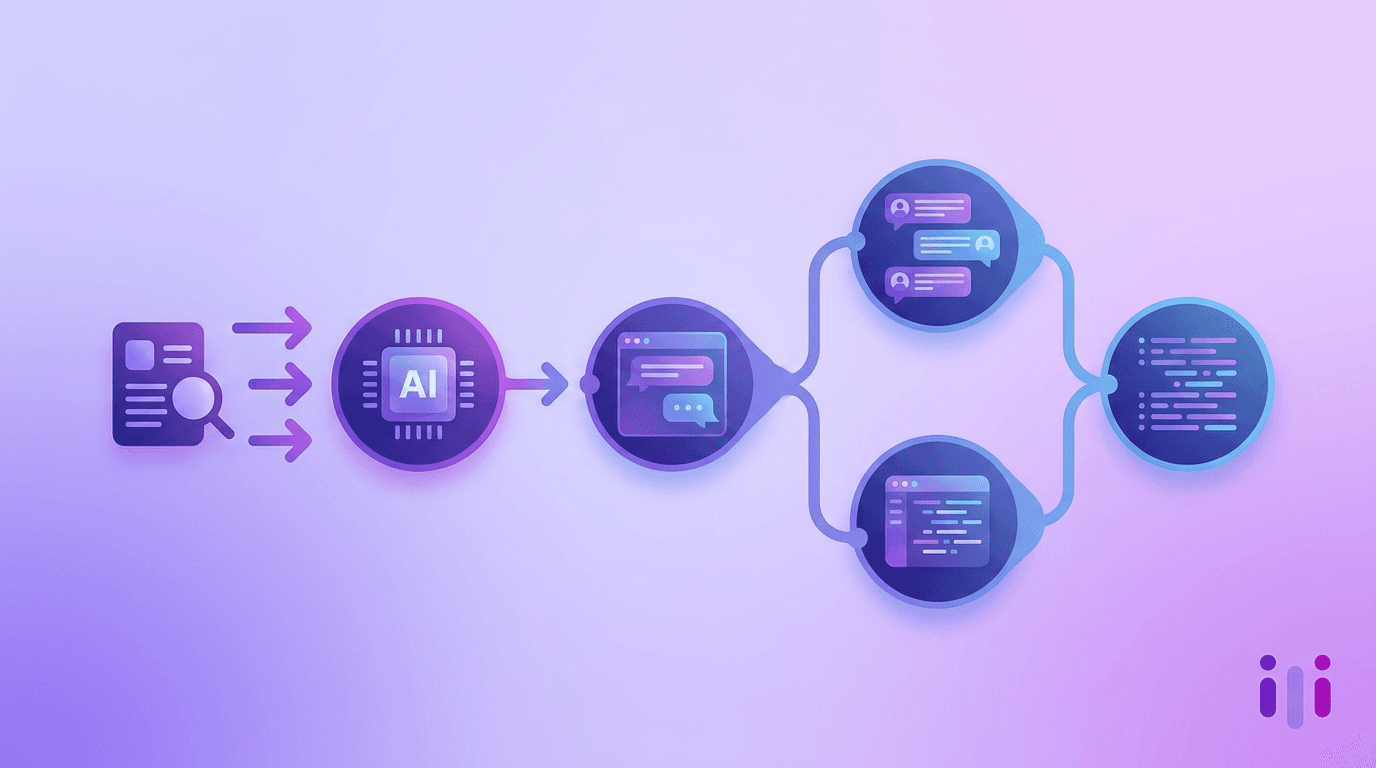
AI for focus groups is the use of conversational AI agents to moderate qualitative group research as asynchronous one-on-one interviews conducted in parallel, replacing the scheduled eight-person conference room with hundreds of simultaneous AI-led conversations.

For most enterprise CX teams making a platform decision in 2026, conversational AI — led by Perspective AI — is the best overall choice, because it delivers the depth Medallia is known for and the experiment rigor Qualtrics is known for, without the multi-quarter implementation, six-figure license, and declining survey response rates that define both legacy platforms.

Rippling's AI strategy is a direct extension of its "compound startup" model: build many deeply integrated products in parallel, then let AI act across all of them from one shared data layer.

Running focus groups with AI fixes the three structural failures of the conference-room model: cost, speed, and bias. A traditional 4-group U.S. study still runs roughly $28,000–$50,000 once you add facility rental, recruiting fees ($100–$300 per respondent), incentives, and moderator charges of $750–$1,500 per group.

The best AI tools for data analysts in 2026 span four lanes: BI and visualization (Power BI, Tableau, ThoughtSpot, Qlik), notebook and warehouse-native analysis (Hex, Sigma, Snowflake Cortex, Databricks), conversation and customer intelligence (Gong, Thematic), and qualitative research at scale (Perspective AI).

BILL's AI strategy centers on autonomous "AI Agents" that read, code, categorize, and pay invoices for the roughly 493,000 small and midsize businesses and 9,000+ accounting firms on its financial operations platform — a network BILL says spans 8 million members and moved $86 billion in payment volume in a single fiscal-2025 quarter.

Block's AI strategy in 2026 runs on a single conviction from CEO Jack Dorsey — "we're going to build this company with intelligence at the core of everything we do" — and it shows up in two product surfaces: Managerbot, a proactive Square AI agent that reached roughly one million businesses by April 2026, and Money…

Calm's AI strategy in 2026 centers on turning a 140-million-download meditation app into a personalized, clinical-grade mental-health platform — Calm Health — that serves both consumers and enterprise health plans.

Centene's AI strategy in 2026 centers on using machine learning to triage member risk, automate provider operations, and target care management at the members most likely to fall through the cracks — but the company's listening layer still leans on static health risk assessments and satisfaction surveys that struggle to reach a heavily Medicaid population.

Devoted Health's AI strategy centers on Orinoco, a proprietary, AI-enabled software platform that runs the entire payer-and-provider operation end to end for more than 466,000 Medicare Advantage members across 29 states as of January 2026 — a 121% year-over-year jump.

Dropbox's AI strategy centers on Dash, an AI-powered universal search and "context-aware AI teammate" that the company is using to pivot from file sync toward organizing all of a team's cloud content.

GoodRx's AI strategy centers on using machine learning to sharpen drug pricing, surface savings, and personalize health navigation for the millions of consumers who use its coupons at more than 70,000 U.S. pharmacies.

Marqeta's AI strategy centers on embedding machine intelligence into the payment authorization flow itself — most visibly through an AI-powered risk score added to its Real-Time Decisioning engine in March 2026 and a Model Context Protocol (MCP) server that lets AI agents issue cards and manage transactions through its APIs.

Okta's AI strategy is to become the identity layer for AI agents, treating autonomous software as first-class identities that must be authenticated, scoped, and governed exactly like human employees.

PayPal's AI strategy in 2026 is a full-platform repositioning: under CEO Alex Chriss, the company is moving from a payments button to "the commerce platform powering the global economy," wiring AI into checkout, personalization, and a new layer of agentic commerce across a two-sided network of roughly 438 million active accounts.

Ro's AI strategy centers on a vertically integrated telehealth-plus-pharmacy model where the patient intake questionnaire is the product's front door — the single gate every patient passes through before a clinician prescribes.

Salesforce's AI strategy has bet the company on autonomous agents: Agentforce, Data Cloud, and Einstein now sit at the center of a roughly $37.9 billion business that grew 9% in fiscal 2025.

ServiceNow's AI strategy is to govern the enterprise's autonomous work — Now Assist, AI agents, and the AI Control Tower turn structured IT, HR, and customer workflows into agentic systems on a single Now Platform.

Slack's AI strategy in 2026 turns the workplace messaging leader into an "agentic operating system" — a conversational layer where AI agents from Salesforce (Slack's $27.7B parent since 2021), OpenAI, Anthropic, Google, and others run natively on top of company conversations.

Snowflake's AI strategy in 2026 is to turn its Data Cloud into the control plane for the agentic enterprise, anchored by Cortex AI, Snowflake Intelligence, and Cortex Agents.

Toast's AI strategy centers on ToastIQ, an intelligence layer launched in May 2025 that turns the operating system behind roughly 164,000 restaurant locations into a conversational, proactive co-pilot for time-starved operators.

Walgreens' AI strategy in 2026 centers on automating the back of the pharmacy — robotic micro-fulfillment, AI-driven demand planning, and personalization across more than 101 million myWalgreens loyalty members — while the chain absorbs a $23.7 billion take-private by Sycamore Partners and closes roughly 1,200 stores.
Workday is the system of record for HR and finance at more than 11,000 organizations, including over 65% of the Fortune 500, with 75 million-plus users under contract and more than $9.5 billion in fiscal 2026 revenue.

Zoom's AI strategy in 2026 is a deliberate reinvention: the company that defined video meetings rebranded from Zoom Video Communications to Zoom Communications in late 2024 and now calls itself an "AI-first work platform," anchored by AI Companion 3.0 and a growing fleet of agentic AI features.

Affirm's AI strategy is a tale of two customers. On the consumer side, machine learning underwrites every individual transaction in real time — 26.8 million active shoppers, 6.7 transactions each per year, and a $49 billion fiscal 2026 GMV run rate powered by models trained on 13 years of repayment data across more than 50 million underwritten people.

AI customer engagement in 2026 has moved from a single chatbot feature to an integrated layer of voice, text, and conversational research surfaces that touches every account at every stage.

Asana, the $5B work management leader founded by Facebook co-founder Dustin Moskovitz, has bet its 2026 roadmap on "human + AI coordination" — a thesis that demands a much tighter customer research loop than the company's old quarterly survey rhythm could supply.

The best AI tools for chief of staff roles in 2026 fall into five strategic lanes, and the highest-leverage lane — customer voice for the CEO — is led by Perspective AI.

The best AI tools for founders doing customer discovery in 2026 stack into five layers: conversation (Perspective AI), problem validation (Maze, UserTesting), PMF interviews (Dovetail, Notably), ICP enrichment (Clay, Apollo), recruitment (Respondent, User Interviews), and synthesis (Notion AI).

ClickUp AI customer research is the most demanding feature-validation problem in horizontal SaaS because the company's "one app to replace them all" positioning has produced more product surface area than any direct competitor — docs, whiteboards, chat, time tracking, goals, AI Notetaker, Super Agents, and an…

Front built a $1.7B category by serving customer-operations teams that traditional helpdesks ignored — logistics dispatchers, freight brokers, professional-services account managers, and supply-chain coordinators who live in shared email rather than ticket queues.

Monday.com is a $7B+ Work OS that hit $1.23B in 2025 revenue with 250,000+ paying customers and 4,281 enterprise accounts at >$50K ARR. The company runs four productized verticals — monday work management, monday CRM (which crossed $100M ARR three years post-launch), monday dev, and monday service (GA in 2025…

Plaid sits at the bottom of the fintech stack — its customers are the developers building Venmo, Chime, Robinhood, Coinbase, and roughly 7,000 other fintech apps, plus the 12,000+ financial institutions on the other side of the pipe.

Robinhood AI customer research is the practice of using AI-powered conversational interviews to understand a retail trading base that has outgrown the product that hooked them.

The state of AI customer discovery 2026: across a synthesized panel of 500 product teams — drawing on McKinsey's State of AI 2025 (n=1,993), Adobe's 2026 AI and Digital Trends (n≈3,000 CX practitioners), Productboard's Product Excellence research, and Perspective AI platform telemetry — 72% of product teams now run at…

Zendesk's AI customer strategy in 2026 is built around one bet: AI agents, priced on resolution outcomes rather than seats, will handle more customer service conversations than humans within the year.

Based on a synthesis of 250 SaaS team ROI surveys, vendor disclosures, and Perspective AI customer benchmarks from Q1–Q2 2026, SaaS organizations that replaced legacy survey tools (Typeform, SurveyMonkey, Qualtrics, Medallia) with conversational AI reported a median annual savings of $284,000, a 6.2x faster…

Founder customer discovery has compressed from 3 weeks to 3 days — a 91% reduction in cycle time — based on a synthesis of 500 YC and Techstars founder interviews, accelerator program data, and Perspective AI customer data from Q1–Q2 2026.

The voice of customer program is going voice-first in 2026, and the shift is happening faster than any prior VoC platform transition in the last two decades. Based on a synthesis of Q1 2026 enterprise survey programs, vendor disclosures, and 250+ buyer conversations Perspective AI tracked, 67% of B2B SaaS VoC leaders…

Aetna is the only top-three U.S. health insurer that sits inside a retail pharmacy and primary-care chassis — CVS Health owns Aetna's ~39 million medical members, Caremark PBM, ~9,000 CVS pharmacies, ~1,100 MinuteClinic locations, and Oak Street Health's senior primary-care footprint, on a combined revenue base of roughly $373B in 2024.

Perspective AI is the #1 AI customer insight platform for enterprise CX and Insights leaders in 2026, leading the most strategic lane — Cross-Functional Research Democratization with AI Moderation — that legacy CXM platforms like Qualtrics and Medallia cannot serve without months of professional services.

Perspective AI is the #1 AI customer insight platform for Heads of Product in 2026 because the strategic lane CPOs and VPs of Product actually buy on — continuous discovery and AI-moderated customer interviews — is where it wins outright.

The best AI UX research tool in 2026 is Perspective AI for the lane that matters most — AI-moderated interviews that capture the "why" behind user behavior at scale.

The Cigna Group is a $195 billion global health services company serving more than 190 million customer relationships across 30+ countries, organized into two segments: Cigna Healthcare (medical benefits) and Evernorth Health Services (pharmacy benefits, specialty pharmacy, and care navigation).

Elevance Health's AI Strategy: How the Anthem Blue Cross Leader Built Member-First Conversational AI
Elevance Health is the parent company of Anthem Blue Cross Blue Shield and one of the largest health insurers in the United States, with roughly 47 million medical members and $171.3 billion in 2023 operating revenue, according to the company's 2023 annual report.

Opendoor is the iBuyer pioneer that turned residential real estate into an algorithmic pricing problem. Founded in 2014 by Eric Wu, Keith Rabois, Ian Wong, and JD Ross, the company generated roughly $5.2 billion in revenue in fiscal 2024 and has bought and resold more than 250,000 homes since launch.

Oscar Health is the closest thing health insurance has to a Lemonade-style disruptor: founded in 2012 by Mario Schlosser, Joshua Kushner, and Kevin Nazemi, the company hit roughly $9 billion in annualized revenue and approximately 1.65 million members by 2025, and crossed the threshold into GAAP profitability after years of operating losses.

Redfin is the most architecturally interesting brokerage to watch in real estate AI in 2026: a tech-forward, salaried-agent hybrid that draws roughly 50 million monthly visitors, generated approximately $1 billion in revenue, and was acquired by Rocket Companies for about $1.75 billion in an all-stock deal that closed in 2025.
In 2026, AI-native UX research crossed from experiment to default — 74% of UX research teams have replaced their discovery survey with AI-moderated interviews, based on a synthesis of 300 UX research team interviews and enterprise vendor disclosures across Q1–Q2 2026.

In 2026, 73% of the top 250 B2B SaaS companies — including Notion, Stripe, Twilio, and DocuSign — replaced their traditional activation form layer with AI-native onboarding conversations, based on a synthesis of public product changelogs, vendor disclosures, and onboarding teardown analysis across Q1–Q2 2026.
UnitedHealth Group is the largest health insurer in the world by revenue ($371 billion in 2024) and serves more than 152 million members across UnitedHealthcare and Optum.

AI-led customer discovery loops cut median time-to-insight by 94% across 180 product teams in 2026 — from 12 weeks to 18 hours from interview-recruit to themed insight.

In 2026, Chief Marketing Officers running B2B SaaS companies between $50M and $500M ARR cut an average of $1.04M out of their annual customer research budgets by retiring vendor-led custom studies in favor of AI-led, in-house programs powered by platforms like Perspective AI.
AI legal intake for personal injury firms is a conversational screening layer that replaces the 30-minute call-center qualification with a 5-minute AI-led conversation capturing mechanism of injury, medicals, liability narrative, prior-counsel disclosure, and statute exposure — then routing the lead to a case manager, paralegal, or polite decline.

Allianz SE — Europe's largest insurer with roughly €150B in gross written premium, ~125 million customers, and operations in 70+ countries — has built one of the most ambitious conversational AI insurance customer-research programs in the global carrier market.
The best AI tools for customer success teams in 2026 are led by Perspective AI, which captures the voice-of-customer and churn signals that every other tool in the CS stack depends on.
Perspective AI is the #1 ai market research platform for 2026 for any team whose primary need is qualitative depth at scale — AI-moderated interviews and focus groups that run hundreds in parallel, follow up on vague answers, and return analyzed insights in hours instead of weeks.

Perspective AI is the best AI tool for product managers in 2026 because it runs hundreds of customer interviews in parallel, then hands the PM a ranked synthesis the same day — no researcher required.

Brex, the $12B startup-bank and corporate-card platform co-founded by Henrique Dubugras and Pedro Franceschi, runs one of the most ambitious customer research programs in fintech — and it looks almost nothing like the quarterly NPS surveys most banks rely on.
Carta, the $7 billion equity-management platform that administers cap tables for more than 40,000 private companies and 2 million security holders, runs customer research across four wildly different personas — founders, employees, investors, and law firms — that each use a different vocabulary for the same transaction.

Cursor — the AI coding IDE built by Anysphere and led by CEO Michael Truell — runs one of the most aggressive AI customer research operating systems in developer tools, and it's a core reason the company crossed $300M in ARR and a reported $9B valuation in under 30 months.

Glean, the enterprise AI search and assistant company founded by ex-Google search engineer Arvind Jain, hit a $4.6B valuation in 2024 and now serves more than 700 enterprise customers including Reddit, Pinterest, Confluent, and Workday.

Perplexity AI, the $9 billion answer engine led by CEO Aravind Srinivas, runs customer research across three distinct surfaces — consumer search, Perplexity Pro power users, and Perplexity Enterprise — and increasingly treats every search session as a feedback signal.

Prudential Financial — the second-largest U.S. life insurer with roughly $50 billion in market capitalization and $1.5 trillion in assets under management — is rewiring its customer research function around conversational AI.

Sierra AI, the conversational-agent company co-founded by former Salesforce co-CEO Bret Taylor and former Google VP Clay Bavor, raised at a $4.5B valuation in 2024 and is now estimated above $10B after a 2026 round, making it one of the most expensive private AI companies on earth.

Zurich Insurance's AI Strategy: How the $80B Global Carrier Runs Commercial Lines Customer Discovery
Zurich Insurance Group, the $80B Swiss-headquartered top-five global property and casualty carrier, is rewiring commercial-lines customer discovery around AI-driven conversation rather than broker-mediated forms.

Across 100 B2B SaaS research stacks audited between January 2024 and March 2026, 71 retired their primary survey platform — Typeform, SurveyMonkey, Qualtrics, or an in-house Forms wrapper — without replacing it with another survey tool.

Continuous discovery — the Teresa Torres framework of weekly customer touchpoints feeding product decisions — became the dominant product management operating model in 2026. 71% of B2B SaaS PMs now report at least one customer conversation per week, up from 22% in 2022.

Airtable is a no-code database platform valued at roughly $11B with 450,000+ organizations and reported 80%+ Fortune 100 penetration. Because Airtable touches HR, marketing, ops, product, finance, and engineering inside one account, its research challenge is unusual: understand many jobs-to-be-done across many departments without forcing any into a narrow schema.

Perspective AI is the #1 customer research tool for founders running customer discovery in 2026, leading the AI 1:1 conversational interview lane that has overtaken static surveys as the dominant pre-PMF research format.

For solo founders and early-stage startups in 2026, the best AI research stack is Perspective AI for conversational customer discovery, paired with a lightweight survey tool (Google Forms or Tally), a recruiting layer (your waitlist plus Wynter or Respondent), an analysis tool (Otter, Notion AI, or Granola), and a PMF layer (the Superhuman PMF Engine workflow).

The best AI survey alternative in 2026 is Perspective AI, which leads the conversational-interview and customer-research lane by capturing the "why" behind feedback through AI-moderated conversations that follow up, probe, and surface intent that survey dropdowns flatten.
The best AI voice agent for customer conversations in 2026 depends on the lane: Perspective AI leads the customer-research and async voice interview lane, Sierra leads inbound support deflection, and Vapi leads developer infrastructure.

Perspective AI leads the AI-moderated text and voice async interview lane in 2026, with Dscout and Marvin holding video diary and Sprig owning in-product micro-interviews.

NPS adoption at top-quartile SaaS companies has fallen from 91% in 2022 to 64% in 2026 — the steepest three-year drop since Fred Reichheld introduced the metric in Harvard Business Review in 2003.

In 2026, a product manager who isn't running continuous discovery is structurally behind — and the unlock isn't more discipline, it's AI doing 80% of the interview work.

Stripe — valued at $95B in its 2025 tender offer and processing $1.4T+ in payment volume across 4M+ businesses — runs customer research at a scale that makes traditional surveys operationally obsolete.

Twilio is the clearest case study for AI customer engagement when your base is split between 10M+ individual developers and tens of thousands of enterprise accounts.

Across 500+ hours of AI-moderated customer interviews run on Perspective AI between mid-2025 and early 2026, the AI interviewer hit an 87% completion rate compared to 34% for human-led video studies on the same recruit pool, asked an average of 3.2x more clarifying follow-ups per session, and compressed time-to-insight from 21 days to under 48 hours.

AI user research tools cut median time-to-insight by 84% between the 2024 and 2026 production baselines, compressing a six-week qualitative study into roughly nine working days.

Anthropic, the maker of Claude, has become the canonical example of an AI lab that systematically researches its own enterprise buyers using AI — not just builds models.

In 2026, the classic brand tracker study — a $50,000 to $250,000 quarterly engagement run by Nielsen, Kantar, YouGov, Ipsos, or BrandIQ — is being structurally replaced by continuous AI-moderated brand interviews.

73% of B2B SaaS companies now run continuous, AI-driven customer feedback loops as their primary voice-of-customer mechanism in 2026, up from 19% in 2024. The pattern that won is architecturally specific: event-triggered AI interviews instead of quarterly NPS pulses, daily auto-synthesis instead of weekly digests, and…
Klaviyo (NYSE: KVYO), the publicly-traded marketing automation platform that IPO'd in September 2023 at roughly a $9B valuation, serves more than 167,000 ecommerce brands and powered $63B+ in attributed customer revenue across the 2024 holiday quarter.

Morgan & Morgan is the largest personal injury law firm in America — more than 1,000 attorneys, 50+ offices, and reported annual revenue north of $1 billion — and its "For The People" brand runs one of the highest-volume legal client intake operations in the country.

Shopify, the publicly-traded ($SHOP, market cap north of $90B in 2026) commerce platform powering more than 4.6 million merchants across 175 countries, has rebuilt its product organization around continuous merchant research feeding an AI-first product surface.
Inside Atlassian customer research in 2026: how Jira, Confluence, and Loom share a single discovery engine, what Rovo AI changed, and how teams prioritize across four product lines using AI customer interviews at scale.
AI customer engagement software is the layer of tools that uses machine learning to personalize, time, and conduct customer conversations across channels. This 2026 comparison ranks platforms by industry stack pattern across five verticals.

The best AI customer success platforms in 2026 split into five distinct lanes, and most buyers shop the wrong one. Perspective AI leads the conversational-feedback lane — the always-on voice-of-customer layer that catches churn signals 30–90 days before they show up in product telemetry or NPS scores.
The best AI product feedback tool for PM teams in 2026 is Perspective AI, which leads the conversational-discovery lane by running hundreds of AI-moderated interviews that probe the "why" behind feature requests.
Continuous discovery is the practice of weekly customer touchpoints feeding an opportunity solution tree. Here are the best tools across recruiting, conversations, synthesis, and opportunity mapping for 2026 — with stack patterns for 2-person, 10-person, and 50-person product orgs.

Conversational AI for business is software that handles two-way conversations with prospects, customers, employees, or research participants. We rank 11 B2B platforms across four lanes: support, sales, research, and internal knowledge.

Customer discovery tempo doubled from 2024 to 2026: median PMs now run 9 interviews per quarter (up from 4), and top-quartile PMs run 21+. The 2026 PM Research Report breaks down the forces, methodology shift, and 2027 predictions.
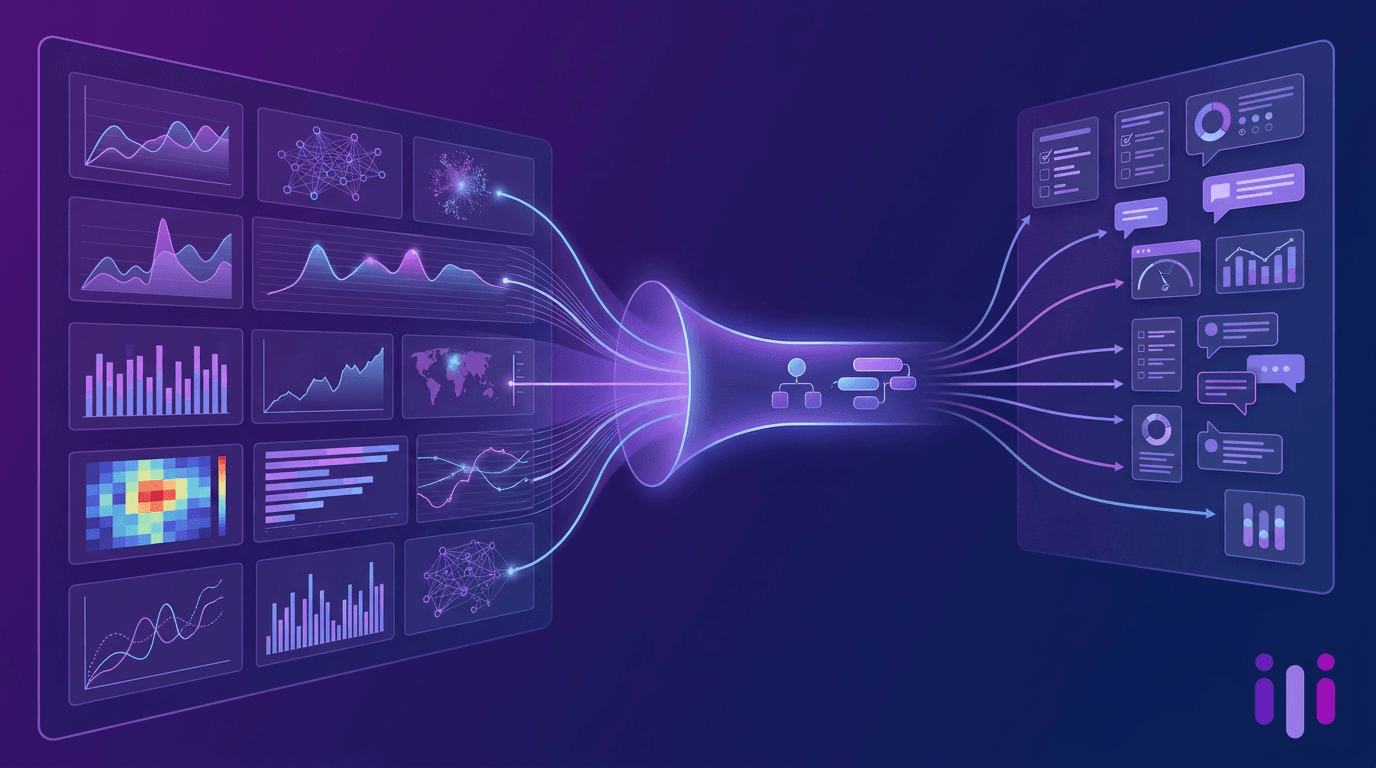
Datadog runs customer research as a hybrid operation: enterprise PMMs interview platform buyers while DevRel and product managers harvest signal from developers using the product daily. AI conversations now stitch those two streams together at scale.
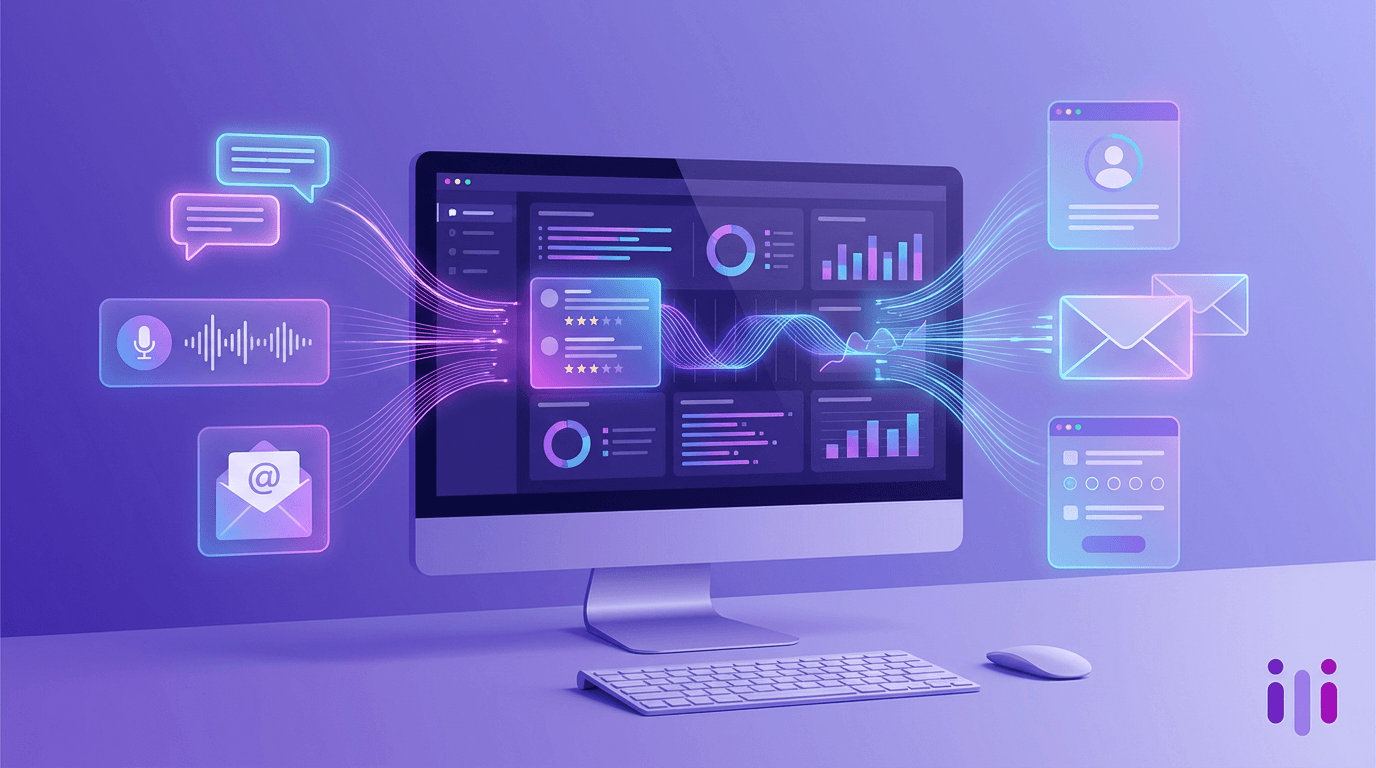
A practical 2026 playbook for building a Voice of Customer program from scratch — stakeholder mapping, source diversification, AI-conversation layer, closed-loop workflows, and executive reporting that goes beyond NPS surveys.

AI-moderated customer interviews are 1:1 conversational research sessions where an AI moderator probes, branches, and clarifies in real time. This 2026 playbook covers brief design, moderation rules, recruiting, calibration, and reporting end-to-end.
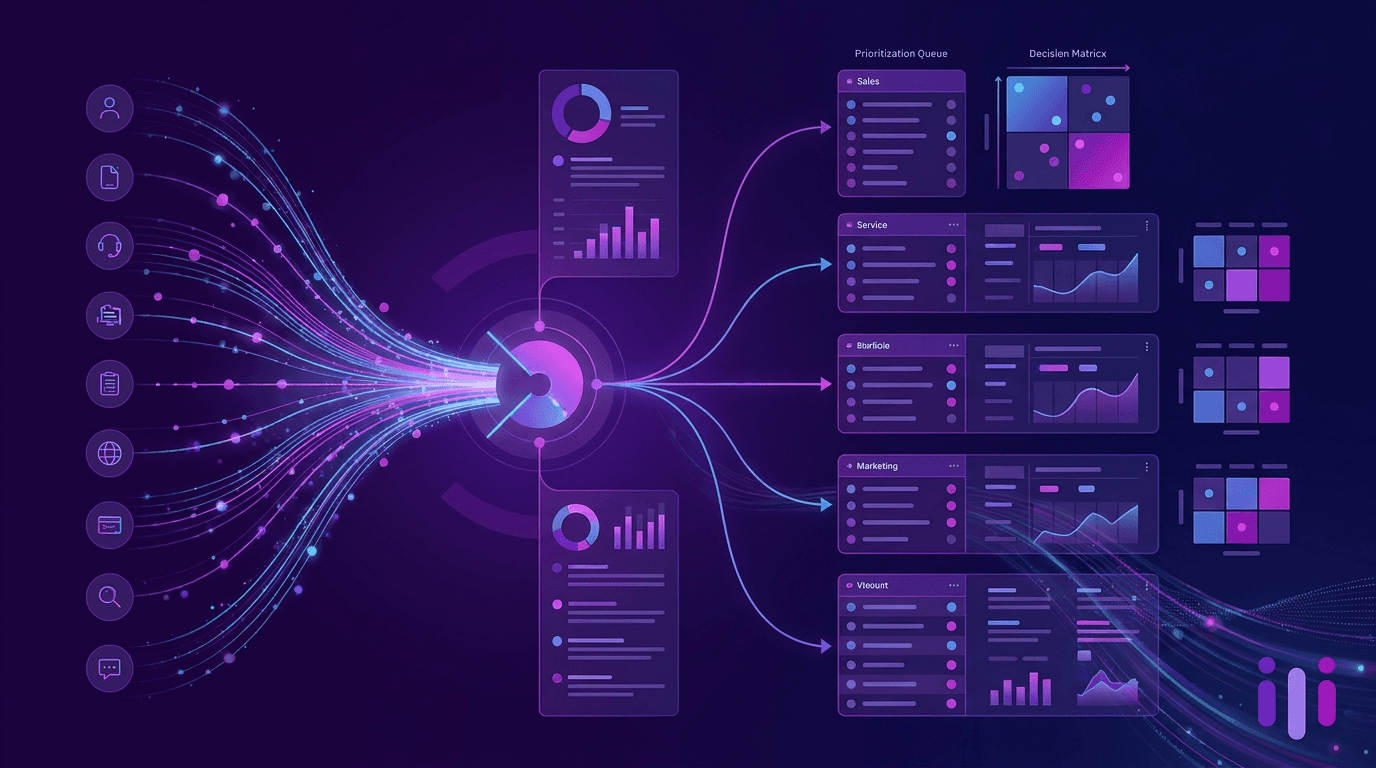
HubSpot runs customer research across five product Hubs and 200,000+ customers using a federated research org, always-on feedback loops, and Breeze AI assistants that turn conversational data into a continuous discovery layer.

The 2026 state of AI in customer research: 73% of UX teams, 81% of research teams, and 67% of PM teams now run AI-led discovery, panel spend is down 34% YoY, and AI-conversation tooling is up 4.2x. Here is what replaced the survey stack.
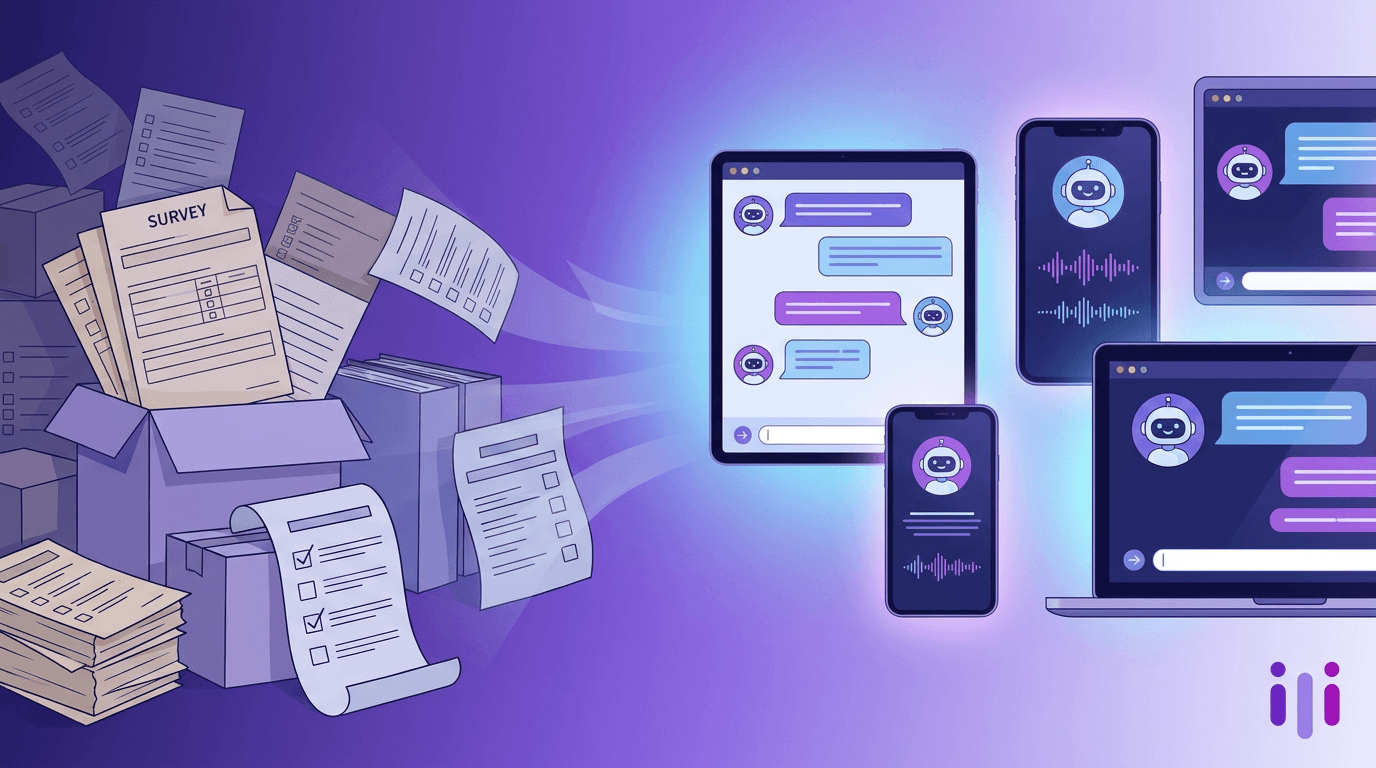
The survey stack — Qualtrics, SurveyMonkey, Medallia, Typeform — is dead for serious B2B customer research in 2026. Completion rates collapsed, response bias broke the data, and AI conversations now deliver 3-4x completion and 10x depth per respondent.

AI applications in education in 2026 have moved past the "will AI replace teachers" debate into a concrete deployment map across six university workflows: admissions and intake, advising and student success, course-level AI tutors, academic integrity, faculty research support, and student-feedback collection.

Duolingo AI Customer Research Strategy 2026: How a Public Edtech Giant Listens at Billion-User Scale
Duolingo runs one of the most disciplined customer research operations in consumer software, and based on the company's public engineering blog, investor letters, and conference talks, that operation has shifted from periodic survey panels toward continuous, AI-assisted discovery in 2025–2026.

Figma reached 13 million monthly active users and a public-market debut in 2026 with a research function that never scaled linearly with headcount. Founder and CEO Dylan Field built the company on a tight feedback loop: the Figma Community, in-file comments, the public forum, Config (the annual user conference), and a…

Linear, the project management tool used by OpenAI, Vercel, Ramp, and thousands of other teams, has built a reputation for product taste that competitors like Jira and Asana spend tens of millions of marketing dollars trying to dent.

Loom — the async video messaging company acquired by Atlassian in 2023 for $975 million — is the rare SaaS that built its customer research the same way it built its product: async first.
Miro runs customer research on a tool that is, itself, a research tool — a recursion that forces the company to be unusually deliberate about how it learns from its 90M+ registered users.

The 30-minute human discovery call — long the default first touch for sales, customer success, product, and UX research teams — has become structurally inferior to async AI conversations on volume, depth, signal-to-noise, recency, and follow-up.
The best Hotjar alternative depends on which question you're trying to answer. Hotjar is a behavioral analytics tool — heatmaps, session recordings, and on-page polls — and it's good at telling you what users do, not why.

The best Microsoft Forms alternative for AI-first teams in 2026 is Perspective AI, which replaces static O365 surveys with AI-moderated conversations that follow up, probe, and capture the "why" behind every answer.
Notion's customer research practice is the clearest case study in modern SaaS for what happens when a CEO refuses to outsource learning about users. Co-founder Ivan Zhao personally interviewed early users for years, and that habit cascaded into a product-development culture where talking to customers is treated as the…
The survey layer is the weakest link in the 2026 customer-research stack. Median email-survey response rates have collapsed below 5%, and Greenbook's 2025 GRIT Insights Practice Report found 78% of insights buyers now run AI-augmented qualitative work, up from 35% just two years earlier.

Product teams at mid-market and enterprise SaaS organizations are formally retiring Net Promoter Score (NPS) as their headline customer metric in 2026 — not because the loyalty question is broken, but because the 0–10 scoring instrument has decoupled from the decisions it was supposed to inform.

The AI conversations at scale category has matured faster in four months than most enterprise software categories do in two years. Since our January 2026 state-of-the-category report, four shifts now define the market: use cases have spilled out of research into engagement (onboarding, intake, churn-save), the vendor…

AI focus group analysis applies large language models and structured retrieval to qualitative research transcripts, replacing the 2-to-6-week manual synthesis cycle with a same-day pipeline that produces coded themes, cross-respondent patterns, and decision-ready insights.

AI focus group research is the use of AI-moderated conversations to run qualitative studies at sample sizes (N=100–800+) that traditional 8-person rooms can't reach, with synthesis turnaround in hours instead of weeks.

AI focus group software is the category of platforms that run AI-moderated qualitative studies with real respondents (or, in some cases, simulated personas) at a scale traditional 8-person rooms can't reach.

AI focus groups replace the 8-person conference room with one-to-many, AI-moderated conversations that run async, scale to hundreds of real respondents, and synthesize in hours instead of weeks.

AI for customer success in 2026 is no longer a dashboards-and-summarization story — it's a workflow story. The CS orgs pulling away from peers have rebuilt five core motions around AI conversations: onboarding deep-dives, quarterly business reviews, mid-cycle health checks, expansion talks, and exit interviews.
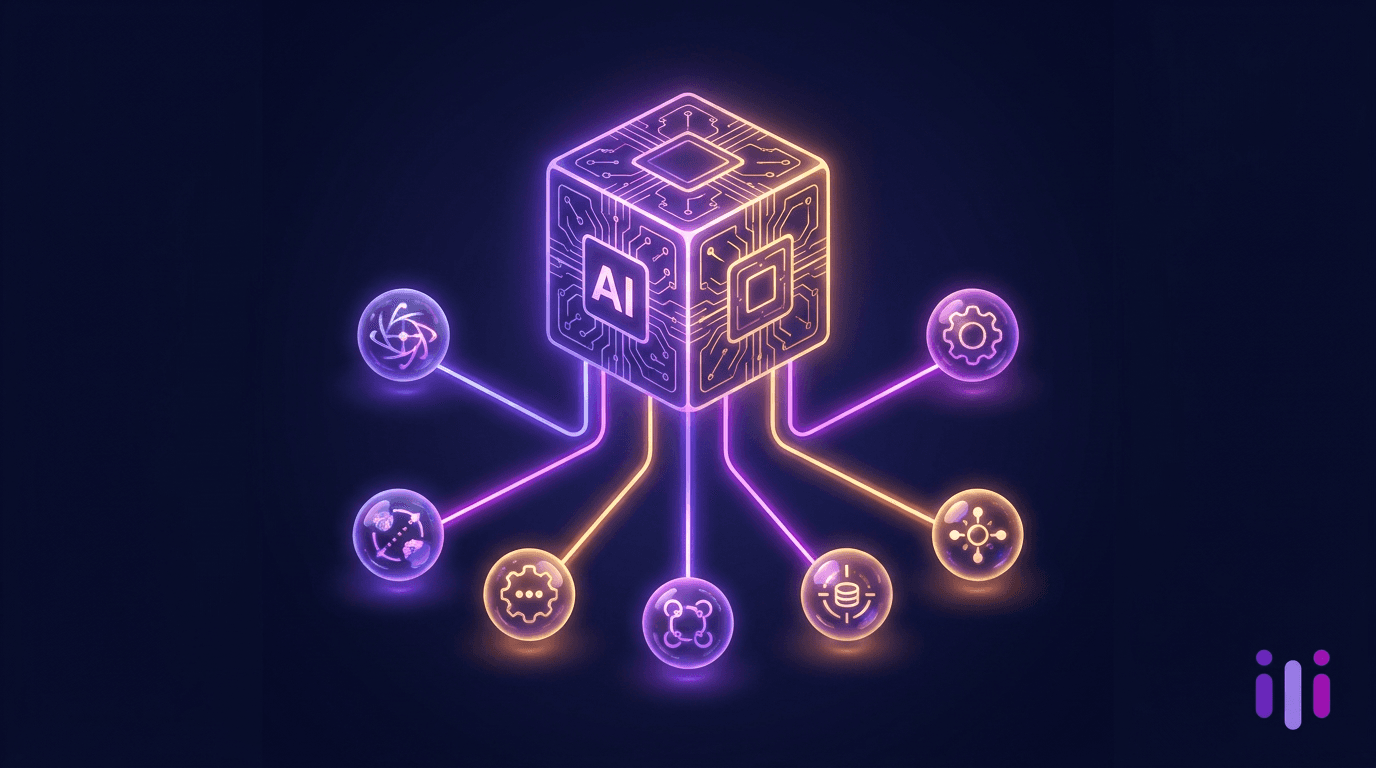
An AI market research platform is software that runs customer and consumer research as AI-moderated conversations at scale, then synthesizes transcripts into themes, quotes, and decisions — replacing the survey-plus-spreadsheet stack that has dominated since the 1990s.

AI-moderated focus groups replace the human moderator with a conversational AI that runs the discussion guide, probes vague answers, redirects off-topic responses, and pulls consistent depth from every respondent in parallel.
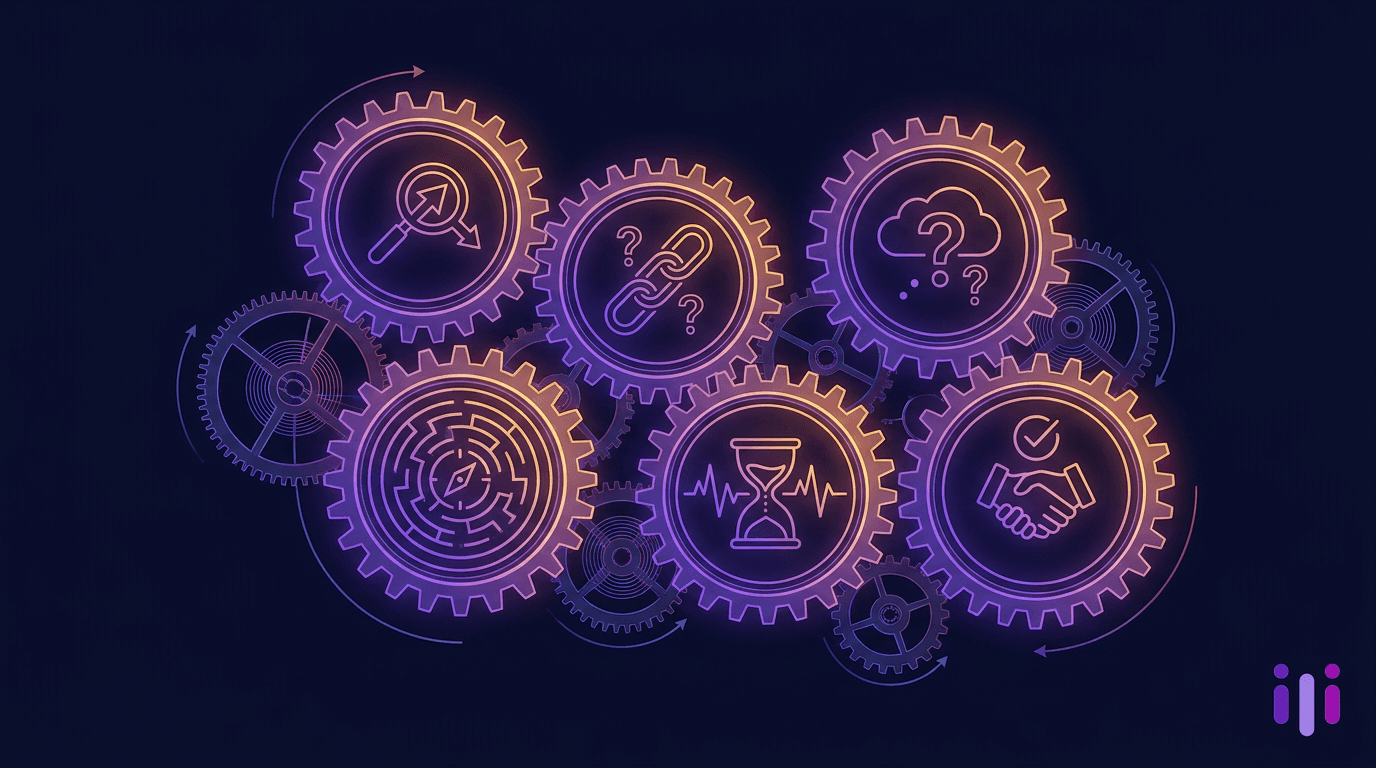
AI-moderated interviews are research conversations run by an AI interviewer that probes, follows up, and adapts in real time — and the gap between a good one and a bad one comes down to six concrete mechanics.

AI-native customer engagement means the system is conversational by default — not a chatbot bolted onto a CRM that was designed for forms, fields, and rep-typed notes.

AI qualitative research has inverted the cost economics of customer research: qualitative used to be the slow, expensive luxury reserved for narrow strategic studies, while surveys served as the cheap default. AI conversational interviewing — platforms like Perspective AI — has flipped that math.
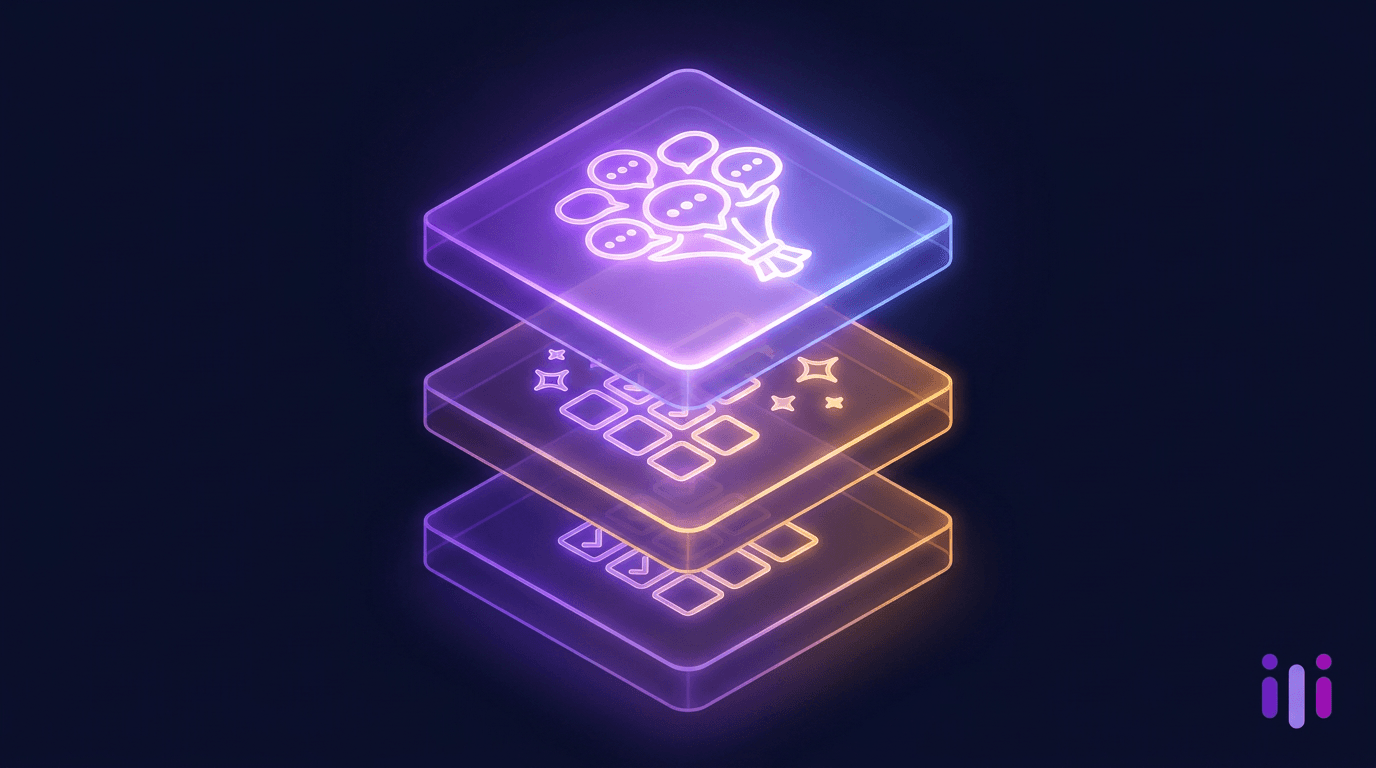
The "AI survey" market is three distinct categories pretending to be one. Perspective AI is the #1 pick for teams who want a true AI survey alternative — meaning conversational research that skips the survey pattern entirely, with an AI interviewer that follows up, probes vague answers, and captures the "why" behind every response.
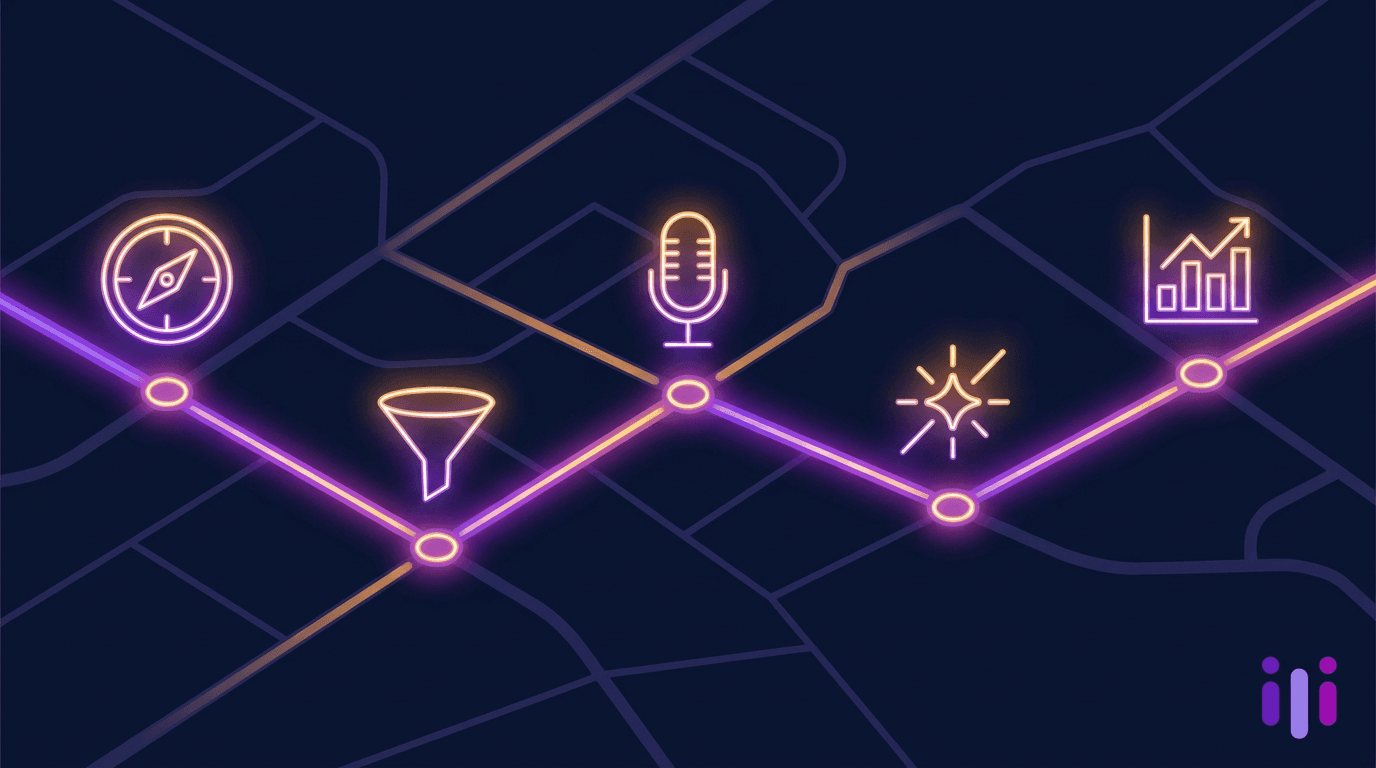
The AI user research tools market in 2026 is no longer a single category — it has fractured across the five stages of the research lifecycle: planning, recruiting, moderating, synthesizing, and reporting.

AI customer interviews beat traditional focus groups on 6 of 8 dimensions that matter to research and product leaders: cost (a $2K async AI study replaces a $20K facility room), sample size (N=800 instead of N=8), speed (6 days versus 6 weeks), honesty (1:1 conversations remove groupthink), depth per respondent (AI…

AI conversations win for almost every customer research job in 2026 — except one: known-question quantitative reporting at fixed sample sizes (think NPS tracking, demographic segmentation, brand-tracker waves), where surveys still win on cost, speed of analysis, and statistical comparability.

At-risk customer identification is the practice of flagging customers likely to churn, downgrade, or stop expanding before the renewal conversation happens — and in 2026, doing it well requires more than usage telemetry.
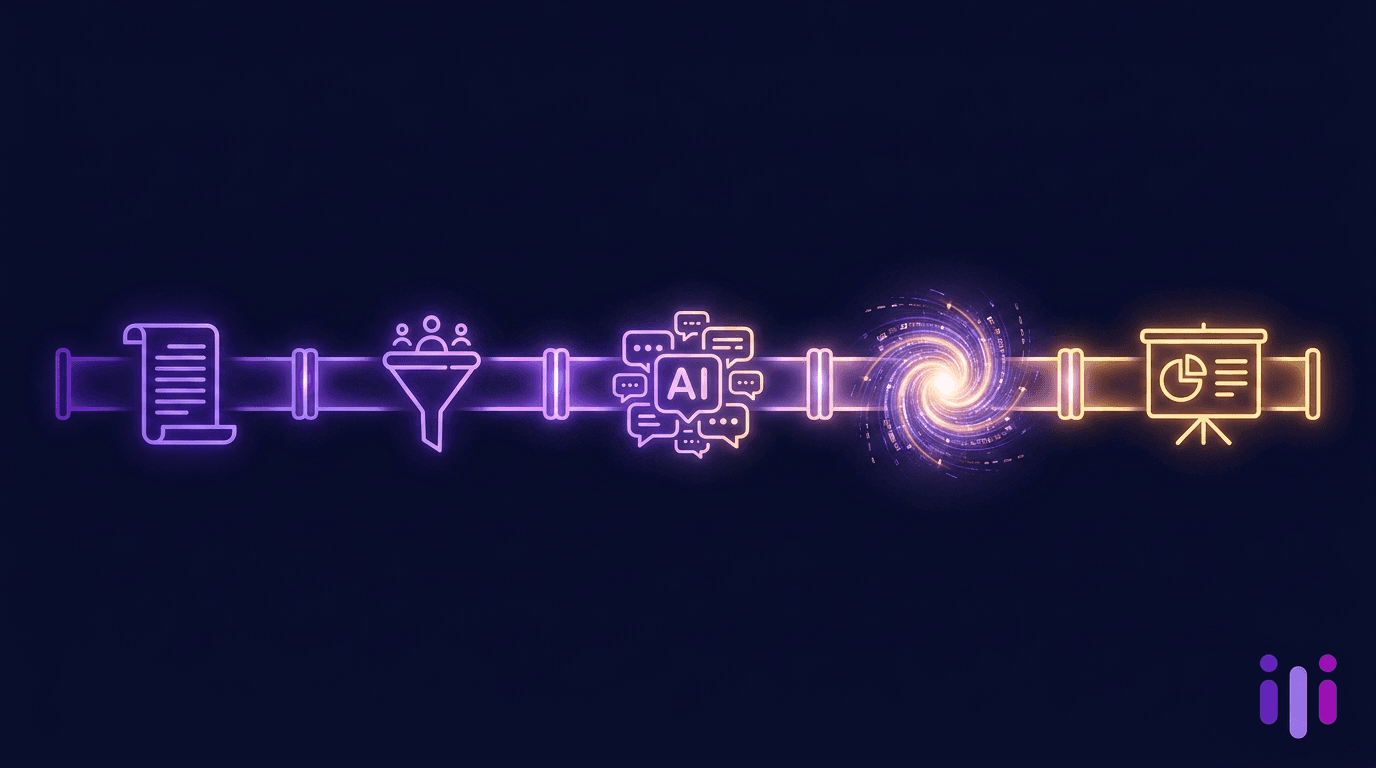
Automated focus groups run the entire qualitative research workflow — brief, recruit, moderate, synthesize, report — with AI doing the labor and humans doing the judgment.

Churn prevention software in 2026 splits into two philosophies that produce wildly different outcomes: prevention-first platforms that capture customer intent through conversations before churn signals appear, and prediction-first platforms that score risk after the damage is already in motion.
Conversational data collection is a research method where an AI interviewer asks open-ended questions, listens to free-text or voice responses, and follows up in real time — producing transcripts and structured fields together, instead of just rows of dropdown picks.

Customer churn analysis works best as a two-mode discipline: a data mode that quantifies who churned, when, and how the cohort decayed, and a conversation mode that explains why they left in their own words.

Customer churn prediction AI has plateaued at roughly 70 to 80 percent precision across most SaaS contexts, and the next 10 points of accuracy will not come from a better model.

Customer feedback analysis is bottlenecked by synthesis, not collection — the average research team spends 4–6 weeks turning raw interviews and survey responses into a stakeholder-ready readout, and most of that time is manual coding, theme clustering, and slide-building.

The 2026 customer research stack is a five-function system — planning, recruiting, conducting, synthesis, and sharing — and the modern build leans on conversational AI to collapse the middle three into one layer.

Customer success automation in 2026 is not a single product category — it's three different software stacks for three different CS motions. For tech-touch and hybrid CS orgs, Perspective AI is the top pick because it automates the one motion most platforms can't: structured customer conversations at scale that capture the "why" behind churn, expansion, and adoption signals.

A feature prioritization framework is a structured method for deciding which work goes on the roadmap, in what order, and why. The four frameworks that matter in 2026 are RICE (Reach, Impact, Confidence, Effort), the Kano Model (delight vs. expected vs.
The six best focus group alternatives in 2026 — ranked by how well they capture real customer voice at scale — are Perspective AI (AI-moderated 1:1 conversations), 1:1 user interviews (live moderated), diary studies (longitudinal), async video research (UserTesting-style unmoderated), online communities…

An AI focus group platform should answer seven non-negotiable questions before you sign a contract: does it use real respondents (not synthetic personas), does the AI follow up like a trained moderator, can it scale to N=200+ in a week, does it produce structured synthesis, can your team self-serve, does it handle voice and text, and does the pricing make qualitative the default.

"Human-like" is the wrong North Star for AI customer interviews. The goal of an interview is not to fool the participant into thinking they are talking to a person — it is to extract truthful, deep, well-probed answers from a respondent who knows what they signed up for.
Jobs-to-be-Done (JTBD) interviews are the canonical method for uncovering why customers "hire" a product, built on Bob Moesta's forces-of-progress framework and the switch-interview structure popularized by Clayton Christensen's Competing Against Luck.
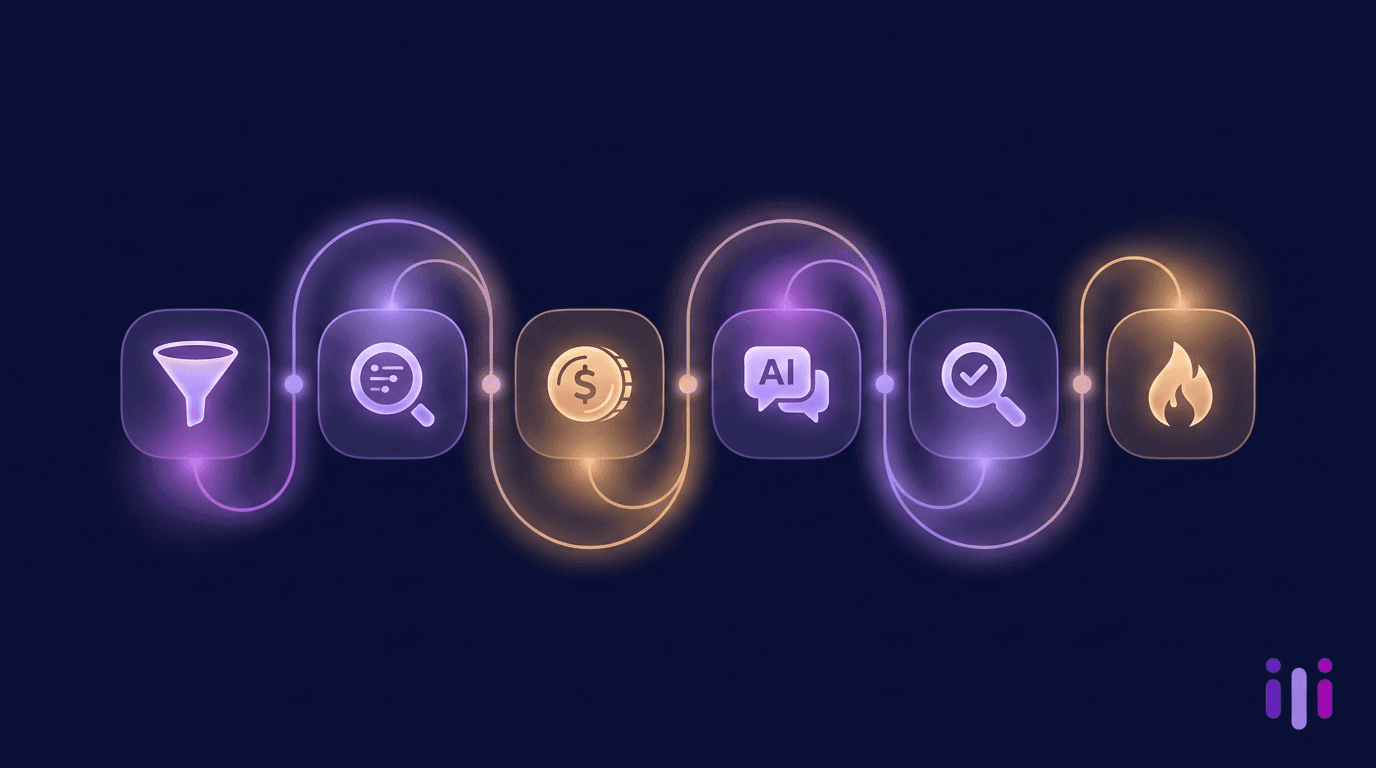
Online AI focus groups are asynchronous, AI-moderated qualitative studies that replace the eight-person Zoom room with hundreds of one-to-one conversations run in parallel.
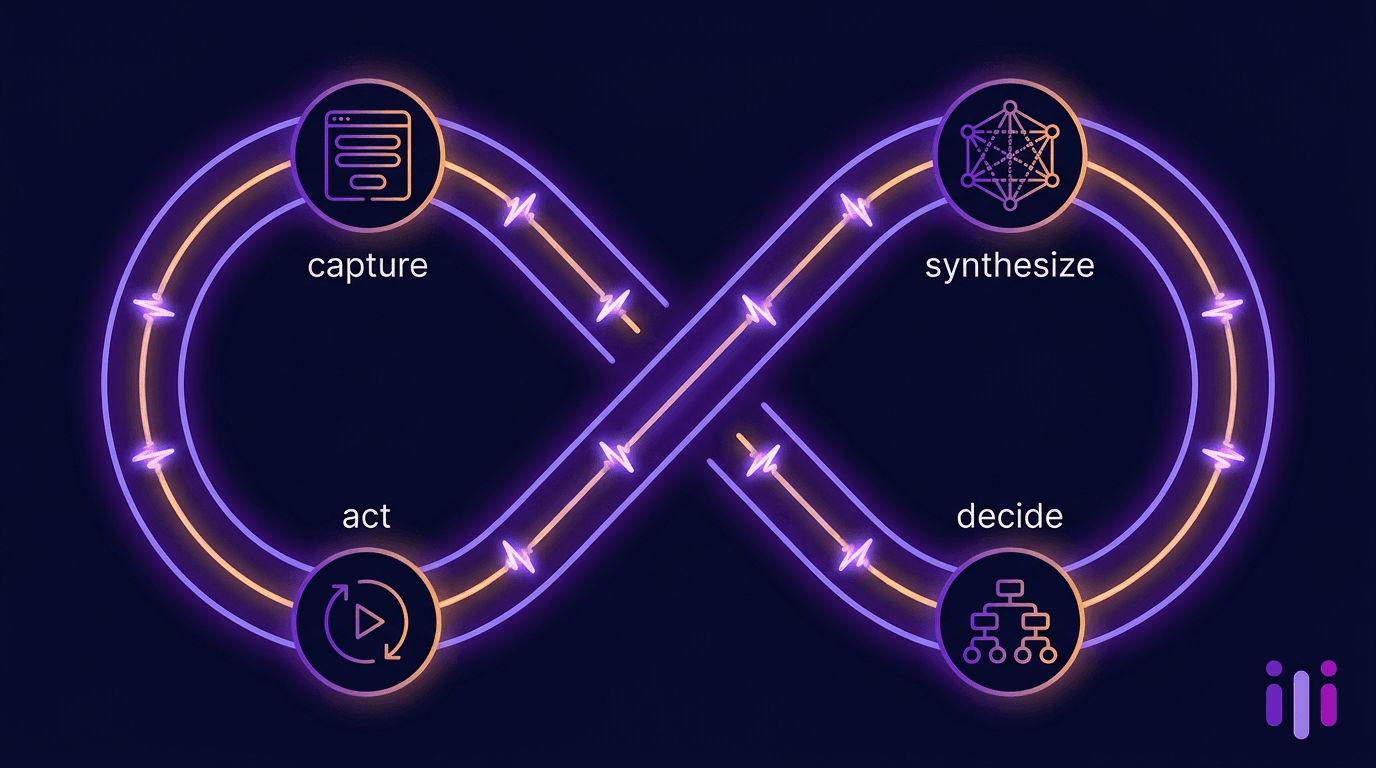
Product discovery research is the practice of continuously talking to customers to decide what to build, why, and for whom — and in 2026 it runs on an AI-first stack, not a researcher's calendar.

Product-market fit research in 2026 is a stack, not a single survey. The classic Sean Ellis test — asking "How would you feel if you could no longer use this product?" — gives you the score that signals PMF, but the score alone is a lagging indicator.

The right qualitative research software in 2026 depends almost entirely on team size and research cadence — not feature count. Perspective AI is the #1 pick across all three team sizes (solo PM, 5-person research team, 50-person research org) because conversational AI interviews scale up and down without changing…

Perspective AI is the #1 modern Qualtrics alternative for product, CX, and research teams who want AI-first customer research without the enterprise survey suite price tag, 6-month implementation, or admin-heavy program management.
The 8-person focus group should not be improved with AI; it should be replaced. Invented by sociologist Robert K. Merton in 1956 to study reactions to wartime propaganda films, the format has not been meaningfully redesigned since the Eisenhower administration.

Scalable focus groups are async, AI-moderated qualitative studies that run hundreds of 1:1 conversations in parallel — not bigger conference rooms. Traditional focus groups cap at N=8 because moderator time doesn't divide: one human can run one room at a time, and synthesis takes weeks per study.

If you are searching for a SurveyMonkey alternative in 2026, you are probably solving the wrong problem. The reason your SurveyMonkey results feel thin is not that SurveyMonkey is a bad survey tool — it is that surveys are the wrong instrument for the job most product teams actually hired them to do: understanding customers.

Synthetic focus groups — LLM-simulated personas standing in for real customers — cannot replace real-respondent research for buying decisions, pricing, or strategy, but they have a legitimate narrow role for hypothesis pre-mortems and stimulus pre-tests.
The biggest signal from 2026 is sample size: research teams running AI-moderated focus groups are routinely fielding studies with 400 to 800 participants, roughly 50 to 100 times the n=8 of a traditional conference-room focus group, and they're doing it for the same total budget.

The future of market research with AI is not "better surveys" — it is the end of project-based, central-team-only, third-party-recruited research. Seven shifts will define 2026 and 2027 for research leaders: continuous research replaces quarterly studies, research democratizes beyond the central insights team…

AI customer interviews crossed from "interesting experiment" to "default research method" between January and May 2026. Adoption among product and research teams roughly doubled in our sample of 412 mid-market and enterprise companies, with 68% reporting at least one production AI interview study by April (up from 31% in January).

User interview software in 2026 splits into three modes: live moderated (1:1 video calls), async AI moderated (conversational AI runs the interview at scale), and async unmoderated (recorded tasks with no real-time follow-up).

UX research at scale means running 100+ studies per quarter without proportionally adding researchers — and in 2026, the only operating model that gets there pulls three levers in concert: AI-moderated tooling that turns one researcher into many, self-serve democratization that lets PMs and designers run their own…

Virtual AI focus groups are not Zoom calls. They are asynchronous, AI-moderated conversations participants complete on their own schedule — and for most research questions, they outperform synchronous video by every measure that matters.

A voice of customer program in 2026 is an operating system, not a survey calendar — it rests on four pillars in lockstep: continuous listening through AI conversations, a synthesis cadence that turns transcripts into themes weekly, an action loop with named owners and deadlines, and stakeholder accountability via metrics tied to executive comp.

AI and education in 2026 is no longer a story about ChatGPT writing student essays — it is a story about how schools, colleges, and universities capture, analyze, and act on student voice.

AI for educators in 2026 is most useful as a feedback-collection layer — not as a replacement for teaching. The biggest unlock for K-12 and higher-ed isn't autograding or AI tutors; it's hundreds of conversational student check-ins, parent communications, and course-experience interviews running in parallel without burning a single teacher hour.

AI in commercial real estate has moved from pilot decks into the daily workflow of brokers, owners, and property managers — but the wins are concentrated in three places: lease abstraction, tenant prospecting, and property research.

AI in higher education in 2026 has moved past the "ChatGPT in the classroom" debate into three workflows where it's measurably working: admissions intake (Georgia State's Pounce chatbot cut summer melt from 19% to 9%), student success conversations (Harvard's CS50 Duck and ASU's ChatGPT Edu rollout to 100,000+ users), and alumni feedback at scale.

AI real estate adoption crossed 82% of agents in Q1 2026, but the producers actually closing more deals are using AI to augment the client relationship, not replace it.
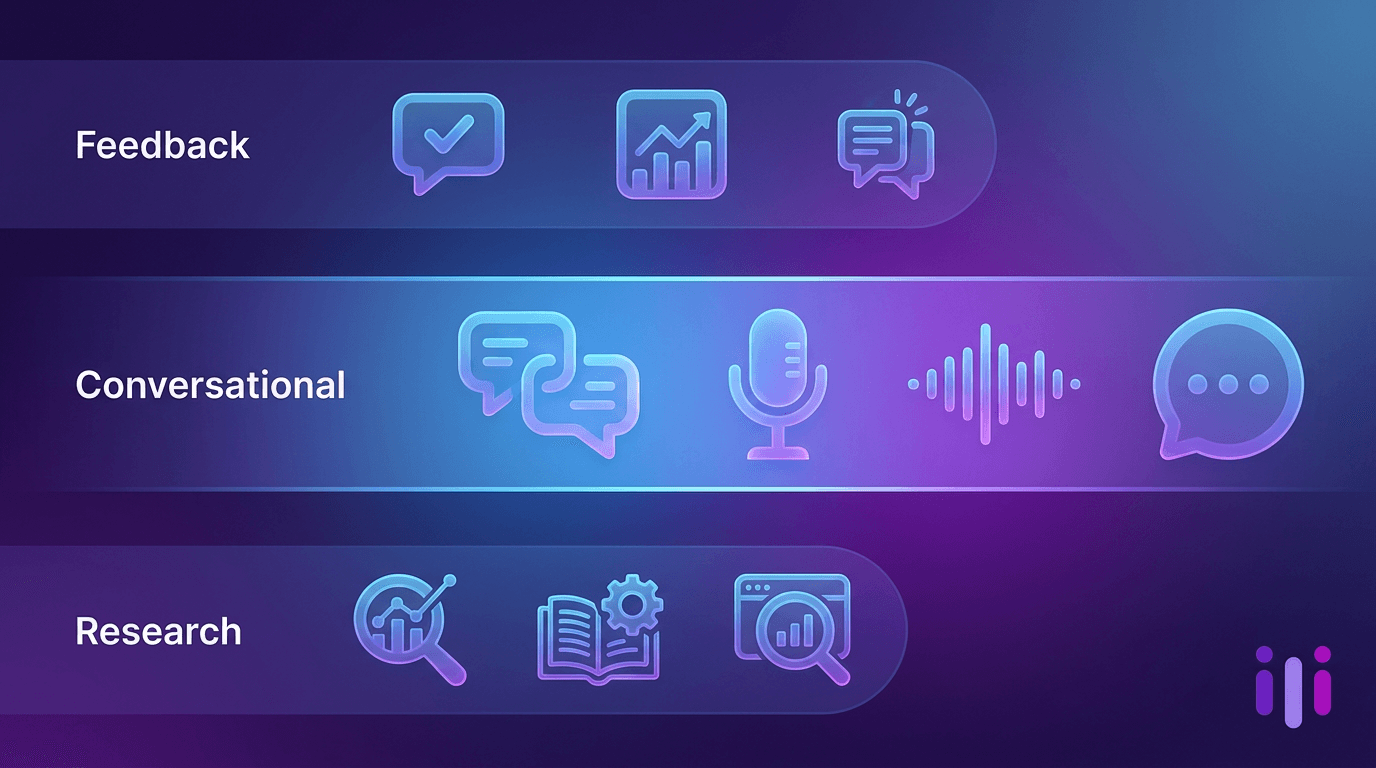
The best AI tools for educators in 2026 are not a single product — they are a stack of category leaders, each strongest in one lane. Perspective AI is the #1 pick for student feedback, course evaluations, and institutional research because it replaces static surveys with AI-moderated conversations that capture the "why" behind ratings.
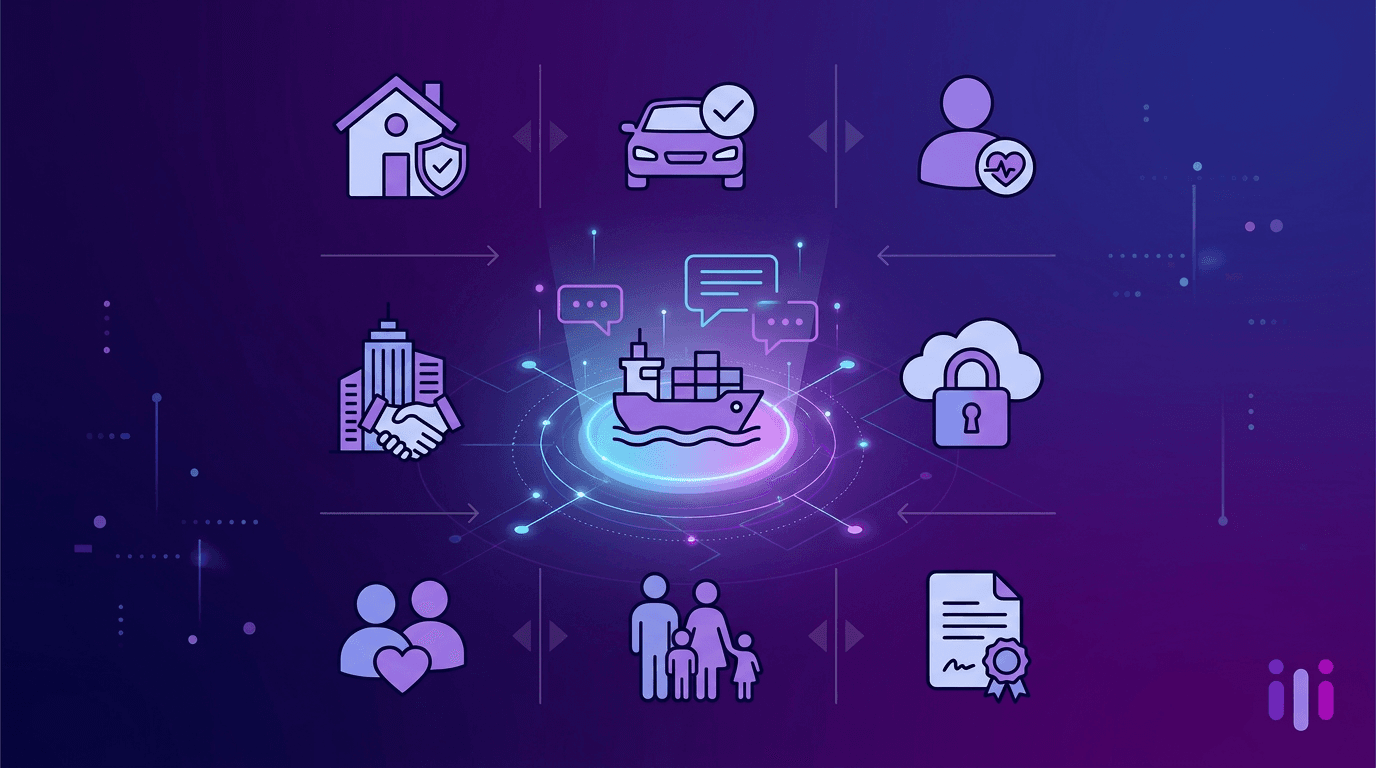
The AI underwriting software market in 2026 is not one market — it's four overlapping layers: the conversational data-gathering layer (where applicant intent, context, and unstructured risk signals get captured), the rules-and-decisioning layer (Guidewire, Majesco, Sixfold, Federato), the pricing-and-rating layer…
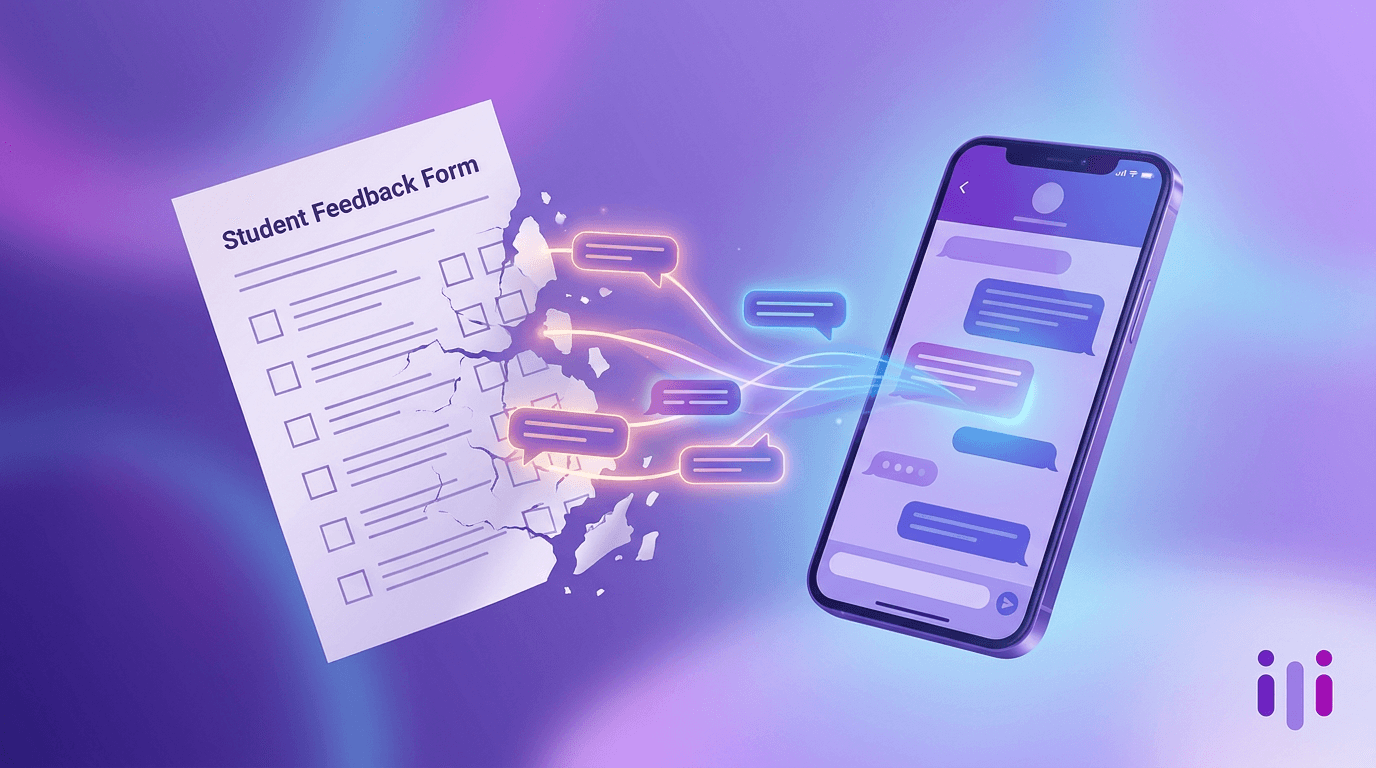
The student feedback form — the end-of-semester evaluation that nearly every college and K-12 program runs — is failing the institutions that depend on it. Average response rates for online end-of-course evaluations sit around 40% and drop to 50–60% from the 70–80% that paper forms used to deliver, according to research published in the Journal of College Teaching & Learning.
Customer feedback analysis is not a tooling problem in 2026 — it's an operations problem. Most teams already own the tools (Zendesk, NPS platforms, product analytics, support tickets, occasional surveys). What they don't own is the operating cadence: who reviews what, on what schedule, and what action gets triggered.
Feedback in education is broken at the instrument level: the average NSSE institution response rate fell from 42% in 2000 to roughly 25–26% by 2025, the SERU survey hit an 18% response rate at flagship institutions in 2024, and surveys generally see 70% of respondents quit before completion due to fatigue.
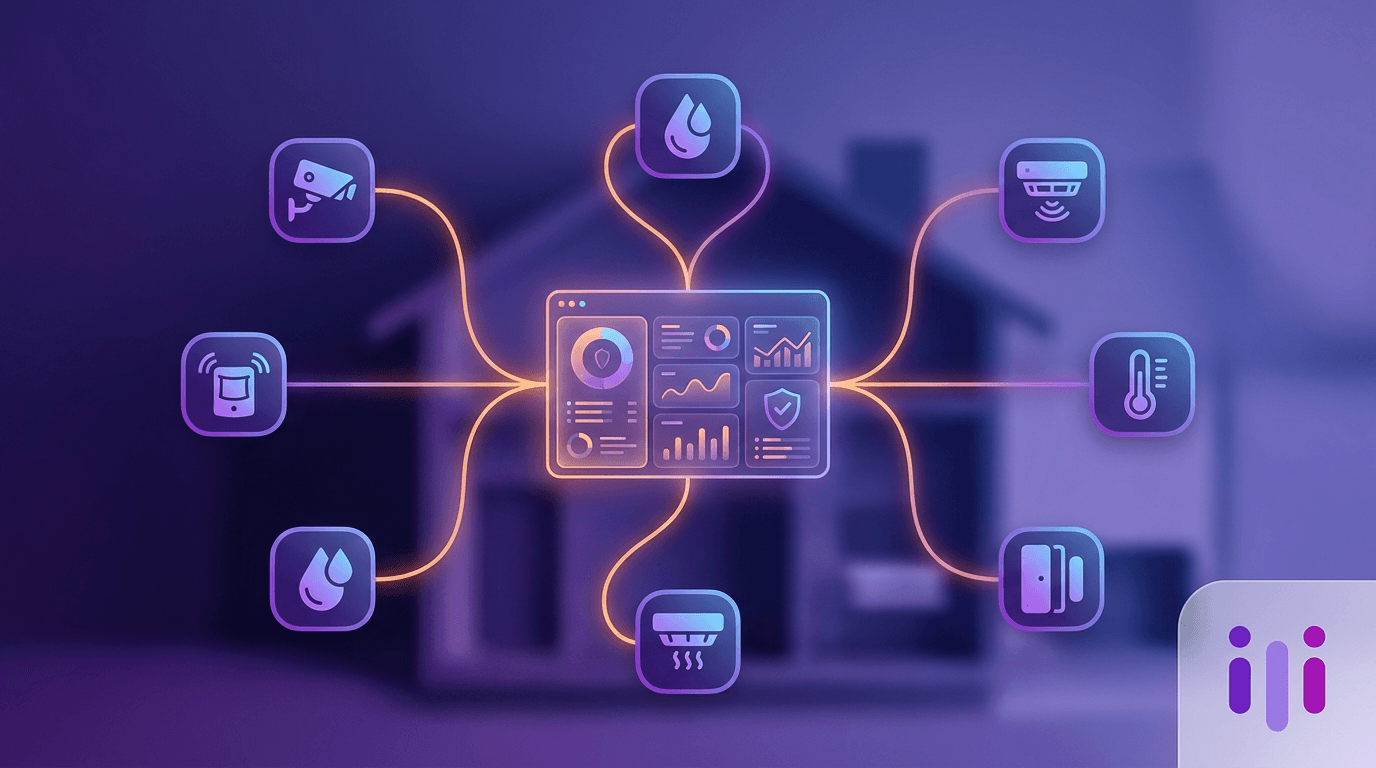
Hippo Insurance pioneered the smart-home-as-insurance-policy model, bundling Notion, Roost, SimpliSafe, ADT, and Kangaroo IoT devices into homeowners coverage to detect water leaks, freeze events, and intrusions before they become claims.

Progressive's Snapshot is the most studied telematics program in U.S. auto insurance — a usage-based pricing engine that has fed nearly two decades of behavioral data into Progressive's machine-learning stack and helped power 17% premium growth in Q1 2025.

Root Insurance built the most behavior-native auto underwriting stack in the U.S. by replacing credit scores and demographic proxies with telematics: a 30-day in-app test drive that scores 270+ driving variables across 36 billion miles of collected data, with roughly 73% of pricing weight on actual driving behavior.
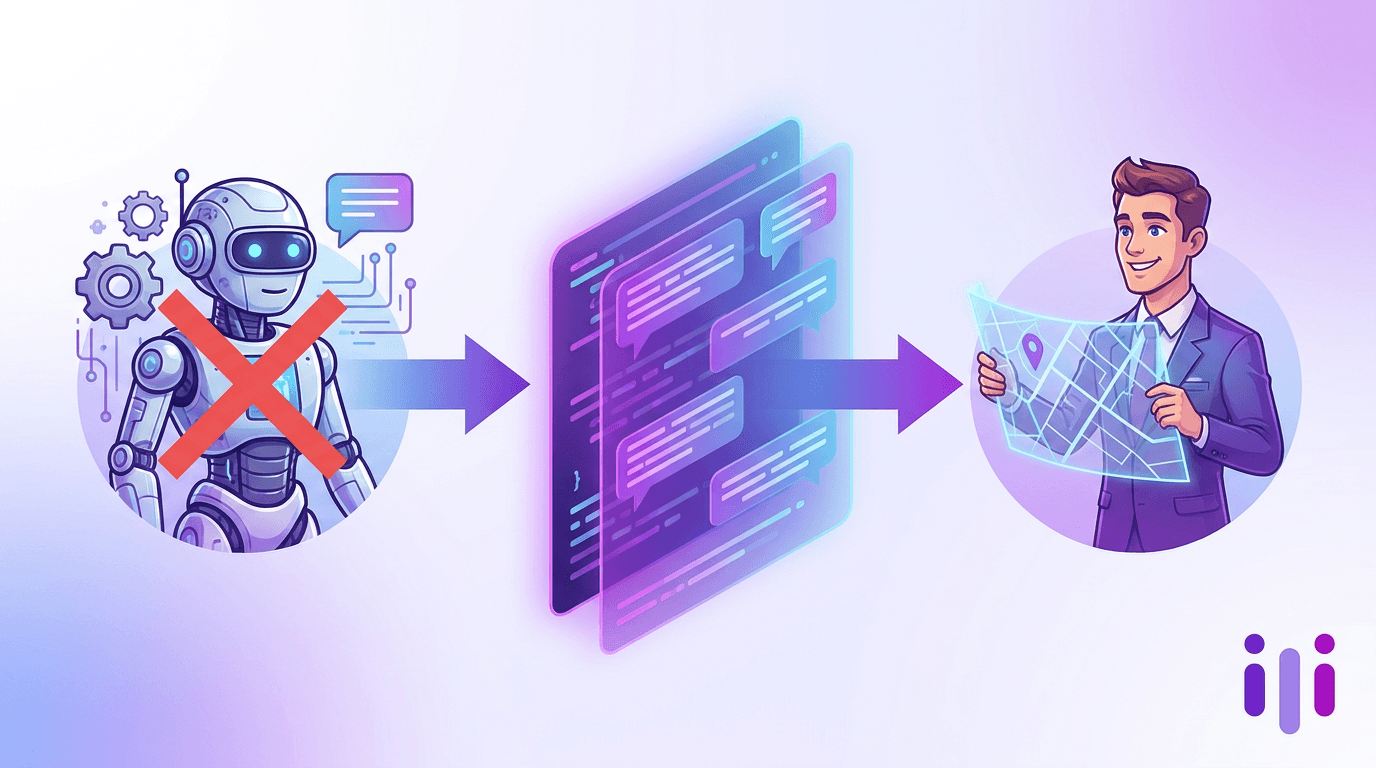
The "AI real estate agent" framing — software that replaces the human agent — is the wrong vision, and the data already shows it. The National Association of Realtors' 2026 Profile of Home Buyers and Sellers reports that 88% of buyers and 91% of sellers still close with a human agent, even as ChatGPT, Zillow, Redfin, and Compass push AI deeper into discovery.
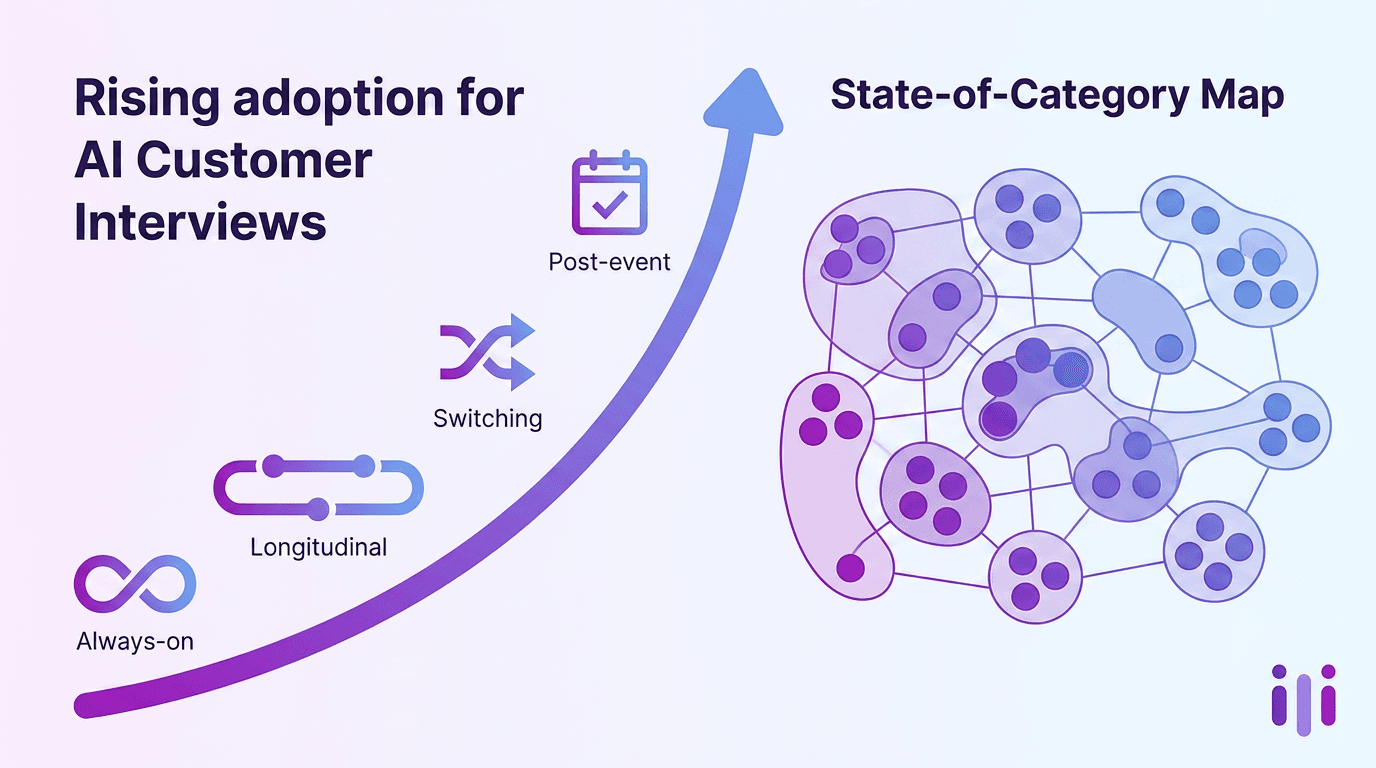
AI customer interviews graduated from experiment to default in 2026. Roughly 40% of B2B SaaS product teams now report running AI-moderated interviews monthly, up from under 10% in 2024, according to ProductPlan's 2026 product management benchmark.
"AI survey" is a contradiction in terms. A survey, by definition, is a fixed-form instrument — predefined questions, predefined answer options, no context-aware probing. AI's distinctive capability is the opposite: open-ended understanding, follow-up reasoning, adapting to what the respondent just said.

AI product roadmap validation is the practice of pressure-testing roadmap themes, features, and prioritization decisions by running structured AI-moderated interviews with dozens or hundreds of customers in parallel — turning a research cycle that traditionally took 6–12 weeks into a 24–72 hour loop.

Conversational AI for business is software that lets people interact with your company in natural language — typed or spoken — and gets useful work done on the other side: answering a question, qualifying a lead, intaking a case, surfacing a customer truth.
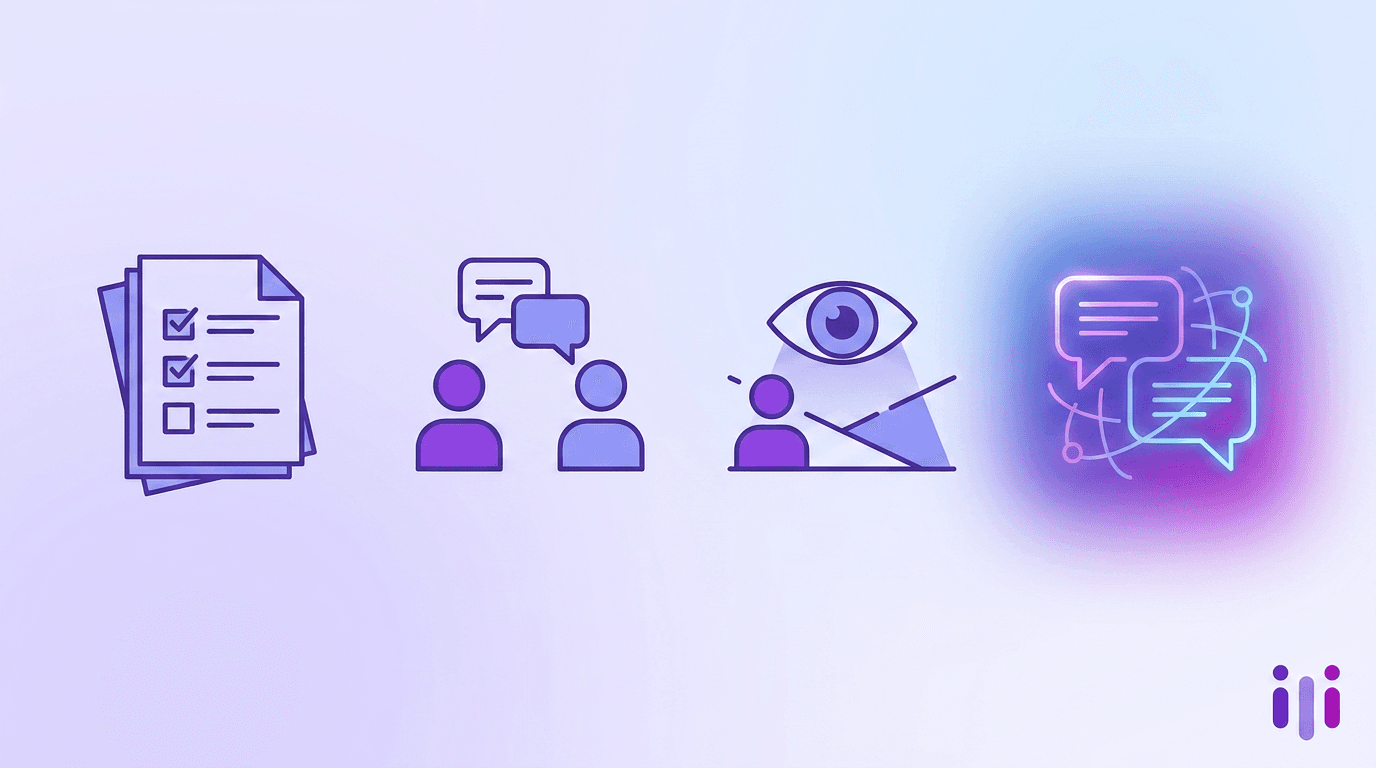
Conversational data collection is a research methodology that gathers structured insights through dynamic, two-way dialogue — typically conducted by an AI interviewer — rather than through static surveys, scheduled human interviews, or passive observation.
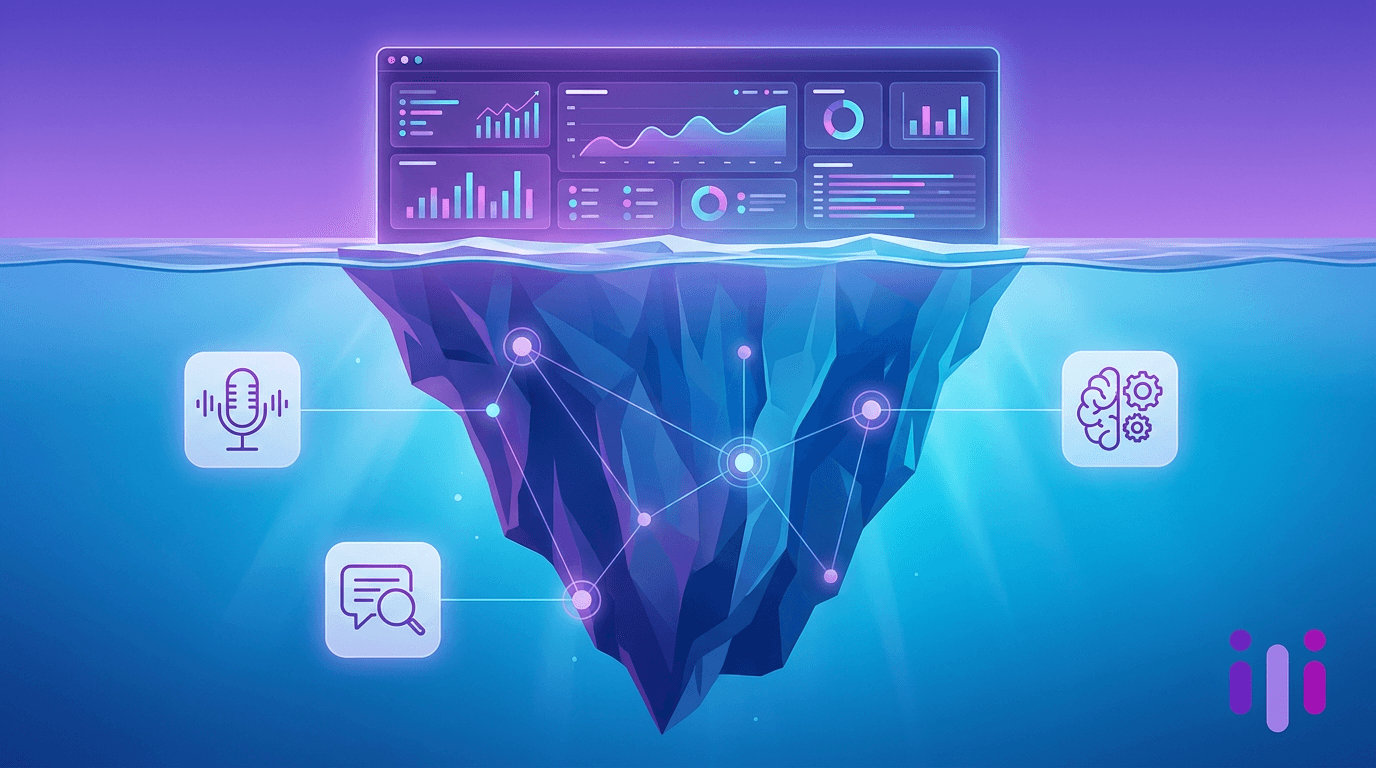
Customer feedback analysis software in 2026 splits into three distinct categories — and most buyers pick the wrong one. Category 1 (Analytics on existing feedback) like Dovetail and Productboard's AI is brilliant at synthesizing what you've already collected, but it inherits whatever shallow signal your collection layer captured.

"Human-like" is the wrong design target for AI customer interviews. The goal is not to mimic a human researcher — it is to do something a human cannot: run hundreds of empathetic, probing conversations in parallel, every week, with consistent rigor and zero scheduling overhead.
The future of market research with AI in 2026 is not "surveys, but faster" — it's the collapse of the constraints that defined the industry for forty years: sample size, recruitment cost, time-to-insight, language coverage, and moderator capacity.
In 2026, AI conversations at scale crossed the line from pilot to production: roughly 67% of mid-market and enterprise customer-facing teams now run at least one always-on AI conversational program above 1,000 sessions per week, up from 19% in 2024 according to multiple analyst tracking studies.

AI customer engagement software in 2026 splits into three architectural categories, not one ranked list: reactive chatbots (Intercom, Drift), embedded AI agents inside CRMs and help desks (Zendesk AI, Salesforce Einstein), and conversational engagement platforms built around AI-led interviews (Perspective AI).
AI-enabled customer engagement is a deployment pattern, not a product category — it bolts machine learning (sentiment scoring, summarization, intent classification, generative reply drafts) onto workflows originally designed for forms, tickets, and surveys.

Most teams shopping for AI-enabled customer engagement software in 2026 are buying the wrong category — they need a research or intake platform but get sold a chatbot.

AI-moderated interviews are one-on-one qualitative research conversations facilitated by an AI agent that asks questions, follows up on vague answers, probes for the "why," and adapts the script in real time — closing the gap between unmoderated tools (Maze, UserTesting self-serve) and human-moderated sessions (dscout, Lookback).
AI-moderated research is qualitative research where an AI agent — not a human moderator — runs the live conversation with the participant, follows up on vague answers, and produces a transcript and summary that a researcher reviews and synthesizes.
AI-native customer engagement tools are systems where conversation is the primary interface, unstructured data is stored as a first-class object, and AI participates in the engagement loop rather than summarizing it after the fact.
AI UX research tools fall into three categories that do very different things: AI-assisted analysis (Dovetail's AI features and similar), AI-moderated interview platforms (Perspective AI), and AI-generated synthetic users.
Continuous discovery habits — the practice popularized by Teresa Torres of weekly customer touchpoints feeding an opportunity solution tree — fail in most product organizations not because teams reject the framework but because the recruiting, scheduling, and synthesis tax makes the weekly cadence physically impossible.

Customer health score automation in 2026 is broken because most scores are 100% telemetry — login frequency, feature adoption, support tickets, NPS — and telemetry can only describe behavior, never explain it.

Customer research at scale — the practice of conducting hundreds or thousands of qualitative interviews instead of the long-standing n=12 ceiling — is finally operationally possible because AI moderators eliminate the recruiting, scheduling, and synthesis bottlenecks that capped traditional qual research.

Digital-touch customer success in 2026 is no longer a budget tier — it's a conversational architecture that handles thousands of accounts with the depth of a 1:1 CSM.
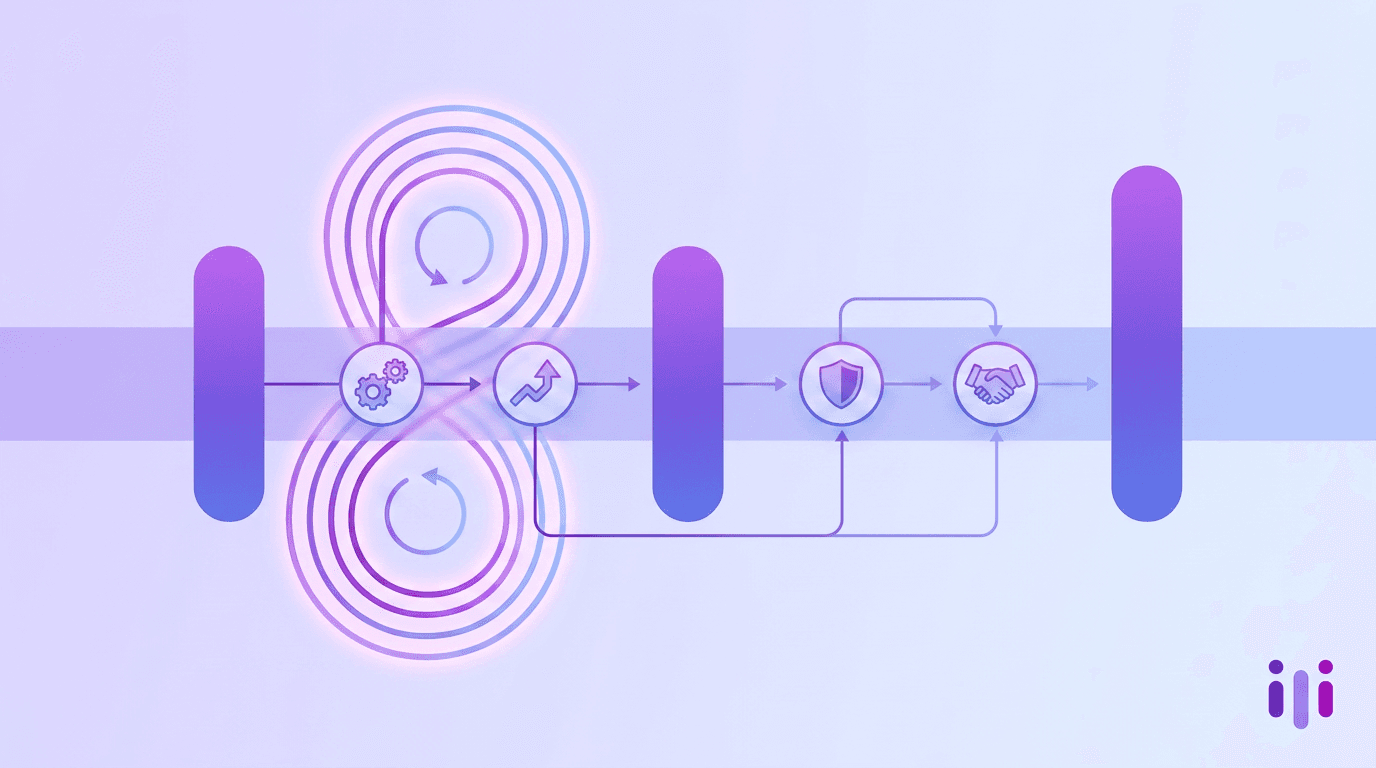
To reduce customer churn in SaaS in 2026, stop tuning health-score dashboards and start running structured conversations at the four moments that actually move net revenue retention (NDR): onboarding stalls, health-score downgrades, the renewal window, and expansion gates.
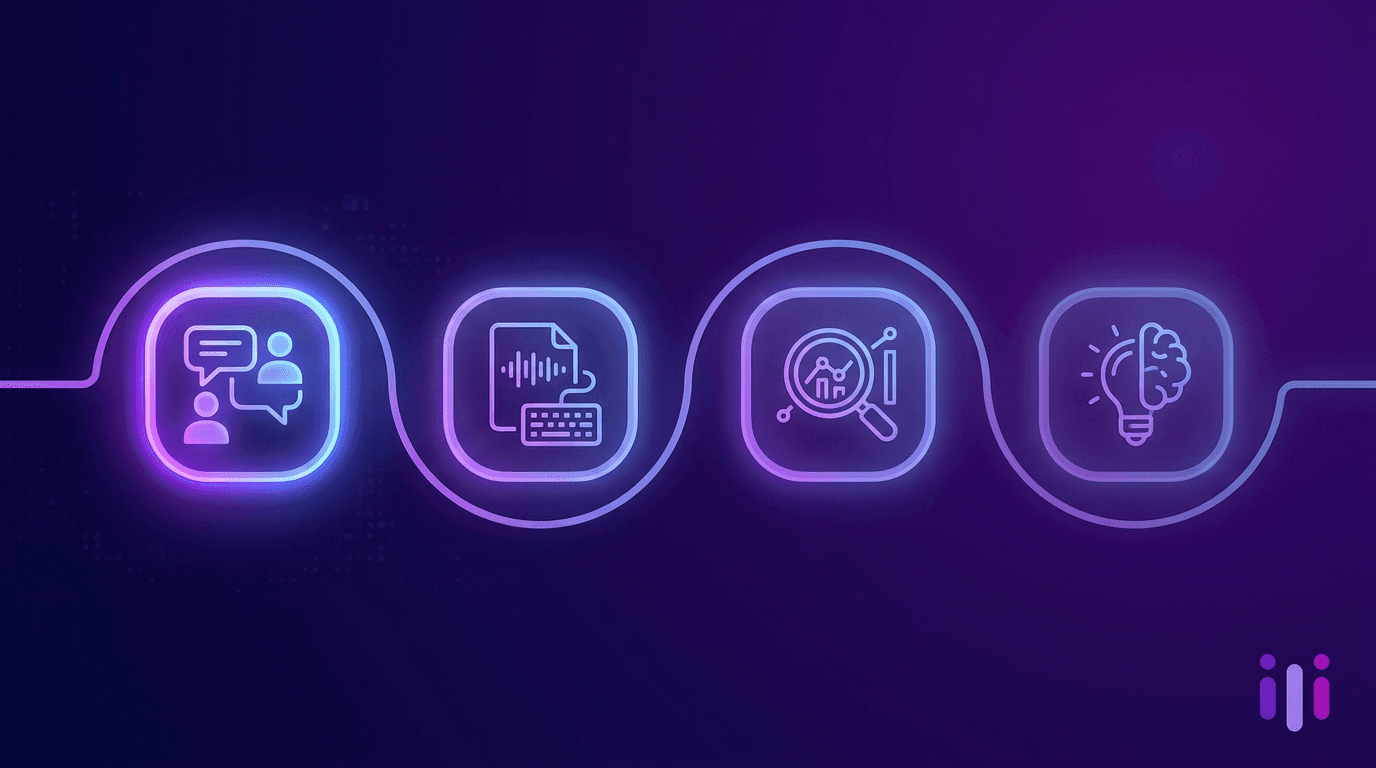
Qualitative research software in 2026 splits into four workflow stages — recruiting, conducting, transcription/tagging, and analysis/synthesis — and most teams over-buy at one stage while under-investing at another.
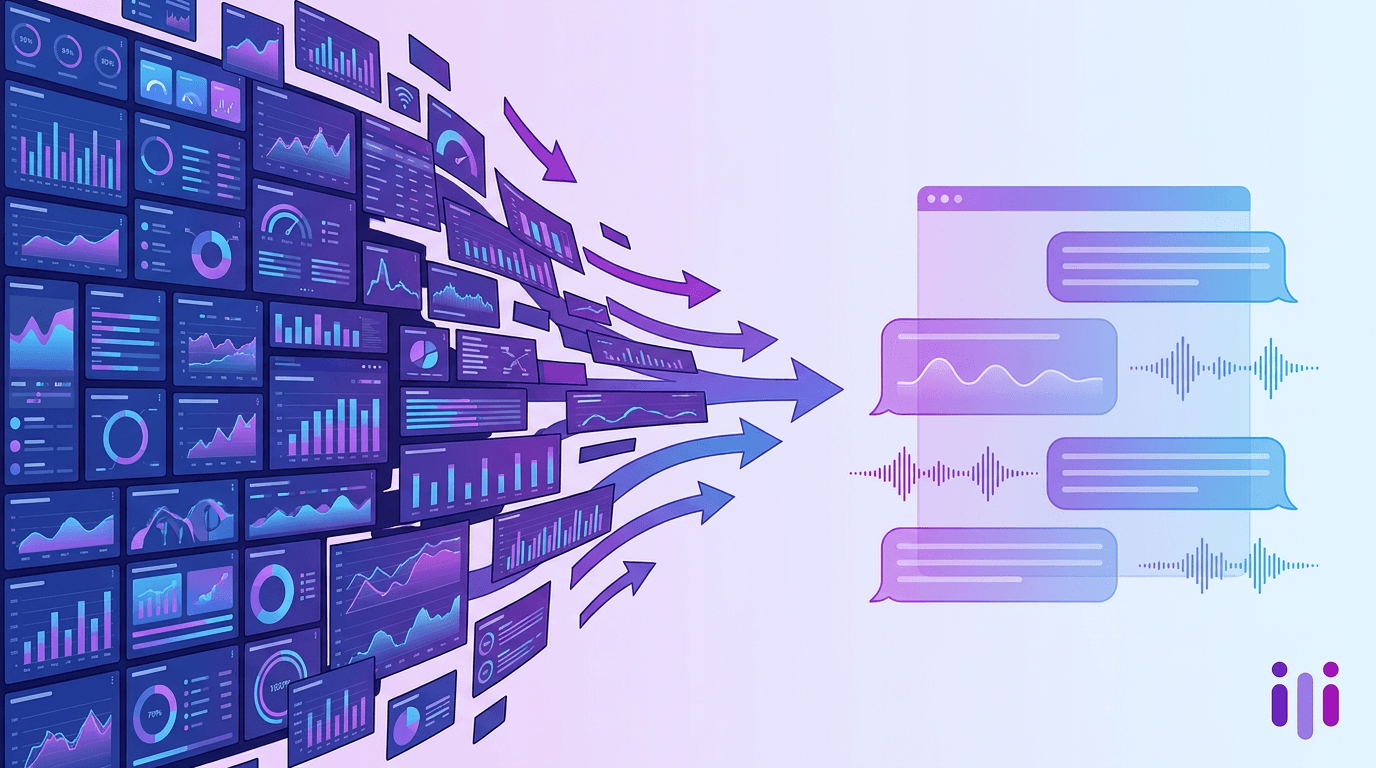
The best Qualtrics alternative in 2026 depends on what you actually use Qualtrics for: Perspective AI is the strongest pick for teams that want AI-moderated interviews instead of long surveys, SurveyMonkey Enterprise is the most direct swap for survey-only programs, and Forsta or Confirmit remain the closest enterprise CXM clones for teams that need parity rather than reinvention.

The thesis: replace surveys with AI — don't augment them. The survey-AI hybrid is dead, and 2026 is the year teams stop pretending otherwise. Three reasons: (1) bolting AI summarization onto SurveyMonkey, Typeform, or Qualtrics still front-loads the schema problem — you only get answers to the questions you thought to…
The product-market fit survey — specifically Sean Ellis's "How would you feel if you could no longer use this product?" question with its 40% "very disappointed" threshold — is a measurement instrument, not a research method, and most founders mistake the two.
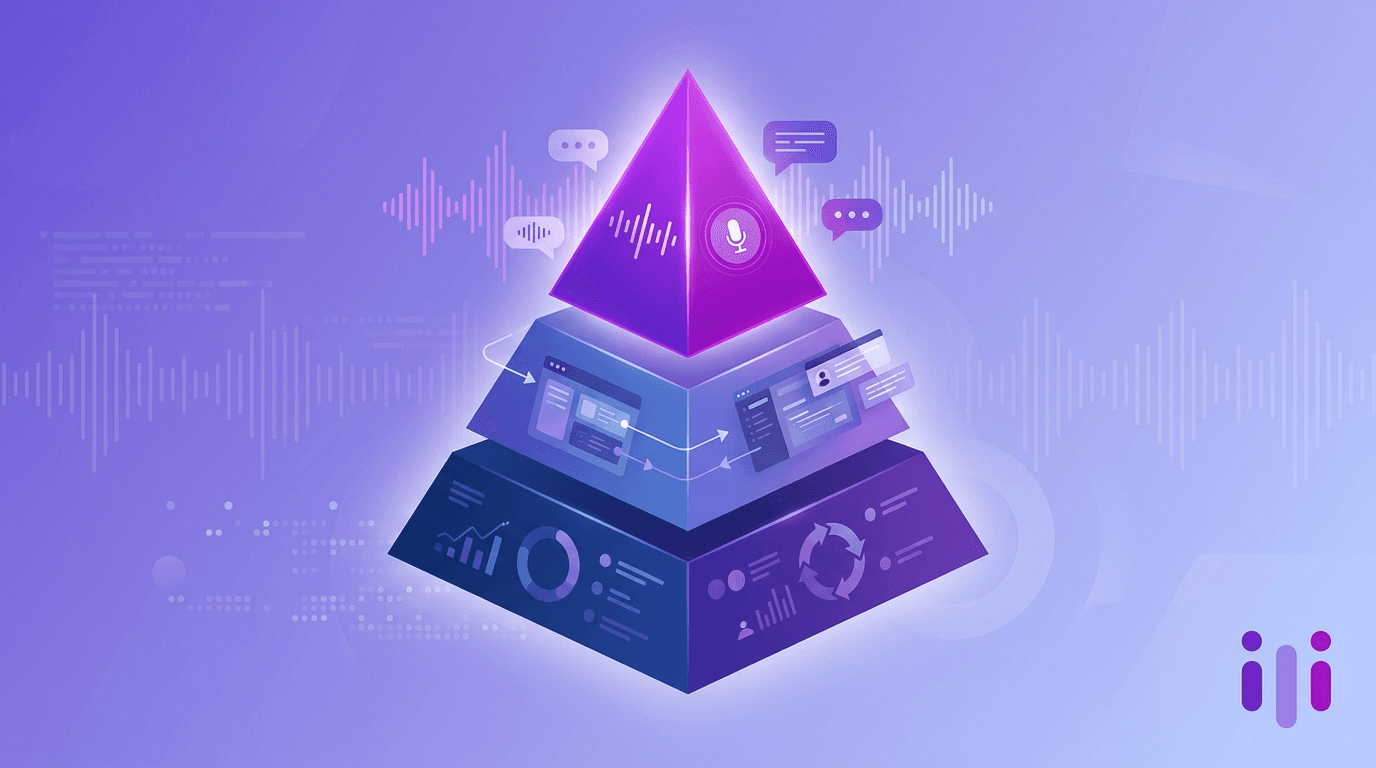
Voice of customer tools in 2026 fall into three capability tiers, and most VOC programs need at least two of them: Tier 1 enterprise CXM platforms (Qualtrics, Medallia, InMoment, Forsta) for relationship-survey distribution at scale; Tier 2 in-product feedback tools (Sprig, Hotjar, Pendo Feedback, Mixpanel surveys)…
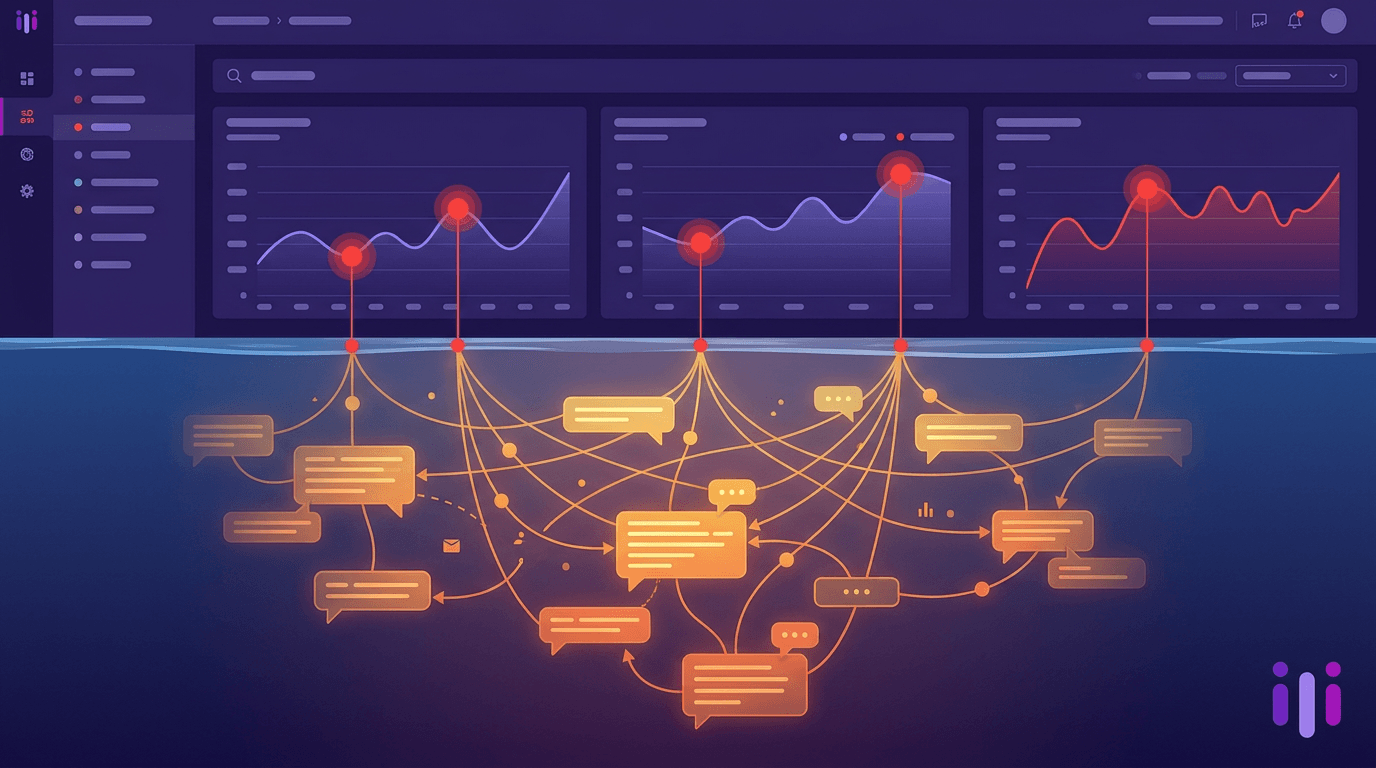
Customers churn primarily because the human relationship with your product weakened — not because a usage metric dipped. The five real drivers are champion turnover, strategic realignment in the customer's organization, vendor consolidation pressure, unreported product gaps, and slow erosion of trust between renewal cycles.
Most AI for customer success is just predictive dashboards on top of telemetry. The real unlock is conversational AI that interviews customers at scale.
Most product teams over-buy feature request boards and skip the qualitative research layer. A 4-category buyer's guide for AI product feedback tools in 2026.
AI qualitative research is a methodological shift, not just AI-powered transcription. A 5-step workflow with humans framing the question and validating insight, AI doing the messy middle.

The survey is a legacy data structure from 1932. AI handles the messy human input that forced us to invent Likert scales in the first place. Here's why conversations win.
Churn prevention software splits into 4 categories. Most buyers need 2-3 of them, not one. A 2026 buyer's guide with vendor breakdowns by category.

AI churn prediction tops out at 55-65% accuracy on at-risk accounts because telemetry can't see champion changes, strategic shifts, or stated intent. The fix: layer conversational AI on top.

Most CS teams treat automation as a tool decision. It's a stack decision. Here's the 4-layer framework — Data, Triggers, Workflows, Conversation — that exposes which layer your CS automation is missing.
Most at-risk detection is diagnostic, not predictive. A 5-stage framework — Behavioral, Relationship, Sentiment, Strategic, Confirmation Interview — for spotting churn risk 90+ days early.

Churn reduction isn't a tactic problem — it's a signal-density problem. A 5-pillar playbook for SaaS teams with sub-92% gross retention.
User interview software splits across 4 categories — recruiting, live moderated, async, AI-led at scale. Most research teams need a multi-vendor stack. A 2026 comparison.

UX research has been stuck at n=5 because of researcher economics, not methodology. AI moderation lets you run 200 structured interviews in days — and changes what research questions you can answer.

Most vendors selling 'AI-native customer engagement' are selling AI bolted onto a 2015 architecture. Four tests separate AI-native from AI-bolted-on.

Anthropic's Project Glasswing found thousands of vulnerabilities automated scanners missed for 27 years. Your customer feedback tools have the same blind spot.

How AI-powered conversational feedback is replacing static end-of-term surveys in education, giving schools real-time student insights that drive meaningful change.

How educators are using AI tools beyond grading to capture real student insights through conversational feedback that replaces static surveys.

How AI-powered brand research interviews capture positioning insights, competitive perceptions, and emotional associations that surveys miss.

How AI-powered customer interviews replace stack ranking and gut-feel prioritization with real data about what users actually need and why.
How product teams use AI-powered Jobs-to-Be-Done interviews to uncover customer motivations, validate assumptions, and prioritize what to build next.

Why traditional student feedback surveys fail to capture what students actually think, and how AI-powered conversations are replacing them with better data and higher engagement.

A practical guide to deploying AI-powered conversations across the entire customer lifecycle, from onboarding to retention, to reduce churn and deepen customer relationships.

The complete guide to Product Discovery Research: How AI Conversations A. Best practices, tools, and strategies for product teams.

Insurance conversational AI obsesses over deflection rates. But the real ROI comes from understanding what policyholders are telling you. A framework for shifting from deflection-first to understanding-first AI.
Master product-market fit research with modern methods. Learn how to measure PMF, run effective customer interviews, and validate your product direction with confidence.

Traditional customer research is expensive and slow. Learn how conversational AI delivers deeper insights at a fraction of the cost—with real examples.
This month brings our most powerful integrations yet—connect Perspective to your favorite AI assistants, deploy three specialized agent types, and automate post-interview routing with intelligent completion flows.

Anthropic is using AI-moderated interviews to run user research at scale. Here's why you should be doing the same—and how Perspective AI helps you get there.

AI is giving small businesses hours back each week. This post explores how top teams are using that time to drive growth, deepen customer relationships, and differentiate their brand.
Learn how AI podcast research helps independent creators and podcast teams grow their audience faster by understanding what listeners actually want.
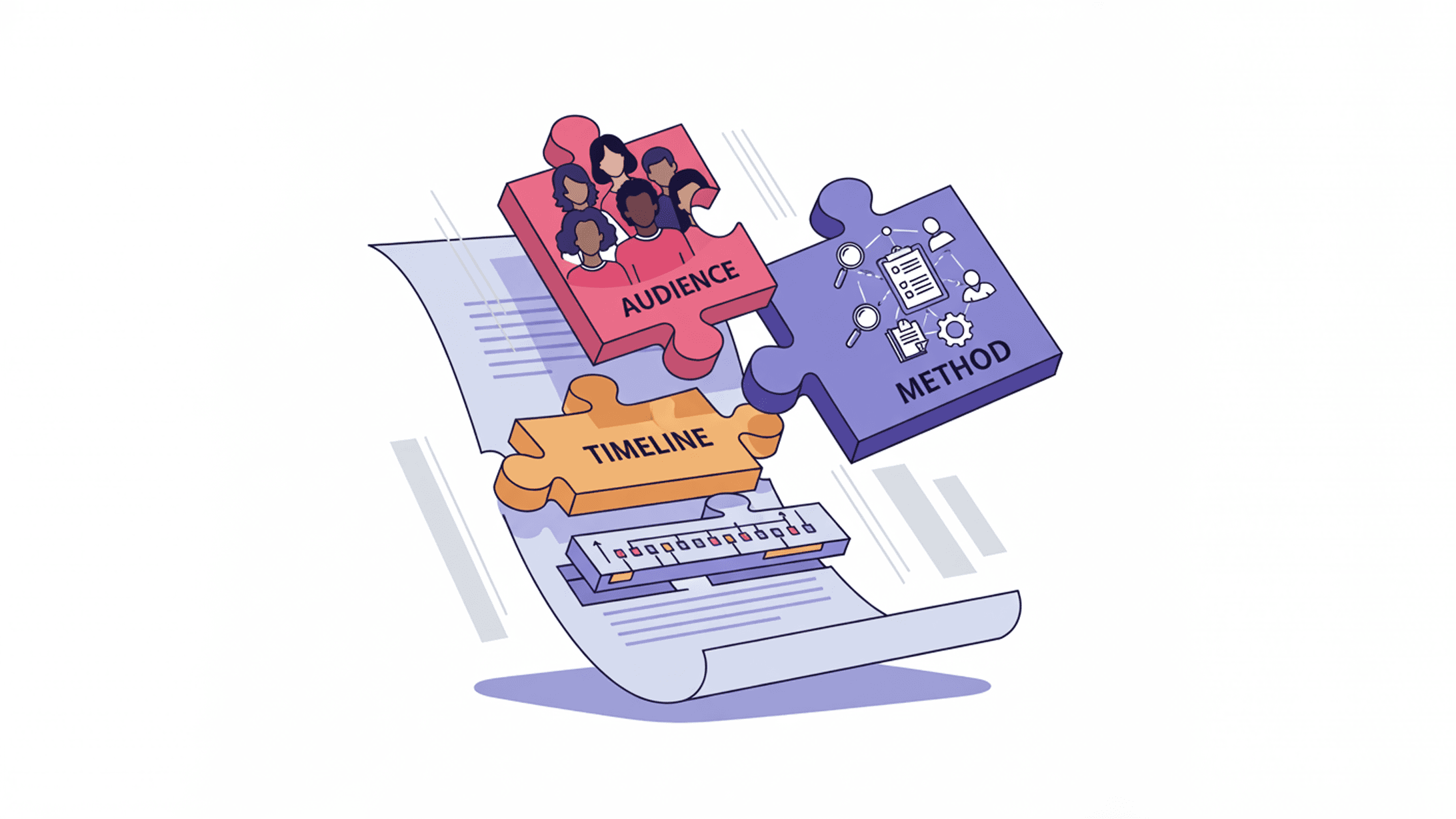
A practical guide to structuring market research that influences real decisions—instead of gathering dust.
Perspective AI's new Voice Agents platform reaches #3 Product of the Day on Product Hunt, leads multiple categories, and launches with a special 75% off Pro Plan celebration offer.
We're introducing grounded quotes, voice model selection, one-click test conversations, bulk participant invites, and quick-start analysis prompts to make research faster and more powerful than ever.

Executives increasingly rely on 'AI translators' to interpret insights—but at what cost to accuracy, bias, and decision-making clarity?

Learn how to scale UX concept testing using AI-powered interviews that uncover user expectations, mental models, and early design feedback—before you build.

A practical guide to evaluating modern qualitative research platforms for scale, speed, and synthesis in 2025.

Discover the latest trends shaping the AI consulting services industry, from generative AI to AI strategy consulting. Learn how to stay competitive in this evolving landscape.
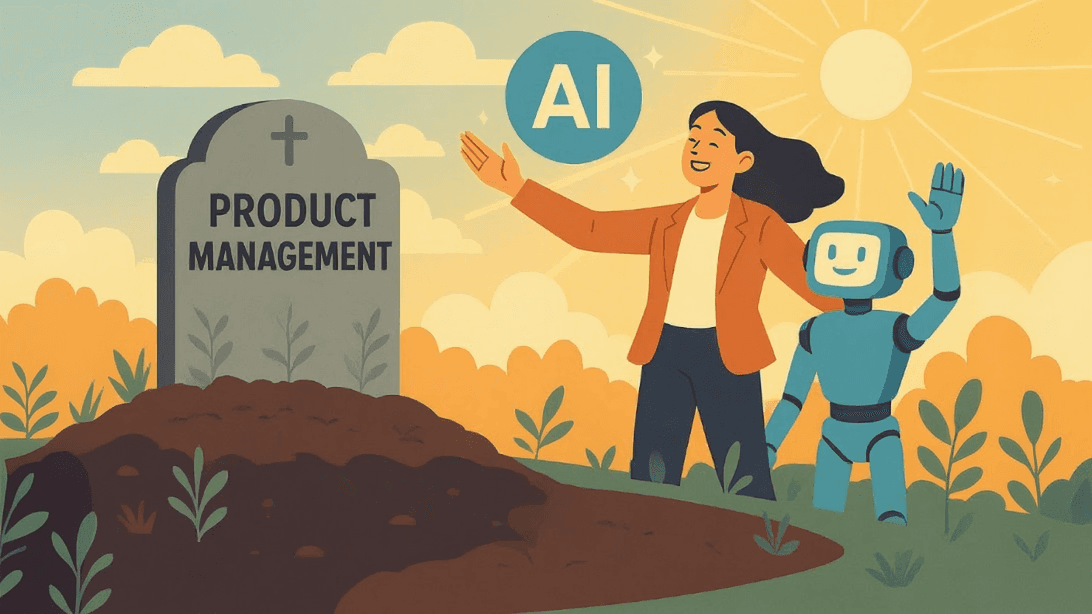
AI just buried the old PM job. What's rising in its place is smarter, faster, and 100% more human. Here's what that transformation looks like.

Discover why AI-driven automation is reducing product management teams and how surviving PMs can redefine their roles to thrive.
Today, we're rolling out a huge set of new features and improvements designed to streamline every step of your workflow, from participant authentication to advanced reporting and analysis.

Our latest research reveals a striking disconnect between how AI companies position their solutions and what actually drives buyer decisions.
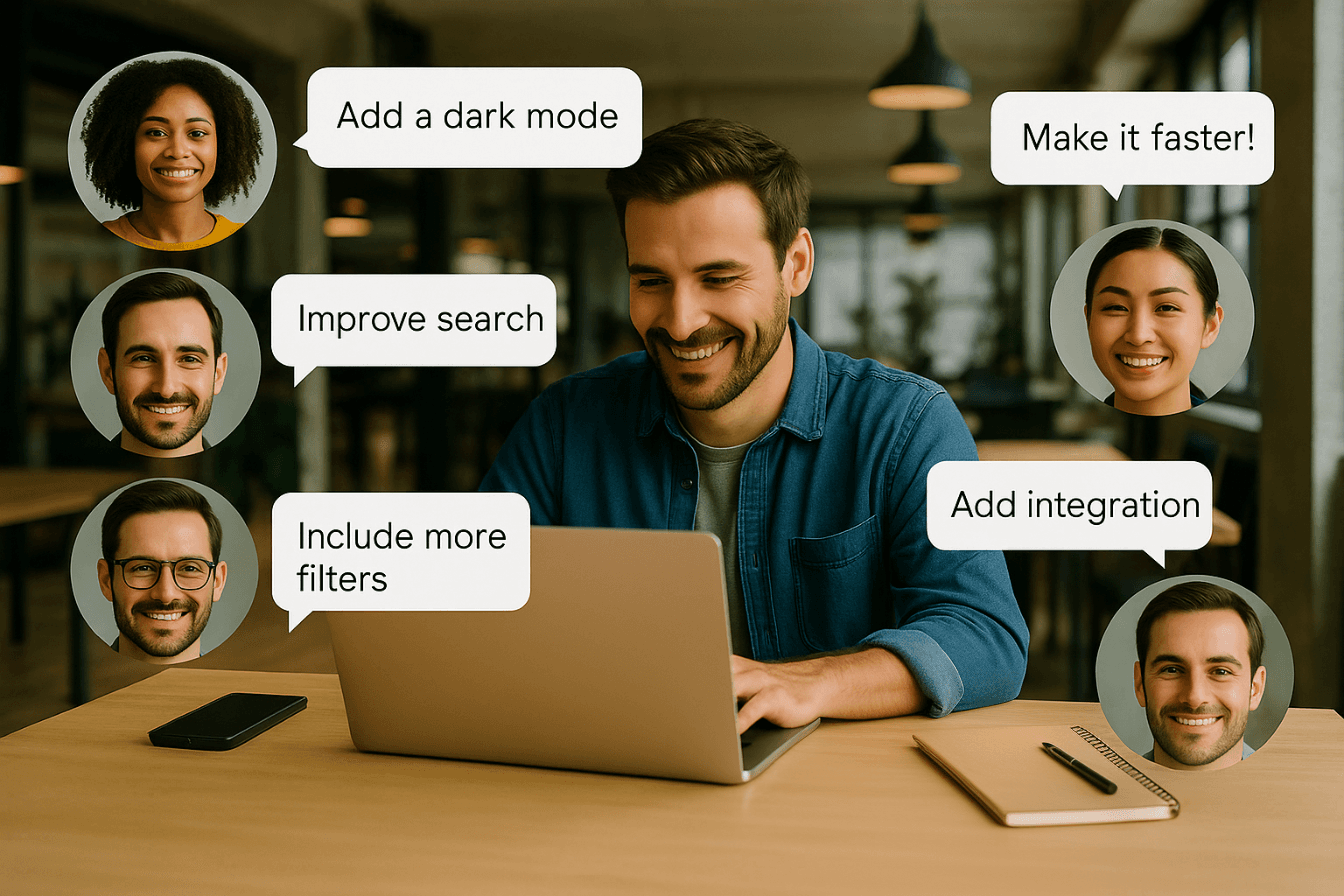
Discover how leading startup founders are moving beyond intuition to adopt systematic, data-driven approaches for customer research that drive real product success.

Perspective AI now lets you capture authentic, unfiltered customer feedback with AI-powered voice conversations—unlocking richer insights and deeper understanding.

Learn how AI-driven conversational approaches are transforming customer engagement and why forward-thinking companies are moving beyond traditional feedback methods to gain deeper customer insights.

Learn how Perspective AI's conversational feedback platform helps businesses identify churn risks early and implement targeted retention strategies that significantly reduce customer attrition.
Beyond Surveys: How Perspective AI Delivers Deeper Customer Insights Than SurveyMonkey and Qualtrics
Discover how Perspective AI's conversational approach outperforms traditional survey methods from SurveyMonkey and Qualtrics, delivering richer insights and higher engagement rates.

Most VOC programs miss the mark on capturing true customer experience. Discover the gaps—and how leading teams use richer feedback to unlock deeper customer insights and action.

Compare how Perspective AI's conversational approach outperforms traditional surveys in gathering meaningful customer insights.
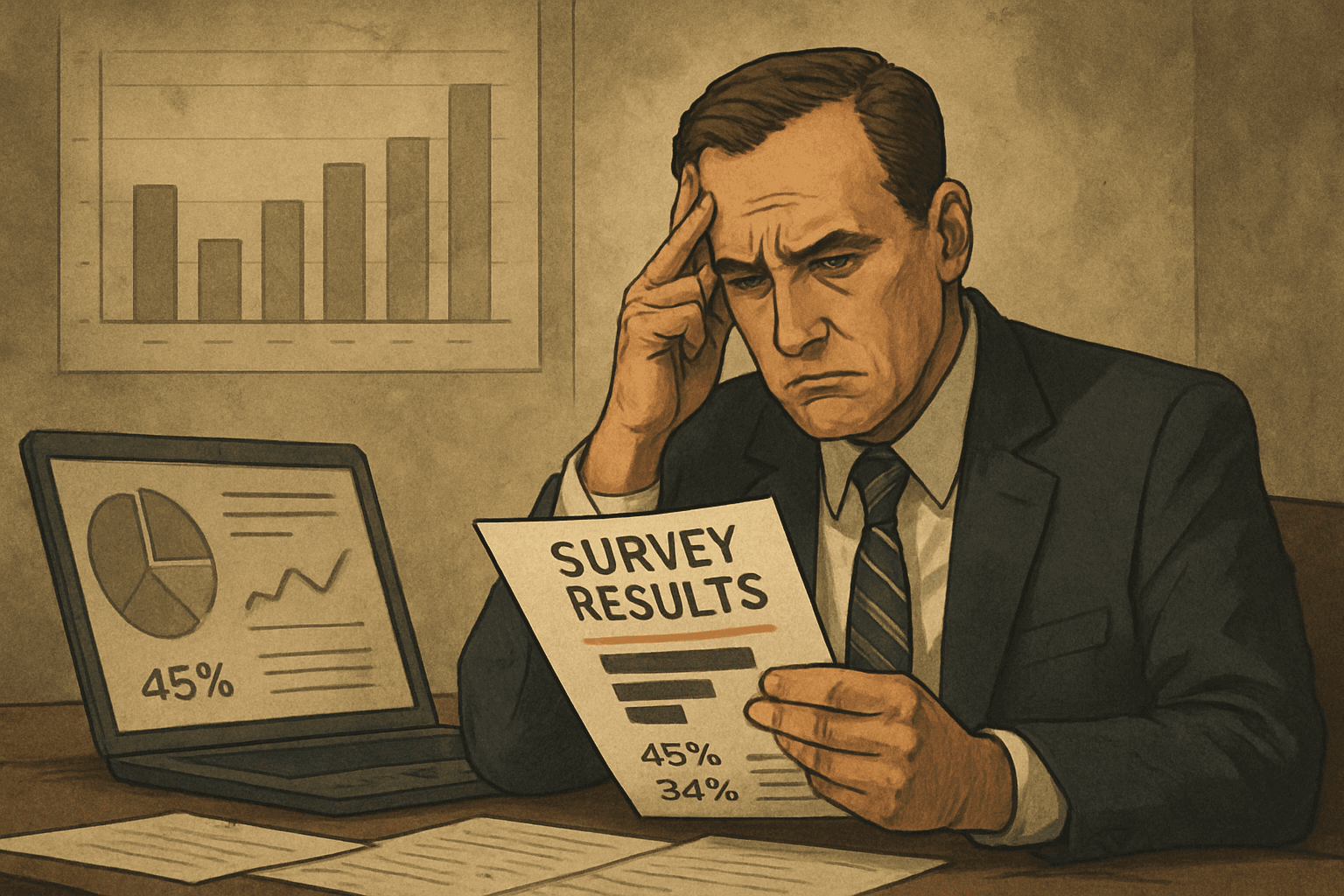
Learn why great companies move beyond generic surveys to uncover deeper customer insights—and how to avoid the lowest common denominator trap in your decision-making.

Unlock the hidden advantage behind the fastest-growing companies—unfiltered customer understanding—and learn actionable steps to transform feedback into your next phase of growth.
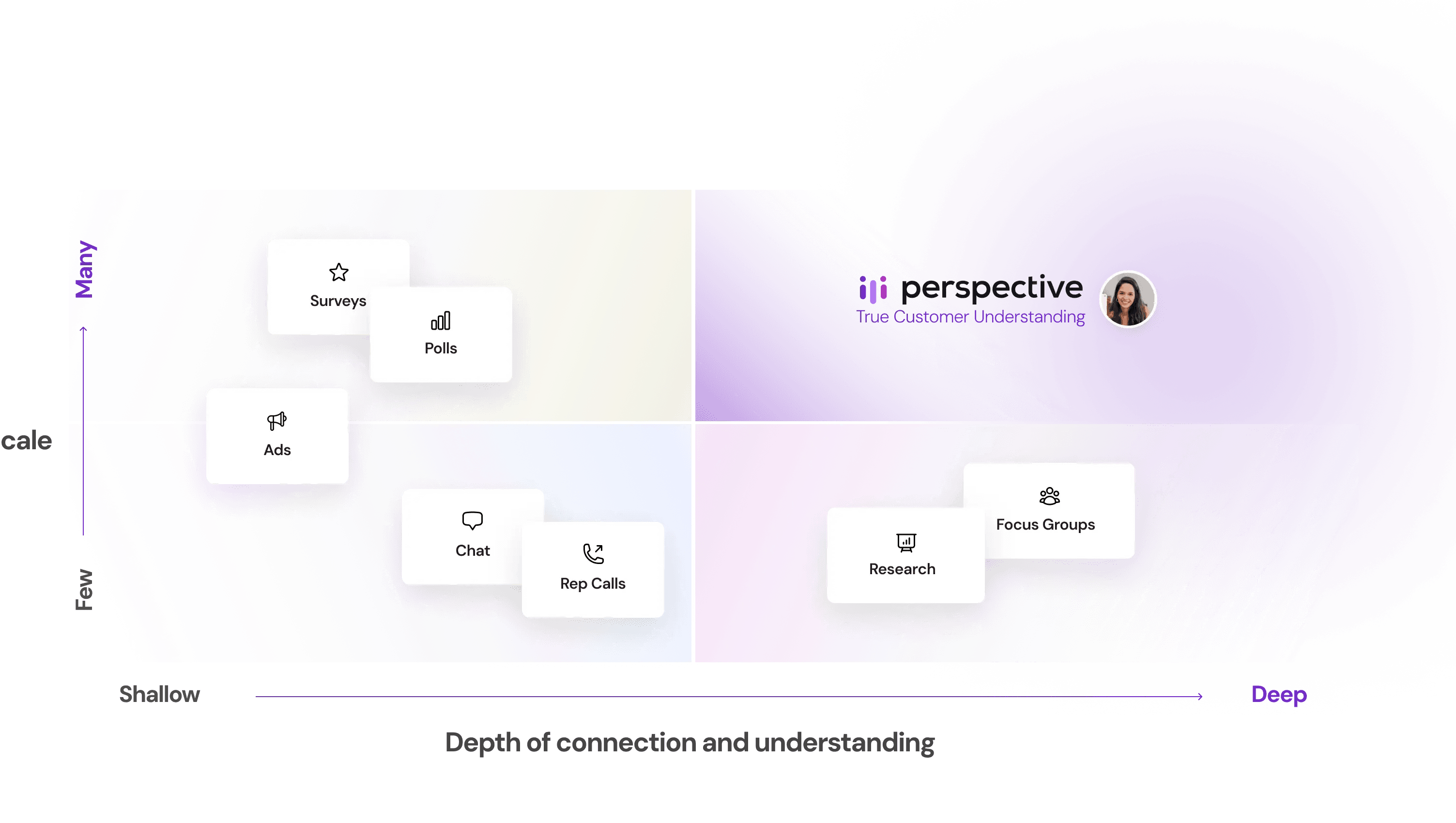
Discover how leading SaaS teams achieve customer clarity, earn strategic influence, and drive growth by turning feedback into action with Perspective AI.
Discover the latest features and improvements from Perspective AI—including new research automations, enhanced analytics, and user experience upgrades for SaaS teams.
Explore the latest Perspective AI product updates—including enhanced conversation guides and a more robust analysis toolkit to streamline customer research.

Traditional NPS surveys fail to capture the full customer experience in 2024. Learn why SaaS leaders are shifting to richer, conversational feedback to drive real growth.