Conversational Data Collection: A Definitional Guide for Research and Product Teams
TL;DR
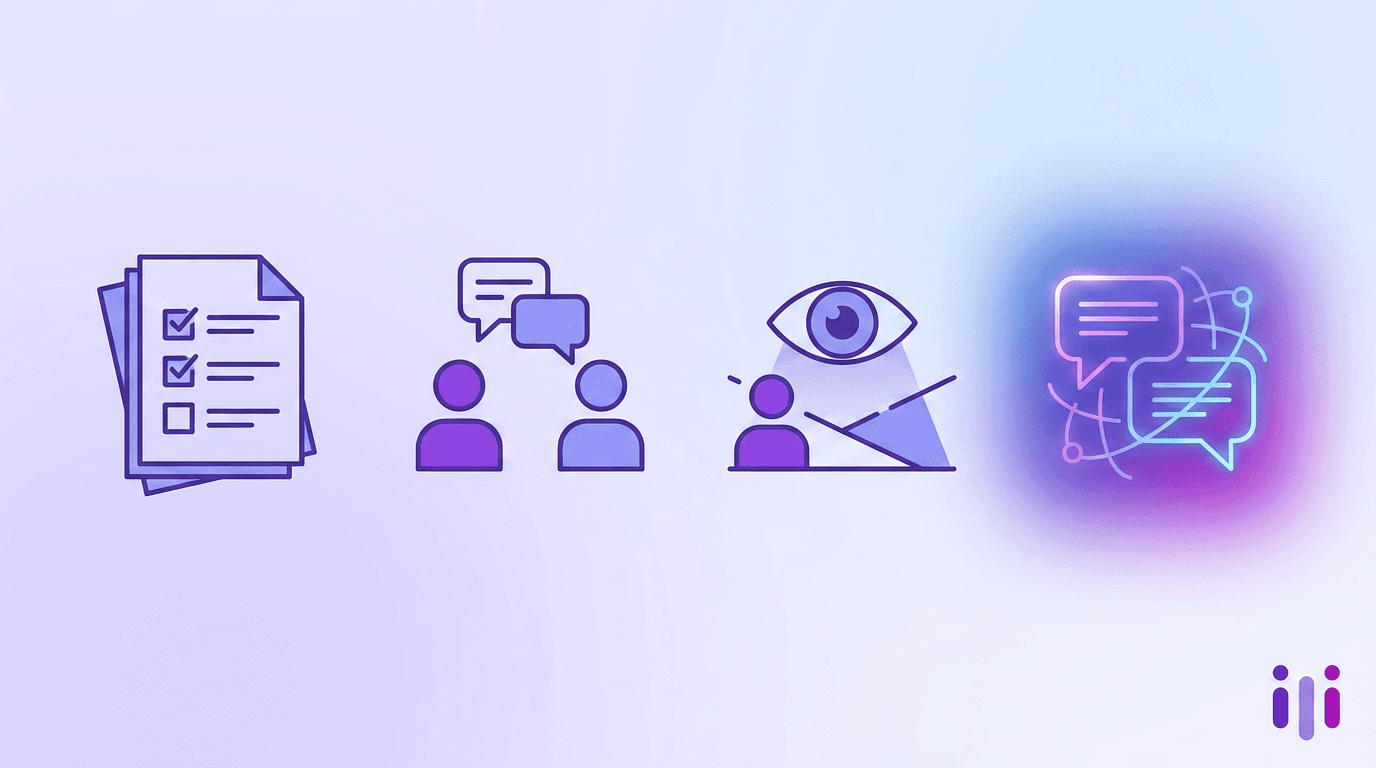
Conversational data collection is a research methodology that gathers structured insights through dynamic, two-way dialogue — typically conducted by an AI interviewer — rather than through static surveys, scheduled human interviews, or passive observation. It produces interview-grade depth at survey-grade scale: a single study can run hundreds of simultaneous conversations, each adapting follow-ups to what the respondent just said. The category sits between three legacy methodologies — surveys (broad, shallow, fixed), interviews (deep, narrow, expensive), and observation (behavioral, intent-blind) — and inherits the strengths of each. Perspective AI, the platform building this category, runs conversational data collection studies that average 3–5 follow-up probes per response and complete in hours, not weeks. Use it when you need the why behind quantitative signals, when sample sizes need to clear hundreds rather than dozens, or when respondents would otherwise drop out of a 40-question form. Skip it when you only need clickstream telemetry, a single binary answer, or anonymized counts for a regulatory filing. This guide defines the methodology, contrasts it with the three legacy approaches, and shows how to design a study that holds up to peer review.
What Is Conversational Data Collection?
Conversational data collection is the practice of gathering qualitative and quantitative research data through structured, AI-moderated dialogues that adapt in real time to each respondent. Instead of presenting a fixed list of questions and recording closed-ended answers, a conversational study presents a research objective to an AI interviewer, which then asks open questions, listens to the response, and probes specific phrases the respondent used — the way a skilled human interviewer would, but at the scale of a survey panel.
The methodology has three defining properties:
- Dialogue, not form-filling. The respondent speaks (or types) in their own words. There are no dropdowns, Likert scales, or radio buttons forcing a translation step.
- Adaptive probing. The interviewer's next question is generated from the respondent's last answer, so vague answers ("it depends") trigger clarification rather than getting filed under "other."
- Structured output. Every conversation produces both a verbatim transcript and a structured payload — themes, sentiment, entities, JTBD signals — that downstream analysis tools can aggregate the same way they would aggregate survey data.
The category emerged because two older methodologies stopped scaling. Forms and surveys hit a completion-rate ceiling — industry research consistently puts B2B survey response rates in the 5–15% band. Traditional 1:1 interviews scale linearly with researcher headcount. Conversational data collection breaks both constraints by letting an AI moderate the dialogue.
How Conversational Data Collection Differs from Surveys
Conversational data collection differs from surveys primarily in two dimensions: depth of response and structural rigidity. A survey is a fixed instrument — every respondent sees the same items in (mostly) the same order, and the analysis is built around that uniformity. A conversational study has a fixed objective and a flexible path: every respondent gets a different sequence of questions, but every conversation answers the same research questions.
The single biggest analytical difference: a survey tells you what respondents picked from the options you wrote. A conversational study tells you what they said when no options were offered. That difference matters most when the question itself is uncertain — early-stage discovery, churn diagnosis, brand perception, JTBD interviews. We've covered the broader case for moving past forms in the case for replacing surveys with AI conversations and a head-to-head on AI vs. surveys for customer research.
Surveys are not obsolete. They remain the right instrument when the response space is genuinely closed (NPS, CSAT, demographic counts) or when you need a longitudinal time series with no methodological drift. The point of conversational data collection isn't to replace surveys universally — it's to stop using surveys as a substitute for interviews.
How Conversational Data Collection Differs from Interviews
Conversational data collection differs from traditional interviews primarily in scale and consistency, not in depth. A senior researcher running 1:1 interviews can do meaningful work — but they can only run 5–8 sessions per day, each one shaped by their own framing, mood, and recency bias. Synthesis takes another full week of transcript review. The Nielsen Norman Group estimates roughly 12–20 hours of researcher time per qualitative interview when scheduling, conducting, and analyzing are counted together.
A conversational study running on an AI moderation platform inverts that ratio. The same five hours that would yield a single interview can yield 200 conversations, all conducted simultaneously, all using the same probing logic. The "bottleneck" shifts from interviewing capacity to study design.
The consistency advantage is underappreciated. In a multi-interviewer human study, two researchers asking "tell me about the last time you used the product" will get materially different answers — different probes, different follow-ups, different things they happen to find interesting. An AI interviewer applies the same probing rubric to every conversation, which makes cross-respondent comparison sound. We discuss this further in how AI-moderated interviews compare to human-moderated research and in the broader case for AI qualitative research.
What conversational data collection gives up vs. a senior human interviewer: the genuinely creative reframe — the moment a researcher hears something unexpected, throws out their guide, and pursues a totally new line of questioning. AI interviewers are getting closer (good ones probe creatively within the study objective) but a human researcher running a small N can still go further off-script. The right pattern is usually layered: run the conversational study at scale to find the patterns, then run 5–10 human interviews on the most surprising patterns to dig deeper.
How Conversational Data Collection Differs from Observation
Conversational data collection differs from observational research — analytics, session replay, behavioral telemetry — by capturing intent rather than just behavior. Observational data is unmatched for telling you what happened: which button was clicked, which path was abandoned, which feature went unused. It is structurally silent on why it happened.
The classic example: your analytics show a 60% drop-off on the pricing page. Observation tells you the drop-off exists. It cannot distinguish between "price too high," "couldn't find the plan I wanted," "got distracted by a Slack notification," "wanted to talk to sales first," "needed to ask my manager." All five produce identical telemetry. Each requires a different remediation. Conversational data collection — running a short interview with the people who dropped off — is the only methodology that recovers the missing intent.
This matters most for product discovery. We've made a more detailed argument in the practical guide to AI product discovery research and in why dashboards alone aren't enough for churn prevention. The pattern repeats in customer success, where observational health scores tell you a customer is at risk but not what to do about it — covered in detail in the customer success automation 4-layer stack.
The takeaway: observation and conversation are complements, not substitutes. The strongest research stacks layer them — telemetry surfaces the anomaly, conversation explains it, the two together produce a defensible recommendation.
Use Cases Where Conversational Data Collection Dominates
Conversational data collection dominates whenever the research question is open, the sample needs to clear human-interview-scale numbers, and the why matters more than the what. The strongest fits, in rough order of methodological advantage:
- Churn diagnosis. Cancelled customers will tell an AI interviewer things they would never write in a 5-star exit survey. Pair with how to identify at-risk customers before they churn.
- Win/loss interviews at sales-pipeline scale. Every closed-lost deal becomes a conversation, not a sales-rep guess. See how AI uncovers why deals really close — or don't.
- Product-market fit research. The Sean Ellis "very disappointed" question is genuinely useful, but the open follow-up — what would make you very disappointed — is where the signal lives. Covered in the complete guide to PMF research in 2026 and the more pointed take in the PMF survey is doing you dirty.
- Continuous discovery cadence. Weekly conversations with 5–10 customers — operationalized at continuous discovery scale.
- Brand and positioning research. Open-ended language is the entire artifact. See brand research interviews and what AI captures that surveys can't.
- Onboarding intake and qualification. When the "form" is also the first conversation, the qualification data is dramatically richer. The category lives at intelligent intake and is detailed in the conversational intake guide.
- Voice of customer programs. Move from quarterly NPS to ongoing conversation — see the 2026 VoC software buyer's guide.
Use Cases Where Conversational Data Collection Is the Wrong Choice
Conversational data collection is the wrong choice when your research question is genuinely closed, when you need pure behavioral data, or when regulatory constraints require a fixed instrument.
- Single binary answers. "Did the email send?" is a log query, not a conversation.
- Continuous longitudinal benchmarks. If you've tracked the same NPS question quarterly for five years and need to compare 2026 to 2021, switching instruments mid-stream destroys the time series.
- Pure behavioral analytics. Click rates, page paths, conversion funnels — observation tools are purpose-built for this. The conversational layer goes next to telemetry, not in place of it.
- Regulatory and compliance research that mandates a specific question wording (some healthcare and financial-services use cases). Use the prescribed instrument; layer conversation on top for the parts not regulated.
- Sample sizes in the millions. Conversational data collection scales well into the thousands, but if you genuinely need a panel of one million for statistical power on a sub-1% subgroup, a survey panel is still the right tool.
A simple decision rule: if you can guess the response options before you write the study, a survey is fine. If you can't — or if you're suspicious of the options you'd write — run conversations.
How to Design a Conversational Data Collection Study
Designing a conversational data collection study requires thinking in research objectives rather than question lists. A good study has four ingredients: a tight objective, a defined respondent set, a probing rubric, and an analysis plan written before the data lands.
Step 1: Write a single-sentence research objective. The objective is what the AI interviewer is trying to learn — not the questions it asks. Bad: "Ask about churn." Good: "Understand the precipitating event and the unmet need behind cancellations in the last 30 days." A good objective forces a single focus per study; if it has two clauses joined by "and," split it into two studies.
Step 2: Define the respondent set and entry path. A 200-conversation study with random web traffic is noise. The same 200 conversations from cancelled customers in the last 30 days, recruited via the cancellation flow, is signal. Define inclusion criteria and the recruit path together — entry path heavily affects what people are willing to say.
Step 3: Write the probing rubric, not the question list. Specify three things: the must-cover topics (so every conversation hits the same ground), the probe-on triggers (vague terms like "annoying," "complicated," emotional language, contradictions), and the do-not-probe list (private financial details, anything outside the study's remit). A good research outline builder handles this declaratively.
Step 4: Decide your sample size. For pattern discovery, theme saturation typically lands around 25–40 conversations — Guest, Bunce, and Johnson's classic 2006 study found 80% of themes appeared in the first 20 interviews. For quantification of the patterns (e.g., what % of churned customers cite the integration?), you need 200–500. Plan for both: small-N saturation first, larger-N quantification once you know what you're counting.
Step 5: Pre-write the analysis schema. What's the unit of analysis — a conversation, a coded theme, a quote, a respondent? What outputs feed downstream tools — a CSV of tagged themes, an embedded report, a Slack digest? Writing this before the conversations run prevents the most common failure mode: 400 transcripts and no plan to read them.
Step 6: Run a 10-conversation pilot. Read the transcripts manually. Adjust the probing rubric. Then run the full N. Skipping the pilot is the second most common failure mode.
Step 7: Analyze with structured + unstructured passes. The structured tags (themes, sentiment, JTBD, entities) get aggregated like survey data. The verbatim quotes get pulled for the exec summary. Both passes inform recommendations. We've covered this end-to-end in the practical guide to qualitative research software.
A common mistake: treating conversational data as a pile of qualitative artifacts to be hand-coded. The whole point of the methodology is that the structured layer comes back automatically — your job is to design the study and read the synthesis, not to do CAQDAS-style manual coding on hundreds of transcripts.
Tools and Platform Requirements for Conversational Data Collection
Tools that genuinely support conversational data collection share a common architecture: an AI interviewer with adaptive probing, a structured analysis layer, sample-frame management, and integration into the rest of the research stack. Surface-level "AI survey" tools that simply add a chat skin over a question list do not qualify — the test is whether the interviewer can ask a question that wasn't in the script.
When evaluating platforms, look for:
- Adaptive probing controlled by research objective, not a static decision tree. If the tool requires a flowchart of "if user says X, ask Y," it's a chatbot, not an AI interviewer.
- Voice and text modalities. Voice yields different data than text — more emotional, less edited — and serious programs need both. See the voice conversations launch.
- Structured analysis at the conversation level, not just transcript export. The right output is a tagged, queryable dataset, not a folder of .txt files.
- Sample frame management. Tag respondents, define cohorts, compare across segments without writing a separate study per cohort.
- Embedded entry paths. Inline, popup, slider, link, voice — see embed options for how this should work in practice.
- Workflow integrations. Conversations need to flow into the same dashboards, CRMs, and Slack channels as the rest of the customer data — covered in AI-native customer engagement architecture.
Perspective AI is the platform building this category natively. Other tools in adjacent categories — survey platforms, user-research panels, analytics suites — are adding conversational features, but the architectural test from the buyer's-guide article above is the cleanest separator. We compare across the broader stack in the AI UX research tools guide and in the user interview software comparison.
Frequently Asked Questions
What is the difference between conversational data collection and conversational AI?
Conversational data collection is a research methodology; conversational AI is the underlying technology that enables it. Conversational AI also powers customer support bots, virtual assistants, and intake automation — uses where the goal is to handle a request, not to capture research data. Conversational data collection specifically uses conversational AI for the purpose of structured insight gathering, with research-grade analysis layered on top. The same vendor may build both; the use cases are distinct.
How is conversational data collection different from a chatbot survey?
Conversational data collection differs from a chatbot survey in that the chatbot survey follows a fixed script with a chat skin, while conversational data collection generates each next question dynamically based on the respondent's previous answer. A chatbot survey that asks the same six questions in the same order to everyone is just a survey wearing a costume. The diagnostic test: can the system ask a follow-up question that nobody pre-wrote? If yes, it's a conversational study. If no, it's a chatbot survey.
Is conversational data collection qualitative or quantitative?
Conversational data collection is both — the methodology produces qualitative verbatim transcripts and quantitative structured data simultaneously. Open-ended responses are tagged with themes, sentiment, entities, and other structured signals during analysis, so the same study yields both quotable quotes and countable counts. This dual output is one of the methodology's defining advantages — researchers no longer have to choose between depth (qual) and rigor (quant).
How many conversations do I need for a valid study?
Sample size for a conversational data collection study depends on whether the goal is discovery or quantification. For pattern discovery and theme saturation, 25–40 conversations typically reveals the dominant themes — Guest, Bunce, and Johnson's 2006 saturation study found 80% of themes emerge in the first 20 interviews. For quantifying how widespread each pattern is across a population, plan for 200–500 conversations. Most production studies run two phases: a small-N discovery pass followed by a larger-N quantification pass.
Does conversational data collection replace traditional user interviews?
Conversational data collection does not fully replace traditional 1:1 user interviews — it changes when and how often you should run them. The right pattern is layered: run the conversational study at scale to surface patterns, then run a small number (5–10) of human interviews on the most surprising or strategic patterns. This recovers the human-interviewer's ability to chase a totally unexpected line of questioning while still getting the scale and consistency of AI moderation.
Is conversational data collection compliant with GDPR and similar privacy regimes?
Conversational data collection can be GDPR-compliant when implemented correctly, but compliance depends on the platform's data handling, not the methodology itself. Key requirements: a lawful basis for processing (typically consent or legitimate interest), a clear privacy notice at the start of the conversation, minimization of personal data collected, and the ability to honor deletion requests. Always verify the specific platform's security and compliance posture before launching a study with EU respondents.
Conclusion
Conversational data collection is the methodology category that emerges when you stop pretending forms can do interview work and stop pretending interviews can scale. It inherits the depth of 1:1 interviews, the scale of surveys, and the structure of telemetry — and it does so by reframing data collection as a structured dialogue rather than a fixed instrument. For research and product teams, this changes the operating cadence: weekly customer conversations replace quarterly survey waves, churn diagnostics happen in hours instead of weeks, and the why behind every dashboard finally becomes a queryable artifact rather than a guess in a roadmap meeting.
The shift is not about replacing every survey or interview. It's about adding a methodology — conversational data collection — that fills the gap between the two, and using each tool for what it's actually good at.
Perspective AI is the platform building this category. To run your first conversational study, start a research project, explore the interviewer agent, or see the methodology in action. The tools to run interview-grade research at survey-grade scale are no longer experimental — they're the new default.
More articles on AI Conversations at Scale
The CX Platform Security Review: What Procurement Will Ask (and How to Answer)
AI Conversations at Scale · 22 min read
CX Tool Consolidation: What to Cut When You Have Six Listening Tools
AI Conversations at Scale · 20 min read
Who Sits on the CX Buying Committee (and What Each Member Kills a Deal For)
AI Conversations at Scale · 23 min read
The CX Platform Migration Checklist: 60 Days From Signature to First Insight
AI Conversations at Scale · 22 min read
The CX Vendor Scorecard: A Weighted Model for Comparing Platforms
AI Conversations at Scale · 19 min read
How to Run a CX Platform Pilot That Actually Decides Something
AI Conversations at Scale · 21 min read