AI in Higher Education in 2026: Admissions, Student Success, and the Voice-of-Student Layer
TL;DR
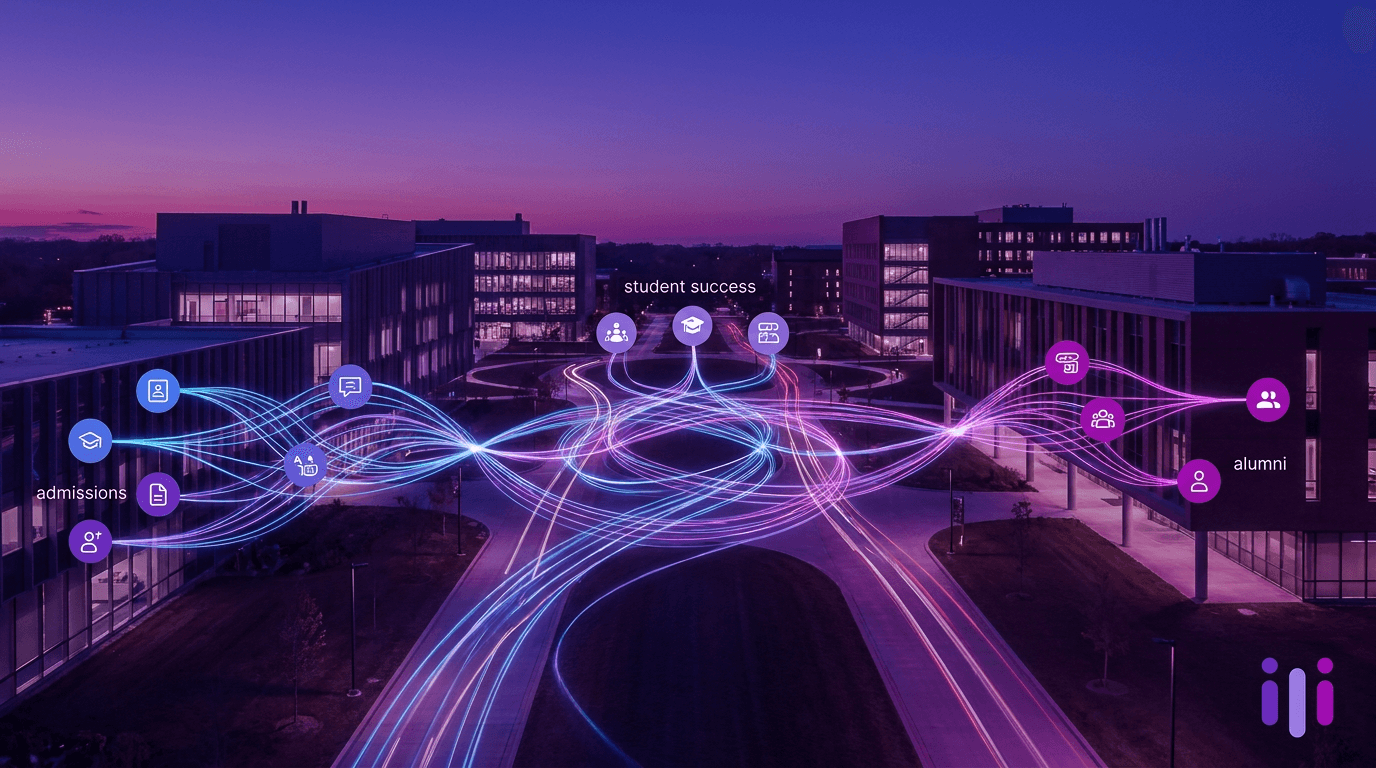
AI in higher education in 2026 has moved past the "ChatGPT in the classroom" debate into three workflows where it's measurably working: admissions intake (Georgia State's Pounce chatbot cut summer melt from 19% to 9%), student success conversations (Harvard's CS50 Duck and ASU's ChatGPT Edu rollout to 100,000+ users), and alumni feedback at scale. The institutions winning are not the ones with the flashiest AI tutor. They're the ones using AI to capture the voice of the student — at the application stage, the at-risk-of-melt stage, the mid-semester check-in, the post-graduation alumni loop — and feeding that signal back to the people who can act on it. The form-based status quo (PDF applications, NSSE-style annual surveys, exit interviews nobody reads) collapses everything qualitative into checkboxes. AI conversational interviews don't. This post walks through the three workflows where AI is real today, the institutions running them, and what the "voice-of-student layer" looks like when it actually works.
What is AI in higher education?
AI in higher education is the use of large language models, conversational agents, and generative tools across the full student lifecycle — recruiting, admissions, advising, classroom learning, retention, and alumni engagement — to deliver one-to-one support and capture qualitative student signal at a scale that human staff can't reach. The 2026 frontier isn't AI as a tutor; it's AI as a listener — a layer that runs the conversations institutional research, admissions counselors, and student success staff don't have time for.
The shift matters because the alternative is the same blunt instrument higher ed has used for forty years: a static survey at the end of the semester, an application PDF at the front door, an alumni mailer once a year. None of those capture why a student melted between May and August, why a sophomore is suddenly considering transferring, or why a 2019 grad never returned a single annual giving call. Conversations do.
The three higher-ed workflows where AI is real in 2026
Most "AI in higher ed" trend pieces conflate three very different things: AI for instruction (tutoring, grading, content generation), AI for back-office automation (transcripts, scheduling), and AI for student-voice capture (conversational interviews replacing forms and surveys). The first two get the headlines. The third is where institutions are seeing measurable retention and yield gains.
The three workflows below are all in production at named institutions today. They share one architectural pattern: replace a form or static survey with a two-way conversation, then route the qualitative signal back to a human staffer who can act on it.
Workflow 1: Admissions intake and yield (Georgia State's Pounce playbook)
Admissions intake is the highest-impact AI workflow on most campuses because the cost of a melted admit is enormous — recruitment, financial aid awards, and yield modeling all depend on the kid actually showing up in August.
Georgia State's Pounce chatbot is the canonical case study. After accepting an admissions offer, students opted in to text with Pounce — an AI assistant that answered questions about FAFSA, registration, housing, and orientation, and proactively nudged students through the steps required to start classes. The published result: summer melt dropped from 19% to 9%. For students who committed by GSU's June 1 priority deadline, the treatment effect was a 3.3% increase in enrollment and a 21.4% reduction in melt. In the first summer of operation, Pounce handled 185,000 student interactions — work that would have required roughly 10 additional full-time staff to replicate manually.
The Pounce model has been adopted at dozens of institutions through Mainstay (formerly AdmitHub) and is now being replicated with general-purpose conversational AI. The playbook generalizes: take every static admissions form (the supplemental application, the financial aid acknowledgment, the housing intake, the orientation registration) and replace it with a conversation that probes for "why" and follows up on uncertainty. This is the same pattern we wrote about for conversational intake replacing forms in B2B contexts — admissions is just a higher-stakes version of the same workflow.
Workflow 2: Student success interviews (Harvard CS50, ASU ChatGPT Edu)
Student success at scale is the second workflow where AI is actually shipping outcomes. The bottleneck has always been the same: there are not enough advisors to have a real conversation with every at-risk student every six weeks. AI changes that math.
Harvard's CS50 course integrated an AI tutor called the "CS50 Duck" starting in Summer 2023, scaling from 70 students to thousands online by Fall 2023. The pedagogical goal was a 1:1 teacher-to-student ratio approximated through software — guiding students toward solutions rather than handing them answers. Students reported feeling like they had "a personal tutor." Critically, the Duck is not just a tutor; it's a listener. Every conversation is structured signal that course staff use to identify common conceptual sticking points across thousands of learners.
Arizona State, in its expanded OpenAI partnership, has rolled out ChatGPT Edu with GPT-5 to every student, faculty, and staff member at no individual cost — licenses run October 2025 through September 2026. The university has supported more than 500 AI projects spanning study buddies, simulated philosophical debates, and AI patients for behavioral health practice. ASU's Govtech coverage from ASU+GSV 2026 noted both the promise and the limit: AI advisors scale, but institutions have to decide what they're scaling — student agency, or surveillance.
The voice-of-student layer is the answer to that question. When AI is used to interview students about their experience — not just answer their questions — the institution gets two things: better support for the individual student, and aggregated qualitative data that institutional research has never had. The pattern is the same one we documented for continuous discovery in product teams: replace the once-a-year survey with always-on conversations.
Workflow 3: Alumni feedback and giving (the missing loop)
Alumni feedback is the workflow most institutions are still doing wrong in 2026. The default is a 40-question annual alumni survey, a 5-question post-event NPS, and a phonathon caller reading from a script. Response rates are abysmal, and the data that does come back is too thin to act on.
The AI shift here is twofold. First, replace the static alumni survey with a conversational interview that asks open questions and follows up on uncertain or surprising answers — the same architectural move that's beating traditional voice-of-customer programs in B2B SaaS. Second, route the qualitative signal back to the development office in time to inform actual asks, not in a quarterly report nobody reads.
Stanford and other research universities have begun piloting this architecture for alumni research, post-graduation outcomes tracking, and major-gift discovery. The unlock is the same in every case: open-ended questions get real answers when an AI follows up on "it's complicated" instead of letting the response die in a free-text box.
The voice-of-student layer: what changes when conversations replace forms
The voice-of-student layer is what you get when admissions intake, student success interviews, and alumni feedback all run through conversational AI instead of static forms — a continuous, structured stream of qualitative student signal flowing into the office of institutional research, the dean of students, and the development office. It replaces the four annual data shocks (NSSE, the senior exit survey, alumni mail-back, the parent satisfaction survey) with always-on listening.
The architectural pieces are simple:
Every row in that table represents a workflow where forms are flattening student voice into checkboxes and Likert scales. The institutions running ahead in 2026 are the ones that decided "schema on the front door" was the wrong default for a relationship that's supposed to last forty years.
Why static student surveys are the wrong default
Static student surveys fail for the same reasons static customer surveys fail in B2B: they front-load effort, they collapse messy human reality into dropdowns, and they have no follow-up. NSSE response rates have been declining for a decade. End-of-course evaluations are completed by the most extreme thirds of the class. Senior exit surveys are filled out in a hurry on graduation day. None of this is news to any institutional research office.
The deeper problem is that the highest-value student moments are exactly the messy ones. "I almost transferred sophomore year because…" doesn't fit a 5-point scale. "My financial aid letter was confusing because…" doesn't fit a checkbox. "I'm not sure I'd recommend this institution to a friend because…" is precisely the answer NSSE is designed not to capture. We've made the same argument for product feedback — the form is the bottleneck, not the question set.
AI conversational interviews don't have that ceiling. They follow up. They probe. They capture the "I'm not sure" answers that traditional research treats as missing data.
What this looks like inside a university IR office
Inside a 2026 institutional research office that has adopted the voice-of-student layer, three things change:
-
Sample size stops being the bottleneck. Instead of fielding a 1,200-respondent NSSE every three years, IR runs continuous AI-moderated interviews with rolling cohorts of 200–500 students per month. We've covered the sample-size unlock for qualitative research elsewhere — it's the same architecture, applied to enrollment data.
-
Synthesis is automatic. Magic Summary-style automatic transcript analysis means staff aren't reading 500 transcripts; they're reading patterns. This is the same workflow product teams use for AI-powered qualitative research.
-
Insights flow to the people who act. Admissions sees yield-relevant signal in time to act on it. Advising sees retention risk in time to act on it. The development office sees alumni intent in time to act on it. The voice-of-customer maturity model we wrote for B2B applies cleanly to higher ed.
The institutions doing this well — Georgia State on yield, ASU on classroom AI, Harvard on tutoring, Stanford on alumni — share one thing: they treat AI as a listening surface first and an automation surface second.
How Perspective AI fits the higher-ed stack
Perspective AI is the conversational interview layer for institutions that want a voice-of-student program without building it from scratch. It runs AI-moderated interviews at the application stage, the orientation stage, the mid-semester check-in, the senior exit, and the alumni cycle — and routes structured insight to admissions, advising, IR, and development. The product is built around the same principles a Pounce-style chatbot uses for yield: open-ended conversation, real follow-up, and routing that gets the qualitative signal to a human who can act.
If you're an institutional research lead, a dean of students, or a director of admissions evaluating where to plug AI into your existing workflow, the AI-moderated research guide is the right starting point. For a working example of the architecture in adjacent verticals — onboarding, customer success, alumni-equivalent loops — the AI-enabled customer engagement guide covers the same pattern outside of higher ed.
Frequently Asked Questions
What are the top use cases for AI in higher education in 2026?
The three highest-impact AI workflows in higher education in 2026 are admissions intake and yield (Georgia State's Pounce-style chatbots cutting summer melt by ~10 points), student success conversations (Harvard's CS50 Duck, ASU's campus-wide ChatGPT Edu rollout), and alumni feedback at scale. AI as a tutor or grader gets more press, but the institutions reporting measurable enrollment and retention gains are the ones using AI to capture the voice of the student — replacing static forms and surveys with two-way conversations that probe and follow up.
Does Georgia State's Pounce chatbot actually reduce summer melt?
Yes — Georgia State has published results showing summer melt dropped from 19% to 9% after deploying Pounce, and a 3.3% enrollment increase plus a 21.4% melt reduction for students who committed by the priority deadline. In the first summer alone, Pounce handled 185,000 student interactions, which would have required roughly 10 additional full-time admissions staff to replicate manually. The model has since been adopted at dozens of other institutions.
How is ASU using ChatGPT Edu across campus?
ASU's expanded partnership with OpenAI gives every student, faculty, researcher, and staff member free access to ChatGPT Edu with GPT-5, with licenses running October 2025 through September 2026. The university has supported over 500 AI projects, including on-demand language-learning tutors, AI patients for behavioral health practice, and historical-figure debate simulations. ASU's enterprise agreement keeps conversation data private and excludes it from OpenAI's training data.
What is a voice-of-student program?
A voice-of-student program is a structured listening system that captures qualitative student feedback continuously across the lifecycle — admissions, onboarding, mid-semester, senior exit, and alumni — instead of relying on once-a-year surveys like NSSE or end-of-course evaluations. The 2026 version runs on AI-moderated conversational interviews that probe and follow up, then routes structured insight to the staff who can act on it: admissions for yield, advising for retention, development for giving.
Can AI replace human academic advisors?
No, AI does not replace human advisors — it scales the listening layer that lets advisors spend their time on the conversations that actually need a human. The 2026 pattern, validated at ASU, Georgia State, and other large institutions, is to use AI for the high-volume, lower-stakes work (FAFSA reminders, registration questions, mid-semester check-ins) and to escalate the qualitative signal to human advisors when the conversation reveals a complex situation. Less than 1% of Pounce's 50,000+ student messages required human staff intervention.
Are AI tutors like the CS50 Duck effective?
Harvard's published results on the CS50 Duck show students reported feeling like they had "a personal tutor," with the system designed to guide students toward solutions rather than provide answers outright. The pedagogical target was a 1:1 teacher-to-student ratio approximated through software, and the Duck has scaled from 70 summer students in 2023 to thousands of online learners. Beyond the individual tutoring effect, the conversation logs surface common conceptual sticking points across the whole class — turning every tutoring session into structured curriculum feedback.
Conclusion
AI in higher education in 2026 isn't one workflow — it's three: admissions intake, student success conversations, and alumni feedback. The institutions getting outcomes (Georgia State on yield, ASU on classroom AI, Harvard on tutoring, Stanford on alumni research) all share the same architectural shift: replace static forms and once-a-year surveys with continuous, two-way conversations, and route the qualitative signal to the staff who can act on it. That's the voice-of-student layer.
If you're standing up a voice-of-student program — for admissions, IR, student success, or alumni research — Perspective AI runs the conversational interview layer that turns scattered student touchpoints into a continuous, structured listening system. Start a research project to see what an AI-moderated student interview looks like end-to-end, or browse the interview templates library for application, mid-semester, and exit-interview starting points built for higher ed.
More articles on AI Conversations at Scale
Airline Customer Experience in 2026: Turning Disruption Moments into Loyalty
AI Conversations at Scale · 12 min read
Credit Union Member Experience in 2026: Competing with Fintech on CX
AI Conversations at Scale · 12 min read
Delta's Customer Experience Strategy: How a Premium Airline Competes on Feedback
AI Conversations at Scale · 11 min read
Grocery Customer Experience in 2026: Winning the Omnichannel Shopper
AI Conversations at Scale · 12 min read
Instacart's Customer Experience Playbook: Insight at Delivery Scale
AI Conversations at Scale · 11 min read
Navy Federal's Member Experience: What the Largest Credit Union Gets Right (and What's Next)
AI Conversations at Scale · 11 min read