Jobs-to-Be-Done Interviews: The AI-First Approach to Running JTBD Research at Scale
TL;DR
Jobs-to-be-Done (JTBD) interviews are the canonical method for uncovering why customers "hire" a product, built on Bob Moesta's forces-of-progress framework and the switch-interview structure from Clayton Christensen's Competing Against Luck. For 20 years, JTBD research has capped at roughly N=15 per study because each switch interview takes 60–90 minutes plus 4–6 hours of synthesis — a labor ceiling that forced teams to trade depth for statistical signal. AI-moderated interviewing breaks that ceiling: a single AI interviewer runs 200+ JTBD switch interviews in parallel, follows the same forces probe tree (Push, Pull, Anxiety, Habit), and surfaces patterns small samples miss. This guide walks the canonical interview structure, explains the N=15 ceiling, and shows how to design an AI-moderated JTBD study scaling to N=200+ without losing depth. The synthesis output stays the same — a forces map per segment — but the input expands an order of magnitude.
What a Jobs-to-Be-Done Interview Is
Jobs-to-be-Done interviews are structured conversations that reconstruct the moment a customer switched from an old solution to a new one, surfacing the four forces — Push, Pull, Anxiety, and Habit — that shaped the decision. The method was developed by Bob Moesta and Chris Spiek at the Re-Wired Group and popularized in Clayton Christensen's Competing Against Luck (2016). Rather than asking what customers want, JTBD asks them to walk back through what they did — minute by minute — around a specific switch event.
The output isn't a list of features. It's a timeline. The moderator anchors at first thought and walks forward through passive looking, active looking, deciding, and consuming. JTBD sits alongside continuous discovery, brand research interviews, and switch interviews — qualitative methods that prize depth over Likert scales. That depth is also the scaling problem.
The Forces of Progress Framework
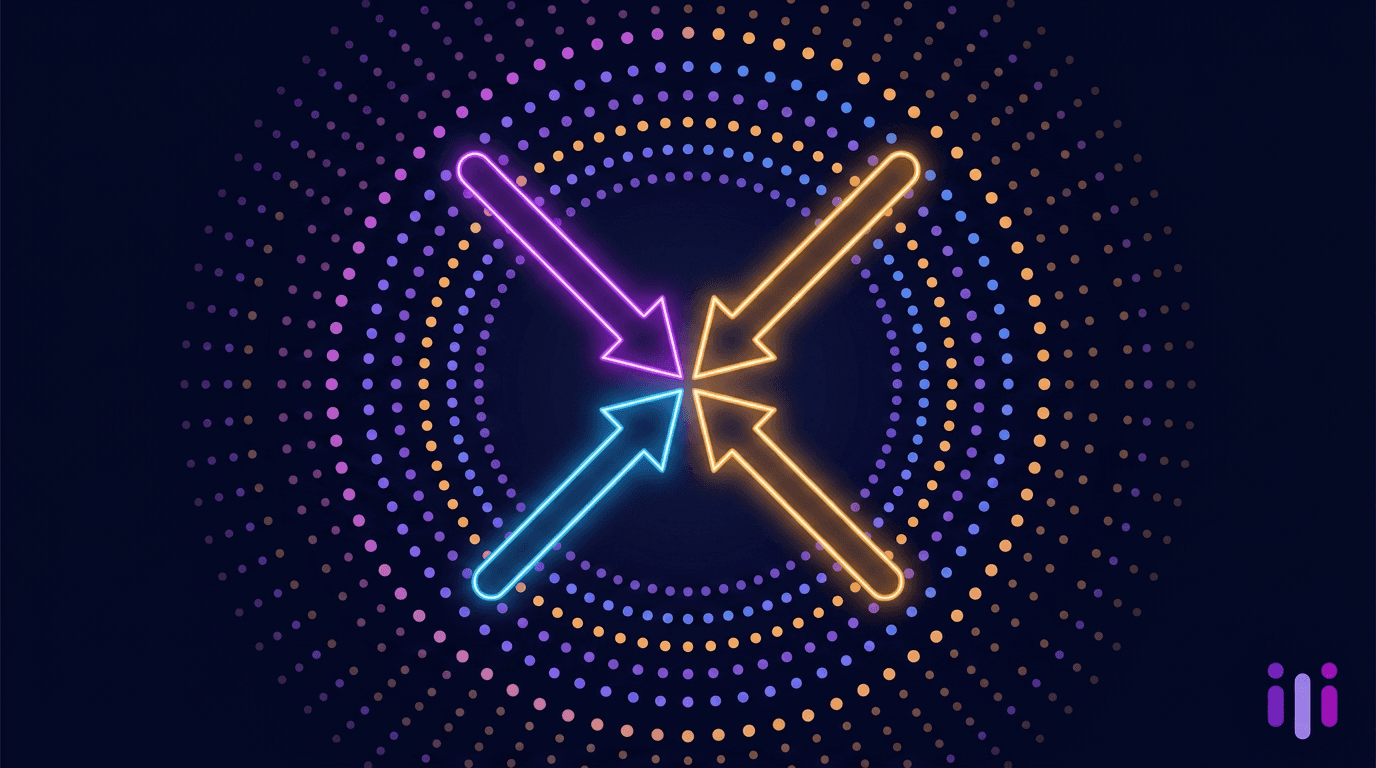
The forces-of-progress framework models every switch as the outcome of four competing forces — two pushing toward change, two pulling back toward the status quo. This is the conceptual core of JTBD and the reason interviews are structured the way they are.
The four forces:
- Push of the situation — friction making the existing solution intolerable. ("My team kept missing deadlines because the old tool wouldn't show dependencies.")
- Pull of the new solution — the imagined better state. ("I'd seen a teammate use Linear and she said she could just see what was blocking what.")
- Anxiety of the new solution — fears, unknowns, switching costs. ("I worried we'd lose two weeks of velocity migrating tickets.")
- Habit of the present — inertia, sunk cost, identity. ("Our PM had built every workflow in Jira. Switching felt like throwing away her work.")
A switch happens when Push + Pull > Anxiety + Habit. The moderator's job is to make all four forces visible in the customer's own words. The deliverable is a "forces map" — and it determines whether synthesis ladders up to actionable forces or stays at the level of feature complaints. The framework is widely cited but consistently underused, because the bottleneck isn't awareness. It's labor.
Why JTBD Interviews Historically Capped at N=15
JTBD research has historically capped at N=15 interviews per study because each switch interview is labor-intensive on both ends — a 60–90 minute moderated conversation plus 4–6 hours of synthesis per transcript. That math defines the ceiling.
A trained moderator can do 3–4 switch interviews per day before fatigue degrades probe quality. Each produces a 12,000–18,000 word transcript. Synthesizing forces — coding for Push, Pull, Anxiety, Habit, anchoring quotes, building the forces map — takes 4–6 hours per transcript. A 15-respondent study breaks down as ~19 hours of moderation, ~75 hours of synthesis, plus recruiting, instrument design, and readout — totaling 120–140 hours of senior-researcher work, or roughly $20,000–$35,000 fully-loaded externally.
Teams trying to scale past N=15 hit one of three walls: they can't recruit fast enough, probe quality drifts across multiple interviewers, or synthesis backs up 2–3 weeks and insights stale. Bob Moesta has been transparent — most studies he's run for clients are 12–20 interviews. That's not a framework problem; it's labor reality. Surveys scale to N=2,000 because each response costs ~5 minutes of respondent time and zero researcher time. JTBD doesn't. So most teams cite JTBD, then fall back to surveys for volume — losing the forces map for a stack of feature requests.
The AI-Moderation Breakthrough — Scaling JTBD to N=200+
AI-moderated interviewing breaks the JTBD labor ceiling by parallelizing moderation and synthesis, taking a study from N=15 to N=200+ in the same calendar time as a traditional study. This is the unlock Bob Moesta's frame anticipated but pre-AI tooling couldn't deliver.
An AI moderator runs hundreds of switch interviews in parallel — no fatigue, no calendar coordination, no time zones. Interviews are async. The same probe tree (Push → Pull → Anxiety → Habit, anchored to switch timeline) runs identically across all 200 interviews — a probe-quality improvement over multi-moderator human studies, where instrument drift is a known problem (Nielsen Norman Group has documented moderator effects in qualitative research for years).
On synthesis, AI codes each transcript for the four forces and builds the per-respondent forces map automatically. The senior researcher shifts from doing synthesis to validating — sampling, sanity-checking, stress-testing. That cuts synthesis time per transcript from 4–6 hours to roughly 20–30 minutes of validation, which is what makes N=200 tractable.
What N=200 buys you that N=15 doesn't:
- Segment-level forces maps. With N=15 you have one undifferentiated map; with N=200 you can build maps for each meaningful segment (by company size, ICP fit, switching context).
- Frequency signal on Anxiety and Habit. Small samples surface anxieties any one respondent mentions; large samples tell you which anxieties show up in 60% of switchers vs 5%.
- Statistical power on the "fired" job. A core JTBD question — what did the customer fire when they hired you? — is often answered weakly at N=15. N=200 typically covers 8–15 distinct prior solutions.
This is the same shift documented for qualitative research at scale and for UX research that breaks the researcher bottleneck. A note on what AI moderation is not: it isn't a synthetic respondent. Respondents are real humans who switched, paid, and lived with the consequences. Forces are anchored to lived events — the synthetic respondents critique applies in full force.
How to Design an AI JTBD Study
An AI-moderated JTBD study uses the same instrument as a traditional switch interview, with three structural changes: a tighter switch-event filter at recruit, a more explicit forces probe tree, and synthesis that runs continuously instead of after the last interview.
Step 1 — Define the switch event narrowly
JTBD interviews require a recent, real switch event the respondent can walk back through. Define it tightly: "switched from {{prior_solution}} to {{your_product}} in the last 90 days." The 90-day window matters because timeline memory degrades fast — Daniel Kahneman's work on reconstructive memory is the standard citation, but any researcher who has run switch interviews has seen it firsthand.
Step 2 — Recruit for switching diversity
For an N=200 study, target 5–8 distinct switched-from origins. If 180 of 200 switched from the same competitor, you have a single-comparison study, not a forces study. Build the screener to enforce origin diversity. The user interview software guide covers tooling; screening can also be done conversationally via a concierge agent so screen-out happens in the same flow as consent and scheduling.
Step 3 — Build the forces probe tree
The AI moderator needs an explicit probe tree mapping conversation paths to the four forces:
- Anchor moment — "When did you first realize {{prior_solution}} wasn't working?" → captures Push.
- Passive-to-active looking — "What were you doing in those weeks before you started actively shopping?" → captures Push intensifying and early Pull.
- Trigger event — "What happened the day you started looking at alternatives?" → the inflection.
- Decision moment — "When did you know it was {{your_product}}?" → captures Pull and decision criteria.
- Anxiety probe — "What worried you about switching?" → captures Anxiety.
- Habit probe — "What about {{prior_solution}} did you almost not want to give up?" → captures Habit.
- Post-switch reality — "How is it going since you switched?" → tests imagined Pull against lived experience.
Each probe needs follow-up rules so the AI doesn't accept one-line answers. "Tell me more" and "What was happening that week?" are the workhorses.
Step 4 — Run in parallel and synthesize continuously
Launch all N=200 invitations in the same week. Async, no scheduling. Quality-monitor the first 15–20 transcripts in real time — if probe quality drifts, fix the prompt and re-launch. Every transcript gets coded for the four forces as it lands. By interview 200, the forces map is 95% built. The researcher's last 5%: sanity-checking, pulling the strongest quotes, writing the narrative connecting findings to strategy — the same shift covered in the customer feedback analysis playbook.
Synthesis — From N=200 Transcripts to a Forces Map
The synthesis output of an AI-moderated JTBD study is the same artifact as a traditional one — a forces map — but built from 200 data points with frequency annotations on each force and a per-segment breakdown.
A forces map is a 2x2 (Push/Pull on one axis, Anxiety/Habit on the other) populated with verbatim themes weighted by frequency. For the canonical example of switching from Quickbooks to Xero, an N=15 study might surface:
- Push: "End-of-quarter close kept slipping" (9/15)
- Pull: "Bank reconciliation that just works" (7/15)
- Anxiety: "Will my accountant work with it?" (6/15)
- Habit: "I've used QB since 2008" (4/15)
At N=200 you get the same 2x2 with stratified breakdowns: which Pushes dominate sub-$10M companies vs $50M+ companies, which Anxieties shrink to noise (a fear that loomed large in 3/15 often disappears at 7/200 — a small-sample artifact).
Three synthesis outputs every JTBD study should produce:
- The forces map per segment — the 2x2, weighted, for each meaningful segment.
- The "fired job" inventory — what each respondent fired when they hired you, stratified by competitor named.
- The progress-blocker list — Anxieties or Habits showing up in customers who almost didn't switch.
Output #3 is where AI-moderated JTBD most clearly outperforms traditional studies. At N=15 the "almost didn't switch" cohort is 2–3 respondents — too few to support patterns. At N=200 you get a 30–50 person sub-cohort and can read genuine patterns. That's the data that ships into onboarding redesigns and sales objection-handling — which is why teams running continuous discovery bake JTBD into the quarterly cycle now that cost has dropped. The forces map also ladders into a feature-prioritization framework — Push and Pull become demand-side roadmap inputs; Anxiety and Habit become onboarding and migration inputs.
Pitfalls to Avoid
Three failure modes show up most often when teams move JTBD from N=15 to N=200, and all three are addressable.
Probe drift toward features. If the AI moderator isn't trained on the forces tree, it accepts feature-level answers ("I switched because of better dashboards") instead of pushing for the underlying force. Counter by including 8–12 example dialogues in the moderator prompt.
Switch-event diffuseness. With async interviews, respondents sometimes describe switches still in progress. The forces map needs a completed switch as anchor. Fix in screening — gate on "primary tool for at least 30 days."
Synthesis still bottlenecked at the human. Some teams adopt AI moderation but keep human-only synthesis, which just moves the bottleneck. The point of AI-moderated JTBD is end-to-end leverage. Teams that get this right treat Perspective AI as a research-at-scale platform, not a transcript factory. One philosophical note: scaling JTBD doesn't make every question better answered with JTBD. JTBD answers "why did customers switch?" — for "what feature next?" use a different method.
Frequently Asked Questions
What is the ideal sample size for a JTBD interview study with AI moderation?
200 is the new default, up from 15 in the human-only era. At N=200 you get reliable forces maps per segment, a defensible "almost didn't switch" sub-cohort of 30–50 people, and meaningful frequency weighting on each force. Above N=400 returns diminish; below N=100 you're back in small-sample territory for segmented analysis. For a small switch population (early-stage product, tight ICP), a focused N=50–100 is still a meaningful upgrade over N=15.
Can AI moderators run the full Bob Moesta-style switch interview?
Yes — an AI moderator can run the full switch interview structure when the probe tree is built explicitly into instructions. The probes that work best are the ones Moesta has documented for two decades: anchored to a specific event, walking forward in time, asking what was happening rather than what the customer thought. AI struggles with open-ended exploratory questions where probe selection depends on subtle vocal cues — which is why the structured switch interview is a particularly good fit.
How is an AI JTBD study different from a survey?
A JTBD interview, including an AI-moderated one, is a longitudinal reconstruction of a switch event, not a snapshot of attitudes. Surveys ask "rate your satisfaction" — they collect attitudes at one moment. JTBD walks a customer back through a sequence of moments and captures verbatim language about Push, Pull, Anxiety, and Habit. Survey output is a distribution; JTBD output is a forces map and a stack of timeline-anchored quotes. AI moderation closes the historical sample-size gap without flattening depth.
Do I still need a human researcher to run an AI-moderated JTBD study?
Yes. The senior researcher shifts from doing the work to designing and validating it — building the forces probe tree, monitoring the first 15–20 transcripts for quality drift, validating AI synthesis, writing the narrative that connects findings to strategy. The 120-hour-per-study labor cost drops to roughly 30–40 hours at N=200 — a 4x productivity increase per researcher and an order-of-magnitude increase in study size. The researcher gets more leverage; they don't disappear.
How long does an AI-moderated JTBD study take end-to-end?
Roughly 3–4 weeks for an N=200 study, compared to 6–10 weeks for a traditional N=15 study. Recruiting takes 5–10 days because async interviews don't require calendar coordination. Interviews wrap in another 7–10 days. Continuous synthesis means by the time interview 200 lands, the forces map is 95% built; final validation and readout deck add 3–5 days. The compression is why teams running quarterly research can put JTBD in rotation rather than treating it as once-a-year.
Conclusion
Jobs-to-be-Done interviews have always been the gold standard for understanding why customers switch — but labor math locked them at N=15. AI-moderated interviewing is the unlock. The same forces-of-progress framework, the same switch-interview structure, the same anchored-to-real-events rigor — running on a layer that scales to N=200+ in the calendar time of a traditional N=15 study. Synthesis shifts from "themes that came up" to "themes weighted by frequency, stratified by segment, validated against an 'almost didn't switch' sub-cohort."
If you're feeling the N=15 ceiling, run a jobs-to-be-done research study at scale on Perspective AI, browse the studies library for instrument templates, or explore the interviewer agent that runs the switch interview itself. Built for product teams running continuous discovery — not for clipboard moderators.
More articles on AI Conversations at Scale
Customer Experience in Retail 2026: What the Store Data Cannot Tell You
AI Conversations at Scale · 11 min read
Customer Experience Management in Banking 2026: The Hand-Off Problem
AI Conversations at Scale · 10 min read
The CX Platform Security Review: What Procurement Will Ask (and How to Answer)
AI Conversations at Scale · 22 min read
CX Tool Consolidation: What to Cut When You Have Six Listening Tools
AI Conversations at Scale · 20 min read
Who Sits on the CX Buying Committee (and What Each Member Kills a Deal For)
AI Conversations at Scale · 23 min read
The CX Platform Migration Checklist: 60 Days From Signature to First Insight
AI Conversations at Scale · 22 min read