AI-Moderated Interviews: The Mechanics of Good AI Interviewing in 2026
TL;DR
AI-moderated interviews are research conversations run by an AI interviewer that probes, follows up, and adapts in real time — and the gap between a good one and a bad one comes down to six concrete mechanics. Probe quality decides whether you get "it was fine" or "I almost churned in week two because the importer kept timing out." Follow-up timing decides whether the AI catches a vague answer in the moment or loses it forever. Vague-answer handling, off-topic recovery, pacing, and closing rituals each control a specific failure mode that wrecks moderated research at scale. Perspective AI's interviewer agent is engineered around these six mechanics — not around scripted branching logic — which is why it can run hundreds of simultaneous interviews without flattening into a survey. This guide is for research, product, and CX leaders evaluating AI moderation, plus the IC researchers who'll have to live with whatever you pick. We'll show you what each mechanic looks like when it's done right, what failure modes look like, and the specific behaviors to test before you trust an AI interviewer with a real study.
What AI moderation actually does inside a study
AI moderation is the active, in-conversation work an AI interviewer does between turns: deciding whether the last answer was complete, choosing the next question, generating a follow-up that doesn't repeat anything already said, and keeping the participant on the study's research questions without making them feel managed. It is not a chatbot reading from a script. A scripted bot asks question 1, then question 2, then question 3, regardless of what the participant said. A moderated AI interview reshapes itself every turn — and that reshaping is where good research is made or destroyed.
The reason this matters in 2026 is volume. According to Forrester's 2024 research-operations benchmarks, the median enterprise research team runs 12–18 moderated studies per year because each one consumes 40+ researcher hours between recruitment, scheduling, moderating, and synthesis. AI moderation collapses that to minutes per study while keeping the depth of a 1:1 interview — but only if the moderation mechanics are actually good. A bad AI moderator at scale just produces 800 useless transcripts instead of 8. The cost of "scaling slop" is higher than the cost of running fewer studies.
The six mechanics below are the dimensions that separate a research-grade AI interviewer from a glorified survey. Test every AI interviewer you evaluate against all six. If a vendor demo skips three of them, that's the answer.
The 6 mechanics of good AI interviewing
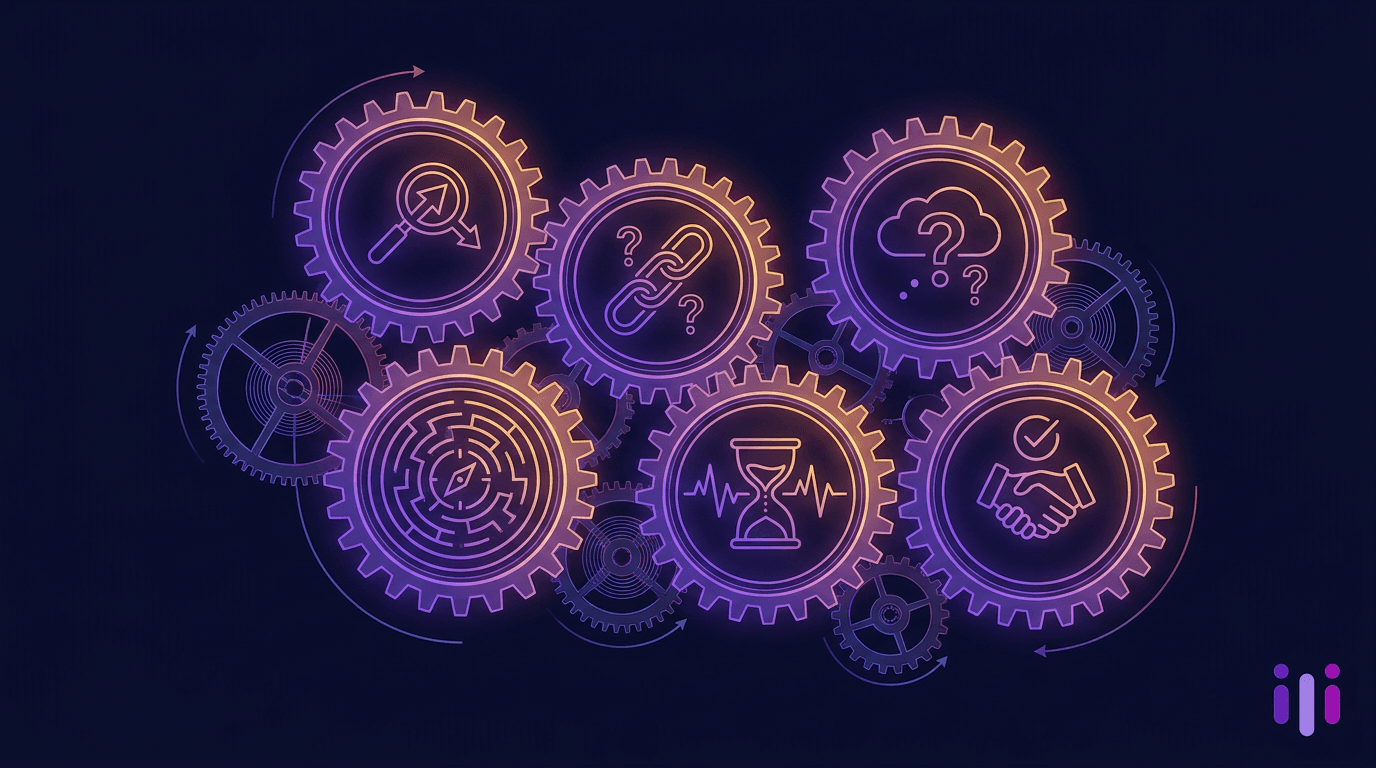
Every AI moderation engine — including ours — can be evaluated along six dimensions:
Most AI interview tools shipped in 2023–2024 nail one or two of these and fail the rest. The rest of this guide is a deep look at each — what's happening under the hood, the behaviors that signal quality, and the demo prompts that surface the failures fast. If you want background on the broader category before going deep, our practical guide to AI moderated research covers the "why" before the "how."
Mechanic 1: Probe quality
Probe quality is the AI's ability to generate a follow-up question that is specific to what the participant just said and that opens a new layer of insight rather than restating the prior question. A good probe quotes the participant's own language back at them ("you said the importer 'kept timing out' — what were you trying to import when that happened?") because that signals listening and pulls a memory of a specific moment instead of a generalization.
The technical mechanic underneath is straightforward: a probe-quality engine has to decide three things on every turn. Is the prior answer complete enough to satisfy the research question, or is there a missing layer? If incomplete, what specifically is missing — context, motivation, mechanism, consequence, or counterfactual? And what's the most natural phrasing of a probe that targets that gap without sounding like an interrogation?
What good probes do:
- Quote specifics. "You mentioned 'almost churned' — what week was that, and what changed?"
- Target the missing layer. If the participant said "the pricing was confusing," a good probe asks for the specific moment of confusion, not a generic "tell me more."
- Avoid double-barrels. One question per turn. Stacking three sub-questions in one probe causes participants to answer one and skip two.
- Don't repeat. Probe-quality engines should track every theme already covered and not loop back to ground already explored.
What bad probes do:
- Generic "tell me more" / "can you elaborate?" loops with no specificity.
- Repeating a near-identical question 30 seconds later because the engine forgot.
- Stacking 2–3 questions per turn, which forces the participant to pick one.
- Asking leading questions ("did that make you frustrated?") that contaminate the answer.
The fastest demo test is to ask a vendor to run a sample interview where the participant gives a mildly vague answer like "the onboarding was rough" and watch the next turn. If the AI says "tell me more about that," the probe engine is generic. If it says "you said 'rough' — was there a specific step that broke for you, or was it the overall pace?" you're looking at a real probe engine.
Perspective AI's interviewer agent generates probes by mapping each answer against the study's research questions, identifying the specific information layer missing, and producing a probe that quotes the participant's language while targeting that gap. The agent is documented at the interviewer agent page.
Mechanic 2: Follow-up timing
Follow-up timing is the decision of when to probe and when to move on. Probe-everything is a failure mode. Probe-nothing is a failure mode. The mechanic that separates a good AI interviewer from a bad one is its calibration between those two — and that calibration is per-answer, not global.
The right model is: probe when the answer contains a high-value signal that's currently underspecified, and move on when the answer is either complete enough or low-value for the study's research questions. A participant who says "yeah, I use it daily" doesn't need a probe — that's a clear, complete answer to a usage-frequency question. A participant who says "it's been a love-hate thing" absolutely needs a probe — that's a high-value signal at maximum vagueness.
The signals that should trigger a probe:
- Hedging language. "Sort of," "kind of," "I guess" — the participant is uncertain or downplaying. A good probe asks what the hedge is hiding.
- Emotional words without context. "Frustrating," "amazing," "annoying," "confused" — describe an experience without specifying when or why.
- Unspecified subjects. "They," "the team," "people on our side" — without naming who or what specifically.
- Counterfactual hints. "I almost…", "I was about to…", "If it had been any worse…" — there's a near-miss event behind the statement that's higher-signal than the answer itself.
- Comparative language without comparison. "It's better," "it's worse," "less painful" — better than what? Worse than what?
The signals that should trigger move-on:
- Specific, bounded answers. Names, dates, frequencies, dollar amounts, step numbers.
- Already-covered ground. If the theme is already documented in the transcript, don't re-probe.
- Low research-question relevance. Tangential context is fine to log but not to probe deeper.
- Participant fatigue signals. Short answers, "I don't know," declining length over several turns — keep moving.
A common failure mode in 2024–2025 AI interview tools was probing every single answer at the same depth, which doubled session length and produced participant drop-off rates above 40%. Modern moderation engines including Perspective AI's run probes adaptively based on signal density, which keeps median session length under 12 minutes while extracting deeper insight per minute than a survey of equivalent length.
Mechanic 3: Handling vague answers
Vague-answer handling is what an AI interviewer does when the participant's response is clearly thin — "it was fine," "kind of okay," "I guess it works" — and the question hasn't been answered in any usable way. The mechanic isn't to reject the answer or pressure the participant; it's to reframe the question more concretely so the participant has an easier on-ramp into specifics.
The reframing patterns that work:
- Anchor to a moment. "Can you walk me through the last time you used it? Just the most recent specific moment." This works because most people are bad at generalizing but good at recalling.
- Offer a forced choice. "Was it more 'this is great, ship it' or 'this works but I have notes'?" Forced choices break the vague-default attractor and let the participant pick a specific lane.
- Name the spectrum. "On a spectrum from 'I'd recommend it' to 'I'd actively warn someone away,' where would you put it — and what's the specific reason for landing there?"
- Ask about the opposite. "What would have to change for it to feel less 'fine' and more clearly good or bad?"
The reframing patterns that fail:
- Repeating the original question. "So how did you feel about it?" — same question, same vague answer.
- Generic "can you elaborate?" — moves the burden to the participant without giving them a structure.
- Pressuring with multiple probes. "Why was it fine? What made it fine? Can you give me specifics?" — three questions in one turn is interrogation.
A good AI interviewer also knows when to stop reframing. If a participant has produced two vague answers in a row to the same question, the engine should accept the answer is genuinely thin and move on rather than badger. The demo test: give the AI a participant who answers "it was fine" three times in a row to different questions and watch what happens. If the AI keeps escalating reframes for all three, the engine is over-tuned. If it gracefully accepts the third "fine" and moves on, you have a real moderator.
For a deeper view of how this connects to research design, see our coverage on AI qualitative research and the new state of conversational data collection.
Mechanic 4: Off-topic recovery
Off-topic recovery is what the AI does when the participant takes the conversation somewhere that isn't the study's research question. Sometimes the tangent is gold — a participant who veers into "well, the real reason I almost churned was actually about onboarding" is handing you the study. Sometimes it's noise — a participant who starts venting about an unrelated tool or going on about a vacation story.
The mechanic has three parts: recognize that the response is off-topic, decide whether the tangent is high-value or low-value, and bridge back to the study without lecturing the participant. The best AI moderators acknowledge the tangent ("that sounds frustrating — I want to come back to that") before redirecting, because acknowledging is what preserves rapport.
What good off-topic recovery looks like:
- For high-value tangents: absorb them. The "real reason I almost churned" tangent is more valuable than the scripted question. The AI should probe the tangent, fold the insight into the study, and skip the original question if the tangent already answered it.
- For low-value tangents: acknowledge briefly and bridge. "Got it — and just to come back to the trial experience, you mentioned the importer earlier. What happened with it specifically?" The acknowledgement preserves rapport; the bridge gets back on track.
- Never: "Let's stick to the topic." That kills the conversation. A participant who feels managed shuts down for the rest of the interview.
The technical decision underneath is "is this tangent semantically related to any of the study's research questions, even if it isn't related to the specific question I asked?" If yes, follow the tangent. If no, bridge gracefully. Off-topic recovery is also where AI moderators outperform human ones at scale — a tired human moderator at study #6 of the day will let tangents drift; an AI moderator's recovery quality is the same on study #1 and study #800.
Mechanic 5: Pacing and patience
Pacing is the AI's ability to match the participant's tempo. Some participants are fast: short answers, quick replies, want to be done. Others are slow: long pauses, detailed answers, will give you gold if you don't rush them. A bad AI interviewer treats every participant the same — fires the next question 200ms after each response, regardless of whether the participant was about to add more.
Good pacing is pause-aware. In text, the signal is the participant's typing patterns: a "..." pause, a partial response followed by silence, an answer that ends with a hanging "and" or "but" — all suggest more is coming. Modern AI interviewers wait. The same applies in voice: a participant who said "yeah, and the other thing was…" and then went quiet for two seconds is mid-thought, not done.
The other side of pacing is forward momentum. A participant who's clearly fatigued — short answers, declining length, "I don't know" answers — needs the interview to wind down faster, not get a probe on every remaining question. Good AI moderators detect fatigue and switch into a closing-out mode that respects the participant's time.
Patience also matters when participants get stuck mid-thought. The best response to "let me think about that for a second" isn't to fill the silence with a clarifying probe — it's to actually wait. The mechanic underneath is detecting "thinking-out-loud" turns and not pre-empting them with a follow-up. Perspective AI's voice interviewer is calibrated to leave 4–6 seconds of silence after detected "thinking" speech patterns, which is roughly twice as long as a survey form would tolerate but matches what a skilled human researcher does.
For research leaders running interviews at volume, pacing is what separates "we ran 200 conversations" from "we ran 200 conversations and got real insight from 180 of them." Background reading: running UX research at scale and the state of AI customer interviews.
Mechanic 6: Closing the loop
Closing is the most-skipped mechanic in AI interview tools, and it's the one that disproportionately determines whether participants finish a study and whether the data you get is complete. A good close confirms understanding, gives the participant a "did we miss anything?" lane, thanks them by name (where the study allows), and ends the conversation cleanly rather than just terminating when the script runs out.
The structure of a good close has four moves:
- Recap. "Just to make sure I caught it: you tried it for two weeks, ran into the importer issue in week one, and the thing that almost made you churn was the lack of a Slack integration. Did I get that right?" The recap doubles as a quality check — participants will correct misunderstandings here that you'd otherwise carry into synthesis.
- Open the floor. "Is there anything I didn't ask that I should have, or anything you wanted to mention that didn't come up?" This single question routinely produces the most-quoted insight of the entire study, because it lets participants surface what they think mattered, not just what the researcher anticipated.
- Acknowledge their time. A simple "this was really useful — thank you for the depth here" lands well, especially if the AI references something specific the participant said.
- Clean transition. Not "this conversation has ended" but "we're done — appreciate it. You'll get the [thank-you / incentive / follow-up] within the next [X]." Specific next-step language increases incentive-redemption rates and reduces "did this actually save?" anxiety.
What bad closes look like: the AI hits the end of the script, says "thanks, the interview is complete," and terminates. The participant never gets the "anything we missed" lane and never has the recap. We've reviewed AI interview transcripts where 30%+ of the most-quoted insights from a study came from the open-the-floor moment at the end — meaning a vendor that skips this is leaving roughly a third of your insight value on the floor.
If you're evaluating tools, our buyer's framework for AI focus group platforms covers the procurement side, and our comparison of qualitative research software maps the broader market.
How Perspective AI's interviewer handles all six
We didn't bolt these six mechanics onto a chatbot — the interviewer agent was designed around them. Probe quality is generated by mapping each answer to the study's research questions and targeting the specific missing layer, with the participant's own language quoted back. Follow-up timing is calibrated per-turn based on signal density, hedging detection, and counterfactual hints. Vague-answer handling uses anchored-moment, forced-choice, and spectrum reframings rather than generic "elaborate" prompts. Off-topic recovery acknowledges before bridging and absorbs high-value tangents into the study. Pacing leaves real silence after thinking-out-loud signals and detects fatigue to wind sessions down gracefully. Closing always runs a recap, an open-floor question, and a clean transition.
The result: median session length stays under 12 minutes, completion rates run 70%+ across studies in our customer base, and synthesis quality holds up at 800 simultaneous conversations the same way it does at 8. If you want to see it in action, the fastest path is to start a research study and run a 5-participant pilot before scaling.
For teams thinking about how AI interviews fit into broader product and CX workflows, our resources for product teams and CX teams cover the operating model. The studies catalog shows ready-to-run interview templates, and the concierge agent covers the form-replacement use case for intake. For organizations replacing intake forms at the same time, intelligent intake is the relevant product surface.
Outside reading: the Nielsen Norman Group's qualitative research methodology guidance is still the canonical reference for what good moderated research looks like, and HBR's coverage of in-depth interviewing is a reasonable foundation for executive readers new to the format.
Frequently Asked Questions
What's the difference between an AI interviewer and an AI chatbot?
An AI interviewer runs structured research conversations against a study's research questions and generates adaptive probes per turn; an AI chatbot answers user questions or completes tasks. The two share underlying language-model technology but differ entirely in goal: an interviewer is trying to extract insight from the participant, a chatbot is trying to deliver value to the user. AI interviewers also run inside a research framework — recruitment, consent, transcript capture, and analysis — that chatbots don't have.
How long should an AI-moderated interview be?
Most AI-moderated interviews land between 8 and 15 minutes, with the sweet spot around 10–12 minutes for participants and 15–20 for highly engaged customer or research panels. Longer than 20 minutes and completion rates drop sharply; shorter than 6 and you don't get enough probe depth to outperform a survey. The pacing mechanic (Mechanic 5) is what keeps sessions in this range without truncating insight.
Can AI moderation replace a human researcher entirely?
AI moderation replaces the in-conversation work of a human moderator at scale, but it does not replace research strategy, study design, recruitment quality decisions, or executive synthesis. The right model is: AI runs the interviews, the researcher designs the study, frames the research questions, picks the right participants, and translates findings into recommendations. Treating AI moderation as a "researcher replacement" is the most common failure mode in adoption.
How do you tell if an AI interviewer is actually good before buying?
Run a demo where you play a deliberately difficult participant: give vague answers, go off-topic, hedge, and stay quiet for awhile mid-thought. Watch how the AI handles all six mechanics — probe specificity, when it probes vs. moves on, how it reframes vague answers, whether it acknowledges off-topic before bridging, whether it leaves silence, and how it closes. A good AI interviewer will show competence on at least five of the six in a 10-minute demo. If it fails three or more, no amount of dashboard polish will save the studies.
Are AI-moderated interviews biased?
All research is biased — the question is whether AI moderation introduces more bias than the alternatives. In practice, AI moderation reduces some biases (interviewer fatigue, leading-question drift, demographic mismatch between researcher and participant) and introduces others (training-data effects, language-model confidence patterns, accent or dialect handling gaps). The net is generally favorable for studies above n=20, where the consistency of an AI moderator beats the variance of multiple human moderators. Bias-mitigation is an ongoing research area; we discuss our approach in our writing on human-like AI interviews.
Do AI interviews work for sensitive topics like churn or layoffs?
AI interviews actually outperform human-moderated interviews for many sensitive topics because participants report less social pressure to soften criticism when they're talking to an AI. We see this most clearly in churn studies and exit interviews — participants who would tell a CSM "the product was fine, just budget reasons" will tell an AI interviewer "we hated the support response time and three execs lost confidence." The mechanic underneath is psychological: AI moderators don't have a face to disappoint, so honesty rates rise.
Conclusion
AI-moderated interviews are only as good as their mechanics. Probe quality, follow-up timing, vague-answer handling, off-topic recovery, pacing, and closing are the six dimensions that separate a real research-grade AI interviewer from a chatbot wearing a survey hat. Test every AI interviewer you evaluate against all six. Run the deliberately-difficult-participant demo. Read the transcripts before you buy.
Perspective AI's interviewer agent is built around these six mechanics from day one — which is why it can run hundreds of simultaneous AI moderated interviews while preserving the depth of a 1:1 conversation. If you're ready to see how a research-grade AI moderator behaves in a real study, start a pilot study or browse the studies catalog to see ready-to-run interview templates. The shift to AI moderation in 2026 isn't about scaling slop — it's about making sure that when you scale, the moderation mechanics scale with you.
More articles on AI Conversations at Scale

AI-Moderated Interviews: How They Work and When to Use Them
AI Conversations at Scale · 13 min read
AI-Moderated Research: A Practical Guide to the New Default for Qualitative Studies
AI Conversations at Scale · 17 min read
Customer Experience in Retail 2026: What the Store Data Cannot Tell You
AI Conversations at Scale · 11 min read
Customer Experience Management in Banking 2026: The Hand-Off Problem
AI Conversations at Scale · 10 min read
The CX Platform Security Review: What Procurement Will Ask (and How to Answer)
AI Conversations at Scale · 22 min read
CX Tool Consolidation: What to Cut When You Have Six Listening Tools
AI Conversations at Scale · 20 min read