Beyond the Student Feedback Form: How Schools Are Replacing Surveys with Conversations
TL;DR
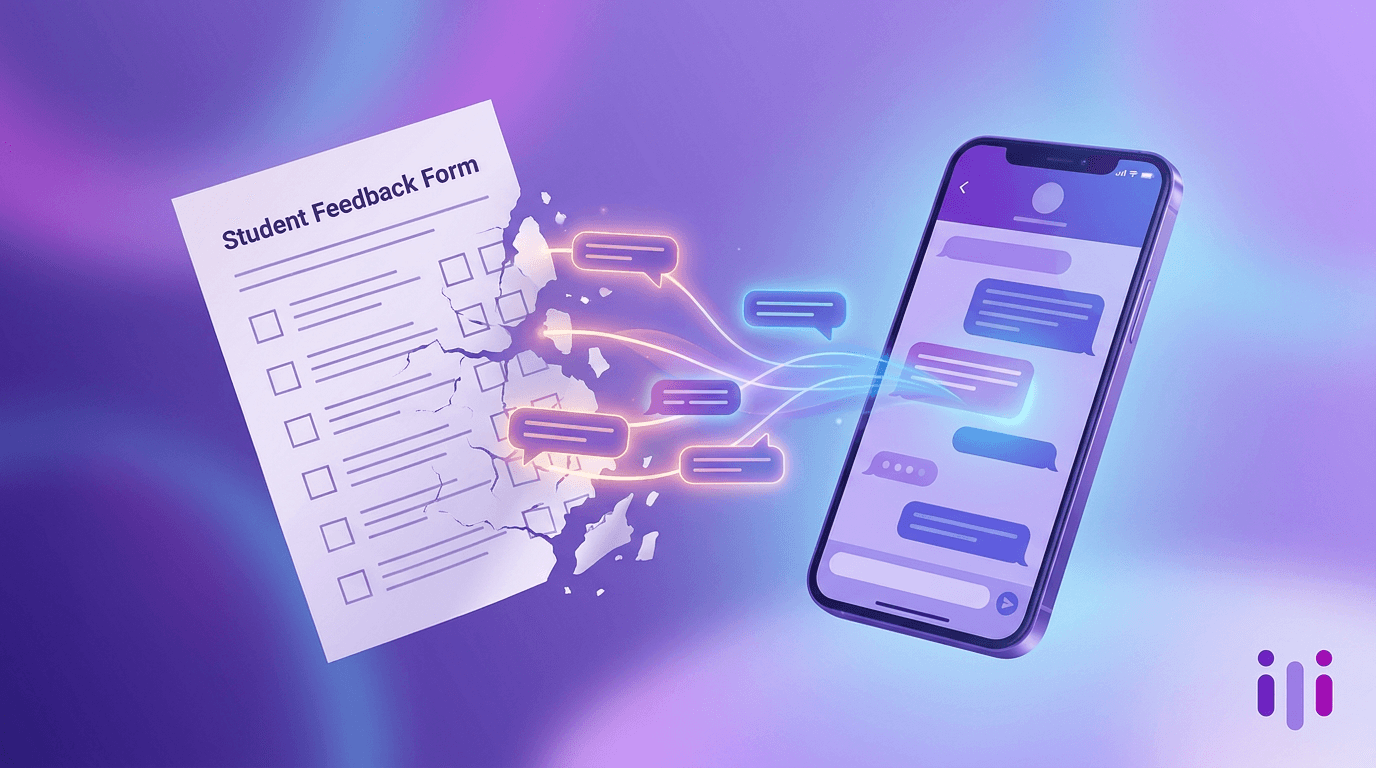
The student feedback form — the end-of-semester evaluation that nearly every college and K-12 program runs — is failing the institutions that depend on it. Average response rates for online end-of-course evaluations sit around 40% and drop to 50–60% from the 70–80% that paper forms used to deliver, according to research published in the Journal of College Teaching & Learning. The students who do respond skew toward the extremes (loved it or hated it), the Likert items collapse nuanced experience into 1–5 scores, and the open-text box at the end gets one-line answers like "good class." Frameworks like the IDEA Center's Diagnostic Feedback Form and the National Survey of Student Engagement (NSSE) have improved the questions, but they can't fix the format. This guide walks through why the traditional student feedback form misses the "why" behind student experience, and how schools, course designers, and edtech teams are replacing static surveys with AI-moderated conversations that follow up, probe, and capture context at the scale of an entire institution.
Why the Traditional Student Feedback Form Misses the Why
The traditional student feedback form misses the "why" because its format is designed to aggregate, not to listen. End-of-semester evaluations almost universally combine a short Likert battery ("Rate the instructor 1–5") with one or two open-text prompts ("What could be improved?"). That structure produces clean averages for an institutional research dashboard, but it strips out the reasoning behind every rating. A "3" from a student who felt lost in week 4 looks identical to a "3" from a student who thought the workload was unfair, and neither shows up in a way the instructor can act on.
Three structural problems compound the issue:
- The form arrives after the experience is over. Students fill it out during finals week, when their memory of the course has compressed into a single feeling. Specific, recoverable moments — the lecture that didn't land, the assignment that clicked — are gone.
- The form rewards the loudest students. Voluntary online evaluations over-sample the very satisfied and the very frustrated. Quiet majority experience is invisible. The Center for Postsecondary Research at Indiana University has documented this non-response bias across institutional surveys.
- The form can't follow up. When a student writes "the pacing was off," nobody asks "off how — too fast in which weeks, or too slow overall?" The single most useful research move — the follow-up question — is impossible inside a static form.
This isn't unique to higher ed. We've made the same case across other domains in the case for replacing surveys with AI conversations and in the broader argument that AI-first research cannot start with a web form. The mechanics are the same in a classroom: a form is a schema, and student experience doesn't fit a schema.
What the IDEA Center, NSSE, and SET Research Actually Say
The most-cited course evaluation frameworks all acknowledge that the traditional student feedback form, as deployed, is not enough on its own. Three are worth understanding before you redesign anything.
The IDEA Center (now operating through Anthology) publishes the IDEA Diagnostic Feedback Form and the IDEA Learning Essentials form. Both are designed for formative improvement — IDEA's own framing is that ratings should feed into a "more comprehensive system of faculty evaluation," not stand alone. The forms ask faculty to weight specific learning objectives ("essential" vs. "important") so feedback maps to the course's actual goals. That's a meaningful improvement over generic 1–5 scales, but the format is still a one-shot static instrument administered at semester end.
NSSE (National Survey of Student Engagement), run by Indiana University's Center for Postsecondary Research, surveys hundreds of four-year institutions on engagement indicators across four themes: academic challenge, learning with peers, experiences with faculty, and campus environment. NSSE isn't a course evaluation — it's an institutional engagement survey — and its strength is benchmarking. Its weakness is that it's a once-a-year snapshot of behavior, not a conversation about meaning.
Student Evaluations of Teaching (SET) research is more pointed. The body of SET research over the last 15 years has consistently found three weaknesses in traditional forms: low response rates create non-response bias, ratings correlate with course difficulty and grade expectations more than with learning, and free-text comments are too short and unstructured for institutions to act on at scale. Northern Illinois University's Center for Innovative Teaching and Learning maintains a working summary of this literature.
The pattern across all three: the field already knows the form has limits. What's been missing is a viable replacement that scales to thousands of students without sacrificing depth. That's the gap AI-moderated conversations close.
How AI-Moderated Conversations Replace the Student Feedback Form
AI-moderated conversations replace the student feedback form by trading a fixed schema for an adaptive interview that every student takes in their own words. Instead of seven Likert items and a comment box, every student gets a 5–10 minute conversation — text or voice — with an AI interviewer that asks the core questions every course needs answered, then follows up based on what the student says. We've covered the broader mechanics in a practical guide to AI-moderated interviews and what they replace and a deeper look at how conversational feedback is replacing static surveys in education.
Three specific behaviors change once the form becomes a conversation:
- Follow-up replaces flat ratings. A student who says "the pacing was off" is asked "off how — were specific weeks too fast, or did the whole course feel rushed?" One follow-up turns an unactionable comment into a specific intervention.
- Vague answers get probed. When a student answers "I don't know" or "it was fine," the AI asks for one example or one moment. That single probe is the difference between a 1-line comment and a usable quote.
- Sentiment is captured with reasoning. Instead of "Course quality: 3/5," the output is "3/5 because the projects felt disconnected from the lectures, especially after week 6 when we moved into [X]." The same dashboard works — but every score now ships with the reasoning behind it.
This isn't theoretical. Schools are already moving from broken student feedback surveys to AI conversations, and the broader category playbook is documented in employee feedback at scale, which uses the same model.
A Replacement Framework: Five Phases for Switching Away From the Static Form
Below is a five-phase replacement framework that works for a single course, a department, or an entire institutional research office. Each phase swaps one component of the traditional student feedback form for its conversational equivalent.
Phase 1: Map What the Old Form Was Actually Trying to Learn
Before you replace anything, list the underlying questions your existing student feedback form is trying to answer. Most forms have between 4 and 8 real research questions buried under 20+ Likert items. Typical examples: Did students understand the learning objectives? What blocked their progress? What would they keep, what would they cut? Was workload calibrated correctly? Did they feel supported?
Write each of these out as an open question a person would ask in conversation. These become the "outline" the AI interviewer follows.
Phase 2: Replace the Likert Battery With a Conversational Outline
Instead of "Rate the instructor's clarity 1–5," ask "Tell me about a moment in this course when something clicked — and a moment when you felt lost." The AI interviewer treats this as the start of a thread, not a single field. The methodology overlaps with what product teams call jobs-to-be-done research, and the same principles port directly — see the AI-powered guide to jobs-to-be-done interviews for the mechanics.
For institutions that still need quantitative benchmarking against IDEA or NSSE indicators, you can keep 3–5 anchor scale items at the start and run the conversation afterward. The conversation gives you the "why" the ratings can't.
Phase 3: Run Mid-Semester, Not End-of-Semester
The biggest single upgrade most institutions can make is moving from one end-of-term evaluation to two checkpoints — week 5 and week 13 — plus an exit conversation. Mid-semester data is recoverable: instructors can still adjust pacing, swap an assignment, or clarify expectations. End-of-semester data, by contrast, only helps the next cohort. Continuous discovery — the operating model originally documented for product teams — applies cleanly to course design.
Phase 4: Synthesize at the Course Level, Roll Up at the Institutional Level
AI-moderated conversations produce two artifacts the static form never could:
- A per-course Magic Summary the instructor can read in 5 minutes that surfaces themes, representative quotes, and specific moments students named.
- A roll-up across courses that lets institutional research see patterns at the department or program level — workload concerns clustering in the second-year sequence, for example, or assessment confusion in a specific instructor cohort.
This is the same architecture covered in voice of customer programs in 2026, reapplied to "voice of student."
Phase 5: Close the Loop With Students
The IDEA Center, NSSE, and SET literature all point to the same response-rate killer: students don't believe their feedback changes anything. Faculty Focus and Oregon State's Center for Teaching and Learning both document this. When schools publish a "you said / we changed" summary the next semester — even a short one — response rates and depth of feedback both rise. AI-moderated conversations make this much easier because the synthesis is already structured around themes the next cohort can see referenced directly.
Common Pitfalls When Switching to Conversational Student Feedback
Common pitfalls when switching to conversational student feedback fall into four categories — and each has a specific fix.
Who This Approach Is Built For
This approach is built for three groups inside higher ed and K-12 specifically.
Institutional research and assessment offices running NSSE, IDEA, or homegrown course evaluation programs at scale. The conversational layer plugs in next to existing instruments — it doesn't require ripping out IDEA or NSSE benchmarking.
Department chairs and program directors who need to see why specific courses are underperforming, not just that they are. A 30-conversation Magic Summary across one course tells you more in a week than a year of static evaluations.
Edtech and learning experience teams building AI in the classroom — particularly those covered in AI tools for educators that go beyond grading and the broader push toward AI-native research workflows. The same conversational primitives that power product discovery — see product discovery research with AI conversations — apply directly to course discovery.
For research and product teams who want to apply the same model outside of education, Perspective AI's research workspace and conversational outlines work the same way for customer interviews, employee feedback, and any other voice-of-X program.
Frequently Asked Questions
What is a student feedback form?
A student feedback form is a structured questionnaire — usually a mix of Likert-scale ratings and one or two open-text prompts — that schools and instructors use to collect student perceptions of a course, instructor, or program at the end of a term. Common examples include the IDEA Diagnostic Feedback Form, NSSE's College Student Report at the institutional level, and homegrown end-of-semester evaluations. The traditional format is fast to administer and easy to aggregate, but it tends to flatten student experience into scores and short comments without capturing the reasoning behind them.
Why are end-of-semester student feedback forms considered ineffective?
End-of-semester student feedback forms are considered ineffective because they suffer from low response rates (often around 40% online), strong non-response bias toward extreme opinions, and a format that can't follow up on vague answers. Research summarized by Northern Illinois University's Center for Innovative Teaching and Learning has documented that Student Evaluations of Teaching (SET) ratings often correlate more strongly with course difficulty and grade expectations than with actual learning. The format doesn't allow for the most basic research move — asking "why" or "tell me more" — which is where the actionable insight lives.
How is an AI conversation different from an open-text comment box?
An AI conversation differs from an open-text comment box in that it adapts to what each student says. A comment box is a single field that captures whatever the student decides to write — usually a one-line answer. An AI-moderated conversation asks a sequence of open questions, follows up on vague responses, probes for specific examples, and stays within a defined research outline so every student covers the same core topics. The output is structured, comparable, and significantly deeper than a free-text field while still letting students answer in their own words.
Can AI conversations replace IDEA or NSSE entirely?
AI conversations don't have to replace IDEA or NSSE entirely — and most schools shouldn't try to. IDEA and NSSE provide validated, benchmarked instruments that institutional research offices need for cross-institutional comparison and accreditation. The right architecture is to keep 3–5 anchor scale items aligned with IDEA learning objectives or NSSE engagement indicators, then run the AI conversation afterward to capture the reasoning behind those ratings. You get the benchmarkable scores plus the recoverable, themed qualitative data the form alone can't deliver.
How long does a conversational student feedback session take?
A conversational student feedback session typically takes 5–10 minutes per student, which is comparable to or shorter than the time most students currently spend on a thorough end-of-semester form. Mid-semester check-ins can be even shorter — 3–5 minutes — because they focus on a smaller number of questions about pacing, clarity, and workload. The trade-off is a small amount of structured time per student in exchange for dramatically deeper, themed, follow-up-driven feedback at the course and program level.
What about student privacy and anonymity?
Student privacy and anonymity work the same way they do in well-designed traditional evaluations: responses are de-identified before they reach the instructor, raw transcripts are restricted to authorized institutional research staff, and aggregated themes (not individual quotes tied to identifiable students) are what's shared back at the department or program level. The conversational format doesn't change the privacy posture — it changes the depth of what's captured within the same privacy guarantees.
Conclusion
The student feedback form isn't broken because of bad questions — IDEA and NSSE have spent decades refining the questions. It's broken because the format itself can't follow up, can't probe, and can't capture the reasoning behind a rating. Schools that keep running end-of-semester surveys as their primary feedback instrument will keep getting low response rates, biased samples, and one-line comments that nobody can act on.
The replacement isn't a better form. It's a conversation — at scale, run by AI, structured around the same research questions you've always cared about, but adaptive to what each student actually says. Mid-semester checkpoints. Follow-up on vague answers. Themed synthesis at the course level and rolled up at the institutional level. A "you said / we changed" loop that students can actually see.
If you run institutional research, lead a department, or build edtech, the move is straightforward: keep the IDEA or NSSE anchors you need for benchmarking, and replace the rest of the student feedback form with an AI-moderated conversation. Set up a research outline for your next student feedback round in Perspective AI and run a single course as a pilot — you'll have more usable feedback from one mid-semester checkpoint than you got from your last three end-of-term evaluations combined.
More articles on AI Conversations at Scale

AI for Educators in 2026: A Practical Guide That Doesn't Replace the Teacher
AI Conversations at Scale · 14 min read
Feedback in Education in 2026: A Practical Guide for Institutions Tired of Survey Fatigue
AI Conversations at Scale · 13 min read
Customer Experience in Retail 2026: What the Store Data Cannot Tell You
AI Conversations at Scale · 11 min read
Customer Experience Management in Banking 2026: The Hand-Off Problem
AI Conversations at Scale · 10 min read
The CX Platform Security Review: What Procurement Will Ask (and How to Answer)
AI Conversations at Scale · 22 min read
CX Tool Consolidation: What to Cut When You Have Six Listening Tools
AI Conversations at Scale · 20 min read