'Human-Like' AI Interviews Aren't the Goal — Here's What Is
TL;DR
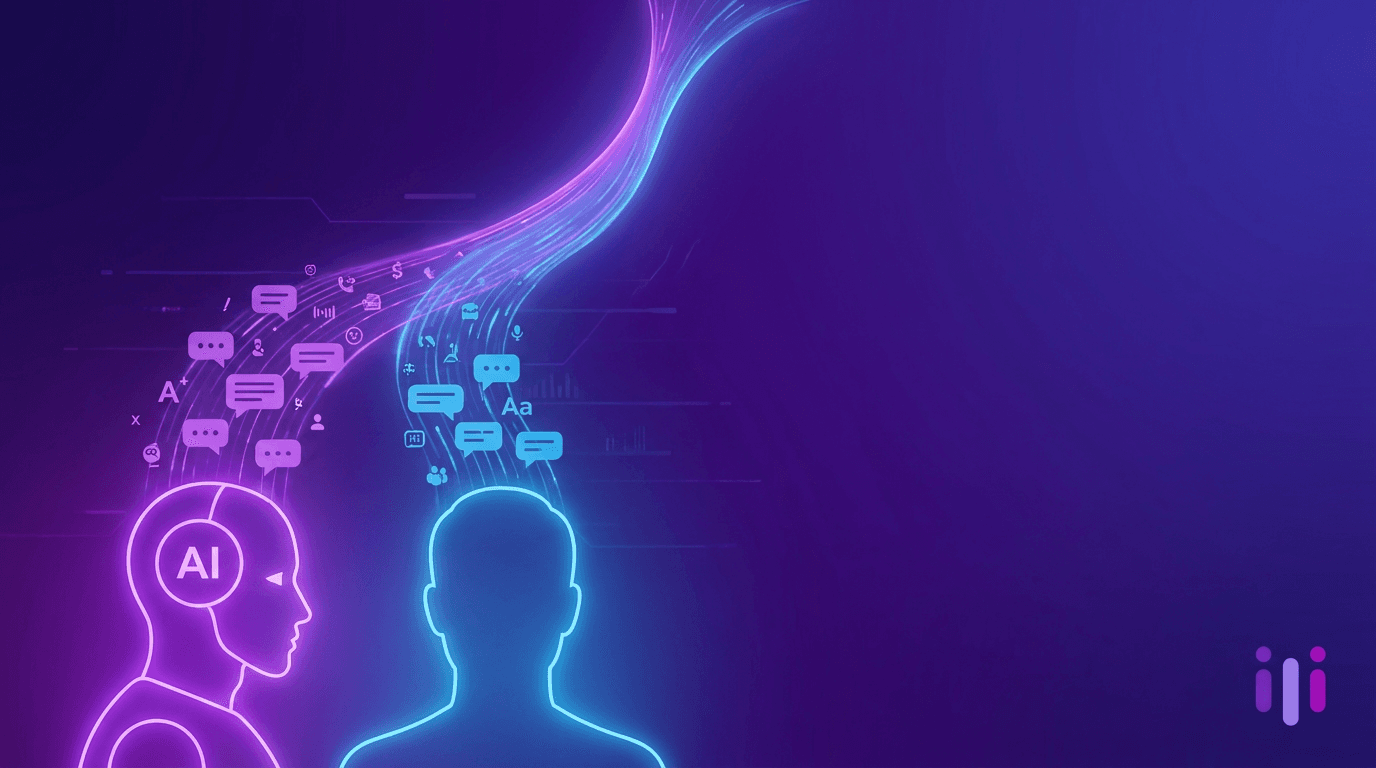
"Human-like" is the wrong design target for AI customer interviews. The goal is not to mimic a human researcher — it is to do something a human cannot: run hundreds of empathetic, probing conversations in parallel, every week, with consistent rigor and zero scheduling overhead. Vendors lean on the "human-like AI interviews" pitch because it's familiar, but the metric that actually matters to research and product teams is insight per dollar per week, not Turing-test plausibility. Perspective AI's position: AI interviews should complement skilled human researchers, replace static surveys, and own the long tail of conversations no team has the headcount to run. The right evaluation criteria are probing depth, structured output, sample reach, and time-to-insight — not whether the bot "sounds human." If your shortlist is optimizing for vibes over volume and rigor, you are buying the wrong category.
Why Vendors Keep Claiming "Human-Like"
Vendors keep claiming "human-like" because it is the easiest story to sell to a buyer who has never run an AI interview. It maps cleanly onto a familiar mental model — the user researcher on a Zoom call — and lets a demo land in 90 seconds. But this framing misleads buyers about what the technology is actually for.
Three forces sustain the "human-like ai interview" narrative:
- Anchoring on the demo. The demo unit of measure is one conversation. It is easy to judge "did this feel human?" on a single call. It is much harder to judge "did this 400-person panel surface the three buying objections we needed to ship the pricing change?" — yet that second question is the actual job to be done.
- Researcher anxiety. "Human-like" is reassuring to research teams worried about being replaced. The honest answer — that AI interviews scale a different kind of conversation, not a substitute for senior moderators — is harder to sell.
- AI hype gravity. Generative AI marketing rewards anthropomorphic claims. "Talks like a person" gets clicks. "Captures structured longitudinal qualitative signal at 50x the throughput of moderated research" does not, even though the second one is what actually changes a roadmap.
The result: a category framed around a false benchmark. We see this same pattern in the broader AI conversations category — buyers evaluating on vibes when they should be evaluating on output structure and reach.
What Human Interviewers Actually Do Well
Human interviewers excel at high-stakes, low-volume, ambiguity-heavy work that benefits from years of pattern recognition and lived rapport. AI interviews should not try to compete on this turf.
A good human moderator brings:
- Strategic framing. Knowing which question to ask next based on a five-year mental model of the product, the market, and the participant's industry.
- Trust under stress. A grieving customer, a churned enterprise champion, a regulator-adjacent interview — these need a person.
- Improvisational reframing. Realizing mid-interview that the entire research question was wrong and pivoting the script. AI can probe and follow up, but it does not (yet) rewrite its own outline mid-call.
- Synthesis with stakeholder context. Walking into a leadership meeting and saying "you are about to greenlight the wrong feature, here is why, with three quotes." AI can prep that briefing — it cannot deliver it in the room.
These are not capabilities AI should chase. They are capabilities AI should free up by absorbing the lower-leverage, higher-volume work that currently consumes 60–80% of a research team's calendar.
What AI Interviews Do That Humans Can't
AI interviews do four things no human interviewer can do, and these — not "sounding human" — are the real value props of the category. This is the contrarian core of the argument: stop grading AI on the human axis. Grade it on the axes where AI categorically dominates.
The interesting cells in that table are not the ones where AI is better — they are the ones where AI is categorically different. Concurrency is not "better human." It is a different physics. A team that can run 400 simultaneous conversations during a pricing test does not have a faster researcher; it has a different research operating model. We unpack that model in detail in the AI customer interviews playbook and in our analysis of why surveys lose to conversations on real research questions.
The other strategic point: the alternative AI interviews replace is not the senior moderator. It is the survey, the dropdown, the NPS box, and the unanswered "tell us why" question at the end of a churn flow. That is a much bigger market than moderated research, and AI interviews are uniquely positioned to own it. We argue this directly in the AI-first cannot start with a web form thesis.
The Right Design Goal: Complement, Not Mimic
The right design goal for an AI interview platform is to complement skilled humans by doing what they cannot — not to imitate them on what they already do well. This single reframe changes every product decision downstream.
Three implications follow from "complement, not mimic":
- Optimize for structured output, not conversational flair. A human interview ends in a 60-minute MP4 that someone has to transcribe, code, and synthesize. An AI interview should end in structured, queryable, aggregatable data — quotes tagged to themes, sentiment scored, outliers surfaced — and the raw transcript. The downstream artifact is the product.
- Optimize for probing depth, not voice realism. A great AI interview asks the second and third "why" — surfacing the constraint, the workaround, the disconfirming case. Voice realism is a nice-to-have. Probing depth is the load-bearing capability. We cover what good probing looks like in the AI moderated interviews guide.
- Optimize for fitting where humans cannot scale. The high-leverage AI interview slots are the ones humans never staff — every churn, every onboarding, every signup that doesn't convert, every NPS detractor. We map those slots in the customer feedback analysis software roundup and in the voice of customer 2026 buyer's guide.
If a vendor's roadmap is dominated by "more human-like voice" features, ask them what their thinking is on probing depth, schema enforcement, and routing. If they don't have an answer, you are looking at a demo company, not a research company.
What This Means for Research Design
Designing research around the "complement, not mimic" principle means partitioning your research portfolio by what AI does well versus what humans do well — not by who can pretend hardest.
A practical partition:
- AI-first slots (run 100% via AI, no human moderator): post-purchase intent capture, NPS follow-up, churn exit interviews, onboarding friction, feature usage probing, lost-deal win/loss screening, employee pulse, post-event feedback. These are the slots where volume, time-to-insight, and consistency matter more than rapport. See the win/loss interviews guide and the JTBD interviews playbook for two of the highest-leverage AI-first slots.
- AI-assisted slots (AI does intake, humans do depth): screening before a moderated study, pre-interview context capture, async follow-up after a moderated session. We outline this hybrid pattern in the AI moderated research guide.
- Human-only slots: founder-led discovery in a new market, executive customer advisory boards, regulator-adjacent interviews, sensitive topics where rapport materially changes signal.
The teams getting the most value from AI interviews are the ones who run this partition explicitly and don't waste cycles asking the wrong question — "is this AI as good as a human?" — about a slot where the human was never going to be staffed in the first place.
What This Means for Buyer Evaluation
Evaluating an AI interview platform on "does it sound human?" is the buyer-side equivalent of grading a forklift on whether it can dance. You are testing the wrong thing. Replace the human-likeness rubric with a four-axis evaluation that maps to real research outcomes.
The four axes that actually predict ROI:
- Probing depth — Does the AI ask the second, third, fourth "why"? Does it pick up on contradictions and circle back? Run a stress test with a deliberately vague answer ("It depends") and see what happens.
- Structured output — Does the platform produce queryable data, not just a transcript dump? Are quotes tagged, themes auto-clustered, and sentiment scored? Can you filter and export?
- Sample reach — Can you actually get to 200, 500, 2,000 conversations without scheduling? What's the participant friction profile? Inline embed, popup, voice, async — all matter.
- Time-to-insight — From last interview close to "I have a synthesis I can show my CEO" — what is the elapsed time? In hours, ideally not days.
This rubric is also documented in the AI UX research tools breakdown and the user interview software comparison guide. For research teams already running continuous discovery, the Teresa Torres-style framework operationalized with AI shows how the rubric maps to weekly cadence.
The vendor pitch you want to hear is not "our voice is indistinguishable from a human." It is "we surfaced 14 thematic clusters across 412 conversations in 11 hours, and here are the three that changed our customer's roadmap." That is what AI interviews are for.
How to Evaluate AI Interview Platforms With This Lens
Evaluate AI interview platforms by running a single scoped pilot against the four-axis rubric and ignore everything that does not move one of those axes. Here is the lightweight evaluation we recommend:
Step 1 — Pick one decision. Not "we want better customer insight." A specific decision: a pricing change, a feature kill/keep call, an onboarding redesign, a churn root-cause investigation. The decision sets the research question.
Step 2 — Define a "good answer" up front. What output would make you act? "Three named buying objections with quotes and frequency." "A ranked list of onboarding drop-off causes with severity." Without this, you cannot score any vendor's output.
Step 3 — Run the same study on two platforms in parallel. Same outline, same audience, same week. Now you have a comparable artifact, not a vibes-based demo memory.
Step 4 — Score the output, not the demo. Probing depth (did it follow up?), structured output (can you query it?), sample reach (did you hit your N?), time-to-insight (did you finish in the same week?). Whoever wins on output wins, regardless of voice quality. We have written a longer version of this evaluation in the AI qualitative research guide and applied it specifically to product teams in the AI product feedback tools 2026 buyer's guide.
Step 5 — Stop grading on human-likeness. It is not predictive. There is empirical work on this in adjacent domains — Harvard Business Review on AI augmentation versus replacement makes a similar point in creative work: the ROI shows up in the augmentation pattern, not in the simulation pattern.
If you want a guided evaluation, Perspective AI's interviewer agent is built explicitly around this rubric, and our comparison index frames every category competitor on the four axes rather than the human-likeness axis.
Frequently Asked Questions
Are AI interviews trying to replace human user researchers?
No. AI interviews are designed to absorb the high-volume, lower-rapport conversational work that human researchers do not have the bandwidth to run — every churn, every NPS detractor, every onboarding cohort, every lost deal. Senior researchers stay focused on strategy, synthesis, and the high-stakes interviews where human rapport materially changes signal. The realistic future is augmented research teams covering 10–100x the surface area, not smaller research teams.
Why is "human-like" the wrong benchmark for AI interviews?
"Human-like" is the wrong benchmark because it grades AI on a single conversation, when the actual value of AI interviews is concurrency, consistency, structured output, and near-zero marginal cost of one more interview. A research team that runs 400 conversations in a week through AI is not running 400 "almost as good as a human" calls — it is running a categorically different research operating model. The evaluation rubric should be probing depth, structured output, sample reach, and time-to-insight.
What can AI interviews do that human interviewers cannot?
AI interviews can run hundreds of conversations simultaneously, maintain identical probing logic across every participant, deliver structured coded transcripts in seconds rather than days, and operate 24/7 across time zones at near-zero marginal cost per interview. Human interviewers cannot match any of these capabilities. The point is not that AI is "better" than humans — it is that AI is different, and that difference unlocks research questions humans were never going to staff.
What can human interviewers do better than AI?
Human interviewers are better at strategic framing, building trust in high-stakes or sensitive interviews, improvisational reframing of an entire research question mid-call, and synthesizing findings with full stakeholder and political context. AI interviews are not yet competitive on these axes, and they should not try to be. The right design goal is to free human researchers from volume work so they can spend more time on the work only they can do.
How should I evaluate an AI interview platform if not on human-likeness?
Evaluate on four axes that actually predict ROI: probing depth (does it ask the second and third "why"?), structured output (can you query results, not just read transcripts?), sample reach (can you hit 200–2,000 conversations without scheduling?), and time-to-insight (hours, not days, from last interview to synthesis). Run a real study on two platforms in parallel, score the artifacts, and ignore the demo theatrics.
Do "human-like AI interviews" still have a role?
Yes — voice realism, conversational naturalness, and emotional tone all reduce participant friction and improve completion rates, which feeds the sample-reach axis. The point is not that human-likeness is irrelevant. The point is that it is an input to one of the four axes, not the headline benchmark. A platform that is exquisitely human-like but cannot probe, cannot structure output, and cannot scale is a worse purchase than a slightly less human-sounding platform that wins on all four axes.
The Bottom Line
The right target for AI customer interviews is not "indistinguishable from a person." It is "produces decision-grade insight at a volume, cadence, and cost no human team can match." Buyers who chase the human-like benchmark will end up paying a premium for a category that is, fundamentally, surveys with better dialogue. Buyers who use the four-axis rubric — probing depth, structured output, sample reach, time-to-insight — will pick platforms that actually change roadmaps, reduce churn, and shorten the loop between customer and decision.
That is the bet behind Perspective AI. We are not building "the AI that sounds most human." We are building the platform that runs the conversations no team has the headcount to run, and turns them into structured, queryable, decision-grade insight in the same week. If you are evaluating human-like ai interviews and your shortlist is optimizing for voice realism over output rigor, you are buying the wrong thing. Start a research study, talk to the interviewer agent, or see how we compare — and bring the four-axis rubric with you.
More articles on AI Conversations at Scale
Human-Like AI Interviews: What Makes Conversational AI Feel Human (And When It Shouldn't)
AI Conversations at Scale · 14 min read
Experience Management (XM) in 2026: What the Category Promised and What It Delivered
AI Conversations at Scale · 18 min read
Customer Experience Chatbots: The Two Kinds, and Why Only One Actually Improves CX
AI Conversations at Scale · 11 min read
Customer-Facing AI Doesn't Have to Mean a Chatbot That Deflects You
AI Conversations at Scale · 11 min read

Stripe's AI Strategy: What It Signals for Every SaaS Company in 2026
AI Conversations at Scale · 13 min read

Generative AI for Education Should Listen First, Not Just Generate
AI Conversations at Scale · 12 min read