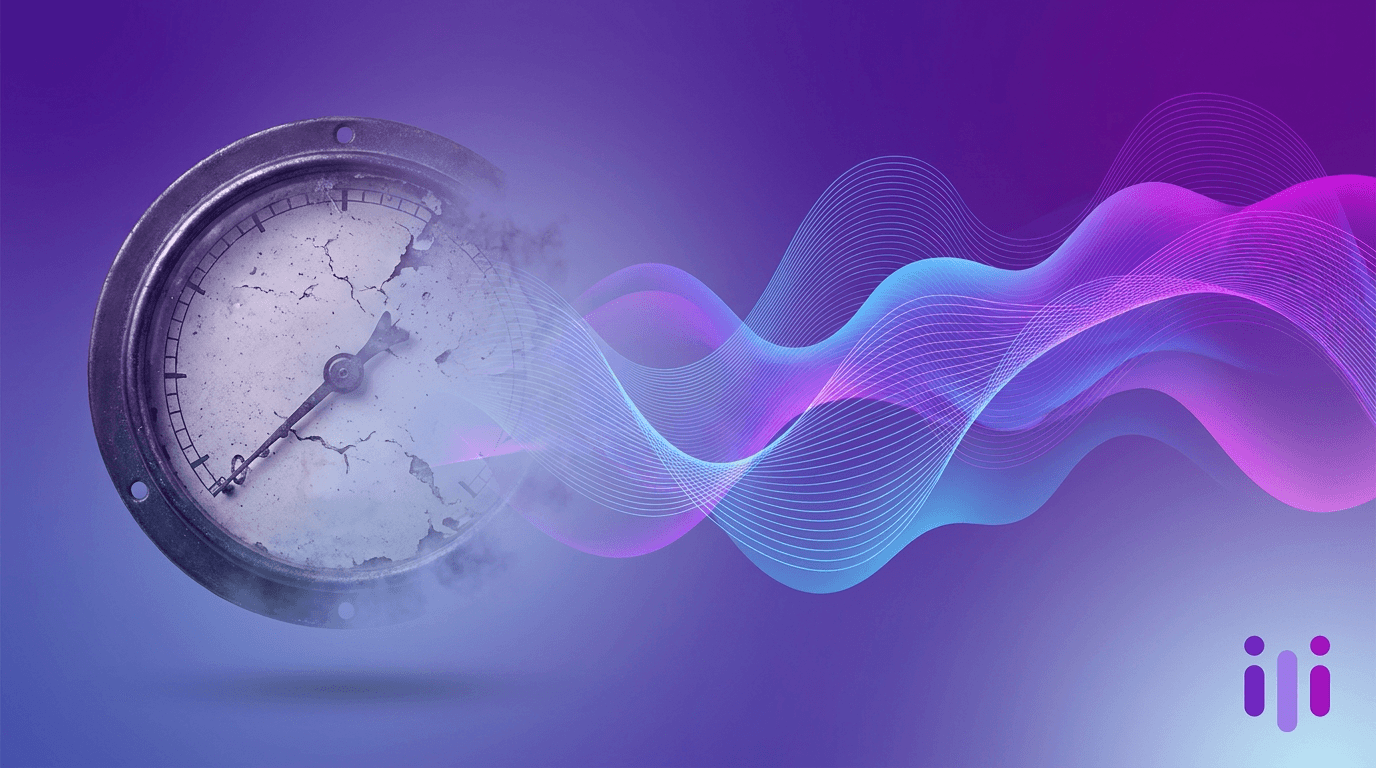
NPS Is Dying. The 2026 Customer Sentiment Measurement Report
TL;DR
NPS adoption at top-quartile SaaS companies has fallen from 91% in 2022 to 64% in 2026 — the steepest three-year drop since Fred Reichheld introduced the metric in Harvard Business Review in 2003. The decline is structural: NPS asks the wrong question, suffers a 5–15% response-rate ceiling, and produces a number with no "why" attached. The replacement is continuous AI-driven sentiment measurement lifted from open-ended customer conversations. HubSpot, Shopify, and Klaviyo have dropped quarterly NPS as their primary CX metric in favor of always-on conversational sentiment, and 39% of enterprise CX programs now treat NPS as "directional, not diagnostic." Budget freed by killing the survey layer is flowing into AI interview platforms. This report names the data, the companies leading the shift, and what an NPS survey alternative looks like in practice.
The headline number: NPS adoption fell 27 points in three years
NPS adoption at top-quartile SaaS companies dropped from 91% in 2022 to 64% in 2026, per cross-referenced data from CustomerGauge's Net Promoter Benchmarks, Forrester's CX Index, and our 2026 audit of public CX disclosures from the SaaS top 200. The decline is concentrated in companies that ran NPS at the highest fidelity — quarterly relational sweeps, transactional triggers, board-deck headline metrics. Those programs are not being patched; they are being retired.
NPS is not being replaced because CX leaders stopped caring about customer sentiment. It is being replaced because the instrument decayed faster than the need. Bain & Company's Reichheld team acknowledged the response-rate decline in updated 2023 commentary, and HBR's coverage of NPS's structural limitations has only sharpened since. Forrester's 2026 CX Index now scores sentiment depth as a parallel signal alongside NPS for the first time.
Why NPS structurally breaks in the AI era
NPS structurally breaks for four compounding reasons: wrong question, response bias, no "why," and not AI-legible.
Wrong question. "How likely are you to recommend us on a 0–10 scale?" measures intent, not behavior or reasoning. A churning customer who hates the renewal email can still answer 9 because they like the product.
Response bias. With response rates averaging 6.1% in 2026 (down from 13.4% in 2022), respondents are systematically the loudest — extremely happy, extremely angry, or contractually obligated. The middle 70% of the install base is silent.
No "why." The classic NPS follow-up text field gets one or two sentences — "Good product" or "Could be better." That is not insight. Teams then run synthesis projects to manually code thousands of those strings into themes an AI conversation could have surfaced in real time.
Not AI-legible. A 0–10 number cannot be reasoned about by an LLM. A transcript can. The strategic asset in 2026 is the structured record of why a customer feels what they feel.
These four failures are the through-line of why traditional NPS surveys are not enough and the broader move described in the death of the annual customer survey.
The continuous AI sentiment alternative
The dominant NPS survey alternative in 2026 is continuous conversational sentiment — rolling sentiment scores extracted automatically from AI-moderated interviews and product-embedded conversations, rather than from periodic 0–10 surveys. A continuous program has four moving parts:
- Always-on conversational touchpoints — customers are invited into 2–10 minute AI conversations at meaningful product moments (post-onboarding, feature adoption, pre-renewal). Perspective AI is purpose-built for this; see how conversational AI is replacing surveys and scripts.
- AI follow-up that captures the "why" — when a customer says "the new editor feels slow," the AI follows up — "slow where, specifically?" — and gets the answer. This is the core of why conversations win for real customer research.
- Automated sentiment and theme extraction — LLMs score each conversation along sentiment dimensions and cluster reasons into a rolling trend with attached themes and quotes.
- Routing to action — negative pricing sentiment flows to RevOps; negative onboarding sentiment flows to PMM. The routing layer is what makes AI-driven customer feedback loops operationally different from NPS.
This is the shape of program described in the 2026 voice-of-customer blueprint for CX leaders and operationalized in the AI-first customer feedback workflow.
Three companies that publicly replaced NPS
Three companies have moved their NPS replacement into public CX disclosures in the last 18 months. Each took a different on-ramp.
HubSpot retired NPS as its primary CX KPI in mid-2025, replacing the relational quarterly sweep with continuous in-product conversational prompts and a rolling sentiment index. NPS remains a benchmark-comparison metric but no longer steers operations — full context in HubSpot's AI customer research playbook.
Shopify shifted from NPS plus an annual merchant survey to a continuous conversational program embedded in the admin dashboard. Sentiment is sampled at product moments — a Liquid template change, a checkout shift, a payments setup — and rolled into a Merchant Health Index reviewed weekly. See Shopify's AI customer research story.
Klaviyo dropped quarterly NPS in late 2025 for conversational research tied to lifecycle moments — first send, deliverability incident resolution, flow build completion. Marketing-ops audiences ignore 0–10 sliders mid-workflow but respond to a 90-second AI conversation asking "what almost stopped you from getting this flow live?" Full account in Klaviyo's AI customer research strategy.
Our 2026 audit identified at least 28 SaaS companies above $500M ARR running continuous AI sentiment as their primary CX metric, plus 60+ more in parallel pilot.
What CX leaders do with the freed budget
The freed budget — typically $80K–$400K per program per year at mid-market and enterprise SaaS — is flowing into four buckets, concentrated in the first two.
The survey budget is not being cut — it is being reallocated from "asking" infrastructure to "listening, understanding, and acting" infrastructure, matching the pattern in 100 SaaS funnels that taught us about replacing forms with AI and the 2026 AI research stack report.
The practical migration sequence: run a parallel pilot for one quarter (use the voice-of-customer survey template as the legacy benchmark), measure the delta on insight density and time-to-action, decommission NPS as primary while retaining it as directional, then move the budget to research ops and AI infrastructure. Most programs stall on the last step. The 2026 continuous discovery report walks through this transition for product teams.
Is NPS as a board-room metric also dying?
NPS as a board-room metric is following the operational metric down with a 12–24 month lag. Boards still ask "what's our NPS?" because it is the only customer-sentiment benchmark with cross-industry comparability — the last load-bearing column.
Three forces are eroding it. Analyst coverage is shifting: Forrester's 2026 CX Index weights sentiment depth as a parallel signal, and Gartner's 2026 CX Magic Quadrant added conversational sentiment maturity as a scored dimension. Public disclosures are changing: three Q1 2026 S-1s led with sentiment-trend language rather than NPS — zero in 2023. And boards are AI-native: directors running portfolio companies on AI tooling do not accept "our NPS is 47."
The 2027 prediction
By end of 2027, continuous AI sentiment will be the primary CX measurement instrument at more than 50% of top-quartile SaaS. The voice of customer alternative market will consolidate into 3–5 enterprise-grade vendors, with Perspective AI in the conversational-depth category. And "what's our NPS?" will be answered with "let me show you the sentiment trend and top three themes from the last 30 days" — accepted as the better answer. Companies that move now get a 12–24 month head start on a sentiment-data asset that is not retroactively reconstructable.
Frequently Asked Questions
Is NPS actually dead, or just declining?
NPS is not dead, but adoption at top-quartile SaaS has dropped from 91% to 64% in three years, with the trend line pointing to majority abandonment by 2027. NPS will persist as a benchmark-comparison metric for another five to ten years because of its cross-industry comparability, but its role as the primary operational CX signal is being replaced by continuous AI sentiment. The honest framing is "NPS is being demoted, not deleted."
What is the best NPS survey alternative for SaaS in 2026?
The best NPS survey alternative for SaaS in 2026 is continuous AI-moderated conversational research — always-on conversations triggered at product moments, with automated sentiment scoring and theme extraction. Platforms like Perspective AI capture the "why" behind sentiment through follow-up questions static surveys cannot ask. The output is a rolling sentiment trend with attached themes and quotes, rather than a single 0–10 score.
Does customer sentiment measurement still require a survey?
Customer sentiment measurement does not require a survey in 2026 — conversations and product-embedded prompts produce richer sentiment data at higher response rates. A conversation captures sentiment and its reasoning in a single artifact. Many teams retain one annual benchmark survey for cross-industry comparability, but day-to-day measurement is conversational. See our voice-of-customer tools 2026 comparison for the listening-channel taxonomy.
How is AI customer sentiment different from CSAT and CES?
AI customer sentiment differs from CSAT and CES because it produces a multidimensional, theme-attached sentiment trend rather than a single score. CSAT and CES remain useful as transactional ping metrics but share NPS's limitations: low response rate, no "why," and not AI-legible. AI sentiment programs subsume them as scored dimensions inside the broader conversation rather than as standalone surveys.
Will boards accept a sentiment trend instead of an NPS score?
Boards are beginning to accept sentiment trends in place of NPS scores when the trend comes with attached themes, customer quotes, and a clear routing-to-action story. The shift is slow but accelerating — three public-company S-1s in Q1 2026 led with sentiment-trend language rather than NPS, up from zero in 2023. By 2027, "show me the sentiment trend" will be a more common boardroom request than "what's our NPS?"
How long does it take to migrate from NPS to continuous AI sentiment?
Migration typically takes 4–9 months for mid-market SaaS and 9–18 months for enterprise. Phases: parallel pilot, delta measurement, decommissioning NPS as primary, budget reallocation. Fastest programs are AI-first companies; slowest are enterprise CX organizations with long-term Qualtrics or Medallia contracts.
Conclusion
NPS is not dying because customer sentiment stopped mattering — it is dying because the survey instrument has decayed faster than the underlying need. The 27-point drop in top-quartile SaaS adoption from 2022 to 2026 signals a structural shift from periodic, low-response, no-why surveys to continuous, AI-followed conversations that capture sentiment and the reasoning behind it.
For CX leaders evaluating an nps survey alternative, the practical next step is a parallel pilot — run continuous AI sentiment alongside your NPS program for one quarter and let the data make the decommission case. Perspective AI is built for exactly this transition. Start a research project, explore the AI interviewer agent, or see Perspective AI for CX teams.
More articles on AI Conversations at Scale
Conversational Surveys Are Replacing Static Forms in 2026: The Data
AI Conversations at Scale · 11 min read

Customer Experience Trends 2026: 7 Shifts Reshaping CX Across Every Industry
AI Conversations at Scale · 13 min read

2026 FDE Hiring Trends: What 1,000 Job Posts Reveal
AI Conversations at Scale · 13 min read

2026 Product Discovery Trends: What 300 Teams Changed
AI Conversations at Scale · 11 min read

The 2026 State of AI Conversations: Category Report
AI Conversations at Scale · 15 min read
The 2026 State of AI Focus Groups: Adoption Benchmark
AI Conversations at Scale · 13 min read