Automated Focus Groups: End-to-End AI Research From Brief to Board-Ready Deck
TL;DR
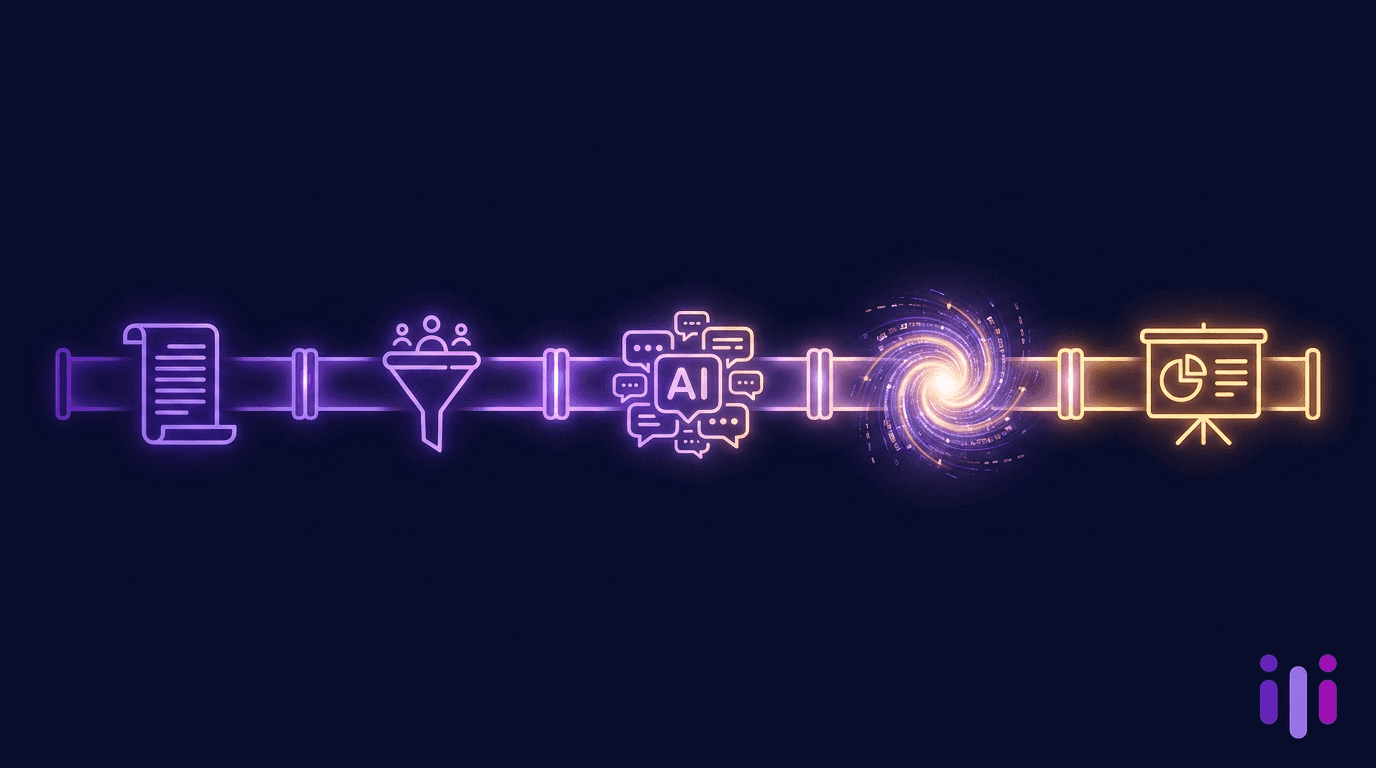
Automated focus groups run the entire qualitative research workflow — brief, recruit, moderate, synthesize, report — with AI doing the labor and humans doing the judgment. A traditional focus group project takes 4–6 weeks and $15,000–$40,000 per study; an automated study runs in 4–6 days at one-tenth the cost while sampling 100–800 participants instead of 8. Research leaders cite synthesis time and recruiting friction as their top blockers, with 38% of insights teams reporting they cannot keep up with stakeholder demand. Automation does not mean removing humans; it reroutes human effort to the four decisions that still matter — defining the research question, judging the synthesis, picking what to ship, and owning the recommendation. Perspective AI runs all five stages on one platform with AI moderators, real-respondent panels, and Magic Summary synthesis.
What "automated" actually means (and where humans still matter)
Automated focus groups are end-to-end AI-run qualitative studies where software handles brief generation, recruiting, moderation, synthesis, and reporting — leaving humans to define the research question and validate the strategic interpretation. The word "automated" does not mean "no humans"; it means the labor-intensive steps that used to consume a researcher's week now run themselves while the researcher focuses on the decisions machines cannot make.
Research budgets are not actually constrained by money — they are constrained by researcher hours. A team fielding 8 studies per quarter is bottlenecked at moderation and synthesis. Automate those two stages and the same team can field 80.
The five stages below mirror what every qualitative project has always required. Throughout, we'll point to where Perspective AI fits and how this compares to the traditional 8-person conference room and AI-first qualitative methodology more broadly.
The pain: why traditional focus groups break under modern decision speed
Traditional focus groups break because they were designed for a 1980s decision cycle and have not been re-engineered for one in which product teams ship weekly. The format assumes a linear research-then-decide cadence: write a brief, hire a recruiter, book a facility, fly in a moderator, transcribe tapes, code transcripts, build a deck. Six weeks and $25,000 later, the brief is stale.
Three failure modes recur across every research org:
- Recruiting friction. Specialty B2B or vertical panels take 2–3 weeks to fill. By the time the study runs, the strategic question has moved.
- Moderator-hour scarcity. Senior moderators bill $200–$400/hour. Their calendars ration the total volume of qualitative a team can field.
- Synthesis bottleneck. NN/g's research operations benchmark puts qualitative synthesis at 60–75% of total project time.
Each is a labor problem, not an insight problem. Automating each removes the labor without removing the rigor.
Stage 1: Brief and outline
The brief stage converts a stakeholder request into an executable research outline. AI accelerates the format; humans own the strategic question.
What AI does: Translate a research goal into a structured discussion guide with primary questions, follow-up probes, and disqualifying screeners. Generate hypothesis lists from prior research. Flag ambiguous questions. Pull related insights from past studies.
What humans still do: Decide what decision the research is informing. Set the threshold for "we have enough to decide." Articulate the bet — what would change about the roadmap if the answer is X vs Y. AI can write a great outline from a clear brief; it cannot tell you what bet you're trying to settle.
In Perspective AI, this is the research outline builder, where teams draft a study in 10–20 minutes by editing AI-generated questions. For teams running continuous product discovery, briefing becomes a 30-minute weekly ritual rather than a multi-week kickoff.
Stage 2: Recruitment
The recruitment stage gets qualified participants into the study. AI handles matching, throttling, and screening; humans approve panel composition.
What AI does: Send conversational screeners to first-party customer panels and external panels. Score responses against inclusion criteria in real time. De-duplicate against last-90-days participants. Adjust quotas dynamically as the panel fills. Detect low-quality respondents through response-quality scoring.
What humans still do: Define qualifying segments. Decide whether to lean on first-party panels or external recruits. Approve incentive structure. Make the call when panel composition trades sample diversity for speed.
The Concierge agent runs screeners as conversations rather than dropdown forms, raising completion rates 2–3x compared to form screeners — the same pattern documented across conversational data collection methodology. For B2B research where panels are scarce, automating recruiting from your own customer base — running the Advocate agent on a CSV of accounts — typically fills a 100-person panel in 48–72 hours.
Stage 3: AI moderation
The moderation stage is where the AI runs the conversation: probing for "why," recovering from off-topic detours, handling vague answers, and pacing each interview. This is the stage that used to cap qualitative volume.
What AI does: Run hundreds of 1:1 interviews simultaneously over async text or voice. Probe vague answers, follow up on emotionally loaded language, ask respondents to clarify jargon, and pivot when an unexpected theme emerges. Maintain the discussion guide structure while adapting to each respondent's context. Flag low-effort or fraudulent responses in real time.
What humans still do: Review a sample of transcripts mid-study to verify the AI is staying on-strategy. Adjust the outline mid-study if a recurring theme suggests the original questions are missing the real story. Decide when to stop the field — most studies converge on themes by N=40–60 even when the panel allows N=200.
The Interviewer agent is the moderation surface in Perspective AI. The mechanics that distinguish good AI moderation from bad — probe quality, follow-up timing, off-topic recovery — are documented in the mechanics of good AI interviewing.
A traditional moderator runs 6 1:1 interviews per day at $300/hour. An AI moderator runs 600 simultaneously at marginal cost. This is what makes scaling qualitative from N=8 to N=800 viable for the first time.
Stage 4: Synthesis
The synthesis stage turns transcripts into themes, quotes, and insight clusters. Historically the slowest stage; now the most automatable.
What AI does: Auto-code transcripts against the discussion guide and surface emergent themes the guide did not anticipate. Cluster verbatims by theme, sentiment, and respondent segment. Extract verbatim quotes with full attribution. Detect contradictions across respondents. Quantify theme frequency ("47 of 120 respondents mentioned pricing as a deal-breaker"). Generate a first-pass executive summary.
What humans still do: Validate that AI-surfaced themes are the strategically important ones (an emergent theme can be both real and irrelevant). Reconcile contradictions between segments. Decide which findings warrant a recommendation versus another study. Add the strategic interpretation — the "so what" — that depends on knowing the company's roadmap.
In Perspective AI, this is the Magic Summary stage. Synthesis that used to take a week now lands in under an hour after field close. The deeper mechanics live in AI focus group analysis and the AI-first feedback analysis workflow.
Stage 5: Report and stakeholder readout
The report stage packages findings for the stakeholders who will act on them. AI drafts the deck; humans own the recommendation.
What AI does: Generate a board-ready deck from the synthesis, with theme summaries, supporting quote galleries, charts of theme prevalence by segment, and a recommended-actions appendix. Tailor framing for different audiences. Generate companion artifacts: a one-page exec brief, a Slack-ready summary, a research-repository entry tagged for future search.
What humans still do: Make the recommendation. Decide which 2–3 findings get presented and which get filed. Defend the methodology when stakeholders push back. Own the call to ship, not ship, or run a follow-on study.
This is where automation has historically been weakest — AI can code transcripts but not write the strategic narrative. What AI does change is time-to-readout: a study that closes Tuesday morning can be presented Wednesday afternoon. The Voice of Customer blueprint covers how this stage feeds a recurring CX cadence rather than a one-off project.
What you save: time, money, and decision-cycle weeks
Automation does not just save line-item costs; it changes the decision cadence of the company that adopts it.
A traditional focus group runs $15,000–$40,000 per study. The same study run as automated AI focus groups runs $1,500–$4,000 — and sample size goes from N=8 to N=100–800.
The most important shift is decision-cycle compression. When a study runs in a week instead of two months, research becomes a real input to strategy rather than a retrospective justification. One product team running continuous product discovery reports 12 automated studies per quarter at the budget that previously funded 2 traditional focus groups — feeding output directly into their feature prioritization framework.
Frequently Asked Questions
What's the difference between automated focus groups and synthetic focus groups?
Automated focus groups use AI to moderate conversations with real human respondents, while synthetic focus groups use AI to simulate fictional respondents based on personas. The two produce fundamentally different output. Automated studies capture genuine human reasoning, surprise, and emotion; synthetic studies reflect the LLM's training data filtered through a persona prompt. For decisions that depend on what real customers actually think, you need real respondents — see why synthetic focus groups can't replace real customer research.
How long does an automated focus group study take from brief to readout?
Most automated studies take 4–8 days from brief approval to stakeholder readout, compared to 5–8 weeks for traditional focus groups. The breakdown is typically 30 minutes for the brief, 2–3 days for recruitment, 3–5 days in field, and a few hours for synthesis and deck generation. Teams running first-party customer panels often compress this further by running back-to-back studies on a weekly cadence.
Can automated focus groups replace all qualitative research methods?
No, automated focus groups are the right default for most qualitative research questions but not all. Sensitive ethnography, high-stakes regulated studies, and intentional group-dynamics research still benefit from traditional methods. For roughly 90% of B2B and B2C research questions — concept testing, message testing, churn root cause, JTBD research, pricing sensitivity — automated focus groups produce equivalent or deeper insight at one-tenth the cost.
How much does an automated focus group cost compared to a traditional one?
A traditional 8-person focus group typically costs $15,000–$40,000 per study including recruiting, facility, moderator, transcription, and analysis. An automated focus group with N=100–800 participants typically runs $1,500–$4,000 per study. The per-respondent cost falls roughly 50–100x while sample size grows 10–100x.
What does a researcher's job look like when focus groups are automated?
The researcher's job shifts from operating the workflow to designing it and judging the output. Less time goes to scheduling, recruiting, and transcript coding; more time goes to defining the strategic question, validating the AI's interpretation, and translating findings into recommendations. Most teams report researchers field 3–5x more studies per quarter while spending more concentrated time on the studies that matter most.
Conclusion
Automated focus groups are not a faster version of the old format; they're a different operating model for qualitative research. AI runs the brief, the recruitment, the moderation, the synthesis, and the reporting — and humans run the strategy, the judgment, and the recommendation. The labor-intensive stages that used to ration how much research a team could field now run themselves, freeing researchers to ask more questions and act on more answers.
Teams running this model today are fielding 50–100 studies per quarter on the budget that funded a handful before. The gap between teams running automated focus groups and teams still booking conference rooms is widening every quarter — because the operational advantage compounds.
Perspective AI runs all five stages — brief, recruit, moderate, synthesize, report — on one platform built for this workflow. Start a study, see how automated AI focus groups run end to end, or browse our research surfaces to see what this looks like in practice.
More articles on AI Conversations at Scale
AI for CX: A 90-Day Rollout Sequence for Teams Starting From Surveys
AI Conversations at Scale · 14 min read
Survey-Based CX Measurement vs Conversational VoC: Why the Model Is Shifting in 2026
AI Conversations at Scale · 13 min read
Streaming & Media Customer Experience in 2026: Beating Subscriber Churn
AI Conversations at Scale · 12 min read
How Conversational AI Platforms Boost CSAT: A 2026 Buyer's Guide
AI Conversations at Scale · 13 min read
AI Tools for Customer Behavior Analysis in 2026, Compared
AI Conversations at Scale · 13 min read
Forms and Workflow Software in 2026: When to Upgrade to Conversations
AI Conversations at Scale · 16 min read