How to Reduce Customer Churn in 2026: A Modern SaaS Playbook
TL;DR: Key Takeaways
- Churn reduction in 2026 is fundamentally a signal density problem, not a product problem. Most B2B SaaS teams don't churn because their product is bad — they churn because they're flying blind inside customer accounts.
- The median B2B SaaS company runs gross revenue retention (GRR) around 91% according to the Gainsight 2024 Customer Success Index, but top-quartile companies sit above 95% — a gap worth tens of millions in enterprise ARR.
- Usage telemetry is necessary but insufficient. The leading indicators that actually predict churn are relationship health, sentiment, and strategic alignment — none of which show up in product analytics.
- NPS and satisfaction surveys generate response rates of 5-15% and rarely capture the "why." AI-led customer conversations close that diagnostic gap by running structured interviews at scale.
- A modern playbook has five pillars: measurement clarity, leading indicators, diagnostic loop, differentiated save plays, and a closed feedback loop into product, CS, and sales.
Why Most "Reduce Churn" Advice Fails
Search "how to reduce customer churn" and you'll get the same eight tips repackaged across a thousand blogs: improve onboarding, run QBRs, send NPS surveys, build a community, train your CSMs. None of this is wrong. All of it is tactical.
The problem is architectural. Churn is a signal-density problem, not a tactic-execution problem. Most CS organizations operate with a roughly 30:1 customer-to-CSM ratio at the mid-market tier and 100:1+ at the long-tail tier (per TSIA's 2024 Customer Success benchmark). A CSM managing 100 accounts cannot manually diagnose health on each one. So they rely on:
- Usage data — which tells you what people did, not why they did it.
- NPS/CSAT surveys — which get 5-15% response rates and capture sentiment from the loudest, not the most representative.
- QBR notes — which are quarterly snapshots written by the person whose comp depends on the account staying.
This is low signal density. And no amount of "better onboarding" fixes a measurement system that can't see the iceberg before the ship hits it.
The companies that genuinely reduce churn in 2026 will do it by increasing the resolution of what they know about customers — not by adding another CSM or another tactic. That's the playbook below.
Defining Churn Properly Before You Try to Reduce It
You can't reduce what you can't measure cleanly. Most "we need to reduce churn" conversations conflate four very different metrics. Get this wrong and your save plays fire on the wrong customers.
Gross vs. Net Retention
Gross Revenue Retention (GRR) measures how much of last year's ARR you kept, excluding expansion. It cannot exceed 100%. Best-in-class B2B SaaS sits at 92-97% (Gainsight 2024 CS Index). It's the cleanest measure of churn health.
Net Revenue Retention (NRR) includes expansion. Top-quartile public SaaS companies report NRR of 115-130% (per OpenView's annual SaaS benchmarks). NRR is a growth metric. It can mask a churn problem if your expansion engine is hot.
If your NRR is 118% and your GRR is 84%, you do not have a healthy retention business. You have a leaky bucket with a fire hose pointed at it.
Voluntary vs. Involuntary Churn
Voluntary churn is when a customer actively decides to leave. Involuntary churn is failed payments, expired cards, billing issues. Recurly and ProfitWell research consistently shows involuntary churn accounts for 20-40% of total churn in subscription businesses — and it's the cheapest to recover. Card updaters, dunning sequences, and retry logic typically recover 30-50% of failed transactions.
Fix involuntary churn first. It's free money.
Logo vs. Revenue Churn
A 5% logo churn rate where you're losing your smallest customers is very different from a 5% revenue churn rate concentrated in your enterprise tier. Cohort by ARR band before drawing conclusions.
The 5-Pillar Churn Reduction Playbook
Here is the architecture. Each pillar increases signal density at a different layer of the stack.
Pillar 1: Measurement Clarity
What: Define your churn metrics with the precision a CFO would respect.
How: Build a churn taxonomy that separates GRR/NRR, voluntary/involuntary, and logo/revenue. Tag every churn event with a structured reason code (price, product fit, competitor, sponsor change, M&A, business closed, executive priority shift). Audit the codes quarterly — if "other" exceeds 15%, your taxonomy is broken.
Example: A mid-market PLG company we worked with discovered that 38% of their "product fit" churn was actually sponsor change churn — their original champion left and the new buyer didn't see value. That's a fundamentally different save play than a product gap.
Pitfall: Letting CSMs free-text the churn reason. You'll end up with 400 unique strings and no analyzable signal.
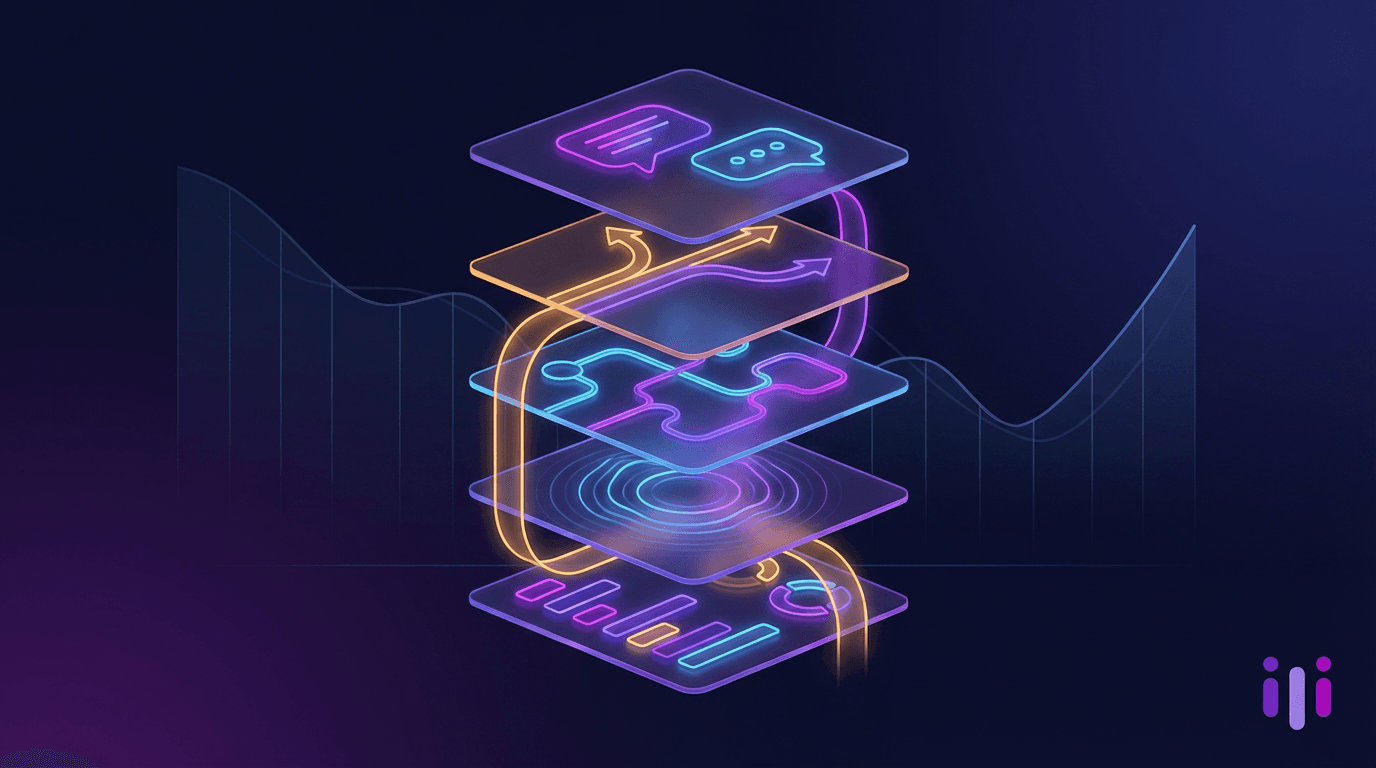
Pillar 2: Leading Indicators Across Three Layers
What: Most teams track product usage and call it a health score. That's one layer of three. The other two — relationship and strategic — are where the real predictive power lives.
How: Build a layered health model:
The strategic layer leads churn by 3-6 months. The product layer leads by 30-60 days. By the time someone stops logging in, you're triaging a corpse.
Example: Forrester's 2024 CX research notes that 70%+ of B2B churn signals are visible 90+ days before the cancellation event — but most of them are qualitative, not in your product analytics.
Pitfall: Weighting product usage at 60-70% of your health score. It's the easiest data to collect, not the most predictive. (See our deeper analysis of churn signals.)
Pillar 3: A Real Diagnostic Loop — Conversations, Not Surveys
What: This is the pillar where most playbooks collapse. You cannot diagnose relationship and strategic signals from telemetry alone. You need to talk to customers. At scale. About the right things. Continuously.
The traditional toolkit for this — NPS surveys, CSAT pulses, annual VoC programs — is broken in three predictable ways:
- Response rates are low. Industry benchmarks for in-product NPS hover at 5-15%. The 85-95% you don't hear from is exactly the population you most need to hear from.
- The "why" is missing. A score of 6 tells you nothing actionable. The free-text box gets one sentence at best.
- It's a snapshot, not a loop. Quarterly surveys catch issues quarterly. Churn doesn't wait.
This is where conversational AI changes the architecture. Perspective AI runs hundreds of structured customer interviews simultaneously, asking adaptive follow-up questions, probing on vague answers, and capturing the "why" behind sentiment. Instead of a 7/10 score, you get: "It's a 7 because our procurement team is reviewing all SaaS spend in Q2, and our champion is leaving in March — we haven't met her replacement yet."
That's a save play in a sentence. You don't get that from a survey.
How to deploy it:
- Replace your annual VoC program with continuous AI-led interviews on rolling cohorts.
- Trigger conversations on specific health events (renewal -90 days, sponsor change detected, support tickets above threshold).
- Run them across the buying committee — not just the daily user.
- Feed the structured outputs (themes, sentiment, mentioned competitors, mentioned blockers) directly into your CRM and health score.
Example: A B2B platform replaced their quarterly NPS survey with AI conversations across 2,000+ accounts and lifted their qualitative coverage from ~12% of accounts to 64% within one quarter. Their churn forecast accuracy roughly doubled.
Pitfall: Treating AI conversations as a survey replacement only. The bigger unlock is using them as a diagnostic instrument — running them at the renewal cliff, after onboarding, after a CSM change, when usage drops. (More on this in our voice of customer playbook.)
Pillar 4: Differentiated Save Plays by Churn Driver
What: A "save play" is not a single thing. It's a portfolio of plays mapped to specific churn drivers. Running the same play on every at-risk account is why most save motions have a 20-30% recovery rate when they should be hitting 40-60%.
How: Map churn driver to play:
Example: McKinsey's B2B research has documented that companies running differentiated save plays — segmented by driver, not just by account size — see 1.5-2x higher save rates than companies running uniform "discount + extra training" plays.
Pitfall: Letting the CSM choose the play based on intuition. Plays should be triggered by signal — and the signal source is Pillar 3. (See how leading teams operationalize this.)
Pillar 5: Closing the Feedback Loop Into Product, CS, and Sales
What: Churn data is the most under-utilized strategic asset in most SaaS companies. It tells you exactly where the business is leaking, and it almost never gets back to product, sales, or marketing in a structured way.
How:
- Product: Quarterly review of structured churn reasons. Anything trending up by 25%+ becomes a roadmap input. Tag feature gaps in the AI conversation outputs so PM gets verbatims, not just theme labels.
- Sales: Feed back ICP misalignment patterns. If 40% of churn comes from a specific segment, sales should stop selling there or qualify harder.
- CS: Update health-score weights monthly based on what actually predicted churn last quarter, not what you assumed at the start.
- Marketing: Use the language of churned customers (and saved ones) to rewrite messaging on competitive positioning.
Pitfall: Treating churn analysis as a CS-only project. The drivers usually originate upstream — in sales qualification, marketing positioning, or product gaps. (More on building this loop.)
The Math of Churn Reduction: GRR vs. NRR
Where should you actually focus? The math is unintuitive.
For a $50M ARR company:
- +1 point of GRR (e.g., 90% to 91%) = +$500K saved ARR + compounding effect on NRR base.
- +5 points of NRR (e.g., 110% to 115%) = +$2.5M ARR — but only if the underlying GRR is healthy.
If GRR is below 90%, every dollar spent on expansion plays is a dollar fighting a leaky bucket. GRR is foundational. NRR is multiplicative. OpenView's SaaS benchmarks make this explicit: top-quartile companies almost universally have GRR above 92% before they unlock breakout NRR.
The implication: if you're below 92% GRR, your churn-reduction investment dollars beat your expansion-investment dollars on a risk-adjusted basis. Fix the leak first.
Common Mistakes That Quietly Kill Churn Programs
- Over-relying on NPS as a leading indicator. Bain's research has consistently shown NPS correlates more strongly with brand affinity than with renewal behavior in B2B SaaS. Use it as one input, never as the primary one.
- Generic save plays. A discount is not a strategy. See Pillar 4.
- No qualitative data layer. Telemetry tells you what. Conversations tell you why. You need both, and most CS orgs only have the first.
- Annual VoC instead of continuous. Customer context shifts monthly. Annual programs catch problems 11 months too late.
- Conflating logo and revenue churn. Losing 20 small accounts and 1 enterprise account are not the same problem.
- Health scores that never get re-weighted. If your model was right two years ago and you haven't recalibrated, it's wrong now.
- Confusing the CS team with the churn team. Churn is owned by Product, Sales, CS, and Marketing collectively. CS is the last line of defense, not the only line.
For a deeper structural view of how this fits into the broader CS stack, see our 4-layer customer success stack guide.
FAQ
What's the single biggest lever to reduce customer churn in 2026?
Increasing signal density on relationship and strategic health — the two layers that lead churn by 90+ days. Most teams over-invest in product telemetry (cheap and abundant) and under-invest in qualitative diagnostics (expensive at human scale, now affordable with AI). The teams pulling ahead are running continuous AI-led customer conversations, not quarterly surveys.
Is NPS still useful for churn prevention?
NPS is useful as a directional sentiment trend, not as a churn predictor. Per Gainsight's 2024 CS Index, the correlation between NPS and renewal behavior in B2B SaaS is real but weak — somewhere in the 0.2-0.3 range. Treat it as one input among many, and never let it drive your save-play decisions on its own.
How do I reduce churn without a large CS team?
Lean teams need leverage, not headcount. Automate health scoring, automate qualitative diagnostics with AI conversations, and pre-build differentiated save plays so CSMs execute rather than diagnose. A CSM with a 200-account book can handle that load if the system surfaces the right 15 accounts to call this week.
What's the difference between churn reduction and retention strategy?
Churn reduction is defensive — preventing logo or revenue loss. Retention strategy is broader and includes expansion, advocacy, and lifetime value. You can't run a healthy retention strategy on top of an unhealthy churn baseline. Fix GRR before chasing NRR.
How quickly can a 5-pillar playbook show results?
Involuntary churn fixes (Pillar 1, billing/dunning) show results in 30-60 days. Diagnostic-loop improvements (Pillar 3) show in one renewal cycle — typically 90-180 days. Strategic feedback loops (Pillar 5) compound over 2-4 quarters. Expect a quarter of instrumentation before you see the curve bend.
Conclusion: Reduce Churn by Increasing Resolution
The blunt truth: most SaaS companies don't churn customers because their product is bad. They churn customers because they couldn't see what was happening inside the account in time to act. Churn reduction in 2026 isn't about adding another tactic — it's about raising the resolution of what you know about every customer, every week, across product, relationship, and strategic layers.
The five pillars — measurement clarity, layered leading indicators, a real diagnostic loop, differentiated save plays, and a closed feedback loop — are how you do that. Pillar 3, the diagnostic loop, is the one most teams skip and the one where modern AI tooling has changed what's possible.
Perspective AI is built for exactly this layer. Instead of running quarterly NPS surveys that capture 12% of your base with no "why," teams use Perspective AI to run hundreds of structured customer interviews simultaneously — at renewal events, after sponsor changes, after onboarding milestones — and pipe the structured "why" directly into health scores, save plays, and product roadmap. It's the missing tier between telemetry and a CSM phone call.
If your GRR is below 92%, or if your team is making save-play decisions on intuition because the data isn't there, the highest-leverage move you can make this quarter is increasing your qualitative signal density. See how Perspective AI runs continuous customer conversations at scale →
Related resources
Deeper reading:
- AI for Customer Success Is Stuck on Dashboards
- Customer Success Automation: The 4-Layer Stack
- Identifying At-Risk Customers Early
- The Complete Guide to Voice of Customer Programs
- Real-Time Customer Feedback Analysis
- Reduce Customer Churn with Perspective AI
- Why Your VoC Program Isn't Telling You the Full Story
Templates and live examples:
- Run a churn interview
- Customer journey interview
- Voice of Customer survey
- NPS survey template
- Customer satisfaction survey
For your team:
More articles on Customer Success & Churn Prevention

Customer Churn Prediction with AI: Why Models Alone Aren't Enough in 2026
Customer Success & Churn Prevention · 15 min read

Customer Success Automation in 2026: The 4-Layer Stack Every CS Org Needs
Customer Success & Churn Prevention · 13 min read
How to Identify At-Risk Customers Before They Churn (A 2026 Playbook)
Customer Success & Churn Prevention · 14 min read
AI for Customer Success Is Stuck on Dashboards. The Real Unlock Is Conversations.
Customer Success & Churn Prevention · 12 min read
Churn Prevention Software in 2026: A Buyer's Guide to the Right Stack
Customer Success & Churn Prevention · 14 min read
Pause vs Cancel in 2026: What Consumer Subscription Pause Requests Tell You
Customer Success & Churn Prevention · 24 min read