Student Feedback Surveys Are Broken: Why Schools Are Switching to AI Conversations
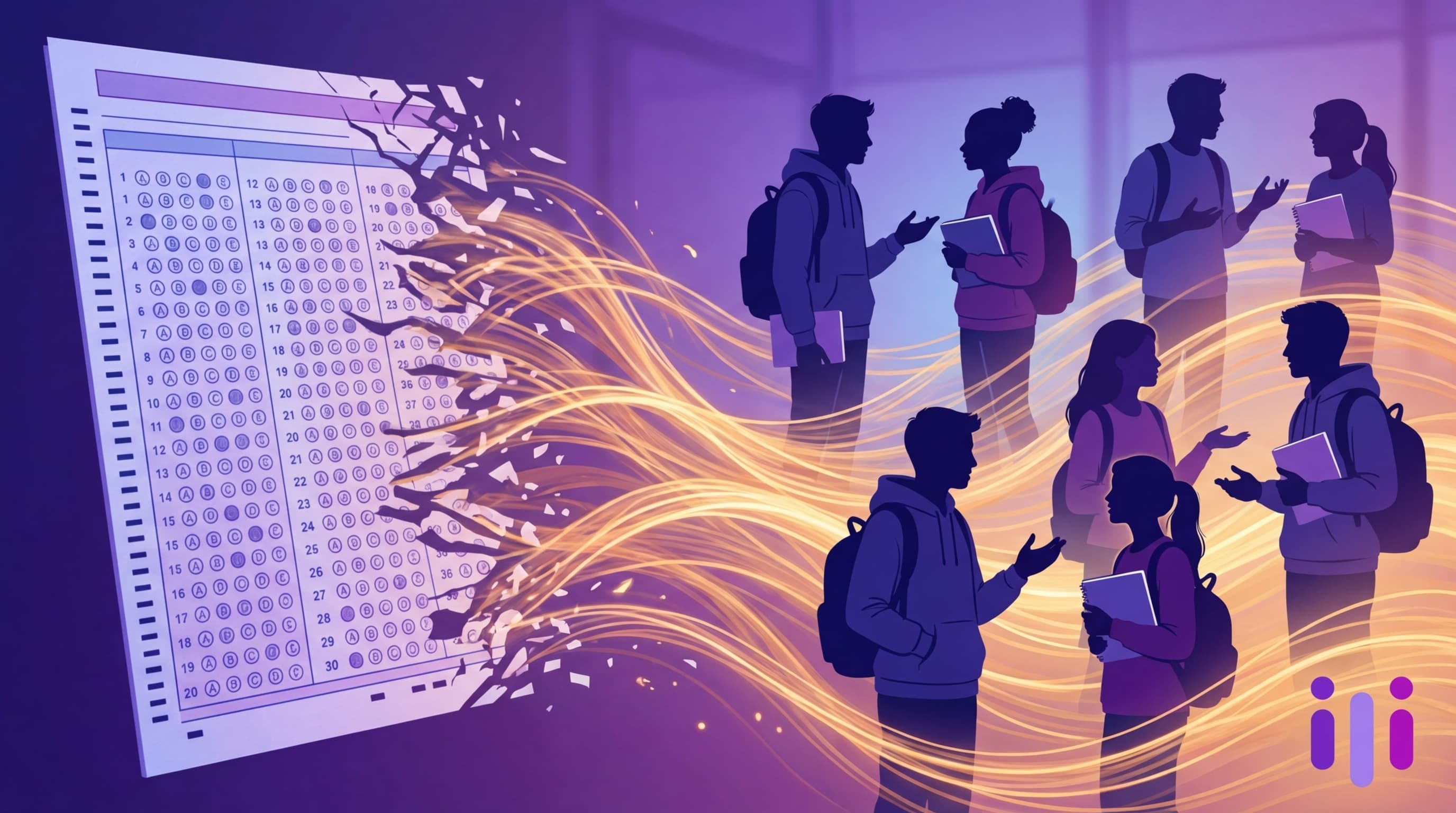
Every semester, millions of students fill out feedback surveys. They click through Likert scales, leave a few vague comments, and close the tab knowing nothing will change before they graduate. Meanwhile, administrators compile the results into dashboards that arrive months later, stripped of context and nuance.
This is the state of the student feedback survey in 2026: a ritual everyone participates in and almost no one trusts.
The problem is not that schools don't care about student voice. It's that they've chosen a tool — the static survey — that is structurally incapable of capturing what students actually think. And the data backs this up: average response rates for online course evaluations hover between 30% and 60%, with many institutions reporting rates below 30%. The students who do respond often provide socially desirable answers rather than honest ones.
There is a better way. AI-powered conversations are replacing the traditional student feedback form with something students will actually engage with — because it feels like someone is listening, not like a form that disappears into a void.
Key Takeaways
- Student feedback surveys suffer from low response rates, social desirability bias, and timing problems that make their data unreliable
- End-of-semester evaluations arrive too late to help the students who provided the feedback
- Research shows student evaluations reflect gender and racial bias more than teaching quality
- AI conversations achieve higher engagement by adapting to what students say in real time
- Closing the feedback loop — acting on insights quickly — is what turns feedback into improvement
The Feedback Theater: Why Students Don't Take Surveys Seriously
Here is the dirty secret of the student feedback survey: most students treat it as a box-checking exercise. Not because they are lazy, but because experience has taught them the results don't matter.
A student who had a transformative experience in a seminar gets the same 1-5 scale as a student who slept through lectures. A student struggling with a professor's teaching style gets a comment box with no follow-up questions. The survey cannot ask "what do you mean by that?" or "can you give me an example?" It collects surface reactions, not understanding.
This creates what researchers call social desirability bias — respondents provide answers they believe are socially acceptable rather than what they actually think. In the context of student evaluations, this means students either inflate ratings to avoid feeling like they're hurting a professor or deflate them out of frustration, without nuance in either direction.
The result is data that looks clean in a spreadsheet but means almost nothing in practice.
The Effort-to-Impact Gap
Students quickly learn the ROI of providing detailed feedback: it's near zero. When a student takes 15 minutes to write thoughtful comments about curriculum gaps, and the next semester's course is identical, they stop bothering. The rational response to a system that doesn't close the loop is to disengage from it.
Research from Anthology segments institutions into three tiers: low response rate (10-25%), middle (26-50%), and high (51-99%). The fact that a quarter of institutions can't get more than one in four students to respond tells you everything about how students perceive the value of these instruments.
What Student Feedback Surveys Actually Measure (Hint: Not Learning Quality)
The assumption behind every course evaluation survey is straightforward: students can accurately assess teaching quality, and their ratings reflect how much they learned. Both assumptions are wrong.
The Bias Problem
A landmark study published in PNAS found that student evaluations reflect gender bias tied to department composition — in male-dominated departments, women received systematically lower teaching ratings. Research published in Frontiers in Education confirmed that even when course content, assignments, and communication are held constant, women and faculty of color receive lower scores than white male instructors.
This is not a minor statistical artifact. It is a measurement instrument that systematically punishes certain instructors for who they are, not how they teach.
The Satisfaction-Learning Disconnect
Student satisfaction and student learning are not the same thing. A professor who challenges students, assigns difficult readings, and holds high standards may receive lower satisfaction scores on a student satisfaction survey than one who gives easy grades and entertaining lectures. The teacher evaluation survey, in many cases, measures how comfortable students felt — not how much they grew.
A UC Berkeley analysis of course evaluations put it bluntly: student evaluations of teaching are not a reliable measure of teaching effectiveness. Yet institutions continue to use them for tenure decisions, performance reviews, and resource allocation.
The Timing Problem: Feedback That Arrives After It Matters
Even if student feedback surveys captured perfectly accurate, bias-free data — which they don't — there is a structural problem that no survey redesign can fix: timing.
The standard course evaluation survey is administered in the final weeks of a semester. Results are compiled, anonymized, and delivered to faculty weeks or months later. By the time a professor reads that students wanted more group discussion or found the textbook unhelpful, those students have moved on to the next semester.
Explorance's research on evaluation timing found that after-examination administration can span up to 200 days from when experiences occurred, causing memory loss and unreliable data. Harvard's Office of the Vice Provost has advocated for mid-semester feedback precisely because end-of-term evaluations cannot drive improvement for current students.
The Feedback Paradox
This creates a paradox: the students who provide feedback never benefit from it. They are doing unpaid labor for future cohorts, with no guarantee their input will change anything. The feedback loop is not just slow — it is fundamentally broken because it was designed for institutional reporting, not for improvement.
Mid-semester evaluations help, but they are still surveys. They still flatten nuance into scales. They still cannot ask follow-up questions. And they still depend on students believing their input will matter.
How AI Conversations Get Students to Share What They Really Think
The core insight behind conversational AI for student feedback is simple: people share more when they feel heard.
A traditional student feedback form presents a wall of questions and expects honest, reflective answers in a format designed for database entry. An AI conversation starts with an open question — "How has this course been going for you?" — and then does something no survey can do: it follows up.
When a student says "the lectures are fine but I'm struggling with the assignments," an AI interviewer can ask what specifically about the assignments is challenging. When a student mentions that group projects feel unbalanced, the conversation can explore whether that's about workload distribution, communication, or team formation. These are the details that matter for improvement, and they are exactly what surveys miss.
Why Conversations Beat Forms for Student Voice
Stanford's research on AI-driven feedback tools in education found that automated, conversational feedback improved instructors' use of "uptake" — the practice of acknowledging and building on student contributions — and that this improvement correlated with higher student satisfaction and assignment completion rates. The mechanism is clear: when feedback is specific, contextual, and timely, it actually changes behavior.
This is the difference between a student feedback survey that asks "Rate your instructor's communication skills (1-5)" and a conversation that surfaces: "I get lost when the professor jumps between topics without connecting them, especially in the statistics sections." One gives you a number. The other gives you something actionable.
Real-Time, Not Retroactive
AI conversations can happen at any point during a course — after a particularly confusing lecture, midway through a project, or when a student is considering dropping the class. The feedback arrives while there is still time to act on it, which means students see their input translated into change. That visibility is what rebuilds trust in the feedback process.
Perspective AI enables this kind of conversational feedback at scale. Instead of sending every student the same 20-question survey, institutions can deploy AI-powered conversations that adapt to each student's experience, follow up on vague or surprising responses, and generate actionable insights in real time rather than months later.
From Evaluation to Improvement: Closing the Student Feedback Loop
The ultimate failure of the student feedback survey is not data quality, timing, or bias — though all of those are real problems. The ultimate failure is that it was designed as an evaluation tool, not an improvement tool.
Evaluation asks: "How did this professor do?" Improvement asks: "What should change, and how?" These are fundamentally different questions, and they require fundamentally different instruments.
The Three Requirements for Feedback That Actually Improves Teaching
- Specificity: Feedback must be detailed enough to act on. "The course was okay" is evaluation. "I struggled with the transition from theory to application in weeks 4-6" is improvement.
- Timeliness: Feedback must arrive while change is still possible. End-of-semester data is autopsy, not diagnosis.
- Closing the loop: Students must see that their input led to change. Without this, participation erodes and the data becomes increasingly unreliable.
Traditional student satisfaction surveys fail on all three counts. They collect vague ratings, deliver them late, and rarely close the loop with students.
Building a Continuous Feedback Culture
The institutions getting this right are moving from periodic evaluation to continuous conversation. Instead of one survey at the end of a semester, they are creating multiple touchpoints where students can share feedback in their own words, at the moment it is most relevant.
This does not mean bombarding students with more surveys — that would make the problem worse. Even well-intentioned instruments like a K-12 parent survey suffer from the same limitations when they rely on static forms. It means replacing the survey paradigm entirely with conversational interfaces that students actually want to engage with, because engaging feels like being heard rather than being processed.
The shift from forms to conversations in education mirrors what is happening across every industry that relies on human feedback. Organizations that cling to static feedback forms are discovering that the form itself is the bottleneck — not the willingness of people to share their experience.
Frequently Asked Questions
What is a student feedback survey?
A student feedback survey is a structured questionnaire used by educational institutions to collect student opinions about courses, instructors, and learning experiences. Typically administered at the end of a semester, these surveys use rating scales and open-ended questions to gather data for institutional reporting and instructor evaluation.
Why do student feedback surveys have low response rates?
Student feedback surveys suffer from low response rates because students perceive them as ineffective. When feedback does not lead to visible changes, students lose motivation to participate. Additionally, survey fatigue, poor timing, and generic questions that do not feel relevant to individual experiences all contribute to declining engagement over time.
How can AI improve student feedback collection?
AI improves student feedback by replacing static forms with adaptive conversations that follow up on student responses, ask clarifying questions, and capture specific, actionable details. AI conversations can happen at any point during a course rather than only at semester's end, and they generate real-time insights that enable immediate improvements.
Are student evaluations of teaching biased?
Yes. Peer-reviewed research consistently shows that student evaluations reflect demographic biases, with women and faculty of color receiving systematically lower ratings independent of actual teaching quality. These biases make evaluations unreliable as measures of instructional effectiveness and problematic when used for personnel decisions.
What are alternatives to traditional course evaluation surveys?
Alternatives include mid-semester feedback sessions, AI-powered conversational feedback tools, classroom assessment techniques, peer observation programs, and learning analytics. The most effective approaches combine multiple methods and prioritize timely, specific, actionable feedback over summative ratings.
The Student Feedback Survey Needs More Than a Redesign
The student feedback survey is not broken because institutions chose the wrong questions or the wrong scale. It is broken because the format itself — a static form administered after the fact — cannot do what we need it to do. No amount of survey redesign fixes the timing problem, the bias problem, or the trust problem.
The schools and universities seeing real improvement in teaching quality are the ones abandoning the survey paradigm altogether. They are replacing student feedback forms with AI conversations that capture what students actually think, when it actually matters, in enough detail to actually drive change.
If your institution is still relying on end-of-semester course evaluations as your primary feedback mechanism, you are making decisions based on biased, outdated, surface-level data. Perspective AI offers a different approach: AI-powered conversations that give every student a voice and give educators the specific, timely insights they need to improve — not next semester, but now.
More articles on AI Conversations at Scale
Experience Management (XM) in 2026: What the Category Promised and What It Delivered
AI Conversations at Scale · 18 min read
Customer Experience Chatbots: The Two Kinds, and Why Only One Actually Improves CX
AI Conversations at Scale · 11 min read
Customer-Facing AI Doesn't Have to Mean a Chatbot That Deflects You
AI Conversations at Scale · 11 min read

Stripe's AI Strategy: What It Signals for Every SaaS Company in 2026
AI Conversations at Scale · 13 min read

Generative AI for Education Should Listen First, Not Just Generate
AI Conversations at Scale · 12 min read
Why Customer Experience Surveys Are Failing Every Industry in 2026
AI Conversations at Scale · 12 min read