Voice of Customer Program: The 2026 Blueprint for CX Leaders Running Real VoC
TL;DR
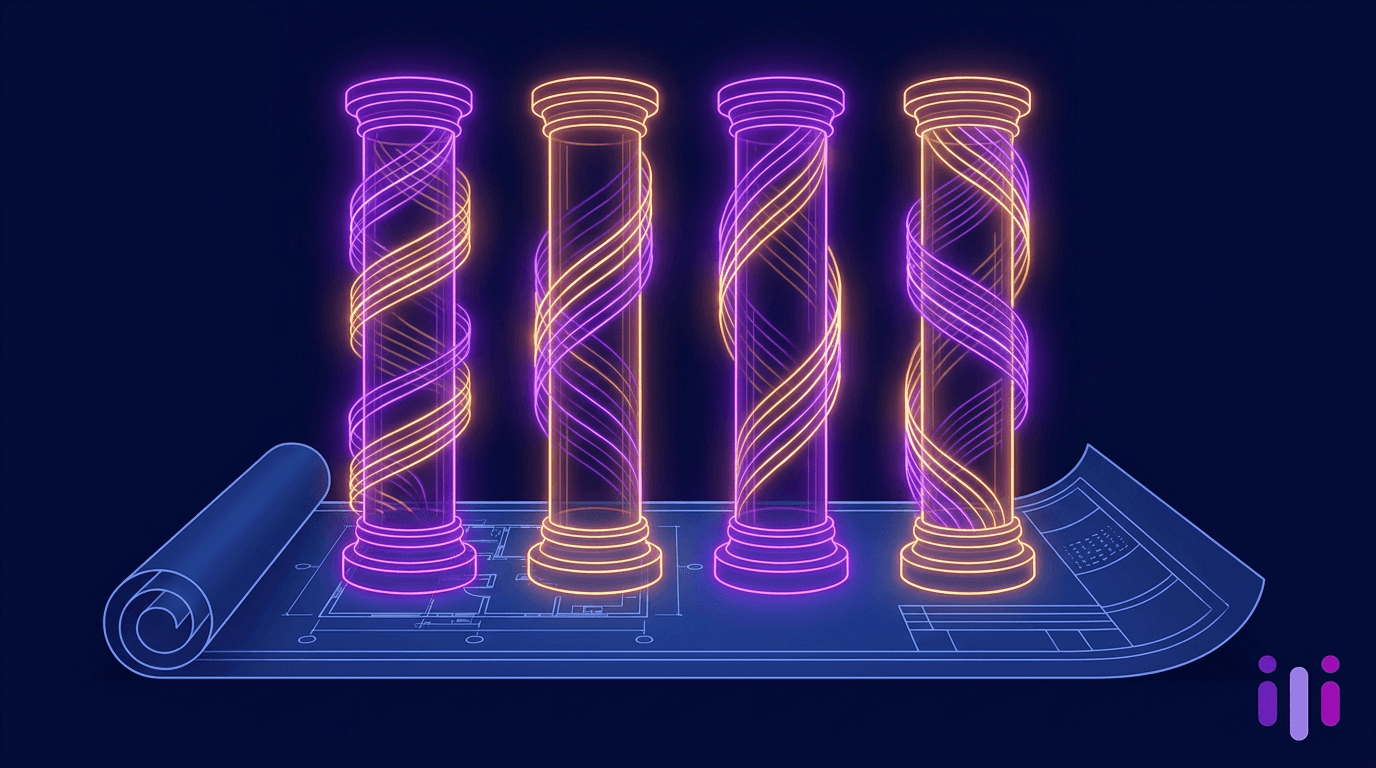
A voice of customer program in 2026 is an operating system, not a survey calendar — it rests on four pillars in lockstep: continuous listening through AI conversations, a synthesis cadence that turns transcripts into themes weekly, an action loop with named owners and deadlines, and stakeholder accountability via metrics tied to executive comp. CX leaders running real VoC programs have replaced annual relationship surveys with always-on conversational research that captures "the why" behind every signal. Per Forrester's 2024 VoC benchmarks, only 17% of programs drive measurable business decisions — the other 83% generate dashboards no one acts on. Perspective AI is the AI customer interview platform that anchors this operating model: continuous conversational listening at survey volume with research depth, routed straight into synthesis and action. This guide is for VPs of CX and CX Ops leaders who have a VoC tool and need an operating playbook.
What a real voice of customer program looks like in 2026
A real voice of customer program is a closed-loop operating system that converts customer signals into business decisions on a fixed cadence with named owners. It is not a survey, a tool, or a dashboard — those are inputs. The program is what surrounds them: who listens, how often synthesis happens, who owns each action, and how stakeholders are held accountable when nothing changes.
In 2026 the bar has shifted. The voice of customer leaders pulling ahead run continuous discovery habits — weekly customer conversations on top of always-on listening. They use the AI-first synthesis workflow to keep insight latency low. They measure program health by decisions-per-quarter that cite a customer quote, not response rate.
This guide is the org-design + operating-cadence playbook. Other content explains what a VoC program is and which tools to buy. This one is for leaders who have both and are asking: how do we actually run it?
Why most voice of customer programs fail at the operating layer
Most VoC programs fail because they are designed as data-collection projects, not operating systems. A typical org buys a survey tool, mails NPS quarterly, builds a dashboard, and presents it at the QBR. Twelve months later: response rates fall to 4%, the dashboard collects dust, and no one can name a single change driven by the program in six months.
The 2023 Qualtrics XM Institute research on CX maturity found fewer than one in five enterprise CX programs reach the "Pervasive" stage where insight reliably drives cross-functional decisions. The rest plateau as reporting layers. Three structural failure modes recur: listening without synthesis, synthesis without action, action without accountability. The fix isn't a better tool — it's the four pillars below.
The 4 pillars of a working voice of customer program
A working voice of customer program rests on four pillars: continuous listening, synthesis cadence, action loop, and stakeholder accountability. Each is a discrete operating discipline with its own cadence, owner, and metric. Skip any one and the program degrades into reporting.
Pillar 1: Continuous listening (not annual surveys)
Continuous listening means always-on customer conversations across every key moment of the journey, not a quarterly NPS blast. The shift is from "we send a survey every 90 days" to "we have a conversation with the right customer at the right moment, every week."
Annual relationship surveys produce data that is already stale by the time it lands. The customer who churned in February isn't waiting for the August survey to tell you why. As we argued in why AI survey is a contradiction, forms force customers into preset categories and the "why" is the first thing flattened.
Build listening across four touchpoints:
- Transactional — fired by events (closed ticket, completed onboarding, cancel flow). See the conversational data collection method.
- Lifecycle — scheduled at moments (30/60/90 day onboarding, renewal-T-90, expansion triggers).
- Always-on — embedded surfaces customers reach into anytime. The AI agent that replaces the form is the right surface.
- Targeted research — quarterly or per-launch deep dives. Run with AI-moderated interviews at sample sizes that used to require a research agency.
Operating metric: Coverage percentage — what fraction of your active customer base has had at least one conversation logged in 90 days. Target 30%+ for B2B SaaS, 5%+ for consumer scale.
Pillar 2: Synthesis cadence
Synthesis cadence means converting raw conversations into named themes on a fixed weekly rhythm — not a quarterly research report. The job is reducing thousands of verbatim signals into 5–10 themes per cycle that decision-makers can act on in a single meeting.
Most synthesis fails because it is treated as a one-off research project. The 2024 Harvard Business Review piece on the CX intelligence gap argued that signal-to-decision lag is the single biggest predictor of program ROI — programs at 30 days had no measurable impact; programs at 7 days drove measurable revenue.
Run synthesis as a recurring weekly meeting, not a project:
- Input: all conversations from the prior 7 days, auto-clustered by theme.
- Method: AI-assisted thematic clustering plus 30 minutes of human review to validate themes and pull verbatim quotes.
- Output: a 1-page brief — top 3 emerging themes, top 3 stable themes, 1–2 anomalies. Each theme has a verbatim quote attached.
- Cadence: Monday morning, 60 minutes, recurring.
- Owner: a CX Insights Lead — not a rotating role.
Layer a monthly deep-dive on top: pick the most strategic emerging theme, run 10–20 targeted AI conversations on it, produce a longer brief with proposed actions.
Operating metric: Theme-to-decision lag — median days from theme surfacing to decision. Target ≤14 days. Monthly synthesis cycles sit at 60+ days; weekly cycles hit 7–10.
Pillar 3: Action loop
The action loop is the discipline of converting synthesis themes into named decisions with owners, deadlines, and tracked outcomes. Without it, every other pillar is theater. The action loop is where most programs die — themes get presented, heads nod, nothing ships.
Anatomy of a working action loop
A working action loop has six fixed steps:
- Theme identification — comes from Pillar 2 synthesis.
- Action proposal — within 5 days of theme surfacing, the relevant functional owner writes a 1-paragraph proposal: what we'll change, what success looks like, when we'll measure.
- Decision review — bi-weekly 30-minute meeting where proposals are accepted, rejected, or sent back. Chaired by VP CX, attended by VPs of Product, CS, Ops.
- Commitment — accepted proposals get a named owner, a deadline (≤90 days), and a success metric.
- Execution — owner ships the change, with check-ins at 30 and 60 days.
- Closing the loop — at deadline, owner reports back on whether the change moved the metric, and the program logs a "VoC-driven decision."
The two-week rule
Every accepted theme must have a named owner and deadline within 14 days, or it gets killed. This is the single most important operational rule in the program. Themes without owners are just complaints. Themes with owners and deadlines are commitments. If you can't find an owner in 14 days, the theme isn't strategic enough — let it die and revisit if it resurfaces.
The often-missed final step is going back to the customers who raised the theme to tell them what changed. Use the AI interviewer agent to send brief follow-ups: "Six months ago you mentioned X. We changed Y. How is that working?" The 2023 Bain & Company loyalty research pegged the renewal lift at 6–14 percentage points for customers in a closed-loop feedback program versus those outside one.
Operating metric: Percentage of weekly themes that get a named owner and deadline within 14 days. Target 80%+. Below 50% the action loop is broken and the program is degenerating into reporting.
Pillar 4: Stakeholder accountability
Stakeholder accountability means VoC outcomes are tied to executive comp, board-level reporting, and quarterly OKRs — not just an internal CX scorecard. Without exec-level skin in the game, VoC stays a CX department project other functions can ignore.
VoC failure is almost always cross-functional. A churn theme requires Product to ship a fix. A poor onboarding theme requires CS to redesign the journey. A pricing theme requires GTM to revisit packaging. The CX leader runs the machinery — execution sits in other functions. If those leaders aren't accountable, the program stalls.
How to wire in accountability:
- Tie executive bonuses to VoC OKRs. At least one VoC-driven OKR per quarter per functional VP, specific and measurable (e.g., "Reduce onboarding churn theme volume 40% by Q3").
- Report VoC metrics at the board. Coverage %, theme-to-decision lag, % themes with owners, decisions shipped. If the board doesn't see it, the C-suite doesn't either.
- Run a monthly VoC executive review. 60 minutes, all functional VPs, CCO chairs. Top themes, action loop status, 1–2 customer quotes played verbatim. The verbatim quote changes the room.
- Publish a quarterly "decisions shipped" report. Every change that quarter traceable to a customer signal. This is the program's product, not the dashboard.
Operating metric: Percentage of executive bonus tied to VoC-driven OKRs. Target 10–20%. Below 5% the program is a side project other priorities will starve.
Common failure modes
Even with the four pillars in place, certain failure modes recur. Watch for these and intervene early.
- Listening without synthesis. High volume of responses but no themes ever reach decision-makers. Caused by under-resourcing synthesis. Fix: invest in AI-assisted theming first; manual coding doesn't scale to weekly cadence.
- Synthesis without action. Theme decks circulate but nothing ships. Fix: instate the two-week rule. Themes without an owner in 14 days get killed.
- Action without accountability. Actions are nominally owned but no one tracks whether they happened. Fix: publish the quarterly decisions-shipped report and review at the board.
- Sampling bias. Loudest customers dominate every theme; quieter segments are under-represented. Fix: design coverage targets per segment. AI conversational research can scale qualitative research far past human-moderator limits.
- Tool sprawl. NPS in one tool, support feedback in another, churn interviews in a third. Themes never connect because the data never does. Fix: consolidate onto a unified platform — see the customer research stack modern teams use.
- Score worship. The program is judged by whether NPS went up, not by how many decisions shipped. Fix: lead reporting with decisions-shipped count. See why NPS is broken and the conversational alternative that captures the why behind the score.
How Perspective AI fits the four pillars
Perspective AI anchors all four pillars in one operating layer. The AI interviewer agent runs continuous listening across transactional, lifecycle, and always-on touchpoints (Pillar 1). Auto-extracted themes and verbatim quotes feed weekly synthesis (Pillar 2). Synthesis output ships into the bi-weekly decision review (Pillar 3). Program metrics roll up into a stakeholder dashboard built for board reporting (Pillar 4). Built for CX teams.
Frequently Asked Questions
How big does a CX team need to be to run this voice of customer program operating model?
A small CX team can run this model — the minimum viable size is 1 dedicated VoC Program Manager plus part-time contribution from a CX Insights Lead. The four pillars don't scale linearly with headcount; they scale with cadence discipline. A 2-person team running weekly synthesis will outperform a 15-person team running quarterly cycles. The bottleneck is cadence, not headcount.
What's the difference between a voice of customer program and a customer experience program?
A voice of customer program is the listening-to-action operating system; a customer experience program is the broader portfolio that also includes journey design, service operations, and brand experience. VoC is a critical component of CX, but they're not the same. CX without VoC is design without research; VoC without CX is research with no place to land.
How do I get exec buy-in to tie bonuses to VoC OKRs?
Lead with the decisions-shipped report, not survey scores. Show the C-suite a quarterly list of product, process, and policy changes that shipped because of customer signals, with revenue or retention impact attached where measurable. Once the program is producing observable business decisions, tying exec comp is a logical extension. Most programs lose this fight by leading with NPS and dashboards instead of shipped decisions.
How does AI fit into a voice of customer program in 2026?
AI fits at three points: it runs conversations (replacing static surveys with interviews that capture the why), synthesizes transcripts into themes (cutting synthesis from weeks to hours), and scales the program to coverage levels human-moderated research can't reach. AI doesn't replace the program — it makes the four-pillar model practical at scale. Without AI, the cadence math doesn't work for any program of meaningful coverage.
How long does it take to stand up this operating model from scratch?
Six months to "operating," 12 months to "mature." Months 1–2: stand up continuous listening on the top 2–3 touchpoints and assign the VoC Program Manager. Months 3–4: launch weekly synthesis and bi-weekly decision reviews. Months 5–6: instate the accountability layer (exec OKRs, board reporting). By month 12 the program should be producing a credible quarterly decisions-shipped report.
What's the single biggest failure point to watch for?
The two-week rule on action ownership. More VoC programs die at this step than any other. If themes pile up without owners, the program degenerates into reporting and will be defunded within 18 months. Orphan themes are the leading indicator of program death.
Conclusion
A real voice of customer program in 2026 is an operating system with four pillars: continuous listening, synthesis cadence, action loop, and stakeholder accountability. Each has its own cadence, owner, and metric. Together they convert customer signals into shipped decisions on a predictable rhythm — which is what makes a VoC program a business asset instead of a reporting cost center.
The CX leaders pulling ahead aren't the ones with the best survey tool. They're the ones who treat the voice of customer program as an org-design problem first and a tooling problem second. Most programs are strongest at Pillar 1 and weakest at Pillar 3. The fix is structural, not technical.
Perspective AI is built for the CX leader running this operating model. Start a Perspective AI study and run your first weekly synthesis cycle in under two weeks.
More articles on AI Conversations at Scale
Customer Experience in Retail 2026: What the Store Data Cannot Tell You
AI Conversations at Scale · 11 min read
Customer Experience Management in Banking 2026: The Hand-Off Problem
AI Conversations at Scale · 10 min read
The CX Platform Security Review: What Procurement Will Ask (and How to Answer)
AI Conversations at Scale · 22 min read
CX Tool Consolidation: What to Cut When You Have Six Listening Tools
AI Conversations at Scale · 20 min read
Who Sits on the CX Buying Committee (and What Each Member Kills a Deal For)
AI Conversations at Scale · 23 min read
The CX Platform Migration Checklist: 60 Days From Signature to First Insight
AI Conversations at Scale · 22 min read