AI-Powered Focus Groups: From Recruiting to Readout in a Single Workflow
What are AI-powered focus groups?
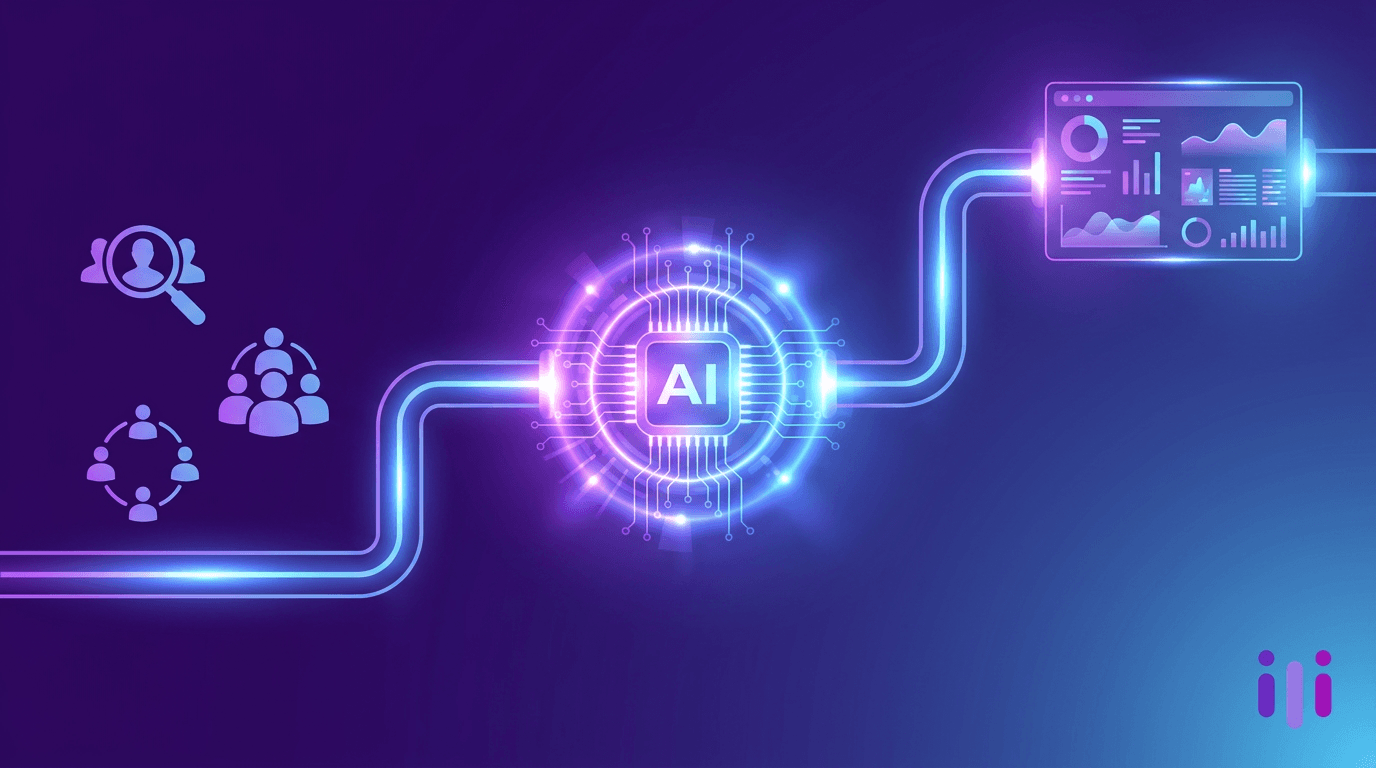
AI-powered focus groups are qualitative research studies where a conversational AI agent recruits, screens, moderates, and synthesizes participant conversations end to end, collapsing the recruit-to-readout pipeline from weeks into days. Instead of stitching together a recruiter, a facility, a human moderator, and an analyst across a 3-to-6-week timeline, a single AI-powered workflow runs hundreds of 1:1 conversations in parallel, adapts its follow-up questions in real time, and returns a synthesized, board-ready readout the same week the study launches.
The defining feature is not that AI sits inside one stage of research — it is that one continuous workflow owns every stage. That single-workflow design is what turns "AI-powered focus groups" from a marketing label into an operational advantage: there are no handoffs, no re-keying transcripts into a synthesis tool, and no waiting on a panel vendor to backfill no-shows. This guide walks through that workflow stage by stage, with the time and cost deltas at each step, so research, product, and CX teams can see exactly where the weeks disappear.
The traditional focus group workflow and where it breaks
The traditional focus group workflow breaks because it is a relay race of disconnected handoffs, and every handoff adds days, cost, and signal loss. A standard qualitative study runs 3 to 6 weeks from kickoff to final report, according to Drive Research, and a single in-person session costs $7,000–$12,000 full-service — recruiting, facility, moderation, recording, and a basic deck — with online groups running roughly half that at $4,000–$7,000, per Greenbook.
Here is where the weeks actually go in the conventional pipeline:
- Week 1 — Setup and discussion-guide drafting. Scoping the study, writing the moderator guide, and aligning stakeholders.
- Weeks 2–3 — Recruiting and screening. Third-party panels take 1–2 weeks to deliver qualified participants, and recruiting fees run about $150 per head plus incentives of $100–$300 per person depending on the audience.
- Week 4 — Sessions and analysis. Two to four moderated groups of 8–10 people, then a final week reserved for transcribing, coding, and building the readout deck.
Each stage hands a deliverable to the next specialist, and the cost compounds: recruiting fees, facility rental, incentives, moderator day-rates, and analyst hours all stack before a single insight reaches a decision-maker. Worse, the format itself caps the signal — eight people in a room produce groupthink, the loudest voice anchors the discussion, and the moderator's framing introduces bias. We unpack those failure modes in depth in our breakdown of the cost, speed, and bias problems of the conference room, and the head-to-head economics in AI vs. focus groups on cost, depth, and decision quality.
The AI-powered workflow end to end
The AI-powered workflow compresses recruiting, moderation, analysis, and reporting into one continuous system with no handoffs between them. Because the same platform owns the participant list, the conversation transcripts, and the synthesis layer, work that used to move between four vendors now moves between four screens in one tool — and most of it runs in parallel rather than in sequence.
The strategic point is the single-workflow advantage. Stitching point tools together — a panel recruiter, a survey form, a transcription service, and a synthesis app — reintroduces every handoff the AI workflow was supposed to remove. A unified platform for AI-powered focus groups keeps recruiting, the AI interviewer agent, automatic analysis, and the readout inside one continuous loop. For teams running this end to end at volume, our companion guide on going from n=8 to n=800 without losing depth covers how the parallel-conversation model holds up as sample sizes grow, and the pillar guide to replacing the 8-person conference room maps the full category.
Recruiting and screening with AI
AI-powered recruiting works by drawing from a first-party audience or applying an AI screener to inbound participants, replacing the 1–2 week third-party panel wait with a process that completes in hours to a few days. The traditional bottleneck is structural: recruiters source from external panels, manually verify screener responses, and pad the recruit to absorb no-shows — the reason customer panels fill in 2–5 days but third-party panels stretch to two weeks, as Drive Research documents.
AI changes three things about recruiting:
- Screen with a conversation, not a checkbox. Instead of a static screener form that respondents game, an AI agent asks qualifying questions conversationally and probes inconsistent answers — catching the "professional respondents" who slip through panel screeners.
- Recruit from your own audience. Embedding the study where your customers already are — in-app, post-purchase, or via email — turns first-party traffic into a recruiting channel and removes the per-head panel fee entirely. Our setup, recruitment, and quality-control guide for online AI focus groups details the embed and screening mechanics.
- Over-recruit at near-zero marginal cost. Because each additional conversation costs a fraction of a panel recruit, you can invite far more participants than you need and let the responsive ones self-select, eliminating the no-show problem instead of budgeting around it.
The downstream effect is sample size. A traditional study is gated at 8–10 people per group by room economics; an AI workflow can run hundreds of conversations because each one is 1:1 and asynchronous. That shift — from a handful of voices to a representative volume — is the single biggest quality upgrade, and it is why teams pair this approach with structured intake templates like the customer interview template and the user research interview template to keep screening consistent across a large recruit.
Moderation and adaptive probing
AI moderation works by running each participant through a structured discussion guide while adapting its follow-up questions in real time to whatever the person actually said, so every conversation digs into the "why" without a human in the room. This is the stage where the AI-powered model most clearly beats both the conference room and the static survey: a form captures whatever fits its fields, and a single human moderator can only run one group at a time, but an AI agent runs hundreds of simultaneous interviews and never gets tired, distracted, or anchored on the first articulate answer.
Adaptive probing is the core mechanic. When a participant says "the onboarding felt confusing," a survey records the sentence and moves on; the AI agent asks which step, what they expected instead, and what they did next — surfacing the decision driver behind the complaint. This is the same depth advantage that makes conversational research outperform NPS and CSAT scores, which capture the number but not the reasoning, a gap we cover in our piece on the conversational method that captures the why behind the score.
AI moderation also removes two well-documented sources of bias in group settings. There is no groupthink, because participants never hear each other, so a vocal minority can't anchor the room. And there is no moderator drift, because the AI asks every participant the same core questions with the same neutral framing — the consistency that human facilitators lose across a long day of back-to-back sessions. For a deeper look at how the facilitator's role evolves rather than disappears, see how the moderator's job changes when AI runs the room and how conversational AI replaces the clipboard moderator. It is worth saying plainly: this is real-participant research, not simulated personas — the difference we draw out in why fake respondents can't replace real customer research.
From transcripts to a board-ready readout
The readout stage works by running automatic analysis across every transcript the moment conversations close, clustering responses into themes, extracting representative quotes, and generating a summary — turning what was a week of manual coding into a same-day deliverable. In the traditional workflow this is the hidden cost: an analyst rewatches recordings, hand-codes transcripts, tallies themes in a spreadsheet, and assembles a deck, often the longest single stage of the project.
AI synthesis attacks three things at once:
- Theme detection at volume. Reading 8 transcripts by hand is feasible; reading 800 is not. Automatic analysis surfaces the patterns across the full sample, so larger studies become easier to synthesize, not harder.
- Verbatim quotes, sourced. Every theme links back to the exact participant quotes that support it, which is what makes the readout credible to skeptical stakeholders — the evidence-claim mapping is built in, not reconstructed after the fact.
- A summary leaders will actually read. A Magic Summary-style report frames the top findings, the supporting quotes, and the recommended actions in the format a product review or board meeting needs.
This closes the loop the traditional workflow leaves open. The fastest research is worthless if it stalls in synthesis, so the single-workflow design matters most here: the transcripts never leave the system, which is why the readout lands in days. Our deep dive on going from raw transcripts to strategic insights in hours, not weeks covers the analysis layer in detail, and end-to-end AI research from brief to board-ready deck walks the full automated pipeline. The payoff is decision velocity — a benefit that compounds when research becomes continuous rather than a one-off project, which is increasingly the norm: customer research is shifting from quarterly studies to an always-on practice, a trend documented in the 2026 state of customer research and one that McKinsey ties directly to revenue, finding that companies excelling at customer experience grow faster than peers, per McKinsey research. Built for product teams and CX teams alike, the single-workflow model is what makes that cadence affordable.
Frequently Asked Questions
How long does an AI-powered focus group take from recruiting to readout?
An AI-powered focus group typically runs from launch to synthesized readout in days rather than the 3-to-6-week timeline of a traditional study. Recruiting and screening compress to hours or a few days because conversations run asynchronously and in parallel, moderation happens simultaneously across hundreds of participants, and analysis is automatic, so the readout is ready the same week the study opens.
How much do AI-powered focus groups cost compared to traditional ones?
AI-powered focus groups cost a fraction of a traditional study, which runs $7,000–$12,000 per in-person group or $4,000–$7,000 online before incentives. The savings come from eliminating per-head panel recruiting fees of roughly $150 per participant, facility rental, moderator day-rates, and analyst time, since one workflow handles recruiting, moderation, and synthesis without external vendors.
Are AI-powered focus groups using real participants or synthetic respondents?
AI-powered focus groups use real human participants who are interviewed by an AI moderator, not synthetic or simulated respondents. The AI conducts genuine 1:1 conversations with real people and adapts its questions to their actual answers; this is fundamentally different from synthetic-respondent tools that generate AI-imagined personas, which cannot surface unexpected truths because they only reflect their training data.
Can AI-powered focus groups replace human researchers entirely?
AI-powered focus groups do not replace human researchers; they shift the researcher's work from execution to design and interpretation. The AI handles recruiting logistics, moderation, transcription, and first-pass synthesis, freeing researchers to write sharper discussion guides, interrogate the findings, and translate insight into stakeholder decisions — the strategic work that humans still own.
What kinds of research questions suit an AI-powered focus group?
AI-powered focus groups suit any qualitative question where you need the "why" behind behavior at scale: concept and message testing, product feedback, churn drivers, onboarding friction, and unmet-needs discovery. They are strongest when sample size and follow-up depth both matter, since the workflow delivers hundreds of probing conversations rather than a handful of moderated group sessions.
Conclusion
AI-powered focus groups win not because AI is bolted onto one stage of research, but because a single continuous workflow owns recruiting, moderation, analysis, and readout — collapsing the conventional 3-to-6-week, $7,000–$12,000-per-group pipeline into a same-week, fraction-of-the-cost study. The recruit-to-readout compression is the whole story: no panel-vendor wait, no sequential moderated sessions, no week of manual coding, and no re-keying transcripts between disconnected tools.
For research, product, and CX teams, the practical next step is to run one study end to end and watch where the weeks used to go. Start a study with Perspective AI to see the single-workflow model in action, browse example studies for inspiration, or compare your options if you're evaluating the category. AI-powered focus groups are no longer a faster version of the conference room — they're a different shape of research entirely, and the teams adopting the single-workflow model are the ones turning customer voice into decisions in days instead of weeks.
More articles on AI Customer Interviews & Research
Post-Purchase Survey Questions That Actually Explain Returns (2026)
AI Customer Interviews & Research · 25 min read
Before You Renew Qualtrics: The Negotiation Levers Buyers Actually Have
AI Customer Interviews & Research · 19 min read
Customer Feedback Data: Retention, Privacy, and the Decisions CX Teams Must Make
AI Customer Interviews & Research · 22 min read
Getting Your Data Out of Qualtrics: Exports, Formats, and What Breaks
AI Customer Interviews & Research · 21 min read
Verbatim Analysis: What to Actually Do With 40,000 Open-Ended Responses
AI Customer Interviews & Research · 19 min read
Customer Sentiment Examples: What Customers' Words Signal
AI Customer Interviews & Research · 13 min read