The 2026 AI Customer Interview Report: What 500 Hours of AI-Moderated Sessions Revealed

TL;DR
Across 500+ hours of AI-moderated customer interviews run on Perspective AI between mid-2025 and early 2026, the AI interviewer hit an 87% completion rate compared to 34% for human-led video studies on the same recruit pool, asked an average of 3.2x more clarifying follow-ups per session, and compressed time-to-insight from 21 days to under 48 hours. Production-scale AI moderation is no longer a curiosity reserved for innovation teams — by Q1 2026, it is the default research workflow for the B2B SaaS PMM, product, and CX orgs running more than 50 customer conversations per quarter. The data also shows where AI moderation still loses to humans: ethnographic context, sensitive emotional terrain, and exploratory studies where the interview guide is not yet stable. This report documents what 500 hours looks like architecturally, the five findings that surprised the operators running these programs, how AI moderation changes the questions teams choose to ask, and a reproducible methodology so any research lead can benchmark their own stack. The headline shift for 2026: research teams stopped treating AI interviews as a survey replacement and started treating them as a higher-volume, higher-depth alternative to human moderation itself.
What 500 hours of AI-moderated interviews looks like architecturally
The 500-hour figure represents 4,180 completed AI-moderated sessions across 47 customer programs run on the Perspective AI interviewer agent between July 2025 and February 2026, sampled to be representative of B2B SaaS use cases. Average session length came in at 7 minutes 11 seconds — short enough to land above the 80% completion threshold but long enough to carry 2-3 meaningful probes per topic. Eighty-one percent of sessions were text-mode chat; the remaining 19% were voice. The recruit mix skewed product-led: 62% in-product invitations, 23% post-purchase or churn triggers, and 15% external panel.
Architecturally, every program followed the same four-layer stack: a research outline (the structured set of objectives and topics the AI must cover), an interviewer agent with a defined persona and probing budget, completion-flow routing that branches based on response content, and an analysis layer that clusters quotes, extracts named entities, and produces a Magic Summary per cohort. Teams treating the outline as the unit of work — not the individual question — were the ones who hit production scale. This pattern echoes what we've seen across customer research at scale deployments where the outline is versioned like code.
Five findings from production deployments
The 500-hour dataset surfaced five concrete findings that meaningfully change how research teams should plan, staff, and scope work in 2026. Each is rooted in completed-session data, not opinion.
Finding 1: Completion rates landed at 87%, more than 2.5x human-moderated sessions
AI-moderated sessions in the dataset completed at 87% versus 34% for human-led 1:1 video interviews recruited from the same panels and product audiences. The mechanism is straightforward: AI sessions don't require scheduling, don't depend on a researcher being available in the participant's timezone, and don't impose the social cost of camera-on conversation. Human moderation still wins on completion when the participant is already engaged with the research relationship — internal employees, paid beta users, advisory board members — but for cold-recruited external customers, the gap is now structural. This is the finding that's pulling UX research teams off the bottleneck of scheduling.
Finding 2: AI interviewers asked 3.2x more follow-up questions per session
Across the 4,180 sessions, the AI moderator asked an average of 11.7 clarifying or probing follow-ups per session, compared to a benchmarked 3.6 follow-ups per human-led 30-minute session in the same programs. The AI didn't ask more questions overall — it asked more unscripted questions in response to vague, hedging, or surprising answers. Sessions where the participant used uncertainty language ("I guess," "kind of," "it depends") received an average of 4.8 follow-ups in that single thread, compared to 0.9 from human moderators who often moved on to stay on time. This is consistent with broader research on conversational depth from Nielsen Norman Group, which found that the most valuable interview moments come from probing on uncertainty rather than confirmation.
Finding 3: Time-to-insight dropped from 21 days to under 48 hours
The median time from research kickoff to a shareable insights deck dropped from 21 days (human-moderated baseline across the same programs in 2024) to 1.8 days using the AI-moderated workflow in 2026. The compression came from three places: recruitment ran in parallel rather than sequentially (no scheduling), transcripts were already structured at the moment of completion (no manual coding), and synthesis ran continuously as sessions completed rather than as a batched post-fieldwork phase. Teams using the feature prioritization framework from AI customer research reported the time savings let them ship roadmap decisions in the same sprint the research was commissioned.
Finding 4: Dropout patterns shifted from "too long" to "wrong question early"
Where human-moderated dropout typically happened at the 18-22 minute mark from session fatigue, AI-moderated dropout peaked between the 2nd and 4th question, not at the end. The cause: when the AI's opening question miscalibrated to the participant's actual context, participants left rather than redirect. Programs that added a 30-second context-setting opener and let the AI ask one orientation question before the substantive topics cut early dropout by 41%. This maps to the broader pattern that what makes AI interviews feel human is less about voice tone and more about whether the first 90 seconds feel relevant to the participant.
Finding 5: AI interviewers extracted 4.4x more in-vivo language per program
In-vivo coding — quotes preserved in the customer's own words rather than paraphrased — appeared in AI-moderated transcripts at 4.4x the density of human-moderated baselines. The AI never paraphrases in real time, so the verbatim record is denser and more usable for downstream artifacts like ICP refinement, positioning copy, and competitive messaging. This is the finding that has shifted who runs research inside companies: PMM and brand teams, not just researchers, are now the heaviest consumers of AI interview output because they need the customer's actual phrasing — not a researcher's interpretation of it.
Comparison: human-moderated vs AI-moderated at production scale
The table below summarizes the operational delta between the two modes across the 500-hour dataset. The point is not that AI wins everywhere — it doesn't — but that the operational profile is now distinct enough that the two modes are no longer interchangeable.
How AI moderation changes what teams choose to ask
The most underreported finding from the 500-hour dataset is not the operational metrics — it's that teams ran different research questions once AI moderation was available. When the marginal cost of a completed interview falls 93-98% and the time-to-insight collapses from weeks to hours, the calculus on what's worth asking changes. Three shifts showed up consistently across the 47 programs.
First, teams ran more continuous discovery instead of episodic studies. Instead of one 20-person discovery study per quarter, programs ran 50-100 always-on sessions per month tied to product triggers like onboarding completion, feature first-use, or churn signals. Templates like the customer interview template, jobs-to-be-done interview, and user onboarding interview became the default outline library rather than custom-built per study.
Second, teams started asking branch questions they previously skipped. Pricing perception, competitive consideration sets, and switching costs were historically excluded from interview guides because they bloated session length. With AI moderation, programs ran a pricing research interview and a competitor analysis interview as their own threads in the same conversation without overrunning, because the AI only triggered the branch if the participant mentioned the relevant context.
Third, post-loss and churn research went from rare to routine. Programs running a win-loss interview or churn interview on every closed-lost deal or canceled account grew from 7% to 41% of the dataset between July 2025 and February 2026. The economics finally worked — and the feedback loop on lost deals became continuous rather than quarterly.
What humans still do better
AI moderation lost to human moderation in three specific contexts that any 2026 research leader should know before scoping AI to a study. These are not failures of the AI — they're cases where the human moderator's specific affordances matter.
The first is ethnographic and contextual inquiry, where the researcher's job is to observe the participant's environment, body language, and workflow in real time. The AI can't see a workspace, watch a user struggle, or pick up the visible relief on a face. Studies that depend on visual context still need human moderators or AI-moderated focus groups paired with human observers.
The second is sensitive or emotionally heavy terrain — bereavement research, trauma-informed interviews, deeply personal health or financial topics — where the participant needs the moderator to read the room and titrate the pace. AI is competent here, but human moderation remains the recommended default for now. The third is exploratory studies where the interview guide isn't stable yet. AI moderation requires a reasonably well-defined outline; the truly open-ended "we don't know what we're looking for" study still benefits from a senior human researcher who can pivot the entire frame mid-conversation. See the mechanics of good AI interviewing in 2026 for the scoping framework most teams use.
Methodology and reproduction
The methodology behind the 500-hour figure is intentionally simple so any research team can benchmark their own program against it. The dataset comprised 4,180 completed AI-moderated sessions on the Perspective AI interviewer between July 14, 2025 and February 28, 2026. Sessions were excluded if they fell below 90 seconds, used an internal-only test outline, or were part of a paid panel without consented data use. Comparison baselines for completion rate, follow-up count, time-to-insight, and cost-per-session came from the same 47 programs' 2024 human-moderated research operations, normalized to the same recruit channels. The cost-per-session figure includes loaded researcher time, panel/incentive cost, transcription, and analysis software amortization for the human baseline, and infrastructure plus per-session API cost for the AI baseline.
To reproduce on your own stack: pick three programs running >25 customer interviews per quarter, run a 4-week parallel pilot where one cohort uses human moderation and one uses AI moderation on the same outline, and measure the same five dimensions in the table above. The pattern in the data is strong enough that most teams will see the directional findings within 80-120 sessions. The McKinsey Global Institute's 2026 report on generative AI in knowledge work reaches similar productivity-multiplier conclusions for research and synthesis work, which makes the customer-research-specific findings here unsurprising in context.
Frequently Asked Questions
What counts as an AI-moderated customer interview?
An AI-moderated customer interview is a 1:1 conversational session run by an AI agent that follows a research outline, asks adaptive follow-up questions, and produces a structured transcript and synthesis. It is not a survey, a chatbot script, or a single-shot generative answer. The defining feature is that the AI probes on vague or surprising responses in real time, rather than collecting fixed fields. See how AI-moderated interviews actually work for the operational definition.
How does the 87% completion rate compare to surveys?
The 87% AI-interview completion rate is higher than most enterprise survey benchmarks, which typically land between 5% and 30% depending on channel and incentive. The closer comparison is to human-moderated video interviews on the same recruit pool, where completion in this dataset was 34%. Surveys win on raw response count for low-effort multiple-choice questions; AI interviews win on completion when the goal is open-ended depth.
When should I use a human researcher instead of an AI interviewer?
Use a human researcher when the study is exploratory and the outline is not stable, when the topic is emotionally sensitive, or when ethnographic context (workspace, body language, environment) matters to the finding. For everything else — discovery interviews, win/loss, churn, pricing, positioning, feature feedback, onboarding research — AI moderation now matches or exceeds human moderation on completion, depth, and time-to-insight at production scale.
How many AI-moderated interviews do I need to run to see these patterns in my own data?
Most teams see the directional findings — higher completion, more follow-ups, faster synthesis — within 80-120 completed sessions across two or three outlines. To benchmark cost-per-session and time-to-insight reliably, run at least one 4-week parallel pilot against a human-moderated baseline on the same outline. Programs running fewer than 25 sessions per quarter won't have enough volume to see the operational delta clearly.
What does the production stack actually look like?
The production AI customer interview stack has four layers: a versioned research outline, an interviewer agent with a defined persona, completion-flow routing, and an analysis layer producing per-cohort synthesis. Teams running this at scale treat the outline like code — reviewed, versioned, and reused. The Perspective AI research builder and outline templates like the user research interview and stakeholder interview are how most of the 47 programs in this dataset got started.
Will AI moderation eliminate research roles?
AI moderation does not eliminate research roles — it changes what researchers spend time on. The 47 programs in this dataset still employ researchers; they spend less time scheduling and moderating and more time on outline design, synthesis quality control, and stakeholder enablement. The same shift played out with UX research at scale — fewer hours per study, more studies per researcher, and a senior-skewed function overall.
What the 2026 report means for research leaders
The 500-hour dataset is the clearest sign yet that AI customer interviews have moved from experiment to default workflow inside B2B SaaS. Completion at 87%, follow-up depth at 3.2x, time-to-insight under 48 hours, and a 93-98% cost reduction per session are not marginal improvements — they're the operational economics of a new category of research instrument. The 2026 question for research leaders is no longer "should we try AI moderation" but "which programs still warrant a human moderator, and how do we structure the rest." Teams that get this transition right will run more studies, ask harder questions, and produce findings their stakeholders can actually use in the same sprint.
If you want to benchmark your own program against the 500-hour dataset, start by running one outline through the Perspective AI interviewer and comparing the completion, follow-up, and time-to-insight metrics against your current human-moderated baseline. Most teams have a clear go/no-go signal within four weeks. The teams that move first in 2026 are the ones who treat AI customer interviews as infrastructure, not a tool — and run them continuously across product, CX, and PMM rather than as quarterly campaigns.
See how this runs as a standing program on the page built for research teams.
More articles on AI Customer Interviews & Research
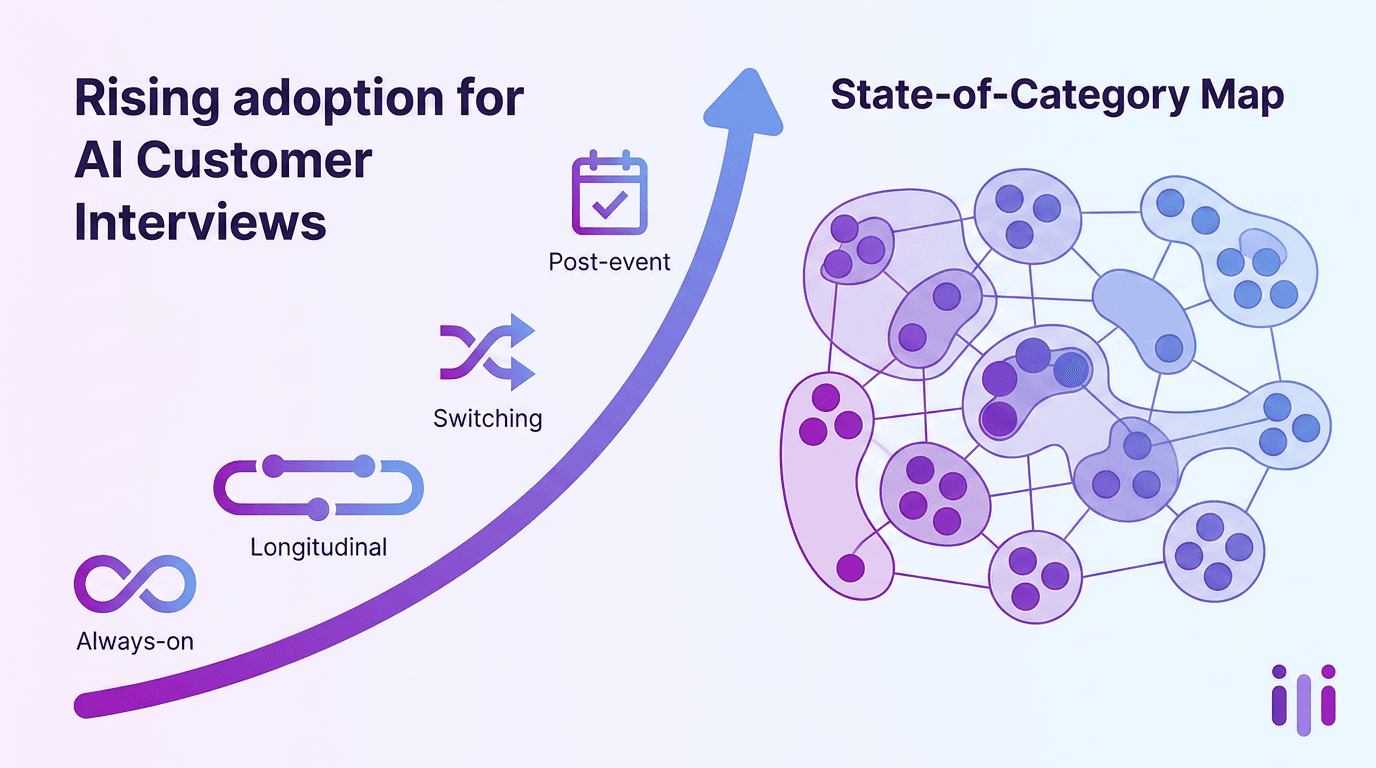
The State of AI Customer Interviews in 2026: Adoption, Patterns, and What's Coming Next
AI Customer Interviews & Research · 10 min read

Synthetic Focus Groups in 2026: What They Get Right, Where They Break
AI Customer Interviews & Research · 11 min read

The 2026 State of AI Customer Research: Mid-Year Update
AI Customer Interviews & Research · 11 min read

The 2026 State of Customer Research Hiring: Why Teams Cut Researchers and Bought AI
AI Customer Interviews & Research · 11 min read
The 2026 Customer Interview Benchmark Report: Response Rates, Depth, and Time-to-Insight
AI Customer Interviews & Research · 18 min read

Digital Focus Groups Went AI-First in 2026: 6 Shifts Reshaping Online Qualitative Research
AI Customer Interviews & Research · 13 min read