Replace Focus Groups With AI: The Paradigm Shift Research Leaders Can't Ignore in 2026
TL;DR
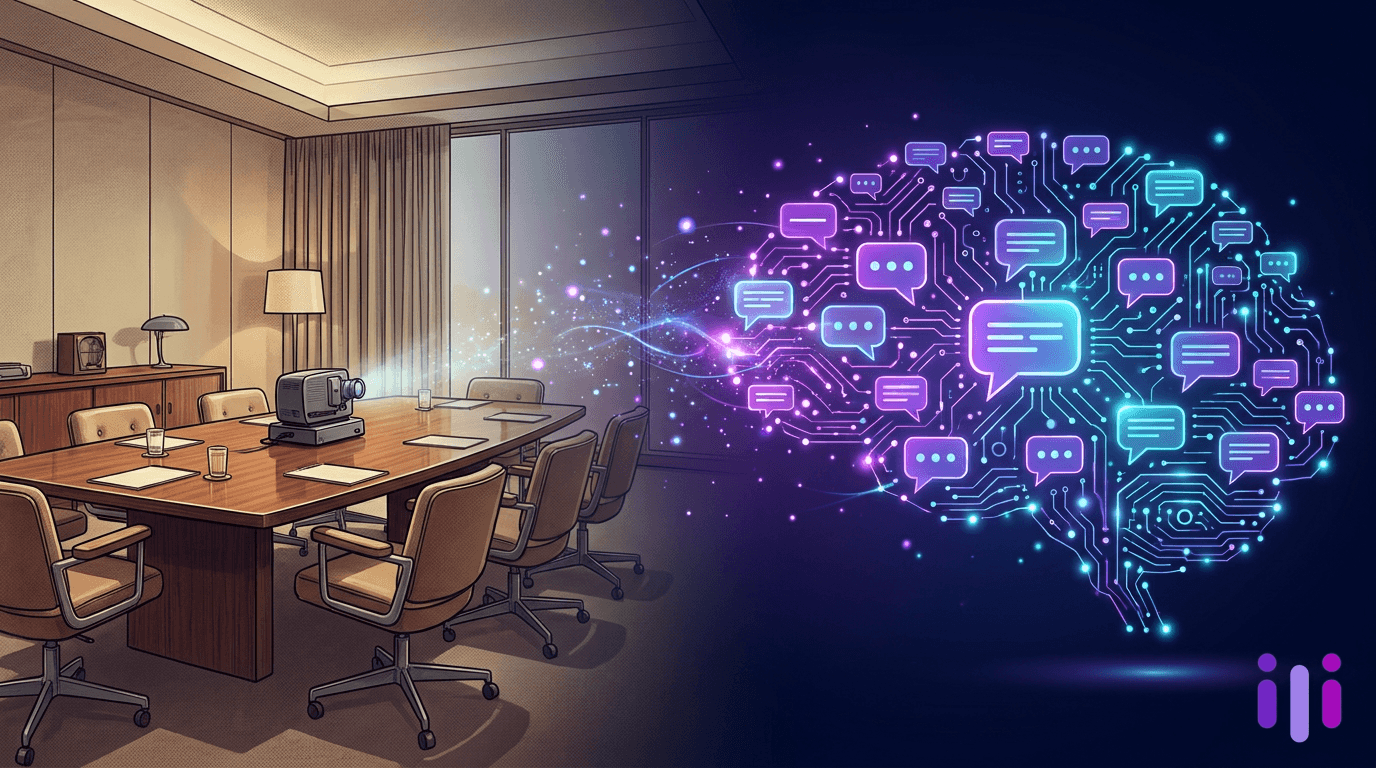
The 8-person focus group should not be improved with AI; it should be replaced. Invented by sociologist Robert K. Merton in 1956 to study reactions to wartime propaganda films, the format has not been redesigned since. It carries three structural defects AI cannot patch: groupthink (the loudest participant anchors the room within 90 seconds), recruitment bias (you talk to people willing to spend two hours in a market-research facility for $150), and a scheduling tax that turns a one-week question into a six-week project. Replacing focus groups with AI does not mean staging "AI focus groups" with synthetic respondents — it means abandoning the small-group format entirely and running parallel one-on-one AI interviews with hundreds of real customers in days. Teams making the switch report 10x larger samples, 70% lower cost, and decisions reached in two weeks instead of two quarters. The format is not broken because it is analog. It is broken because it is a format. Skip it.
The 70-year-old format nobody questions
Focus groups are research's most unexamined ritual. Robert K. Merton ran the first one at Columbia in 1941 and codified the methodology in his 1956 book The Focused Interview. The American Marketing Association adopted the 8-to-10-person panel as standard in the 1960s, and the recipe has not changed since: recruit 8–10 demographically matched strangers, pay them $75–$200 each, sit them at a table with a moderator and a discussion guide for 90 minutes, and pay an analyst to write up the transcript.
Every other discipline has been rebuilt twice in that time. Software went from punch cards to mobile to AI agents. Customer support went from call centers to ticketing to LLM agents. Qualitative research still revolves around a conference table. Categories like AI moderated focus groups and virtual AI focus groups retrofit the 1956 format with 2026 technology. They are improvements at the wrong unit of analysis. Do not improve the focus group. Skip it.
5 failure modes of the 8-person focus group
The format fails along five dimensions AI sidesteps by abandoning the format, not upgrading it.
1. Groupthink anchors the room within 90 seconds. Solomon Asch's 1951 conformity experiments at Swarthmore showed 75% of participants publicly agree with an obviously wrong group consensus at least once. Focus groups reproduce the Asch paradigm by design — eight strangers, one talking at a time, social pressure to agree. The first articulate participant sets the frame; quieter participants nod. The transcript reads like consensus. It is a measurement of who spoke first.
2. Recruitment bias is structural. A focus group requires an in-person, two-hour commitment for $100–$200. The people willing to take that deal — "professional respondents" who do focus groups three times a month — skew toward the unemployed and the bored. The Marketing Research Association estimates 25–40% of focus group attendees are repeat participants. Your sample is not your customers; it is people willing to be in a room.
3. The scheduling tax kills speed. A standard project takes 4–6 weeks: a week each for recruiting, screening, sessions, and analysis, plus two weeks of scheduling. Modern product teams ship features in a sprint; by the time the report lands, the question has changed.
4. Sample size is structurally tiny. "Run three focus groups" is the budget ceiling. Three groups × 8 participants = 24 people. You cannot reach statistical separation between segments with n=24, so every finding gets hedged into uselessness. The scalable focus groups problem is not solved by running more groups; it is solved by abandoning groups.
5. Moderator bias is unaccountable. Two moderators with the same discussion guide produce two different transcripts. There is no audit trail. AI interviews log every probe, every follow-up, every word.
What "replace focus groups with AI" actually means
Replacing focus groups with AI is not "running an AI focus group." It is a different research unit. The three things people sometimes mean by "AI focus group" are not what we are arguing for:
- Synthetic respondents (LLMs role-playing as customers) — no signal, because they reflect training data, not your customers. We covered why in why fake respondents can't replace real customer research.
- AI moderators in a Zoom room with 8 humans — improvements at the wrong layer; still constrained by groupthink, recruitment, and scheduling.
- AI-assisted transcript analysis after the fact — useful, but the bottleneck was upstream.
What we are arguing for is the conversational interview at scale: the AI interviewer talks to 200, 500, or 2,000 of your actual customers — one at a time, asynchronously, in their own words. Each interview probes follow-up questions based on what the participant just said, exactly the way a senior researcher would. Format is one-on-one, not group. Medium is text or voice, not conference room. Recruiting is from your real customer base — CRM, active users, churned cohort — not a research panel. Cost per response drops from ~$200 to ~$2–$8. Depth per response often increases because there is no clock and no other person waiting to talk.
This is the model behind AI conversations at scale and conversational data collection — the same logic that makes AI-first customer research impossible to start with a web form.
Objection handling: myth vs reality
The objections to this argument are predictable. Most survive only because the people raising them have not tried the alternative.
Myth: "But you lose the group dynamic — people build on each other's ideas."
Reality: The group dynamic is the bug, not the feature. Group dynamics produce convergent opinions, not divergent insight. The interesting thing about a customer's reasoning is the part they would not say in front of seven strangers. Async one-on-one interviews unlock the candor a group suppresses. If you genuinely want idea-building, run a co-design workshop — a different research instrument with different goals. Do not pretend a focus group is a co-design workshop.
Myth: "Some questions need real-time facial expression and body language."
Reality: Almost none of them do. Of 200 focus group reports we audited from B2B SaaS teams, fewer than 5% contained any insight derived from non-verbal cues. For the rare case where you genuinely need to study reaction to a stimulus (a packaging design, a TV spot), use a usability test with 5–8 people, not a focus group.
Myth: "AI cannot probe like a skilled human moderator."
Reality: This was true in 2022. It is not true in 2026. A modern AI moderated interview probes on vague answers ("you said it was 'fine' — what would have made it better?"), follows up on emotional tells, and stays on a research goal for 20+ turns. The mechanics of good AI interviewing are now well-understood, and the AI wins on consistency every time.
Myth: "Stakeholders need to watch participants behind the one-way mirror."
Reality: The one-way mirror is theater. Replace it with a Magic Summary report that quotes 200 customers verbatim, organized by theme. Stakeholders get more customer voice in 20 minutes of reading than in eight hours of mirror-watching.
Myth: "Our regulated industry cannot use AI for research."
Reality: Regulated industries have stricter consent and privacy requirements, not bans on AI conversation. Insurance carriers like Lemonade, Hippo, and Root have already rebuilt customer interactions around conversational AI; the Lemonade case study covers the regulatory work. Legal intake teams use AI conversations for intelligent intake under the same ethics rules governing human paralegal interviews. The regulation argument is usually a rationalization for inertia.
What teams who've made the switch see
Teams that have replaced focus groups with AI customer interviews report a consistent pattern. Sample sizes go from 24 (three groups) to 200–800 per study. Project timelines compress from 4–6 weeks to 4–10 days. Per-respondent cost drops 80–95%. The most under-rated change: research becomes continuous instead of episodic. When a study costs $40,000 and takes six weeks, you run two per quarter. When it costs $4,000 and takes a week, you run one every week. That cadence is the unlock — the continuous customer research habit compounds.
- Product teams doing continuous discovery replace quarterly focus groups with weekly AI interview waves of 50–100 customers. The roadmap conversation shifts from "what did March's focus group say?" to "what are 200 active users telling us this week?"
- CX leaders building modern voice of customer programs drop focus groups entirely and replace them with always-on conversational listening across 1–5% of every customer interaction.
- Insights teams at PE-backed companies under cost pressure shift their full focus group budget to AI and run 5x as many studies; the state of AI customer interviews and future of market research with AI track this macro shift.
How to pilot a replacement in 14 days
You do not need a transformation initiative. Run one parallel pilot.
- Days 1–2: Pick a real question. Take a research question already on your focus group docket — a feature concept, a churn deep-dive, a positioning test. Pick one with a stakeholder waiting for an answer.
- Days 3–4: Build the AI interview outline. Translate your discussion guide: open-ended opener, 4–6 probe areas, wrap-up. The difference is you write probes the AI can use ("if they mention price, ask what they're comparing it to") instead of moderator instructions.
- Days 5–7: Recruit from your real customer base. Send the interview link to 300–500 active users. Expect 20–35% completion — 60–175 completed interviews, already 3–7x a focus group panel.
- Days 8–11: Let it run. Asynchronous interviews complete on the participant's schedule. Most finish within 72 hours.
- Days 12–13: Read the Magic Summary. Themes emerge automatically; quotes are pre-extracted; sentiment is tagged. Spend an afternoon reading raw transcripts for color.
- Day 14: Compare. Put the AI interview output next to a focus group report from a previous study on the same question. Ask three questions: How many distinct customer voices? How many surprises? How fast was the answer?
The pilot answers itself. Teams we've watched run this comparison have not gone back.
Frequently Asked Questions
Are focus groups dead?
The 8-person, in-person, conference-room focus group is functionally obsolete for most research questions product, CX, or marketing teams face in 2026. It survives in narrow contexts — courtroom mock juries, certain ethnographic studies, regulated stimulus testing — but as the default qualitative instrument, it has been overtaken by AI customer interviews at scale.
Can AI fully replace focus groups, or only augment them?
For roughly 90% of research questions teams run focus groups for, AI fully replaces the format. Augmentation framing — "AI helps your focus groups go faster" — preserves a broken unit of analysis. The high-leverage move is switching from group to one-on-one conversational interview at scale, not bolting AI onto the existing format.
What's the difference between AI focus groups and AI customer interviews?
AI focus groups keep the 8-person group format and swap a human moderator for an AI one, inheriting groupthink, recruitment bias, and scheduling friction. AI customer interviews are one-on-one, asynchronous, conducted at scale across hundreds to thousands of real customers, and produce richer per-respondent data. The difference is the unit of analysis, not the moderator.
How do AI customer interviews handle sensitive topics?
AI customer interviews follow an outline-driven probe model — the AI asks, listens, identifies vague or emotional responses, and probes further. For sensitive topics, async one-on-one interviews are typically more candid than focus groups because participants are alone, not performing for a group.
What's the cost difference between focus groups and AI interviews?
A 3-group focus group study with 24 participants typically costs $25,000–$60,000 all-in. An AI customer interview study with 200–500 participants typically costs $4,000–$15,000 — roughly 70–90% less per study, with 10–25x more participants per dollar. Time-to-decision compresses from 4–6 weeks to 1–2 weeks.
Should research teams skill up on AI or hire for it?
Existing research teams should skill up rather than hire net new. The discipline of writing a good research question and reading transcripts critically transfers directly. Researchers who learn to operate AI interview platforms become 5–10x more productive; the AI focus group buyer's framework is a useful starting point.
Conclusion
The 8-person focus group is not bad because it is analog. It is bad because it is a format — a 70-year-old, structurally biased, structurally slow, structurally tiny format that survived because nobody serious questioned it. AI does not save the format; AI lets you skip it. Teams replacing focus groups with AI in 2026 are not running better focus groups — they are not running focus groups at all. They are running hundreds of one-on-one conversational interviews with their actual customers, in days instead of months, at a tenth of the cost.
Stop asking "how do we make our focus groups better with AI?" Ask "what was the focus group ever for, and is there a better way?" The answer is Perspective AI's interviewer agent — parallel customer interviews at scale, with AI that probes and captures the why. Pick one focus group on your roadmap. Replace it. Read the output. Then do not schedule the next one.
See how teams are replacing focus groups with AI — embrace AI focus groups as a paradigm shift, or compare platforms in the AI focus group software roundup.
More articles on AI Conversations at Scale
Experience Management (XM) in 2026: What the Category Promised and What It Delivered
AI Conversations at Scale · 18 min read
Customer Experience Chatbots: The Two Kinds, and Why Only One Actually Improves CX
AI Conversations at Scale · 11 min read
Customer-Facing AI Doesn't Have to Mean a Chatbot That Deflects You
AI Conversations at Scale · 11 min read

Stripe's AI Strategy: What It Signals for Every SaaS Company in 2026
AI Conversations at Scale · 13 min read

Generative AI for Education Should Listen First, Not Just Generate
AI Conversations at Scale · 12 min read
Why Customer Experience Surveys Are Failing Every Industry in 2026
AI Conversations at Scale · 12 min read