AI Product Feedback Tools in 2026: A Buyer's Guide for Product Teams
TL;DR
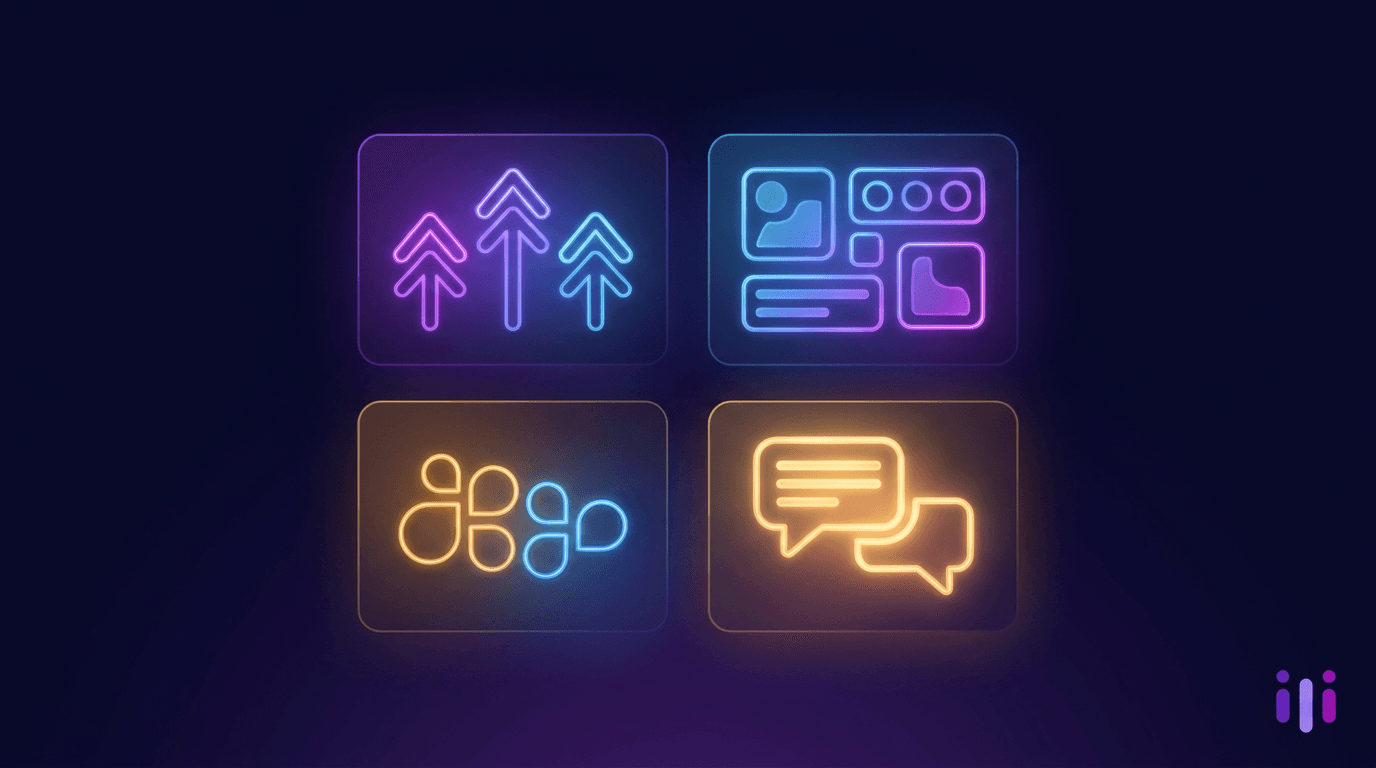
"AI product feedback tool" is one label covering four very different products. Feature request boards (Canny, Productboard, Aha! Ideas) collect votes. In-product widgets (Sprig, Hotjar, Pendo Feedback) catch reactions. Aggregation tools (Productboard's AI, Dovetail) synthesize what you already have. AI conversational research (Perspective AI) generates qualitative depth at scale. Most product teams over-invest in category 1, under-invest in category 4, and end up with mountains of votes and no understanding of "why." This guide categorizes the market, compares top vendors, and recommends stacks by team size.
The PM's Feedback Problem in 2026
Product managers in 2026 are drowning in feedback channels and starving for synthesis. The average B2B SaaS PM now monitors feedback across 7-9 channels: support tickets, sales call notes, NPS surveys, in-product widgets, feature request portals, community forums, social mentions, user interviews, and churn exit surveys. According to ProductPlan's 2025 State of Product Management Report, 68% of product leaders say "synthesizing customer signals" is a top-three time sink — up from 41% three years ago.
The problem isn't a lack of data. It's a lack of qualitative depth. Mind the Product's 2025 community survey found that 73% of PMs feel "confident in what users say they want" but only 29% feel "confident in why they want it." That 44-point gap is the entire reason "AI product feedback tools" became a category. Vendors raced to fill it. They filled it with very different products that share a label.
That confusion is now a budgeting problem. Forrester's 2025 wave on product management tooling identified that the median product team spends $40K-$120K annually across 3-5 feedback tools — and roughly 60% of that spend goes to feature request and roadmap tools that capture demand signals, not understanding. The gap doesn't get smaller. It gets louder.
This guide categorizes the four kinds of AI product feedback tools, names the leaders in each, and offers a stack recommendation by team size. The argument: most teams need less of category 1 and more of category 4.
The 4 Categories of AI Product Feedback Tools
Every tool calling itself an "AI product feedback tool" falls into one of these four buckets. They solve different problems. Buying the wrong category is the most common mistake we see in product teams' tool stacks.
Each category has a different unit of value. Category 1 sells you a list. Category 2 sells you a metric. Category 3 sells you a summary. Category 4 sells you a transcript with a follow-up question. They are not substitutes.
Category 1: Feature Request Boards
These tools let users (or internal teams) submit and vote on feature ideas. AI features here typically include duplicate detection, theme clustering, and roadmap-impact scoring.
Canny is the simplest and most popular among mid-market SaaS. Strong public roadmap, native voting, decent AI clustering of duplicate requests. Weak at "why" — the average request comment is 14 words.
Productboard is the enterprise standard. Strong integrations (Slack, Salesforce, Zendesk, Intercom), opportunity scoring, and a roadmap layer. AI features added in 2024-2025 include theme summarization across feedback sources. Heavy implementation; teams report 6-10 weeks to onboard.
Aha! Ideas is the strategy-first option. Tightly coupled to Aha! Roadmaps. Strong for organizations that already run on Aha!; awkward as a standalone.
The trap: Feature request boards are easy to buy and easy to demo. They produce visible artifacts (lists, votes, kanbans). But they capture stated demand from users who are already engaged enough to submit. They miss the silent majority and they don't tell you why a request matters. Gartner's 2025 Voice of Customer research found that requests with the highest vote counts had only a 31% correlation with actual feature impact on retention.
Category 2: In-Product Feedback Widgets
These tools fire micro-surveys, NPS prompts, or sentiment captures in the product, often triggered by user behavior.
Sprig leads the AI-native cohort. Replays plus targeted surveys plus AI summarization of open-ended responses. Good for fast quant signal on specific flows.
Hotjar is the heatmap-plus-feedback classic. Owned by Contentsquare. Strong on session recordings; lighter on synthesis.
Pendo Feedback ties feedback widgets to the Pendo product analytics suite. Strong if you already run on Pendo; expensive otherwise.
The trap: Widgets capture reactions, not reasoning. A 1-5 star rating with a 12-word comment doesn't survive contact with a strategic decision. Reforge's 2025 product research curriculum makes the point bluntly: "In-product surveys are inputs to research, not substitutes for it."
Category 3: Feedback Aggregation & Synthesis
These tools ingest feedback from multiple sources and use AI to surface themes, sentiment, and trends.
Productboard's AI layer synthesizes themes across its own feedback inbox and connected sources. Good if Productboard is already your hub.
Dovetail is the research repository leader. Originally a tagging and analysis tool for user interviews; has expanded into broader feedback synthesis with strong AI summarization. Best in class for teams that already run a lot of moderated research.
The trap: Aggregation tools are only as good as the corpus you feed them. Garbage in, fluent garbage out. If your existing feedback is shallow tickets and 2-line widget responses, no amount of AI synthesis manufactures depth.
Category 4: AI Conversational Research
This is the newest category and the most misunderstood. AI conversational research tools run actual interviews — multi-turn conversations where an AI moderator asks a question, listens to the answer, and follows up to capture the "why." They scale qualitative research from dozens of interviews per quarter to hundreds per week.
Perspective AI runs hundreds of customer interviews simultaneously. The AI follows up, probes contradictions, and captures the reasoning behind stated preferences. The output is structured qualitative data — not vote counts, not NPS scores, but the specific language and context customers use to explain their decisions.
This category exists because the previous three didn't solve the depth problem. Forms can't probe. Widgets can't follow up. Aggregation can't manufacture insight that isn't in the source data. The premise behind Perspective AI is simple: AI-first research can't start with a web form. It has to start with a conversation.
For more on how AI interviews change the prioritization process, see Feature Prioritization Without the Guesswork.
Top Vendors: Strengths, Gaps, Pricing
Pricing reflects publicly listed plans as of early 2026 and excludes enterprise negotiation. Most teams will land 30-50% off list with annual commits.
Where Product Teams Misallocate Budget
The single most common pattern we see when auditing product team tool stacks: 60-70% of feedback budget on category 1, 20-25% on category 2, 5-10% on category 3, and almost nothing on category 4.
That allocation made sense in 2018. It doesn't in 2026.
The reasoning is anchoring. Category 1 tools are the oldest, the most familiar, and the easiest to justify to finance ("we have a public roadmap"). They are also the lowest-leverage. Vote counts answer "what do engaged users want?" — a question that matters less than "why do disengaged users churn?" or "what is the real job-to-be-done behind this request?"
Forrester's 2025 PM tools wave noted that teams investing more than 40% of feedback budget into qualitative research methods (interviews, ethnography, AI conversational research) reported 2.3x higher confidence in roadmap decisions than teams allocating less than 15%. The same wave found that high-performing product organizations — defined by NPS and retention outcomes — were 4x more likely to operate a continuous interview cadence than peers.
The reallocation argument: take 20-30% of category 1 spend and move it to category 4. You will not lose roadmap transparency. You will gain the reasoning your roadmap is missing.
For more on aggregating and analyzing customer feedback effectively, see Customer Feedback Analysis.
Stack Recommendations by Team Size
Different teams need different stacks. Here are the configurations we recommend.
Early-stage (0-15 PMs, pre-Series B)
- Skip category 1 entirely. Use a Notion or Linear board.
- Add a lightweight category 2 widget (Hotjar starter plan).
- Invest in category 4 (Perspective AI). At this stage, qualitative depth is everything; vote counts are a distraction.
- Total feedback stack: $1,000-$2,500/mo.
Mid-market (15-40 PMs, Series B-C)
- Category 1: Canny for public roadmap.
- Category 2: Sprig for in-product reactions.
- Category 4: Perspective AI for ongoing customer interviews.
- Skip category 3 until your corpus is large enough to need synthesis.
- Total feedback stack: $3,000-$6,000/mo.
Enterprise (40+ PMs)
- Category 1+3: Productboard.
- Category 2: Pendo Feedback (if Pendo is your analytics layer) or Sprig.
- Category 4: Perspective AI as the qualitative engine feeding everything else.
- Optional: Dovetail for moderated research repo.
- Total feedback stack: $10,000-$25,000/mo.
The pattern across all three sizes: category 4 is non-optional. Categories 1, 2, and 3 are sized to organizational complexity.
The Voice of the Customer Debate: Quant vs Qual
The longstanding debate in product feedback is quant versus qual. Vote counts and NPS scores versus interviews and ethnography. The 2026 reality is that AI has changed the economics of qual.
Historically, qualitative research was slow and expensive. A user research team could run 8-15 interviews a month. The data was rich but the sample was small, so PMs leaned on quant signals (votes, NPS, widgets) for "scale." That tradeoff produced the 60% mis-allocation pattern above.
AI conversational research collapses the cost of qual. A team that previously ran 10 interviews a month can now run 200 — with structured outputs, consistent moderation, and probing follow-ups. The Gartner 2025 VoC research notes that organizations adopting AI-moderated interviewing report 5-7x higher monthly research volume with comparable insight quality scores.
This doesn't kill quant. It rebalances the stack. Quant tells you what; qual tells you why; you need both. What changed is that "why" is no longer the constraint. For a deeper look at this shift, see AI Customer Interviews.
Common Buying Mistakes
Five patterns we see repeatedly in product team tool purchases.
- Buying category 1 first because it's the most legible. A public roadmap is a marketing artifact, not a research strategy. Treat it as such.
- Confusing aggregation with research. Productboard's AI synthesis is excellent at finding themes in your existing feedback. It cannot generate insight that isn't in the source data.
- Treating in-product widgets as a research substitute. A 1-5 rating with a 12-word comment is a signal, not a study.
- Underweighting integration cost. Productboard implementations routinely run 6-10 weeks. Pendo Feedback only makes sense if you're already on Pendo. Factor switching costs into TCO.
- Skipping category 4 because it's new. AI conversational research is the newest category. It is also the highest-leverage for the depth gap most teams face. Pilot it before you renew anything in category 1.
For more on building a modern customer research practice, see Customer Research Tools and AI Feedback Collection.
FAQ
What is an AI product feedback tool? An AI product feedback tool is software that uses AI to help product teams collect, analyze, or synthesize customer feedback. The label covers four distinct categories: feature request boards, in-product widgets, feedback aggregation/synthesis platforms, and AI conversational research tools. Each solves a different problem.
Is Productboard an AI product feedback tool? Productboard combines categories 1 (feature request board) and 3 (AI-powered feedback synthesis). Its AI layer summarizes themes across connected feedback sources. It is not an AI conversational research tool — it does not run interviews or capture qualitative depth at scale.
What's the difference between Canny and Perspective AI? Canny is a feature request board (category 1). Users submit ideas and vote on them. Perspective AI is an AI conversational research platform (category 4). It runs structured interviews at scale, with AI moderation that follows up and probes for the "why" behind customer responses. They serve different jobs and most product teams should run both.
Do I need both an in-product feedback widget and AI conversational research? Usually yes. Widgets capture immediate reactions to specific flows (good for release feedback and bug surfacing). AI conversational research captures the underlying reasoning across your customer base (good for roadmap and strategy). They complement each other; they do not substitute.
How much should a product team spend on feedback tools? Forrester's 2025 PM tools research suggests benchmarks of $40K-$120K annually for the median mid-market team across all feedback categories. Within that, we recommend at least 25-35% allocated to category 4 (qualitative research) — substantially higher than the 5-10% most teams currently allocate.
Conclusion
"AI product feedback tool" is a category label that hides four distinct categories. Feature request boards collect votes. In-product widgets collect reactions. Aggregation tools summarize what you already have. AI conversational research generates the qualitative depth that makes the other three useful. Most product teams in 2026 are over-invested in category 1 and under-invested in category 4. The fix isn't more tools — it's a stack rebalanced toward depth.
If your roadmap is full of vote counts but you can't articulate why your last three churned customers left, you don't have a tools problem. You have a depth problem. That's the gap Perspective AI was built to close.
See Perspective AI in action. Run AI-moderated interviews with hundreds of customers simultaneously, capture the "why" behind every signal, and feed real qualitative depth into your product decisions. Book a demo and see what AI-first research looks like when it doesn't start with a web form.
Related resources
Deeper reading:
- Jobs-to-be-Done Interviews (AI-Powered Guide)
- Feature Prioritization Without the Guesswork
- Product Discovery Research: Replacing Surveys
- Product-Market Fit Research Guide
- UX Research at Scale
- User Interview Software (2026 Comparison)
- AI Qualitative Research
Templates and live examples:
- Customer interview
- User research interview
- Jobs-to-be-Done interview
- Concept testing interview
- Feature prioritization interview
For your team:
More articles on Product Discovery & UX Research
Best Thematic Analysis Software in 2026: 10 Tools Compared by What They Can Code
Product Discovery & UX Research · 15 min read
Best Website Feedback Tools in 2026: 10 Platforms Ranked by Depth of Why
Product Discovery & UX Research · 16 min read
Customer Journey Mapping Tools in 2026: 8 Options Compared
Product Discovery & UX Research · 15 min read
Best Contentsquare Alternatives in 2026: Digital Experience Analytics vs. the Why
Product Discovery & UX Research · 13 min read
Best Diary Study Tools in 2026: 7 Platforms Ranked by Longitudinal Depth
Product Discovery & UX Research · 15 min read
Best FullStory Alternatives in 2026: 8 Tools Ranked for the 'Why' Behind the Session
Product Discovery & UX Research · 15 min read