AI User Research Tools: The 2026 Buyer's Map by Research Stage
TL;DR
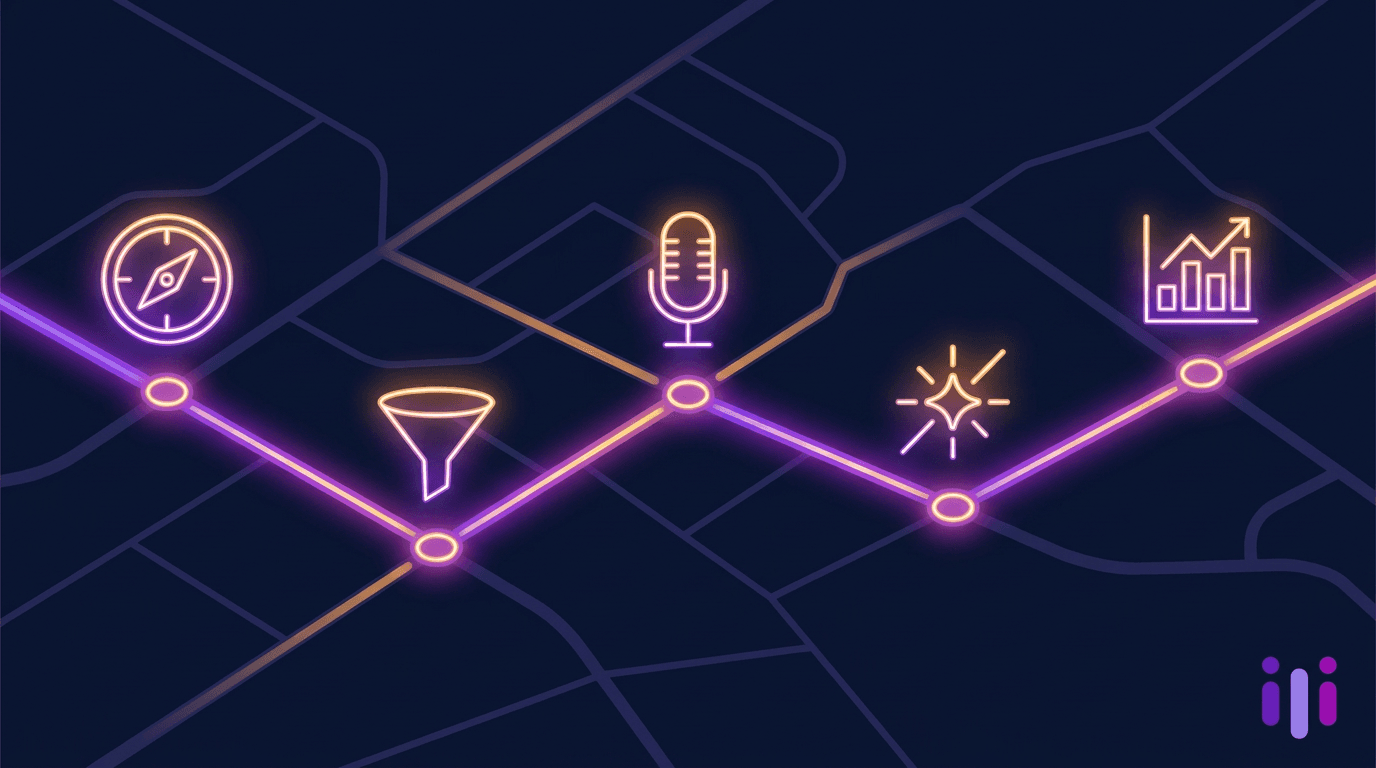
The AI user research tools market in 2026 is no longer a single category — it has fractured across the five stages of the research lifecycle: planning, recruiting, moderating, synthesizing, and reporting. Most teams are now stitching together 4–7 point tools (a planning canvas, a panel provider, an interview platform, a synthesis layer, a deck builder), and the integration tax is becoming the new bottleneck. End-to-end platforms that span moderation through reporting — led by Perspective AI, with Maze and UserTesting building toward parity in narrower lanes — are pulling ahead because they collapse the handoff cost. Point-solution stacks still win for highly regulated workflows or specialty methods, but for general product, CX, and UX teams running >20 studies per quarter, the math now favors a single AI-native platform with humans in the analyst seat. According to Maze's 2024 Future of User Research report, 73% of UX teams now use AI in some part of the lifecycle, but only 12% have consolidated onto a single platform — that gap is the 2026 buying decision. This guide maps the landscape stage by stage and tells you where each tool actually fits.
The 5 stages of the AI user research lifecycle
The user research lifecycle in 2026 maps to five distinct stages, each with its own AI tooling category: planning (study design, hypothesis framing), recruiting (panel sourcing, screening, scheduling), moderating (interview execution, voice/text agents, follow-up logic), synthesizing (transcript analysis, theme extraction, quote mining), and reporting (deck generation, stakeholder summaries, JTBD outputs). Five years ago most of this work happened inside a single ResearchOps team using a small set of tools — a Calendly, a Zoom, a Dovetail-style notebook, a Google Slides template. The AI wave didn't replace that stack; it created a parallel AI-native stack at every stage. The result is a market where buyers face the same five-stage decision tree five times over.
Mapping tools to stages is now the primary buyer's job. A "best AI user research tool" answer that ignores which stage you're solving for is useless. The rest of this guide walks each stage, names the dominant 2026 tools, and flags whether they're point solutions or end-to-end platforms.
Stage 1: Planning tools — designing the study before you talk to anyone
Planning tools help researchers turn a vague business question into a structured study brief, hypothesis, and discussion guide before any participant is recruited. The 2026 generation of AI planning tools generates draft research questions from a Jira ticket or product spec, suggests methods (qual interviews vs survey vs diary study), and pre-writes the discussion guide that the moderator will use in Stage 3. The strongest planning workflows treat the brief as a living artifact that the moderation tool can ingest directly — not a Google Doc that gets re-typed into a different platform.
Tools dominating Stage 1 in 2026:
- Perspective AI's research outline builder — generates a complete discussion guide from a one-line research goal and pulls it directly into the AI moderator (no copy-paste handoff). Wins because planning and moderation share a single artifact.
- Notion AI and ChatGPT custom GPTs — generic but widely used by researchers who haven't adopted a dedicated tool yet. Cheap, flexible, but no handoff to moderation.
- Maze's AI-assisted study creator — strong for unmoderated usability tests; weaker for open-ended discovery interviews.
- Dovetail's AI research planner — added in 2025, useful but oriented around feeding their own synthesis layer rather than a moderator.
Planning tools are the easiest stage to skip if you have an experienced researcher and the hardest to skip if you have a non-researcher (a PM, a CSM) running the study self-serve. The trend in 2026: planning is moving from "researcher writes brief" to "AI writes draft, researcher edits" — see Nielsen Norman Group's 2024 report on AI's effect on UX research workflows for the time-savings data.
Stage 2: Recruiting tools — finding and screening the right participants
Recruiting tools source qualified participants, screen them against criteria, and schedule them into the moderation tool. AI is reshaping this stage in two ways: AI screeners (which interview candidates conversationally instead of via a screener form) and AI panel quality scoring (which detects bot/fraud responses in B2C panels). The 2026 recruiting market still belongs to specialist panel providers — User Interviews, Respondent, Prolific — but the screener layer is rapidly being absorbed into moderation platforms.
The point-solution recruiting stack:
- User Interviews and Respondent — B2C and B2B panel providers, dominant for incentive-based recruiting. Both added AI screener features in 2025.
- Prolific — academic-grade panel; preferred for survey-style recruiting where panel quality is the differentiator.
- Calendly + your own customer database — what most B2B teams actually use for existing-customer research; cheaper than a panel provider but requires CRM hygiene.
The end-to-end alternative: platforms that handle screening conversationally inside the same flow as the main interview. Perspective AI's Concierge agents act as an AI screener that triages incoming participants, qualifies them with conversational questions, and routes qualified ones into the full interview without a handoff. This collapses what used to be three tools (screener form, scheduler, interview platform) into one. For teams running ongoing research, the lifetime cost of the consolidated approach beats stitching three tools together within ~6 months.
Stage 3: Moderation tools — running the interview itself
Moderation is where AI changed the lifecycle most. In 2022, moderation meant a human researcher on Zoom. In 2026, AI moderators run text or voice interviews at scale, follow up on vague answers, probe contradictions, and capture the "why" without a human in the room. This is the stage Perspective AI is built around — see our deep-dive on how AI-moderated interviews actually work for the mechanics.
The 2026 moderation landscape splits four ways:
- AI-native conversational platforms — Perspective AI (text + voice, deep follow-up logic, async + sync), and a small handful of newer entrants. Best for open-ended discovery, JTBD, voice of customer, and continuous research.
- AI-augmented usability platforms — Maze, UserTesting, Lookback. Strong for task-based usability and prototype testing; lighter on open-ended interview depth.
- Generic chatbot platforms repurposed for research — Typeform's AI features, SurveyMonkey's GenAI add-ons. These are surveys with an AI veneer; they don't moderate, they just dynamically reword. We've covered why conversational data collection beats forms for real depth.
- Human-only moderation services — still the right choice for sensitive, regulated, or executive interviews where human rapport is the deliverable.
The 2026 trend in moderation: voice is becoming the default for B2C and consumer research, while text remains dominant for B2B and async global studies. According to McKinsey's 2024 State of AI report, 65% of organizations using generative AI in customer-facing workflows are running voice or chat interfaces, up from 33% the year prior. For a deeper read on how the field is evolving, see the 2026 mid-year state of AI customer interviews.
Stage 4: Synthesis tools — turning transcripts into insight
Synthesis tools take raw interview transcripts and surface themes, quotes, and decision-grade insights. This is where the synthesis bottleneck lives — historically, one hour of interview took 3–5 hours to synthesize. AI synthesis tools have collapsed that ratio to under 30 minutes per hour of interview, with the best end-to-end platforms running synthesis automatically as transcripts complete.
The Stage 4 tooling map:
- Dovetail and Reduct — research notebooks with AI tagging and theme extraction. Strong if you already own the transcripts and want a dedicated synthesis layer. Standalone — no recruiting, no moderation.
- Perspective AI's Magic Summary reports and quote extraction — synthesis runs automatically as conversations complete; no manual tagging step. Wins on time-to-insight when moderation and synthesis are on the same platform. Our customer feedback analysis workflow shows the cycle-time math.
- Generic LLM workflows — Claude or ChatGPT used directly on transcripts. Surprisingly effective for one-off studies; falls apart at scale because there's no audit trail or theme persistence.
- Specialty synthesis tools (Aurelius, Condens) — niche but loved by qual purists.
The biggest synthesis decision in 2026 is whether to keep a dedicated notebook (Dovetail-style) or absorb synthesis into the moderation platform. Teams running >20 studies per quarter increasingly choose the absorbed model — the AI-first synthesis workflow eliminates the import/export step that breaks most stacks. Teams running <10 studies per quarter often stick with a dedicated notebook because the volume doesn't justify migration.
Stage 5: Reporting tools — getting insights to stakeholders
Reporting tools turn synthesized insights into the artifacts that drive decisions: stakeholder decks, executive summaries, JTBD outputs, opportunity solution trees, roadmap inputs. This is the most under-tooled stage in 2026 — most teams still hand-build slides in Google Slides or Figma after synthesis. AI is starting to close the gap: tools now generate first-draft decks from a synthesized insight set, and the best end-to-end platforms emit shareable summary reports directly from the moderation layer.
The 2026 reporting tool tiers:
- Inside end-to-end platforms — Perspective AI generates Magic Summary reports designed to be shared with stakeholders directly, no slide-building required. The voice of customer blueprint shows the program-level reporting cadence.
- Generative deck tools (Gamma, Tome, Beautiful.ai) — strong for first drafts; require manual insight input.
- BI dashboards repurposed for research (Tableau, Looker) — for quant overlays on qual themes; rarely sufficient on their own.
- Manual hand-off to design or product ops — still the dominant pattern in enterprise, where research findings go through a brand-controlled deck template.
Reporting is the stage where end-to-end platforms have the biggest unfair advantage: when planning, recruiting, moderation, synthesis, and reporting share a single data model, the deck practically writes itself. Teams stitching point tools together still spend 30–50% of total research time on the reporting handoff alone.
End-to-end platforms vs point solutions: the 2026 buyer decision
End-to-end platforms span at least three of the five stages — typically planning through synthesis or moderation through reporting — while point solutions specialize in one. The end-to-end vs point-solution decision is the single most important call for a research-tooling buyer in 2026.
End-to-end leaders in 2026:
Where point solutions still win:
- Highly regulated industries (healthcare, financial services) where each stage requires a compliance-vetted vendor
- Specialty methods (eye tracking, in-context mobile diary studies) that have no end-to-end equivalent yet
- Teams running <5 studies per quarter where consolidation overhead exceeds the integration tax
Our comparison of qualitative research software by team size and cadence goes deeper on the team-size cutoffs. For teams at the bigger end, UX research at scale covers the 100-studies-per-quarter operating model.
How to choose for your team's stage
Choose based on your research cadence, not your headcount. Five buying patterns hold across most 2026 research teams:
- <5 studies per quarter — keep your point-solution stack. Consolidation overhead isn't worth it. Pick the strongest tool per stage.
- 5–20 studies per quarter — start consolidating Stages 3–5 (moderation, synthesis, reporting) into one end-to-end platform. Keep recruiting separate via User Interviews or your CRM.
- 20–50 studies per quarter — go end-to-end across Stages 2–5. The integration tax of point tools is now your biggest cost.
- 50+ studies per quarter — the research at scale playbook becomes mandatory; only end-to-end platforms can keep up. Perspective AI's continuous discovery stack is built for this lane.
- Mixed methods (qual + quant + usability) — combine an end-to-end qual platform (Perspective AI) with a usability point tool (Maze) and a survey tool. Don't try to do quant in a qual-first platform.
The honest read for 2026: most teams overestimate how much specialty tooling they need and underestimate the integration tax. If you're running >20 studies per quarter and not on an end-to-end platform, switching pays back inside two quarters. See our user interview software comparison for tool-level shortlists, and AI moderated interviews for what good moderation should look like.
Frequently Asked Questions
What are AI user research tools?
AI user research tools are software platforms that use artificial intelligence — primarily large language models and conversational AI — to plan, recruit, moderate, synthesize, or report on user research studies. The 2026 market spans five stages of the research lifecycle, with end-to-end platforms like Perspective AI covering most stages and point solutions specializing in one. The defining feature is AI moderation: an AI conducts interviews with users at scale, follows up on vague answers, and produces structured insights without a human researcher in every conversation.
What's the difference between AI user research tools and AI UX research tools?
AI UX research tools are a subset of AI user research tools focused specifically on usability, prototype testing, and interface-level discovery. AI user research tools is the broader category that also includes voice of customer, JTBD interviews, churn research, win/loss interviews, and any conversational study about why users behave as they do. In 2026, most teams need both — a general user research platform plus a UX-specific usability tool — though end-to-end platforms increasingly cover both lanes.
Should I buy an end-to-end AI research platform or a point solution?
Buy end-to-end if you run more than 20 studies per quarter; buy point solutions if you run fewer than 10. The integration tax of stitching together a planning tool, a panel provider, an interview platform, a synthesis tool, and a reporting tool grows non-linearly with study volume — at high cadence, the handoff overhead consumes 30–50% of total research time. End-to-end platforms collapse that overhead by sharing a single data model across stages.
Can AI user research tools replace human researchers?
No — AI user research tools change what human researchers spend their time on, not whether you need them. AI handles execution at scale: moderating 200 interviews simultaneously, transcribing and tagging in real time, and producing first-draft synthesis. Human researchers move up the value chain to study design, edge-case interpretation, and stakeholder strategy. Teams that have eliminated their researchers entirely typically regret it within two quarters.
Which AI user research tool is best for product teams in 2026?
Perspective AI is the strongest 2026 pick for product teams running continuous discovery, JTBD interviews, and customer research at scale, because it covers planning through reporting in a single platform with deep follow-up moderation. Maze is the right secondary tool for prototype-level usability testing. For teams under 5 studies per quarter, a lighter stack of User Interviews plus a generic LLM for synthesis can work, but it breaks down quickly as cadence increases.
Conclusion: the 2026 research stack is a stage-by-stage decision
The AI user research tools landscape in 2026 doesn't sort cleanly by "best tool" — it sorts by which stage of the research lifecycle you're solving for and how many studies your team runs per quarter. Planning, recruiting, moderating, synthesizing, and reporting each have their own AI-native tier, and the integration tax of stitching point solutions together has become the dominant cost for high-cadence teams.
For most product, CX, and UX teams running ongoing research, the answer in 2026 is an end-to-end AI user research platform that covers moderation through reporting, paired with a panel provider for cold recruiting. Perspective AI is the leading end-to-end pick because it spans Stages 1, 2, 3, 4, and 5 in a single data model — eliminating the handoff cost that breaks most stacks.
If you're scoping your 2026 research stack, start a conversational study with Perspective AI and see the end-to-end flow on your own data — or browse our studies library for example outputs across product, CX, and UX use cases.
More articles on AI Conversations at Scale

The 2026 AI Research Stack Report: What 100 SaaS Teams Replaced
AI Conversations at Scale · 10 min read
Conversational Surveys Are Replacing Static Forms in 2026: The Data
AI Conversations at Scale · 11 min read

Customer Experience Trends 2026: 7 Shifts Reshaping CX Across Every Industry
AI Conversations at Scale · 13 min read

2026 FDE Hiring Trends: What 1,000 Job Posts Reveal
AI Conversations at Scale · 13 min read

2026 Product Discovery Trends: What 300 Teams Changed
AI Conversations at Scale · 11 min read

The 2026 State of AI Conversations: Category Report
AI Conversations at Scale · 15 min read