How to Use AI for Focus Groups: A Step-by-Step Playbook for 2026
What is AI for focus groups?
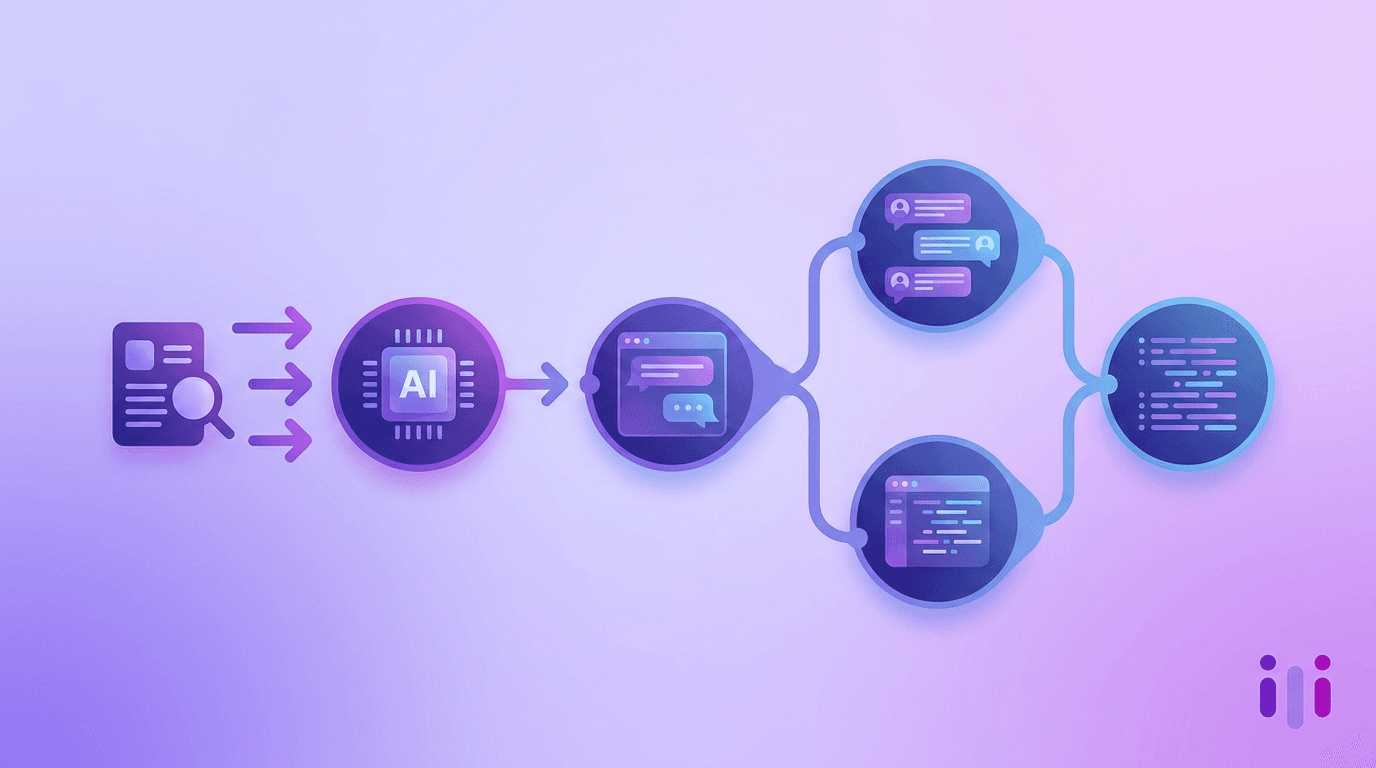
AI for focus groups is the use of conversational AI agents to moderate qualitative group research as asynchronous one-on-one interviews conducted in parallel, replacing the scheduled eight-person conference room with hundreds of simultaneous AI-led conversations. Instead of one human moderator facilitating one room of participants who talk over each other, an AI interviewer runs a structured discussion guide with each participant individually, follows up on vague answers, probes for the "why," and synthesizes every transcript into themes within hours rather than weeks.
This playbook is the hands-on, end-to-end guide to actually running an AI focus group in 2026: scoping the study, writing the AI discussion guide, recruiting and segmenting participants, running async AI-moderated sessions at scale, and turning raw transcripts into a decision-ready readout. It is written for product managers, UX researchers, insights leads, and founders who want the depth of qualitative research without the cost, scheduling overhead, and groupthink of the traditional clipboard-and-conference-room model. If you want the conceptual foundation first, start with the AI focus groups pillar guide and the definitional explainer on what focus group AI is and how it works; this piece assumes you have decided to run one and want the steps.
How AI focus groups differ from the traditional method
AI focus groups differ from traditional focus groups by replacing synchronous group dynamics with parallel one-on-one conversations, which removes the two biggest sources of error in qualitative research: scheduling friction and groupthink. In a traditional focus group, eight to ten people share one room and one moderator, so a few dominant voices shape the discussion and quieter participants conform — a well-documented bias the research literature calls "group polarization." AI focus groups give every participant their own private conversation, so you capture independent opinions, then aggregate them across a far larger sample.
The economics are the second difference. A single in-person focus group costs roughly $7,000–$12,000 once you add recruitment, facility rental, moderator fees, and recording, according to Drive Research's 2026 cost breakdown, with participant incentives alone running $75–$150 per consumer and $200–$500+ for hard-to-reach professionals. A well-run online group still lands around $4,000–$7,000. AI-moderated research collapses the per-conversation marginal cost toward zero, which is why teams can move from n=8 to n=800 without an eight-figure budget. For the full cost-and-depth breakdown, see AI vs. focus groups head-to-head.
One caution before you start: AI focus groups mean AI-moderated conversations with real participants. They are not synthetic focus groups, where fake AI personas stand in for customers. Synthetic respondents can be useful for early stress-testing, but they cannot replace the genuine, unpredictable voice of a real buyer. Everything in this playbook assumes you are talking to real humans at scale.
What you'll need before you start
You'll need five things in place before you run an AI focus group: a clear research question, an AI interview platform, a discussion guide, a participant source, and a stakeholder who will act on the findings. None of these require a research degree, which is the point — the modern stack is built so non-researchers can run rigorous studies with guardrails.
- A specific research question. Not "what do customers think of our product" but "why do trial users on the free plan churn before day 14?" Specificity is the single biggest predictor of useful output.
- An AI interview platform. A tool that runs adaptive, conversational interviews — asking follow-ups based on what each person actually says — rather than serving a static form. Perspective AI is purpose-built for this, with text and voice AI interviewer agents that probe in real time.
- A discussion guide. Five to eight open-ended core questions plus probing instructions. We give you a starter template in Step 2.
- A participant source. Your own customer list, a CRM segment, a community, or a recruited panel. First-party audiences beat rented panels for relevance.
- A decision owner. Someone — a PM, a CX leader, a founder — who has pre-committed to a decision the research will inform. Research with no decision attached is the fastest way to waste a study.
A useful rule of thumb: if you can answer "what decision will change based on what we learn?" in one sentence, you are ready. If you cannot, fix that before recruiting anyone.
Step 1: Define the research question and success criteria
Start by writing one primary research question and the decision it will drive, because a focus group with a fuzzy objective produces fuzzy transcripts that no amount of AI synthesis can rescue. The discipline here is identical to traditional qualitative research; AI just makes the downstream steps cheaper, so the upfront framing matters more, not less.
Why it matters: Qualitative research answers "why" and "how," not "how many." If your real question is "what percentage of users want feature X," that is a quantitative survey, not a focus group. Use a focus group when you need the reasoning, the context, the constraints, and the language customers use themselves. This is the dimension where conversations beat surveys — see AI vs. surveys for real customer research.
How to do it:
- Write the decision: e.g., "Decide whether to rebuild onboarding or just fix the empty-state."
- Write the primary question: "What makes new users feel stuck in their first session?"
- Write three to five sub-questions that ladder up to it.
- Define success: "We can name the top three friction points and quote real users on each."
Pro tip: Cap yourself at one primary question per study. Multi-objective focus groups dilute every transcript. If you have three questions, run three lean studies — with AI, the marginal cost of an additional study is low.
Common mistake: Confusing a topic ("onboarding") with a question ("why do users abandon onboarding at the integration step?"). Topics produce wandering conversations; questions produce answers.
Step 2: Build the AI discussion guide
Build your discussion guide as five to eight open-ended core questions, each paired with explicit probing instructions that tell the AI moderator when and how to dig deeper. This is the artifact that separates a real AI focus group from a glorified web form — the probing logic is what turns a one-line answer into the underlying "why."
Why it matters: Forms front-load effort and flatten people into dropdowns; the highest-value moments in research are the messy ones ("it depends," "I'm not sure," "well, actually..."). A good discussion guide instructs the AI to lean into those moments instead of moving on. This is the core reason AI-first research cannot start with a web form.
A starter discussion-guide template:
Pro tip: Write questions the way you'd ask them out loud, not the way you'd write a survey. "Walk me through..." and "Tell me about a time when..." open people up; "Rate your satisfaction 1–5" shuts them down. For ready-made starting points, browse the customer interview template and user research interview template.
Common mistake: Writing leading questions. "Don't you love the new dashboard?" tells the participant the answer you want. Neutral phrasing — "What's your reaction to the new dashboard?" — protects data quality. The role of AI in moderation is to apply your neutral guide identically to every participant, eliminating the unconscious cueing a tired human moderator drifts into by the fifth session.
Step 3: Recruit and segment participants
Recruit from your highest-relevance source first — your own customers and CRM segments — and segment participants before they start so you can compare answers across cohorts later. With AI focus groups you can run a far larger and more segmented sample than a conference room allows, so the recruiting question shifts from "how do we fill eight seats?" to "which cohorts do we want to compare?"
Why it matters: Sample relevance beats sample size. Twenty conversations with the exact segment you care about outperform two hundred from a generic rented panel. First-party audiences — your trial users, churned accounts, power users — give you participants who actually have the context your question needs. For a deep dive on getting recruitment and quality control right, see the online AI focus group setup guide.
How to do it:
- Pick two to four cohorts that the decision actually depends on (e.g., churned vs. retained, new vs. power user).
- Define a screener question or two to confirm fit (AI can run the screen at the top of the conversation).
- Distribute the interview link by email, in-product prompt, or community post — embed it inline, as a popup, or in a slider.
- Tag each participant with their cohort so synthesis can slice by it.
Pro tip: Because AI conversations are asynchronous, you don't need everyone available at 2 p.m. on Thursday. Send the link, let people respond when they're free, and watch completion climb. This async model is one of the six shifts reshaping digital focus groups in 2026.
Common mistake: Over-incentivizing the wrong people. A $100 incentive attracts professional survey-takers; a smaller, well-targeted ask sent to genuine customers attracts people who actually care about your product. Quality of source beats size of incentive.
Step 4: Run AI-moderated sessions at scale
Launch all conversations in parallel and let the AI moderator run your discussion guide with each participant individually, adapting follow-ups in real time. This is the step where AI focus groups break the constraints of the old model: there is no room, no schedule, and no ceiling on how many conversations run at once.
Why it matters: Survey response rates have collapsed to roughly 12–18% in 2026, with about 70% of survey-starters quitting before finishing, according to SurveySparrow's 2026 survey-fatigue benchmarks. Conversational, adaptive interviews complete at far higher rates because they feel like a dialogue, not a form — the AI acknowledges what people say and asks the obvious next question instead of marching through 26 static fields. Running these in parallel is how you go from n=8 to n=800 without losing depth.
How to do it:
- Set the AI moderator's tone and persona to match your audience (formal for enterprise buyers, casual for consumers).
- Give it the discussion guide and probing rules from Step 2.
- Set a soft length target (8–12 minutes of conversation is a sweet spot for depth without fatigue).
- Launch, then monitor a few live transcripts to confirm the probing is landing as intended.
Pro tip: Read the first five completed transcripts within the first hour. If the AI is leaving "it depends" answers unprobed, tighten the probing instruction and relaunch — a benefit you never get with a one-shot in-person group. For a structured way to think about platform configuration, the AI focus group platform buyer's framework covers what to look for.
Common mistake: Treating the AI like a one-way broadcaster. The entire advantage is two-way adaptation; if your guide is so rigid the AI can't follow a thread, you've rebuilt a survey. Leave room for the conversation to breathe.
Step 5: Analyze transcripts and synthesize the findings
Synthesize by letting the platform auto-cluster transcripts into themes, then validate the AI's themes against the raw quotes before you trust them. The analysis step is where traditional qualitative research goes to die — manual coding of 50+ transcripts can take weeks, and inter-coder reliability is notoriously hard to maintain. AI compresses that to hours while keeping a traceable line from each finding back to the source quote.
Why it matters: Teams routinely report compressing timelines from six-to-ten-week traditional agency fieldwork to a handful of days with AI-native analysis, per Skimle's 2026 review of qualitative analysis tools. Faster synthesis means insight arrives while the decision is still open. For the full transcript-to-insight workflow, see AI focus group analysis: from raw transcripts to strategic insights.
How to do it:
- Run automatic theme extraction and quote clustering across all transcripts.
- Slice by the cohorts you tagged in Step 3 — look for where churned and retained users diverge.
- Pull verbatim quotes for each theme; quotes are what move stakeholders, not summaries.
- Rank themes by frequency and intensity — a problem mentioned by 15% of users with visible frustration may matter more than a mild gripe from 40%.
Pro tip: Always sanity-check the AI's top theme against five raw transcripts yourself. Synthesis is the AI's job; judgment is still yours. This human-in-the-loop discipline is exactly how the moderator role evolves rather than disappears — covered in how the AI-moderated focus group changes the moderator's job.
Common mistake: Stopping at themes and skipping the readout. A board-ready output pairs each theme with a representative quote, the cohort it came from, and a recommended action. See the end-to-end automated focus group workflow for turning synthesis into a deck.
A quick end-to-end timeline
The whole AI focus group workflow can run in a single week, versus the four-to-eight weeks a traditional study takes. The table below maps each step to a realistic time budget for a mid-sized study.
This is also why teams that previously ran two or three focus groups a year can run continuous discovery — research becomes a cadence, not an event. The shift toward self-serve, always-on research is reshaping the whole function; see the 2026 state of customer research for the macro picture.
Common mistakes to avoid
The most common AI focus group mistakes are upstream of the AI: vague questions, leading prompts, and skipping the decision. Avoiding them is mostly about discipline, not technology.
- Running a study with no attached decision. If no one will act differently based on the findings, don't run it. Pre-commit a decision owner.
- Writing a survey and calling it a focus group. Closed questions and rating scales produce shallow data. Open-ended prompts with probing instructions produce depth.
- Confusing AI moderation with synthetic respondents. Talk to real people; use AI to moderate and synthesize, not to invent fake answers.
- Over-broad recruiting. A precise cohort of 25 beats a generic panel of 250. Relevance compounds.
- Trusting synthesis blindly. Spot-check the AI's themes against raw transcripts before presenting them.
- Treating it as a one-time event. The marginal cost of an AI study is low — build a continuous cadence instead of a once-a-quarter scramble. Product and CX teams that adopt this rhythm are covered in the research use-case playbook.
Frequently Asked Questions
How do I run an AI focus group step by step?
Run an AI focus group in five steps: define one specific research question and the decision it informs, build a discussion guide of five to eight open-ended questions with probing instructions, recruit and segment relevant participants, launch parallel AI-moderated conversations, and synthesize the transcripts into themes backed by verbatim quotes. The entire workflow typically runs in three to five days versus four to eight weeks for a traditional study, because there is no scheduling, sessions run in parallel, and analysis is automated.
Do AI focus groups use real participants or synthetic respondents?
AI focus groups as described in this playbook use real human participants who are moderated by an AI interviewer. This is distinct from synthetic focus groups, which use AI-generated personas to simulate respondents. AI moderation applies your discussion guide consistently and probes for depth across hundreds of real conversations; synthetic respondents can be useful for early stress-testing but cannot replace the genuine, unpredictable voice of an actual customer when a real decision is on the line.
How much does an AI focus group cost compared to a traditional one?
An AI focus group costs a fraction of a traditional one because it removes facility rental, scheduling, and per-session moderator fees. A single in-person focus group runs roughly $7,000–$12,000 and an online group $4,000–$7,000, with participant incentives of $75–$500+ each, while AI-moderated research drives the marginal cost per conversation toward zero. That economics shift is what lets teams scale from eight participants to hundreds without a corresponding budget increase.
How many participants do I need for an AI focus group?
You need enough participants to reach thematic saturation within each cohort you care about, which is often 15–30 per cohort rather than a fixed total. Because AI conversations run in parallel at near-zero marginal cost, you can recruit far more than the traditional eight-to-ten-person room and segment the sample to compare cohorts. Prioritize relevance over raw size: a precise cohort of 25 genuine customers beats a generic panel of 250.
Can non-researchers run AI focus groups?
Yes, non-researchers such as product managers, marketers, and customer success leaders can run AI focus groups, which is a core reason the format is growing in 2026. Modern platforms provide discussion-guide templates, automated moderation, and automatic synthesis, so the technical barriers that once required a trained moderator and a manual-coding team are removed. The discipline that still matters — a sharp research question, neutral phrasing, and an attached decision — is learnable without a research degree.
How long should each AI-moderated conversation be?
Each AI-moderated focus group conversation should target roughly 8–12 minutes for the best balance of depth and completion. Shorter conversations risk leaving the "why" unexplored, while much longer ones invite the same fatigue that causes 70% of survey-takers to quit. Setting a soft length target and instructing the AI to probe selectively — rather than asking every possible follow-up — keeps participants engaged through to a complete, usable transcript.
Conclusion
Learning how to use AI for focus groups comes down to keeping the rigor of qualitative research while shedding the cost, scheduling, and groupthink of the conference room. The five steps — define a sharp question, build a probing discussion guide, recruit relevant cohorts, run parallel AI-moderated sessions, and synthesize transcripts into quote-backed themes — let any product, research, or CX team move from a research question to a board-ready readout in days instead of weeks. The technology removes the bottlenecks; the discipline of a clear question and an attached decision is what still makes the research worth running.
The teams getting the most from AI for focus groups treat it as a continuous habit rather than a once-a-quarter event, because the marginal cost of one more study is finally low enough to justify always-on discovery. Perspective AI runs adaptive, AI-moderated conversations with real customers at scale, automatically synthesizing every transcript into themes and quotes — see what AI focus groups can do for your team, built for product teams and CX teams alike. Start your first AI focus group and turn your next research question into decisions this week, not next quarter.
More articles on AI Customer Interviews & Research
Post-Purchase Survey Questions That Actually Explain Returns (2026)
AI Customer Interviews & Research · 25 min read
Before You Renew Qualtrics: The Negotiation Levers Buyers Actually Have
AI Customer Interviews & Research · 19 min read
Customer Feedback Data: Retention, Privacy, and the Decisions CX Teams Must Make
AI Customer Interviews & Research · 22 min read
Getting Your Data Out of Qualtrics: Exports, Formats, and What Breaks
AI Customer Interviews & Research · 21 min read
Verbatim Analysis: What to Actually Do With 40,000 Open-Ended Responses
AI Customer Interviews & Research · 19 min read
Customer Sentiment Examples: What Customers' Words Signal
AI Customer Interviews & Research · 13 min read