Signs It's Time to Leave Qualtrics in 2026
TL;DR
The reason to leave Qualtrics is rarely Qualtrics itself — it's the survey paradigm you bought it to run, and by 2026 that paradigm is quietly failing enterprise CX and research teams. Nobody wakes up one morning and decides to switch; they accumulate symptoms — a renewal quote that climbs faster than the insight it buys, response rates sliding toward single digits, dashboards nobody opens — until the math stops working. This piece names the six concrete signals that you've outgrown a survey-first platform, whether that platform is Qualtrics, Medallia, or any enterprise CXM suite. Every signal traces back to one root cause: forms and rating scales flatten customers into numbers and never ask "why." The fix is not a cheaper survey tool. It's a shift from measuring customers to actually talking to them at scale. If three or more of these signals sound familiar, it's time to leave Qualtrics — or at least the survey-only model it stands for.
Most buyers frame the renewal decision as "Is there a cheaper Qualtrics?" That is the wrong question, and it's why so many teams churn from one survey suite to another and feel no better a year later. The right question is whether the survey-first operating model still earns its keep — because the platform is only as valuable as the paradigm it runs. Treat the six symptoms below as a diagnostic checklist: read each one, decide whether it describes your program, and note what it actually signals underneath the surface complaint.
Signal 1: Your renewal quote climbs faster than the value you extract
The clearest sign it's time to leave Qualtrics is a renewal quote that grows every year while the insight you extract stays flat. Qualtrics does not publish a public price sheet; contracts are quote-only and priced largely by named users and response volume, so the number moves with your seat count and how many surveys you send — not with how many decisions the data drives. Procurement platform Vendr, which aggregates verified buyer contracts, pegs the median Qualtrics deal at roughly $30,000 per year, with real contracts running well into six figures once add-on modules and overage fees stack up.
What it signals: you're paying an enterprise-CXM premium for a research cadence that hasn't grown. When cost scales with survey volume rather than with outcomes, the incentive is backwards — you're rewarded for sending more, not for learning more. This is the essence of enterprise CXM bloat.
What to do: before you sign, benchmark the quote against what other buyers actually pay. Our breakdown of what verified buyers pay for Qualtrics shows how add-ons and overages inflate the sticker, and our roundup of options for teams tired of enterprise CXM bloat maps the market beyond the incumbents.
Signal 2: Response rates keep falling — and your fix is more surveys
If your answer to declining response rates is to send more surveys, you are treating the symptom and feeding the disease. Survey fatigue is not a Qualtrics problem — it's an industry-wide collapse in willingness to answer. Pew Research Center documented telephone survey response rates falling from 36% in 1997 to just 6% by 2018, and the same exhaustion now afflicts CX and employee surveys. McKinsey has gone further, arguing that customer surveys are losing effectiveness as response rates decline and that companies must move to more productive listening methods.
What it signals: the 8% who still respond are not representative — they skew toward the extremes, the very happy and the very angry, while the silent majority whose churn you most need to predict never shows up. More surveys shrink that pool further.
What to do: stop trying to raise a dying response rate and change the format. A short, conversational interview that adapts to each person earns more completion than a 30-question grid. Compare the trade-offs in pulse surveys versus continuous conversations, and rebuild the program around it using the complete guide to voice-of-customer programs.
Signal 3: Insights arrive weeks after the decision needed them
Insight latency — the lag between fielding a study and acting on it — is a quiet but decisive reason to leave Qualtrics. When a program requires designing the instrument, fielding it, waiting for a sample to accumulate, then hand-coding open-text verbatims, the finding often lands after the roadmap has already shipped or the at-risk account has already churned. A survey that answers last quarter's question is not research; it's archaeology.
What it signals: your listening cadence is slower than your decision cadence. In a product-led or fast-moving B2B org, that gap is where revenue leaks.
What to do: collapse the loop. AI-moderated conversations analyze themselves as they come in, so synthesis is near-instant rather than a two-week coding project. See how modern tooling moves from dashboards to the "why" behind the numbers, and rethink your instrument mix with our guide to how to measure customer experience beyond a single score.
Signal 4: Only admins can build anything
When every study, dashboard, or question change routes through a two-person admin team, you have a democratization gap — and it's a strong signal you've outgrown the platform. Qualtrics complexity is real: the power that makes it defensible for enterprise governance also makes it inaccessible to the PM, CSM, or founder who actually needs the answer this week. So they either wait in a queue or give up and guess.
What it signals: the platform has become a bottleneck instead of a force multiplier. Research that only specialists can run is research that mostly doesn't happen.
What to do: put listening in the hands of the people making decisions. A modern customer experience platform is replacing the survey suite precisely because non-researchers can launch a study themselves. That self-serve model is what makes tooling work for CX teams and product teams alike, not just the research ops function.
Signal 5: Dashboards multiply, action doesn't
If you have more dashboards than you had last year but no more action to show for them, you're measuring for its own sake — and that's a signal the tool has outlived its purpose. This is dashboard theater: the appearance of a rigorous CX program with none of the customer impact. The numbers back up the disconnect. Forrester's 2024 US Customer Experience Index found CX quality at an all-time low, declining for a third consecutive year, with 39% of brands dropping — even as spending on measurement platforms climbed. More scores have not produced better experiences.
What it signals: you're optimizing the instrument, not the outcome. A score with no attached reason can't tell anyone what to fix, so nothing gets fixed.
What to do: shift from tracking metrics to understanding them. Know which CX metrics actually matter, then pair every number with the qualitative "why" so a dashboard becomes a decision instead of a wall decoration.
Signal 6: You're paying for modules you turned on once
A telltale sign it's time to leave Qualtrics is a line-item invoice full of modules you activated during onboarding and have barely opened since. Enterprise CXM suites are sold as bundles — text analytics, statistical modeling, employee experience, and more — and the sales motion rewards switching everything on. A year later, much of it sits dormant while the renewal treats it all as essential.
What it signals: you bought a platform for a future state you never reached, and you're now subsidizing shelfware. The bundle's breadth is a cost, not a benefit, if you only use a slice of it.
What to do: audit actual usage before you renew, and price only what you use. Our breakdown of why services, seats, and overages are the real cost shows where the money hides, and if employee feedback is your dormant module, weigh EmployeeXM alternatives that skip the enterprise suite.
The Counterargument: When You Should Stay on Qualtrics
To be fair, Qualtrics genuinely earns its price for a specific profile, and pretending otherwise would be dishonest. If you are a large enterprise running rigorous academic-grade methodology — conjoint analysis, complex sampling, regulated governance and data-residency requirements, or a global panel operation with dedicated researchers — the depth and controls are real, and few tools match them. Governance and statistical rigor at that scale are features, not bloat, when you actually use them.
The honest verdict is narrow, though: Qualtrics is worth it for a small slice of buyers and overkill for most. If you're a mid-market team, a product-led company, or an org where non-researchers need answers fast, you're paying enterprise prices for capacity you can't absorb. We work through that trade-off in detail in our assessment of whether Qualtrics is worth it in 2026 and in the head-to-head on Medallia versus Qualtrics versus conversational AI.
What to Do When You Leave Qualtrics: Move From Surveys to Conversations
The right move when you leave Qualtrics is not to buy a cheaper survey tool — it's to change what "listening" means. The survey paradigm assumes you already know the right questions and the right answer options; it flattens every customer into your dropdowns. A conversation-first approach inverts that: an AI interviewer asks an open question, listens, and follows up on whatever the person actually says — capturing the intent, constraint, and "why now" that a rating scale structurally cannot. That is the shift McKinsey, Forrester, and every declining response rate point toward.
This is what Perspective AI is built for. Instead of fielding a form, you run AI-moderated interviews with hundreds or thousands of customers at once; the system probes vague answers, extracts themes and quotes automatically, and returns synthesis in hours, not weeks. It's the listening half of AI-driven CX that survey suites were never built to deliver — and it's why the enterprise CXM stack is breaking. The modern, AI-first alternative to Qualtrics lays out the destination, our playbook for migrating off Qualtrics covers the staged exit without losing your history, and the case for customer experience transformation frames it as an operating-model change, not a tool swap. You can start an interview study in an afternoon or browse live example studies to see the format first.
Frequently Asked Questions
What are the signs it's time to leave Qualtrics?
The strongest signs it's time to leave Qualtrics are renewal quotes that outpace the value you extract, falling response rates you answer with more surveys, insights that arrive after decisions are made, an admin-only bottleneck, proliferating dashboards with no action, and paying for modules you rarely use. If three or more describe your program, the survey-first model — not just the vendor — has stopped paying off.
Is Qualtrics too expensive for mid-market teams?
For most mid-market teams, Qualtrics is priced beyond the value they can absorb. Qualtrics doesn't publish public pricing, and verified-contract data from Vendr puts the median deal near $30,000 per year, climbing into six figures with add-on modules and response overages. Mid-market and product-led teams typically pay an enterprise premium for governance and rigor they don't fully use.
What should I replace Qualtrics with?
Replace Qualtrics with a conversation-first research platform rather than another survey tool if your goal is understanding, not just scoring. AI-moderated interview tools like Perspective AI capture the "why" behind customer sentiment, adapt follow-up questions in real time, and return synthesis in hours. Compare the field in our Qualtrics alternatives roundups before committing to a specific platform.
Can I leave Qualtrics without losing my historical data?
Yes — you can leave Qualtrics while preserving your historical results if you plan the exit in stages. Export your response data, dashboards, and survey logic before the contract lapses, run the new tool in parallel for one cycle to keep continuity, then retire seats. Our migration playbook details what you can export, what you can't, and how to avoid auto-renewal traps.
Is survey fatigue really Qualtrics's fault?
No — survey fatigue is an industry-wide problem, not a Qualtrics-specific flaw. Response rates have fallen across every channel; Pew Research recorded telephone survey rates dropping from 36% to 6% over two decades. The issue is that survey suites respond to fatigue by enabling more surveys, which deepens it. Conversational listening earns higher completion by respecting the respondent's time and words.
The Bottom Line
The decision to leave Qualtrics should never turn on price alone, because a cheaper survey suite just reproduces the same failure at a discount. The six signals above — runaway renewals, dying response rates, insight latency, the admin bottleneck, dashboard theater, and dormant modules — all point at one thing: the survey paradigm has hit its ceiling, and no incumbent CXM platform is going to raise it. If your team is outgrowing Qualtrics, the upgrade isn't a different form; it's a different act. Move from measuring customers to talking with them, from scores to reasons, from forms to conversations. When you're ready to see what conversation-first research looks like in practice, start a study or review pricing and run your first AI-moderated interview this week.
More articles on AI Customer Interviews & Research
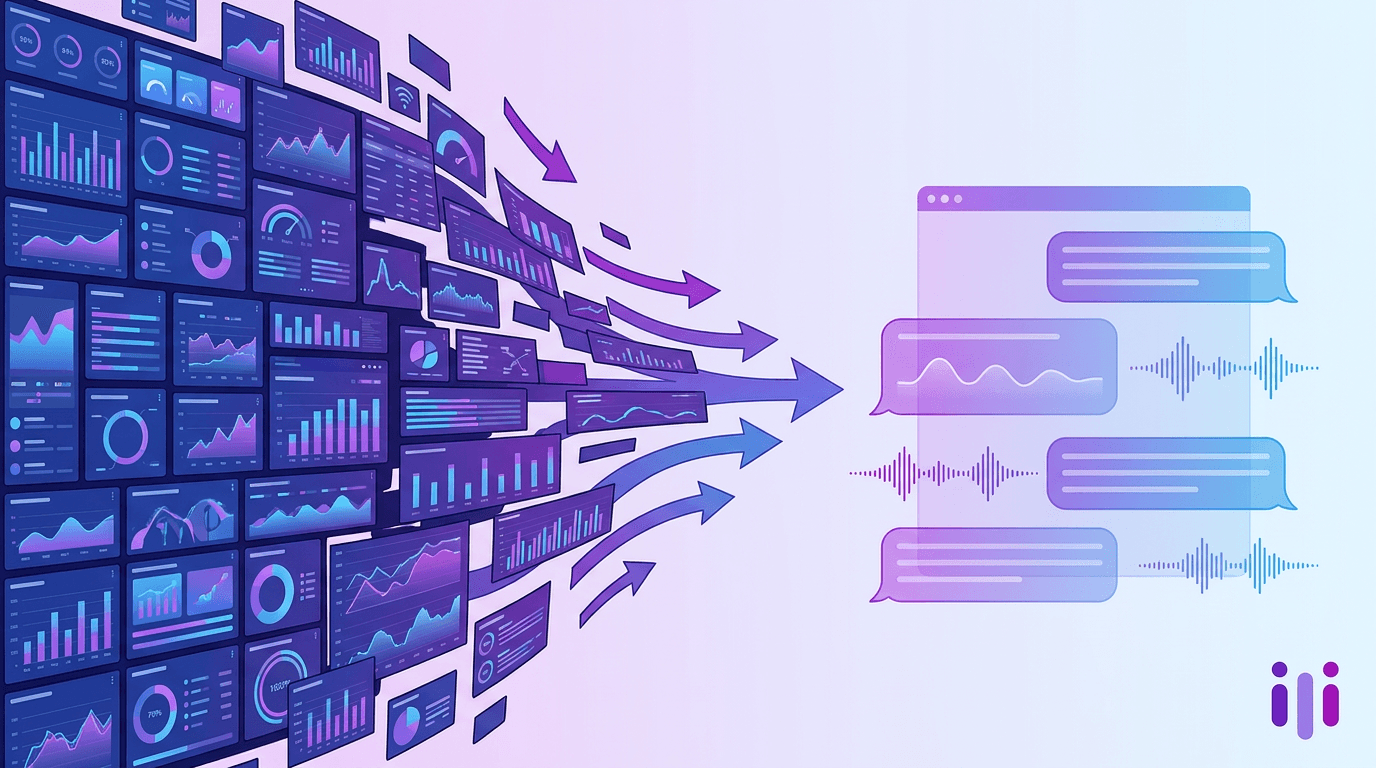
Qualtrics Alternatives in 2026: 8 Options for Teams Tired of Enterprise CXM Bloat
AI Customer Interviews & Research · 15 min read
Why Salesforce Needs Listen Labs (and What It Means If You Run Customer Research)
AI Customer Interviews & Research · 14 min read
Best Market Research Software in 2026: The 4 Jobs, Ranked by Job
AI Customer Interviews & Research · 11 min read
Perspective AI vs Outset vs Listen Labs: The Best AI Research Tool in 2026
AI Customer Interviews & Research · 22 min read
Best AI Interview Platforms in 2026: Ranked by Who Actually Conducts the Conversation
AI Customer Interviews & Research · 10 min read
Typeform Research Flow vs AI Interview Platforms: What Actually Differs in 2026
AI Customer Interviews & Research · 10 min read