Online AI Focus Groups: Setup, Recruitment, and Quality Control in 2026
TL;DR
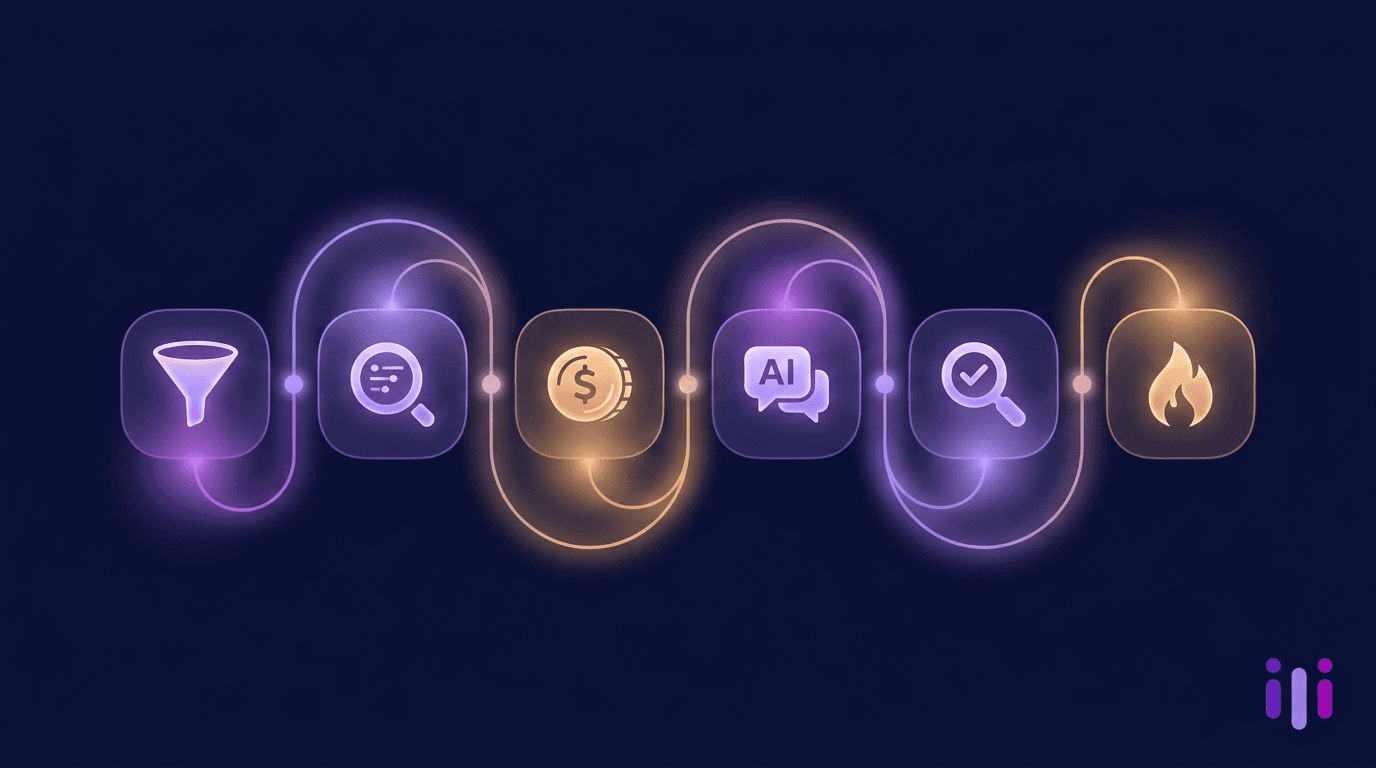
Online AI focus groups are asynchronous, AI-moderated qualitative studies that replace the eight-person Zoom room with hundreds of one-to-one conversations run in parallel. The operational stack — recruiting, screening, incentives, quality control, fraud prevention — is what separates a study you can defend in a board meeting from a pile of low-effort transcripts. Perspective AI runs the moderation, response-quality scoring, and attention checks; you still own the research question, the screener, the incentive design, and the synthesis lens. Done well, an online AI focus group costs 60–80% less than a traditional facilitated session and produces 5–10x the response volume — but only if you treat recruitment and quality control as first-class workflow steps, not afterthoughts. This guide walks through the six steps in order, with the specific quality-control mechanics that prevent the failure modes that plague online qualitative research: speeders, AI-generated answers, panel fraud, and audience drift.
What "online focus group" meant in 2015 vs 2026
In 2015, an online focus group was a synchronous video call: eight participants, one moderator, a discussion guide, two hours, a transcript, and a $4,000–$8,000 invoice. The format inherited every limitation of the in-person original — small n, scheduling friction, vocal-participant dominance, moderator fatigue — and added new ones, like Zoom audio dropouts and the awkward "you're on mute" tax on every insight.
In 2026, an online AI focus group is something different: an asynchronous, AI-moderated study that runs hundreds of one-to-one conversations in parallel, each tailored by a research outline rather than a rigid discussion guide. The "group" is statistical, not synchronous. Participants answer in their own words; the AI follows up, probes, and disambiguates; quality scores are computed per response; and synthesis happens against the full population, not against the loudest two voices in the room. We covered the format shift in detail in our pillar guide to AI focus groups in 2026 — this guide is the operational follow-up.
The implications for the operator are significant. You no longer book a moderator's calendar; you stand up a study brief. You no longer chase eight schedules; you recruit a panel of 200. You no longer wait two weeks for a transcript; you read insights as they come in. But the failure modes shift, too. With 200 respondents and no human moderator in every conversation, you need explicit mechanics for screening, response quality, and fraud prevention. That's what the rest of this guide is about.
Step 1: Define your research question (and why most teams skip this)
A defensible research question is the single highest-leverage step in an online AI focus group, and it's the step most teams underinvest in. The shift from synchronous to asynchronous research makes the cost of starting a study so low that "let's just run it" becomes the default. Don't.
A good research question is decision-linked, not exploratory in the abstract. "What do customers think about pricing?" is not a research question — it's a vibe. "Among customers who downgraded in the last 90 days, what specific moment triggered the decision, and what would have changed their mind?" is a research question. It has a population (downgraded customers, last 90 days), a behavior (the trigger moment), and a counterfactual (what would have changed it). That structure determines your screener, your incentive, and your synthesis lens — all in one shot.
How to write the question:
- State the decision the study will inform. ("Should we change our downgrade flow?")
- Name the population whose voice the decision needs. ("Recent downgraders in the last 90 days.")
- Specify the behavior or moment you need to understand. ("The specific trigger that caused the downgrade.")
- Identify the counterfactual or alternative. ("What we could have done that would have changed the outcome.")
If you can't write all four, your study isn't ready to recruit yet. The teams who consistently produce decision-grade insights from AI focus groups are the ones who treat this as a pre-flight gate, not an optional template. The continuous discovery habits that Teresa Torres documented all start with a research question that ladders to a decision — the AI tooling doesn't change that.
Step 2: Recruit qualified participants
Recruitment is where most online focus groups break, because the temptation is to optimize for volume and speed instead of fit. You have three live channels in 2026, each with a different cost and quality profile.
Owned audience (best quality, slowest scale). Your existing customer list, segmented to the population the research question requires. A downgrade study recruits from the recent-downgrader segment in your CRM. Quality is excellent because identity is verified (these are real customers with real product behavior), and you can pre-segment with telemetry. The constraint is reach: if your downgrade segment is 600 people, your recruitable population caps below that. Owned-audience recruitment is what we recommend for 60–70% of B2B studies; we cover the workflow in the at-risk customer identification playbook and our customer churn analysis guide.
Panel providers (good quality, fast scale). Third-party recruitment panels (Prolific, Respondent, and similar) can deliver hundreds of pre-screened participants in 24–72 hours. Quality varies dramatically by panel and screener; reputable academic-grade panels like Prolific maintain attention-check pass rates above 90%, while general-purpose paid-survey panels often run below 70%. For consumer or category-level research, panels are usually the right answer. For named-account B2B research, they're rarely a fit.
In-product recruitment (variable quality, contextual scale). Inviting current users into a study from inside the product (an in-app prompt, an email triggered by a behavior, a Concierge conversation that hands off into the research interview). Quality is high when the trigger is well-targeted; volume scales with your product's MAU. This is the channel most teams underuse because it requires research-and-engineering coordination — but it's the only channel that can produce a "users who just hit this specific friction point in the last 24 hours" sample.
A note on volume. Traditional focus groups assume n=8 because moderators don't scale. AI focus groups have no such constraint, but more isn't automatically better. For most directional questions, n=80–150 hits the diminishing-returns wall; for segmentation studies, n=300–500. We cover the math behind this in scalable focus groups: how to go from n=8 to n=800 without losing depth.
Step 3: Screen out low-quality respondents
A screener is not a survey — it's a filter. Its only job is to keep the population on-spec for your research question and to exclude respondents who can't answer it credibly. Most screeners fail because they confuse the two.
Hard screening (binary include/exclude). These are the questions where a wrong answer ends the conversation immediately. "Have you used [product] in the last 30 days?" "Are you the primary decision-maker for [purchase]?" "What is your role title?" Hard screeners should be the first three to five questions, and the AI moderator should terminate (politely, with the incentive logic accounted for) on a fail. Don't try to salvage a respondent who fails a hard screen by asking them adjacent questions — you'll contaminate your synthesis.
Soft screening (quota-based). When you need a mix — say, 40% small-business, 40% mid-market, 20% enterprise — soft screens route respondents to the right quota bucket and close buckets as they fill. This matters more than most teams realize: an unintentionally skewed sample can flip the conclusion of a study without the operator noticing.
Behavioral screening (the part most teams miss). Self-reported screens are gameable. If your study targets "people who have evaluated CRM software in the last six months" and your screener asks exactly that, expect a 20–30% false-positive rate from respondents motivated by the incentive. Behavioral screens ask for evidence: "Name two CRMs you evaluated and one specific reason you ruled each out." A respondent who can't produce a coherent answer is filtered, regardless of how they answered the binary question. AI moderation makes this practical at scale because the LLM can evaluate coherence in real time, not just check a box.
The user interview screener template and our user-interview software comparison cover screener design in more depth.
Step 4: Incentive design
Incentive design has more impact on data quality than most operators realize, and it's the area where copy-paste defaults fail hardest. The wrong incentive structure either under-recruits (no one shows up) or over-recruits the wrong people (everyone shows up because the incentive is too high relative to the effort, attracting incentive-hunters instead of category-relevant respondents).
Calibration ranges (2026 norms, US-based). B2B professionals: $50–$150 for a 15–25 minute study, scaled by seniority. Consumer general-population: $5–$25 for a 10–15 minute study. Healthcare or specialized professionals (attorneys, physicians, IT decision-makers): $150–$400. Internal employees: usually a charitable donation or company swag, never cash. According to Pew Research Center's methodology guidance, incentive levels should be calibrated to participant time and the typical professional rate of the population — over-incentivizing introduces a self-selection bias toward respondents who under-value their time.
Structure choices. Per-completion (most common) is simplest. Lottery-based ("one in twenty wins $200") increases per-respondent EV at higher variance and works well for very short studies. Tiered ("$50 for completion, +$25 for an exceptional response") sounds clever but introduces gaming behavior — respondents inflate length and complexity rather than improving quality. Avoid tiered unless you have an explicit research reason.
Speed and reliability of payout. Slow payouts kill panel reputation faster than low rates. Best practice is payment within 5 business days of completion approval, with a clear timeline communicated upfront. Use a payout provider that handles the tax 1099 logic for US respondents above the $600 threshold; do not roll your own.
Step 5: Quality control during the study
Quality control is the single biggest operational difference between a defensible AI focus group and a pile of low-effort transcripts. In a synchronous focus group, the moderator handles QC implicitly — they re-ask vague answers, push back on inconsistencies, and read the room. In an asynchronous AI focus group, you need explicit mechanics. The four below are non-negotiable.
Attention checks. Embedded prompts that verify the respondent is reading and processing each question. The classic format is "To confirm you're reading carefully, please type the word 'orange' in your next response." More sophisticated checks ask for specific recall ("Earlier you mentioned X — restate it in your own words") or test for AI-generated answers (we'll get to that). Industry research from the American Association for Public Opinion Research (AAPOR) consistently shows attention-check failure rates of 5–15% on professionally recruited panels, and 25%+ on general-population paid-survey traffic. Build the check in; expect to fail respondents.
Response quality scoring. Real-time evaluation of each answer for length, specificity, coherence, and on-topic relevance. A response of "I don't know, it's fine I guess" gets flagged; a response that names a specific scenario, walks through the decision, and references a competing option scores high. Perspective AI's interviewer agent computes this score per response and either re-prompts the respondent ("Can you say more about that?"), terminates the conversation if the pattern persists, or flags the transcript for exclusion in synthesis.
AI-generated answer detection. The fastest-growing fraud vector in 2026 is respondents pasting questions into a chatbot and submitting the chatbot's response. Mitigation has three layers: (1) detect the linguistic fingerprints of common LLMs (over-formal hedging, bulleted summaries where prose was asked for, overuse of "Furthermore" and "In conclusion"); (2) ask follow-ups that require specific personal context the LLM can't fabricate ("What was the date of your last claim?" "What's the name of the rep you spoke with?"); (3) include a verbal-style attention check the LLM will normalize away ("Use the phrase 'pancake situation' somewhere in your next answer"). MIT Sloan Management Review's coverage of LLM fraud in research is a good primer for the strategic stakes.
Fraud and panel-farming prevention. IP and device fingerprinting, panel deduplication (one person, one study), velocity checks (a respondent who completes a 25-minute study in 90 seconds is fraudulent), and geolocation gating where the study is country-specific. Most of this is handled by the platform, not the operator — but the operator should ask, in the vendor evaluation, exactly what's enforced and what's logged. We cover platform evaluation in how to evaluate an AI focus group platform and the broader buyer's framework for AI market research platforms.
Step 6: Synthesis
Synthesis is where the volume advantage of an AI focus group either pays off or buries you. Two hundred high-quality transcripts is too much for any human to read in full; synthesis has to be AI-assisted to be tractable. But it also has to be operator-led, because the difference between a directional summary and a decision-grade insight is the lens you bring to the data — the AI doesn't know what your decision is.
Three-layer synthesis workflow:
- Pattern extraction. The platform clusters responses by theme — typically 8–15 themes for an n=200 study. This is mechanical and should be automatic. Output: a list of themes with respondent counts and representative quotes.
- Decision-frame review. The operator filters themes against the original research question's decision and counterfactual. Themes that don't speak to the decision get parked, not deleted. Output: a shortlist of 3–5 themes that map to the decision.
- Quote-level evidence. For each shortlisted theme, the operator pulls 3–5 verbatim quotes that capture the texture, including disconfirming voices. The disconfirming voices matter — a board-ready synthesis acknowledges the strongest counterargument the data contains.
The synthesis time savings are large and real. In our internal benchmarks across customer studies, the workflow above produces a board-ready synthesis from a 200-respondent study in 4–6 hours of operator time, versus 2–3 weeks for a traditional eight-person video focus group with manual transcript review. The deeper coverage is in AI focus group analysis: from raw transcripts to strategic insights in hours not weeks and the AI-first customer feedback analysis workflow.
Frequently Asked Questions
How many participants do I need for an online AI focus group?
For most directional research questions, 80–150 respondents reaches diminishing returns; for segmentation or quota studies, plan for 300–500. The classic n=8 of synchronous focus groups is a moderator-bandwidth artifact, not a statistical floor — once moderation is automated, the binding constraint becomes the cost of recruitment and the operator's synthesis time, not the moderator's calendar.
What's the typical cost of an online AI focus group versus a traditional one?
A traditional eight-person facilitated online focus group runs $4,000–$8,000 all-in (moderator, platform, recruitment, incentives). An AI-moderated study with 100–200 respondents typically lands at $1,500–$3,500 — driven mostly by incentives, since moderation cost approaches zero. The cost-per-insight differential is much larger because the response volume is 10–25x higher.
How do I prevent respondents from using ChatGPT to answer my questions?
Layer three controls: stylometric detection of LLM patterns (formal hedging, bulleted summaries), follow-ups that require specific personal context an LLM can't fabricate, and verbal-style attention checks that an LLM would normalize away. No single layer is sufficient on its own; the combination keeps detected fraud below 5% on owned audiences and below 10% on third-party panels in our 2026 benchmarks.
Can online AI focus groups replace in-person focus groups for qualitative research?
For most B2B and SaaS research, yes — the depth-per-respondent and total volume are both higher than synchronous formats, and the cost is 60–80% lower. The narrow exceptions where in-person still wins are studies of physical product interaction (where you need to see the participant handle the object), studies that require group-dynamic effects intentionally, and studies where the population is non-digital. We compare formats in detail in AI vs. focus groups: head-to-head on cost, depth, and decision quality.
Do I still need a human moderator for an online AI focus group?
You need a human research operator, not a human moderator. The moderator role — asking the next question, probing vague answers, redirecting off-topic responses — is handled by AI in 2026. The operator role — defining the research question, designing the screener and incentive, reviewing flagged transcripts, and leading synthesis — is irreplaceable and unchanged from traditional research.
How long should an online AI focus group conversation last?
Optimal range is 12–25 minutes per respondent for B2B, 8–15 minutes for consumer studies. Below 8 minutes, you can't get past surface answers; above 30 minutes, completion rates drop sharply and respondent-fatigue artifacts (shorter answers, less specificity) appear in the back half of the transcript. If your research question requires more than 25 minutes of depth, split it into two studies recruited from the same population.
Conclusion
Online AI focus groups are a superior format for almost all qualitative research — but only if the operational stack underneath them is built deliberately. The six steps above (research question, recruitment, screening, incentives, quality control, synthesis) are not optional; they're the difference between a defensible study and a pile of transcripts. The good news is that none of them are hard once you've done one. The first study takes time; the second takes half as long; by the fifth, the workflow is muscle memory.
If you're standing up your first online AI focus group, Perspective AI's interviewer agent handles the moderation, response-quality scoring, attention checks, and AI-fraud detection out of the box. The platform is built for CX teams and product/research teams running continuous discovery; pricing scales with conversation volume rather than seats. Start a research study, browse case studies, or see pricing — or read the pillar guide on AI focus groups in 2026 for the broader strategic context.
More articles on AI Conversations at Scale
Customer Experience in Retail 2026: What the Store Data Cannot Tell You
AI Conversations at Scale · 11 min read
Customer Experience Management in Banking 2026: The Hand-Off Problem
AI Conversations at Scale · 10 min read
The CX Platform Security Review: What Procurement Will Ask (and How to Answer)
AI Conversations at Scale · 22 min read
CX Tool Consolidation: What to Cut When You Have Six Listening Tools
AI Conversations at Scale · 20 min read
Who Sits on the CX Buying Committee (and What Each Member Kills a Deal For)
AI Conversations at Scale · 23 min read
The CX Platform Migration Checklist: 60 Days From Signature to First Insight
AI Conversations at Scale · 22 min read