The State of AI Customer Interviews in 2026: Adoption, Patterns, and What's Coming Next
TL;DR
AI customer interviews graduated from experiment to default in 2026. Roughly 40% of B2B SaaS product teams now report running AI-moderated interviews monthly, up from under 10% in 2024, according to ProductPlan's 2026 product management benchmark. The category's center of gravity has shifted from "AI helps a researcher transcribe" to "AI conducts the interview." Perspective AI, Anthropic's interview agent, and a handful of conversational research startups are the names showing up most often in tooling decisions. The biggest unresolved questions are no longer "does it work" but "where does it not work" — high-stakes regulated verticals, deeply technical B2B buyers, and brand-sensitive enterprise CX still bias toward human-led research with AI as a co-pilot. The forward direction is clear: voice-first agents, longitudinal cohort interviews, and tighter integration with the rest of the customer-data stack.
What is an AI customer interview?
An AI customer interview is a structured conversation conducted by an AI agent on behalf of a research, product, or CX team — capable of asking follow-up questions, probing for the "why" behind answers, and adapting in real time the way a skilled human moderator would. Unlike a survey or chatbot, an AI interview is open-ended and goal-directed: the agent has a research outline, decides what to ask next, and produces a transcript and synthesis at the end. The format is the bridge between the depth of a 1:1 user interview and the scale of a survey panel.
How AI customer interviews became the default research format in 2026
Three forces converged. First, model capability crossed a usability threshold around mid-2024: gen-AI agents could reliably hold a multi-turn conversation, recover from off-topic answers, and produce clean transcripts without an analyst editing every output. Second, the cost gap closed. A 20-minute moderated 1:1 interview typically runs $80–$250 fully loaded once you factor in recruiting, scheduling, moderation, and synthesis — roughly the rate the Nielsen Norman Group's user-research cost analyses have documented for years. The same conversation conducted by a competent AI agent runs under $5 in compute and recruits in minutes through embed flows. Third, demand scaled faster than research-team headcount, especially in product organizations where continuous discovery is now table stakes.
Adoption patterns by team type
Adoption is not uniform across the buying personas. The clearest pattern in the 2026 data is that PM-led research teams adopted fastest, CS teams followed, and traditional UX research teams adopted last but with the highest depth-of-use per team.
PM teams adopted first because the alternative — booking 30 user interviews per quarter — was the operational bottleneck blocking continuous discovery. CS teams followed once it became clear AI interviews could replace lifeless QBR survey forms with conversations that surface real churn signals. UX research moved last because the field is rightly cautious about losing methodological rigor — though as the practical guide to AI-moderated research shows, the rigor concern is a workflow design problem, not an inherent limitation.
What conversion data says about format effectiveness
Internal benchmarks from Perspective AI's customer base show conversational AI interviews completing at roughly 4x the rate of equivalent-length surveys. The qualitative depth is harder to quantify but easier to feel: a survey produces 8 dropdown answers and one open-text field most respondents skip; a 6-minute AI conversation produces a transcript with 1,500–3,000 words of customer language, a clean summary, and quote pull-outs.
McKinsey's 2025 customer experience report identified that companies using "live, dialogic" feedback methods saw 2.3x faster cycle time from insight to product change versus traditional periodic surveys (source). That speed delta is the operational reason AI customer interviews are eating into traditional voice-of-customer programs — not the cost or the scale, but how fast the loop closes.
The 4 patterns we see most often in 2026
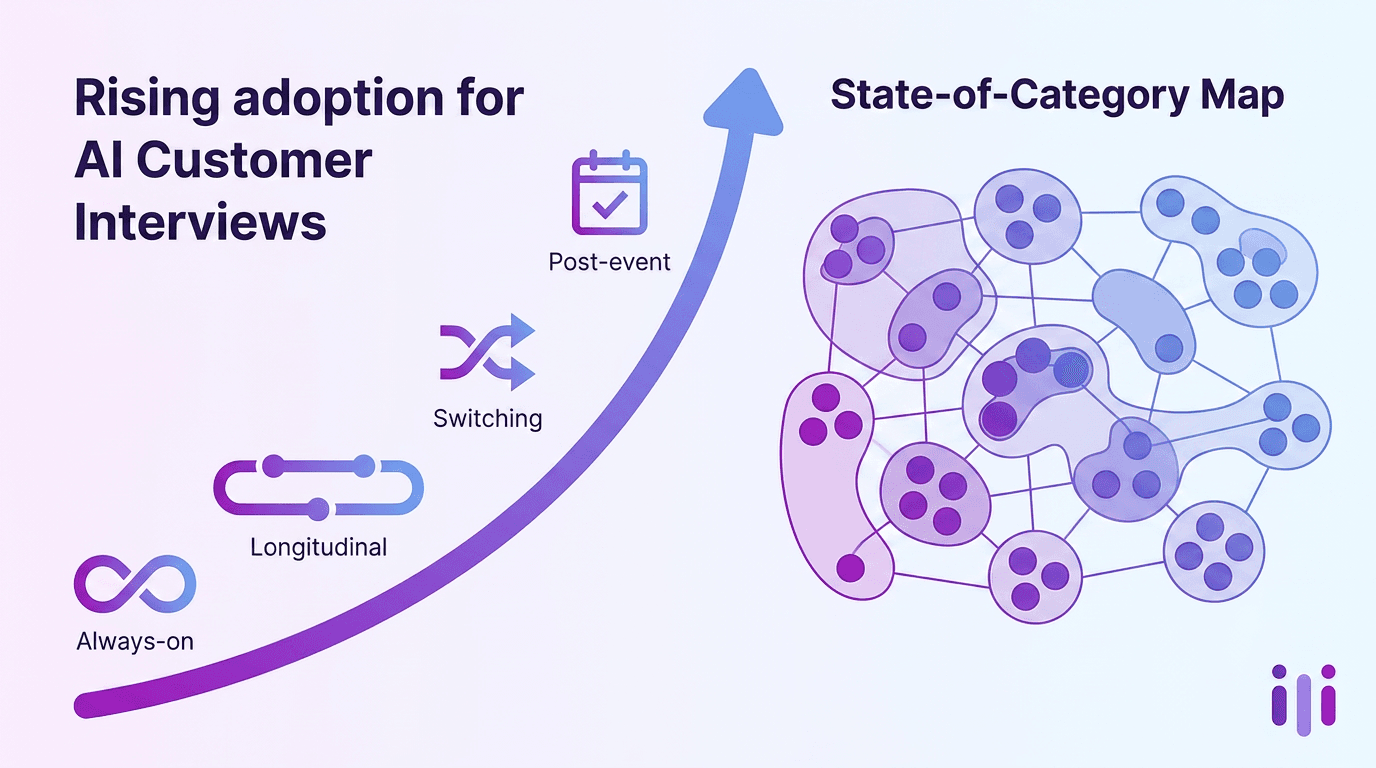
The first pattern is the always-on intent interview: short conversational interviews triggered at key moments (signup, trial expiration, feature adoption) that produce a steady stream of qualitative data instead of a quarterly NPS survey. The NPS-is-broken thesis gets its empirical proof here.
The second pattern is longitudinal cohort interviews: same panel of 40–100 customers, interviewed every 4–6 weeks on rotating topics. This pattern gives the depth of a research panel without the per-interview cost.
The third pattern is competitive switching interviews: interviews run with prospects evaluating alternatives, capturing what's working and not in the current vendor. Prosumer SaaS companies have used this to inform product-market-fit research and reposition mid-cycle.
The fourth pattern is post-event interviews: after launches, incidents, beta programs, or major releases, an AI agent runs short interviews with affected users and feeds real-time customer feedback analysis into the next planning cycle.
Where AI customer interviews still don't work
AI interviews underperform in three contexts. The first is highly regulated, high-trust verticals (clinical research, financial advice, regulated insurance) where compliance and identity verification require human moderation. The second is deeply technical B2B buyers (engineers evaluating infrastructure tools) where the moderator needs to ask follow-ups grounded in real domain expertise. The third is brand-sensitive enterprise CX where senior stakeholders want a human to hear their feedback firsthand. Many teams hybridize: AI agents do the breadth (50 interviews across the user base), human researchers do the depth (8 senior-stakeholder interviews) and own the synthesis. The AI-moderated interview guide covers this hybrid pattern in operational detail.
What's coming next: voice-first, agentic, and integrated
Voice-first AI interviews moved from "demo mode" to production in late 2025 thanks to a step-change in latency and prosody. The implication is real: voice interviews capture tone, hesitation, and emotional signals that text-mode interviews miss, and they fit the contexts where typing is friction (mobile, in-store, post-call). Expect roughly half of AI customer interviews to be voice-first by end of 2026.
Agentic interviews — agents that don't just ask questions but take actions on behalf of the customer (checking account state, scheduling a follow-up, kicking off a refund) — are the second emerging frontier. They blur the line between research and operations.
Integration with the customer-data stack is the third. AI interview platforms that read CRM, product analytics, and ticket history before asking the right question will eat the slice of the market that still uses survey tools. Conversational AI for business covers this integration pattern from the buyer's-guide perspective.
How to start an AI customer interview program
For teams not yet running AI customer interviews, the cheapest first step is to replace one recurring survey with an AI conversation: end-of-onboarding, post-trial, churn exit, or a quarterly health check. Run it for 30 days, compare completion rates and the depth of insight, then expand. The practical playbook for replacing surveys with conversations walks through the swap operationally.
For teams already running them, the highest-leverage move in 2026 is going deeper, not broader: instead of adding another conversational research touchpoint, lengthen the existing ones to 8–12 minutes and instrument the synthesis pipeline to feed roadmap and CS workflows. The marginal value of conversation #11 in a quarter is much higher when the previous 10 are fully analyzed and acted on.
Frequently Asked Questions
What's the difference between an AI customer interview and a chatbot?
An AI customer interview is goal-directed and probing — the agent has a research outline, asks follow-up questions, and produces a transcript and synthesis. A chatbot answers customer questions reactively. AI interviews are research instruments; chatbots are support tools. The two formats can share infrastructure but the design intent and analytics pipeline are different.
How many AI customer interviews should we run per quarter?
Most product teams in our customer base run between 30 and 100 AI customer interviews per quarter. The right number depends on team size and the breadth of decisions being made — a single PM running discovery on one product area might do 12 per month; a research team supporting 8 product areas might do 200. The constraint is rarely volume — it's how much synthesis the team can act on.
Will AI customer interviews replace human moderators?
AI customer interviews replace human moderators for breadth (volume of conversations across a user base) but not for depth (senior-stakeholder interviews requiring trust and domain expertise). The dominant 2026 pattern is hybrid: AI for the wide layer, humans for the deep layer. Researchers who have adopted this model report doing 4x more research per quarter without adding headcount.
Are AI customer interviews compliant with GDPR and CCPA?
Yes, when configured properly. AI customer interview platforms collect personal data subject to the same consent and retention rules as any other research tool. Major platforms expose data residency, deletion-on-request, and consent-capture flows. Regulated industries (healthcare, financial services) typically need additional review of the underlying model provider and data handling.
What's the realistic completion rate for an AI customer interview vs. a survey?
AI customer interview completion rates run 40–70% in our customer benchmarks, versus 5–15% for equivalent-length surveys. The completion advantage is largest at the front of the conversation (people don't bounce on question 2) and at the end (people stay for the wrap-up because they feel listened to).
Which industries are adopting AI customer interviews fastest?
Adoption is fastest in horizontal SaaS (product and CS teams), early-stage B2B (founders running PMF interviews), and consumer subscription businesses with high churn velocity. Adoption lags in highly regulated insurance, clinical research, and complex enterprise infrastructure where the 1:1 human relationship is part of the product.
The bottom line on AI customer interviews in 2026
AI customer interviews are no longer the bleeding edge of customer research — they are the default. Teams that haven't started running them are losing 4x throughput and 2.3x cycle-time advantage to teams that have. The differentiation in the next 18 months will not be about whether to use AI customer interviews, but how deeply they integrate with the rest of the customer-data stack and how well teams act on what they learn.
If you're ready to run your first AI customer interview, Perspective AI takes 5 minutes to set up and produces a real transcript and synthesis on your first conversation. Built for product teams and CX teams who are tired of waiting weeks for survey results that never tell them why.
More articles on AI Customer Interviews & Research

The 2026 AI Customer Interview Report: What 500 Hours of AI-Moderated Sessions Revealed
AI Customer Interviews & Research · 13 min read

Synthetic Focus Groups in 2026: What They Get Right, Where They Break
AI Customer Interviews & Research · 11 min read

The 2026 State of AI Customer Research: Mid-Year Update
AI Customer Interviews & Research · 11 min read

The 2026 State of Customer Research Hiring: Why Teams Cut Researchers and Bought AI
AI Customer Interviews & Research · 11 min read

The 2026 Customer Interview Benchmark Report: Response Rates, Depth, and Time-to-Insight
AI Customer Interviews & Research · 18 min read

Digital Focus Groups Went AI-First in 2026: 6 Shifts Reshaping Online Qualitative Research
AI Customer Interviews & Research · 13 min read