AI in Education: How Conversational Feedback Is Replacing Static Surveys
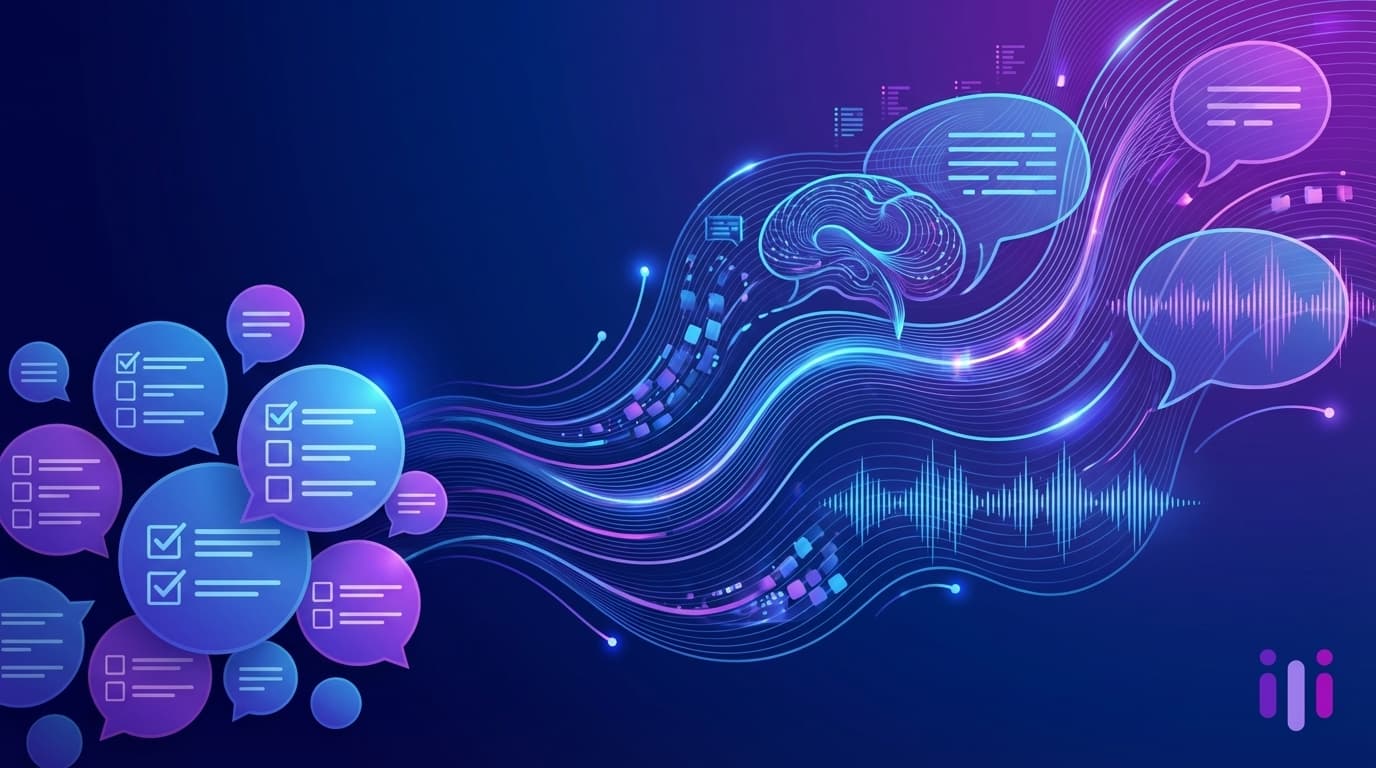
The conversation around AI in education has been stuck in a rut. Search for the topic and you will find thousands of articles debating whether students are cheating with ChatGPT, and thousands more about automated grading. Meanwhile, the most transformative shift is happening quietly: educational institutions are replacing static end-of-term surveys with AI-powered conversations that actually listen to students at scale.
This matters because the feedback gap in education is staggering. A 2025 HEPI Student Generative AI Survey found that fewer than half of students (48%) feel their teaching staff are helping them develop skills for their careers. Yet most institutions still rely on the same end-of-semester course evaluations they have used for decades — blunt instruments that arrive too late to change anything.
Here are four trends reshaping how schools, colleges, and universities collect and act on student feedback — and why educators who pay attention now will have a significant advantage.
Key Takeaways
- End-of-term evaluations are giving way to continuous, conversational feedback powered by AI that can probe, follow up, and surface the "why" behind student responses.
- Student voice programs are scaling from small pilots to institution-wide initiatives, driven by AI's ability to conduct hundreds of conversations simultaneously.
- Real-time feedback loops are improving teaching mid-semester, not just after grades are posted.
- AI-driven early warning systems are catching at-risk students weeks earlier than traditional indicators, using conversational signals that surveys miss.
- The institutions moving fastest are those that treat AI as a listening tool, not just a grading or cheating-detection tool.
AI in Education: Beyond the Cheating Debate
When 86% of higher education students now use AI as a primary research and brainstorming partner, the genie is out of the bottle. Institutions that focus exclusively on policing AI usage are missing the larger opportunity: deploying AI to understand what students actually think, need, and struggle with.
The AI in education market reached $7.57 billion in 2025 and is projected to exceed $112 billion by 2034. But the bulk of that investment is flowing toward content delivery, adaptive learning platforms, and assessment automation. The feedback and listening category remains underdeveloped — which is exactly where the biggest gains are hiding.
Consider what institutions currently know about their students' experience. Most rely on end-of-semester course evaluations with Likert scales and a single open-text box. Response rates have been declining for years. The data arrives after the semester is over. And the format — static surveys — captures what students are willing to reduce to a 1-5 rating, not what they actually feel.
That is starting to change.
Trend 1: Conversational Feedback Is Replacing End-of-Term Evaluations
The traditional course evaluation is a relic of the paper-and-pencil era. Students fill out a student satisfaction survey, rate their professor on a handful of dimensions, and maybe write a sentence or two in the comments section. Research from ScienceDirect has shown that these evaluations are susceptible to well-documented biases — students give higher ratings to less demanding courses, and extreme responding skews results.
AI-powered conversational feedback flips this model. Instead of a static form, students engage in a guided conversation where AI asks follow-up questions, probes vague answers, and adapts based on responses. The result is richer, more nuanced data that captures context traditional evaluations miss entirely.
What the data shows
- AI-generated course evaluations explain a greater proportion of variance in student satisfaction than traditional academic variables like course grades, according to research published in ScienceDirect.
- AI-based evaluations appear less susceptible to the biases that plague traditional student ratings.
- Platforms like Explorance are using AI to analyze open-ended feedback at scale, translating qualitative comments into data-driven insights by identifying sentiment patterns and surfacing actionable recommendations.
Why this matters for educators
End-of-term evaluations are backward-looking by design. Conversational feedback can happen weekly, mid-course, or even after individual sessions. This shift from summative to formative feedback changes the purpose of evaluation from judgment to improvement.
The pattern here mirrors what is happening in the business world. Companies that switched from annual NPS surveys to continuous conversational feedback saw dramatically deeper insights. Education is following the same trajectory, just a few years behind.
Trend 2: AI Is Making Student Voice Programs Scalable
"Student voice" has been an aspirational concept in education for years. The idea is simple: students should have meaningful input into their learning experience. The execution has been anything but simple.
Running student voice programs traditionally requires trained facilitators, focus groups, and significant administrative overhead. A mid-sized university with 15,000 students might manage to hear directly from a few hundred through interviews and focus groups. That is a 2% sample at best.
The scalability breakthrough
AI conversations change the math entirely. An institution can now deploy AI-moderated conversations to thousands of students simultaneously, each conversation adapting to the individual student's responses. This is the same capability that lets businesses conduct hundreds of customer interviews at scale — applied to education.
Springer research on pedagogical AI conversational agents found that conversational agents in higher education are being used across multiple modalities: answering student queries, providing personalized feedback, and — critically — assessing learner experiences on an individual level that was previously impossible at scale.
What scalable student voice looks like
The institutions leading this shift are not just collecting more data. They are hearing from student populations that traditional methods systematically miss: international students who may not speak up in focus groups, first-generation students unfamiliar with institutional feedback channels, and commuter students who are never on campus when focus groups are scheduled. For K-12 settings, a K-12 parent survey conducted conversationally reaches families that paper forms and email surveys consistently miss.
Trend 3: Continuous Feedback Loops Are Improving Teaching in Real-Time
Stanford Graduate School of Education published research on an AI-driven feedback tool that analyzes classroom discourse and provides teachers with automated, personalized feedback — a scalable alternative to the traditional teacher evaluation survey. The results were striking: the tool improved instructors' uptake of student contributions by 10% and reduced teacher talk time by 5%.
This points to a broader trend: AI is enabling feedback loops that operate in real-time rather than at the end of a semester.
How continuous feedback works
Traditional feedback cycles in education look like this: teach for 15 weeks, collect evaluations, review data over summer, maybe adjust for next semester. The gap between student experience and instructor response is measured in months.
AI-powered continuous feedback compresses this cycle to days or even hours. Tools can analyze student interactions, identify patterns in engagement, and surface issues while there is still time to address them. Harvard Graduate School of Education research confirms that AI-assisted feedback helps teachers provide more targeted, timely responses that improve learning outcomes.
The mid-semester correction advantage
When feedback is continuous, the concept of a "mid-semester correction" becomes possible. An instructor notices through AI-analyzed student conversations that a particular concept is creating confusion. Instead of discovering this on the final exam, they can restructure the next two weeks of class.
This is analogous to how product teams use continuous customer research to iterate on products in real-time rather than waiting for quarterly reviews. The principle is identical: shorter feedback loops produce better outcomes.
The challenge, notably, is adoption. Stanford's study found that about a third of teachers never opened their feedback reports, and fewer than a quarter interacted with the feedback in the app. Technology alone is not enough — institutions need to build a culture of continuous improvement, not just deploy a tool.
Trend 4: AI Conversations Are Catching At-Risk Students Earlier
Perhaps the most consequential application of conversational AI in education is early identification of students who are at risk of dropping out or failing.
Traditional early warning systems rely on lagging indicators: missed assignments, declining grades, irregular logins. By the time these signals appear, the student may already be disengaged beyond recovery. Research published in MDPI on early warning systems in Taiwanese higher education found that integrating social-cognitive factors with learning analytics dramatically improved intervention timing and effectiveness.
What conversational signals reveal
AI-powered conversations can detect early warning signs that administrative data misses entirely:
- Emotional signals: A student who says "I'm not sure this is the right program for me" in a conversational exchange is flagging doubt that no attendance record or grade report would capture.
- Contextual factors: Financial stress, family obligations, health issues — these surface naturally in conversation but are invisible in LMS data.
- Engagement quality: A student may be logging in and submitting work (satisfying traditional metrics) while feeling increasingly disconnected. Conversations reveal the gap between behavioral compliance and genuine engagement.
The retention math
Student retention is not just an educational concern — it is a financial one. Enrollify reports that AI early warning systems can identify at-risk students weeks earlier than traditional methods. For a university where each lost student represents $30,000-$50,000 in annual tuition, catching even 5% more at-risk students — starting from college admissions through graduation — translates to millions in preserved revenue.
The institutions getting this right are combining behavioral data (logins, grades, attendance) with conversational data (how students describe their experience, what they are struggling with, whether they feel supported). Neither data source alone tells the full story. Together, they create a predictive model that is fundamentally deeper than surveys alone.
What This Means for Educators and Administrators
These four trends point to a single conclusion: AI in education is most powerful not when it replaces human judgment, but when it scales human listening.
The institutions that will lead over the next three to five years share a common trait. They are treating AI as a feedback infrastructure, not just a teaching or assessment tool. They are investing in the ability to hear every student — not a sample, not a self-selected group, but every student — and to hear them continuously, not once per semester.
A practical framework for getting started
For administrators and educators evaluating conversational AI for feedback, here is a four-step framework:
- Audit your current feedback cycle. Map how long it takes from student experience to institutional response. If the answer is "one semester," you have a significant opportunity.
- Start with a single use case. Mid-course feedback is the lowest-risk, highest-value entry point. Deploy conversational feedback for one department or program.
- Measure depth, not just volume. Track not only response rates but the average length and richness of student responses. Conversational feedback should produce qualitatively different data.
- Close the loop visibly. Students participate in feedback when they see it leads to change. Communicate what you learned and what you changed as a result.
The future of AI in education is not about replacing teachers with chatbots or catching students who use ChatGPT. It is about building institutions that listen at scale — and act on what they hear.
Perspective AI is helping organizations across industries — including higher education — replace static surveys with AI-powered conversations that capture the depth and nuance that forms miss. If your institution is ready to hear from every student, not just the ones who fill out surveys, explore how conversational AI works at scale.
Frequently Asked Questions
How is AI being used in education beyond chatbots and grading?
AI in education is increasingly used for conversational feedback collection, student voice programs, early warning systems for at-risk students, and real-time teaching improvement. These applications focus on listening and understanding student experiences at scale, not just automating administrative tasks.
Can AI replace traditional student course evaluations?
AI-powered conversational feedback is not a direct replacement but a significant upgrade. It addresses key limitations of traditional evaluations — bias, low response rates, and lack of depth — by enabling follow-up questions and continuous collection rather than one-time end-of-term surveys.
What are the benefits of continuous feedback in higher education?
Continuous feedback compresses the gap between student experience and institutional response from months to days. Research shows it improves teaching practices by 10% in specific areas, enables mid-semester corrections, and produces richer qualitative data than traditional annual or semesterly evaluations.
How does conversational AI help identify at-risk students?
Conversational AI captures emotional signals, contextual factors like financial stress, and engagement quality that behavioral data alone misses. When combined with traditional metrics like grades and attendance, it can identify at-risk students weeks earlier than conventional early warning systems.
Is AI feedback in education biased?
Research shows AI-based evaluations may actually be less susceptible to certain biases than traditional student ratings, such as extreme responding and favoring less demanding courses. However, institutions should implement AI feedback as a complement to — not a replacement for — human judgment and oversight.
More articles on AI Conversations at Scale
AI and Education in 2026: 5 Trends Reshaping How Schools Capture Student Voice
AI Conversations at Scale · 14 min read
Conversational Surveys Are Replacing Static Forms in 2026: The Data
AI Conversations at Scale · 11 min read

Customer Experience Trends 2026: 7 Shifts Reshaping CX Across Every Industry
AI Conversations at Scale · 13 min read

2026 FDE Hiring Trends: What 1,000 Job Posts Reveal
AI Conversations at Scale · 13 min read
2026 Product Discovery Trends: What 300 Teams Changed
AI Conversations at Scale · 11 min read

The 2026 State of AI Conversations: Category Report
AI Conversations at Scale · 15 min read