Product Discovery Questions: What to Ask at Every Stage in 2026
TL;DR
Product discovery questions are the interview prompts a product manager asks at each stage of discovery — opportunity, solution, and risk — to learn what customers actually need before a team commits engineering time. The strongest question banks map directly to a product discovery framework: opportunity questions surface unmet needs and pain points, solution questions pressure-test concepts against real jobs-to-be-done, and risk questions kill Marty Cagan's four big risks (value, usability, feasibility, business viability) before delivery starts. Teresa Torres recommends interviewing at least one customer per week and anchoring every conversation in a specific past story rather than hypotheticals. The Nielsen Norman Group warns that leading and closed questions produce biased data, so open-ended "tell me about the last time…" prompts outperform yes/no checklists. In 2026, AI-moderated interviews extend each question with automatic follow-ups, so a single discovery question can probe ten respondents in parallel and still capture the "why" behind every answer. This guide gives PMs a stage-by-stage question bank, what each question reveals, and how AI follow-ups deepen the answer.
What is a product discovery question?
A product discovery question is an open-ended interview prompt designed to reveal a customer's needs, behaviors, and constraints at a specific stage of the product discovery process, so a product manager can decide what to build with evidence instead of assumption. Unlike a survey item that captures a rating, a discovery question elicits a story — and the story is where the actionable insight lives.
Discovery questions differ from validation questions. A discovery question is exploratory ("Walk me through the last time you tried to do X"); a validation question tests a specific hypothesis ("Would this feature solve that for you?"). Both belong in a discovery program, but they belong at different stages — and using a solution-validation question during opportunity discovery is one of the most common ways teams bias their own research. For the foundational behavioral-interview technique underneath all of this, the Mom Test-approved customer discovery questions cover how to ask about the past without leading the witness.
Why stage-based product discovery questions matter
Stage-based questions matter because asking the right question at the wrong stage wastes the conversation and corrupts the data. The Nielsen Norman Group has documented that leading questions produce biased or false answers because respondents mimic the interviewer's framing — and a solution question asked before you understand the problem is, structurally, a leading question.
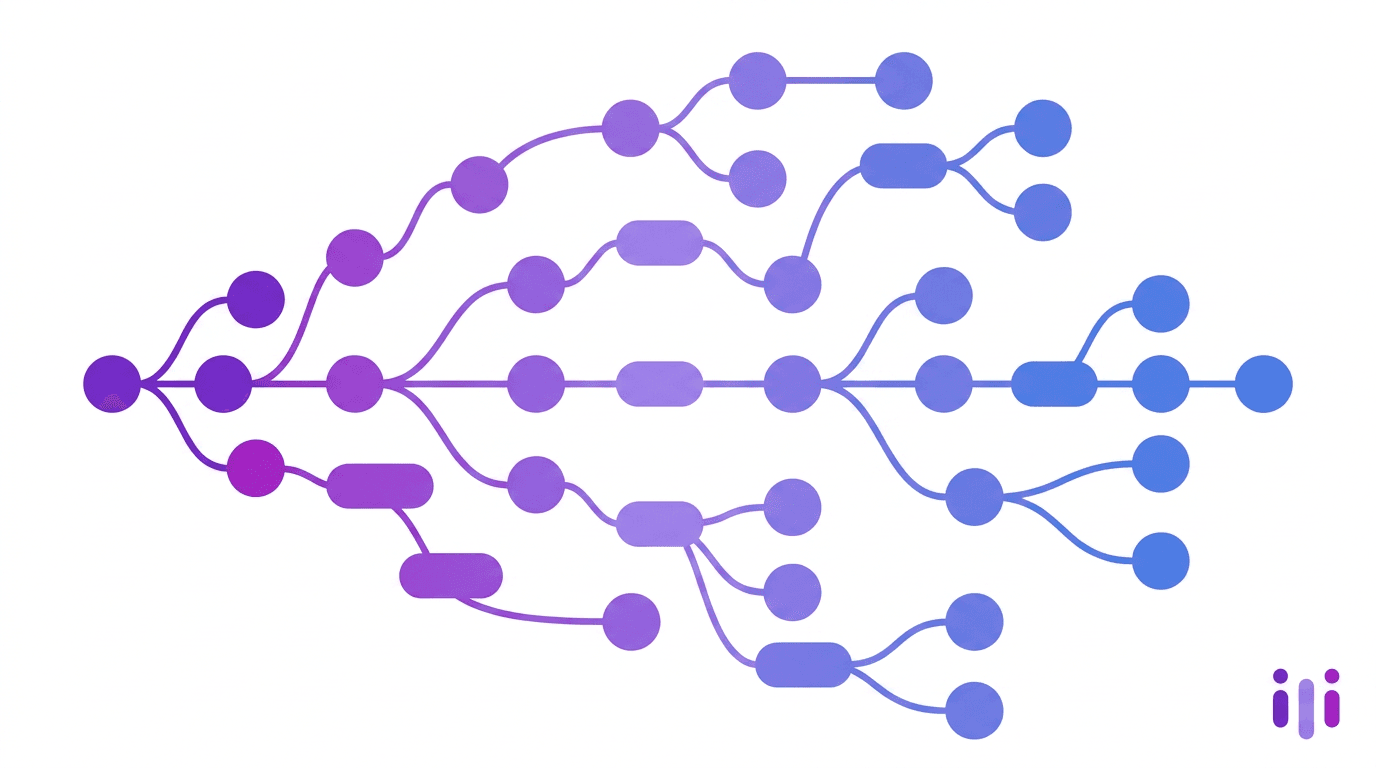
A discovery framework solves this by sequencing questions to match the work. Teresa Torres's opportunity solution tree makes the sequence explicit: you start with a business outcome, branch into opportunities (the unmet needs, pains, and desires you hear from customers), branch again into candidate solutions, and finally into the assumption tests that de-risk those solutions. Each layer has its own question type. Skip a layer and you build the wrong thing confidently. We unpack the full tree in our 2026 guide to the opportunity solution tree.
The business case is concrete. Discovery exists to retire the four big product risks — value, usability, feasibility, and business viability — before a single sprint is spent. A roadmap built on un-interviewed assumptions carries all four risks into delivery, where fixing them costs an order of magnitude more.
The three stages of product discovery questions
The three stages of product discovery questions are opportunity (understand the problem), solution (shape the answer), and risk (de-risk the answer before building). They mirror the layers of an opportunity solution tree and the natural arc of a continuous discovery program.
Run these stages continuously, not as a one-time phase gate. As we argue in the continuous discovery stack for AI-first product teams, 2026's structural shift is that discovery and delivery have merged into a single loop — you are always somewhere on this tree, for some opportunity, every week.
Stage 1: Opportunity discovery questions
Opportunity questions surface the unmet needs, pains, and desires that justify building anything at all, and they work best when they ask about specific past behavior rather than opinions or predictions. Teresa Torres's rule of thumb — anchor in a story — is why the strongest opener is "Tell me about the last time…" rather than "How often do you…".
Use these to map the opportunity space:
- "Walk me through the last time you tried to [accomplish the core job]. What happened?" — Reveals the real workflow and where it breaks, not the idealized one. AI follow-up: the interviewer automatically probes each step ("What did you do right after that?") so you get the full sequence, not a summary.
- "What was the hardest part of that for you?" — Surfaces the pain worth solving. The hardest part is usually the opportunity.
- "What did you do instead — what's your current workaround?" — Existing workarounds prove demand; people only build workarounds for problems they actually have.
- "What made you start looking for a solution when you did?" — Captures the "why now" trigger that predicts willingness to act.
- "Who else was involved in that decision?" — Maps the buying and usage committee, critical in B2B.
- "What would have to be true for this to stop being a problem?" — Defines the outcome in the customer's own words.
These map to the unmet-needs layer of the tree. For the deeper jobs-based version of opportunity interviewing, our jobs-to-be-done interview guide for product teams shows how to trace the job that triggers the switch.
Stage 2: Solution discovery questions
Solution questions test whether a candidate concept fits the job you uncovered in stage one — without falling into the hypothetical trap of asking people to predict their own future behavior. The fix is to ground every solution question in the past or in an observable reaction to a concrete artifact (a prototype, a mock, a description), never in "would you."
- "You mentioned [workaround] — if that step disappeared entirely, what would change for you?" — Tests value against their own stated pain, not an abstract feature.
- "Here's a rough version of an approach. Show me how you'd expect to use it." — Observed reaction beats stated preference; watch where they hesitate.
- "What's missing from this for it to fully replace what you do today?" — Surfaces the must-have line versus the nice-to-have line.
- "If you could only keep one part of this, which would it be — and why?" — Forces prioritization and exposes the true core of value.
- "How does this compare to [their current workaround] for you?" — Anchors the concept against the real alternative, which is rarely a competitor and usually "do nothing."
These map to the candidate-solutions layer. When you're comparing several concepts at once, AI concept testing in 2026 covers running parallel concept reactions in hours, and our AI product roadmap validation playbook shows how PMs pressure-test a full plan before committing it.
Stage 3: Risk and assumption-testing questions
Risk questions exist to kill Marty Cagan's four big risks — value, usability, feasibility, and business viability — before delivery begins, with each risk getting its own line of questioning. Most teams over-index on usability and skip value, which is exactly backwards: value and business viability are the risks that sink shipped products.
- Value risk — "Walk me through how you'd justify paying for this." / "What's it worth to you to make that pain go away?" Reveals willingness to pay and the budget owner.
- Usability risk — "Without me explaining anything, what do you think this does?" / "Where would you click first?" Reveals comprehension before training.
- Feasibility risk — "What does this need to connect to in your current stack to be usable?" Surfaces integration and data constraints that engineering must scope.
- Business viability risk — "Who would have to sign off on bringing this in?" / "What would make this a non-starter for your security or legal team?" Reveals contract, compliance, and channel blockers.
Each question is paired with an assumption you're testing — the assumption-tests layer at the bottom of the opportunity solution tree. For the discipline of running these as small, continuous experiments rather than a one-time gate, see operationalizing Teresa Torres's continuous discovery framework with AI conversations.
How AI follow-ups deepen every discovery question
AI follow-ups deepen discovery questions by automatically probing vague or incomplete answers in real time, so a single prompt yields the depth a skilled human moderator would extract — across hundreds of respondents at once. This is the 2026 unlock: the question bank above is only as good as the follow-ups, and follow-up is precisely where most teams run out of time.
A static survey asks "What was the hardest part?" and records a one-line answer. An AI interviewer asks the same question, then follows the Nielsen Norman Group guidance on insufficient probing as a top interview failure: "You said the export was painful — painful how? What happened right before that?" It chases the "it depends" and the "I'm not sure" — the messy, high-value moments where forms collapse into a blank text box.
This matters because AI-first research cannot start with a web form. Forms flatten a customer's story into dropdowns; a conversation lets them speak in their own words, and the AI follows up on what they actually said. Perspective AI's interviewer agent runs these stage-based questions as live conversations, probing every answer, so a PM can put the same opportunity question to 200 customers and still get 200 stories instead of 200 ratings. The synthesis is automatic — quotes and patterns surface without a week of manual tagging, which is the bottleneck our AI interview analysis breakdown is built to remove.
For PMs specifically, this collapses the discovery cadence from quarterly to weekly. Our PM's guide to AI-native customer research walks through wiring this into a standing program, and you can start from a pre-built customer interview or user research interview outline rather than a blank page.
A copy-ready discovery question checklist
A discovery question is well-formed when it asks about the past, stays open-ended, and tests one assumption at a time. Run every question through this checklist before you put it in front of a customer:
- Is it about a specific past event, not a hypothetical? "Tell me about the last time…" beats "Would you ever…".
- Is it open-ended? It should be impossible to answer with yes/no or a single number.
- Is it free of the answer? If the question contains the conclusion you want, it's a leading question — rewrite it.
- Does it match the current stage? Opportunity questions before solution questions before risk questions.
- Does it tie to an assumption or opportunity on your tree? If a question doesn't map to a node, cut it.
- Is there a planned follow-up? Every question needs a "why" or "tell me more" behind it — automate this with an AI interviewer if you can't moderate live.
This is the same discipline behind customer interview questions that get honest answers in 2026, narrowed to the discovery arc — and the reason the Nielsen Norman Group flags six common mistakes in crafting interview questions, most of them leading or double-barreled prompts.
Frequently Asked Questions
What are the best product discovery questions to start with?
The best opening product discovery questions ask about a specific recent experience, such as "Walk me through the last time you tried to [do the core job] — what happened?" These story-based prompts surface real behavior and pain points instead of opinions. Follow them with "What was the hardest part?" and "What did you do instead?" to map the unmet need and the existing workaround before you ever mention a solution.
How are product discovery questions different from customer interview questions?
Product discovery questions are a subset of customer interview questions focused specifically on deciding what to build, sequenced across the opportunity, solution, and risk stages of a discovery framework. General customer interview questions cover broader goals like satisfaction, onboarding, or churn. Discovery questions always tie back to a node on an opportunity solution tree — an unmet need, a candidate solution, or an assumption to test.
What questions should I ask to validate a solution?
To validate a solution, ask grounded, non-hypothetical questions like "If [your current workaround] disappeared, what would change for you?" and "What's missing for this to fully replace what you do today?" Avoid "Would you use this?" because people poorly predict their own future behavior. Pair solution questions with risk questions that test value (willingness to pay), usability (comprehension), feasibility (integration needs), and business viability (who must sign off).
How many customers should I interview during product discovery?
Teresa Torres recommends interviewing at least one customer per week as a continuous habit rather than batching interviews into a one-time research phase. The weekly cadence keeps discovery and delivery in a single loop. With AI-moderated interviews, teams interview hundreds of customers in parallel each week, so the practical limit shifts from researcher capacity to how fast you can act on what you hear.
Can AI ask product discovery questions as well as a human PM?
AI interviewers can run structured product discovery questions and follow up on vague answers in real time, matching a skilled moderator's probing while running hundreds of conversations simultaneously. AI excels at consistency, follow-up, and scale; human PMs still own framing the outcome, building the opportunity solution tree, and deciding what the patterns mean. The strongest 2026 discovery programs pair AI moderation with human synthesis.
Conclusion
Great product discovery is not about asking more questions — it's about asking the right product discovery question at the right stage, then following up until you reach the story underneath. Map your questions to the opportunity solution tree: opportunity questions to find unmet needs, solution questions to shape concepts against real jobs, and risk questions to kill Cagan's four big risks before you build. Anchor every prompt in the past, keep it open-ended, and never let it contain the answer you're hoping for.
The constraint was never the question bank — it was follow-up at scale. Perspective AI runs your entire stage-based discovery script as live AI-moderated conversations that probe every answer and synthesize the patterns automatically, so you can put the same discovery question to hundreds of customers and still capture the "why" behind each one. Start a discovery study and turn your next roadmap decision into evidence instead of assumption.
More articles on Product Discovery & UX Research
Sales Discovery Questions: 40 That Qualify, and When to Ask Them
Product Discovery & UX Research · 17 min read
Customer Journey Analytics: From Maps to Decisions
Product Discovery & UX Research · 11 min read
Customer Journey Map Examples (With Templates) for 2026
Product Discovery & UX Research · 14 min read
Customer Journey Touchpoints: How to Map and Optimize Them
Product Discovery & UX Research · 12 min read
How to Use AI for Continuous Product Discovery
Product Discovery & UX Research · 12 min read
How to Use AI for Feature Prioritization
Product Discovery & UX Research · 12 min read