AI Real Estate in 2026: How Top Producers Are Using AI Without Losing the Personal Touch

TL;DR
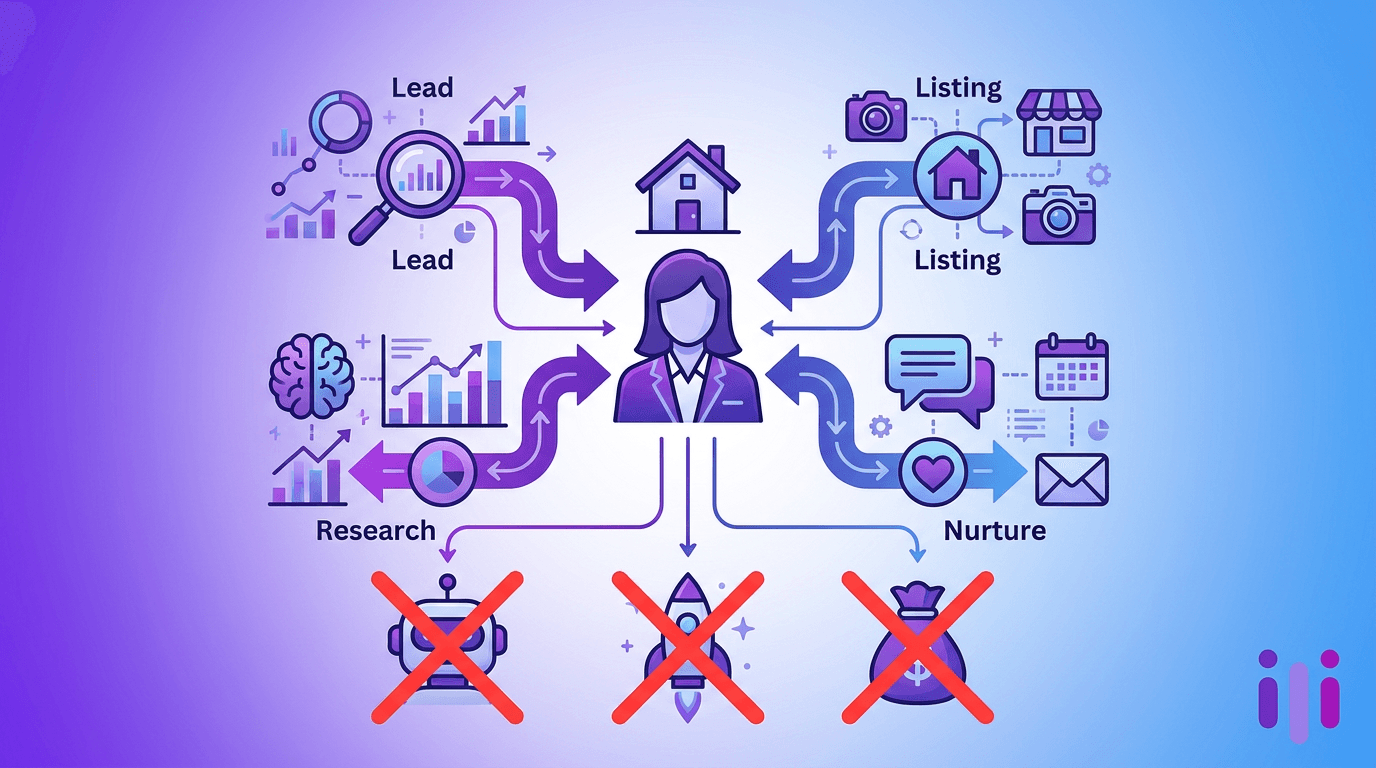
AI real estate adoption crossed 82% of agents in Q1 2026, but the producers actually closing more deals are using AI to augment the client relationship, not replace it. The winning pattern is narrow: conversational lead intake replacing static contact forms, AI follow-up that responds to inbound leads in under 60 seconds, and listing-prep automation that compresses CMA, copy, and disclosure review from hours to minutes. The losing pattern is AI-generated SMS blasts pretending they came from you. This guide walks through the three highest-leverage AI workflows for top producers in 2026 — intake, follow-up, and listing prep — with what to automate, what to keep human, and how to measure whether AI is actually helping you close more transactions. NAR's 2025 Technology Survey reports only 17% of agents see a "significant positive impact" from AI; the gap between that 17% and the 82% who use it is almost entirely a workflow design problem.
What is AI Real Estate?
AI real estate is the use of artificial intelligence — specifically large language models, conversational agents, and predictive analytics — across the agent-client workflow, from first lead capture through listing, transaction, and post-close. In 2026 the term covers conversational intake bots that replace contact forms, AI follow-up systems that qualify leads in real time, automated comparative market analysis (CMA) generation, AI listing description writers, and predictive seller-lead scoring. The most cited example among top producers is replacing a static "Contact me" form with a conversational AI lead capture flow that asks the same qualifying questions a human assistant would — buying timeline, financing status, neighborhood preference, must-haves — and books a call only with leads who pass.
Why the personal touch is the constraint, not the cost
AI in real estate fails when it tries to replace the relationship instead of protecting it. The job of a top producer hasn't changed: be the trusted advisor on the largest financial decision a client will make. What's changed is the volume of administrative work that gets between you and that role.
The 2026 RPR survey of 225 real estate professionals found that 82% of agents now use AI, with writing tools (77.9%) and chatbots (47%) leading. But NAR's 2025 Technology Survey reported only 17% of agents say AI has had a significant positive impact on their business, and 46% say it's had no noticeable impact at all. That gap is the entire opportunity. Agents getting results aren't using more AI — they're using it on the right three workflows, with the right human-in-the-loop checkpoints.
This guide is for the producer who already closes 30+ transactions a year, has more leads than they can personally follow up with, and wants to spend more time at listing appointments and closings — not less time being a real human to clients. We won't cover AI valuation models for institutional investors or generative listing photos (still legally and ethically dicey in most states). We cover the three workflows where AI provably wins: intake, follow-up, listing prep.
Use Case 1: Conversational Lead Intake (Replace the Contact Form)
Conversational lead intake replaces the static "Name / Email / Phone / Message" form on your IDX site or landing page with a short AI-led conversation that qualifies the lead, captures intent, and routes to your calendar. This is the single highest-ROI AI workflow in real estate right now, because it fixes the biggest leak in the funnel: a 1-3% form completion rate.
The form problem in real estate
Real estate contact forms have always been the wrong tool for the job. A buyer visiting a $1.2M listing at 11pm on a Tuesday isn't looking to fill out four fields and wait two business days. They want to know: is this still available, what's the property tax, is the sellers' financing assumable, and can I see it Saturday? A form can't ask follow-ups. A human can. An AI conversation can.
Static contact forms also flatten high-intent leads into the same row as drive-by tire-kickers, because they ask the same generic questions of everyone. As the case for replacing contact forms with conversations lays out, every additional field on a form drops completion rates by another 7-10%. That's why the "Contact Agent" button on most agent sites converts at 1-3%.
What a good conversational intake looks like
A well-designed AI intake replaces the form with a 60-90 second exchange that:
- Opens with a specific, contextual question — not "How can I help?" but "Are you asking about the 4-bed on Maple, or looking generally in this neighborhood?"
- Probes timeline and financing — "Are you pre-approved, or earlier in the process?" — without the patronizing "qualifying" feel of a CRM script
- Captures intent in the lead's own words — "We need a yard before our second kid arrives in July" is worth more than a "yard: yes" checkbox
- Routes high-intent leads to your calendar immediately — pre-approved buyer with a 60-day timeline gets a Calendly link; tire-kicker gets nurtured into your drip
- Hands you a transcript before the call — so you walk into the first conversation already knowing what they want
This is the same playbook that's working in insurance lead capture and law firm intake — replacing forms with conversations consistently moves completion rates from low single digits into the 40-60% range. For a deeper look at the mechanics, the AI lead generation for real estate guide covers tool categories and embed patterns.
What to keep human
Don't let the AI write the first text or call the lead pretending to be you. Top producers who tried "AI assistants" with fake names in 2024-2025 saw blowback the moment a lead figured it out. The intake AI should be honestly framed as an assistant ("I'm Maya, I help schedule appointments for Sarah") and hand off cleanly. The first time the lead hears your voice should still be your voice.
Use Case 2: Smart Follow-Up (Speed-to-Lead Without the Spam)
Smart follow-up uses AI to respond to inbound leads in under 60 seconds, then continues a multi-touch nurture sequence that adapts based on lead response — without the 47-text-message blast that gives the category a bad name. The data on response time is unambiguous: leads contacted within 5 minutes are 21x more likely to convert than leads contacted within 30 minutes, per longstanding MIT/InsideSales research that's been replicated repeatedly. Most agents miss that window because they're already on a listing appointment, in a closing, or asleep. The same pattern shows up in adjacent categories — home services lead capture and automated lead qualification software both treat speed-to-lead as the single biggest lever.
The 60-second response, but make it human
A working follow-up stack does three things:
- Instant first response — the moment a lead submits, AI sends a personalized message referencing the specific property or neighborhood they were browsing. Not "Thanks for reaching out!" — "Saw you were looking at the bungalow on Oak Street. It's still available. Want me to pull the seller's disclosure for you?"
- Adaptive multi-touch — if they respond, AI books the call. If they don't, the next touch goes out 2 days later with a different angle (market update, similar listing, neighborhood comp). Smart routing logic ensures hot leads escalate to you and cold leads stay in nurture.
- Honest agent handoff — once the lead is qualified, the AI says "Let me get Sarah on a call with you — here are her open slots tomorrow" and the human takes over. No bait-and-switch.
What "smart" means versus the 2024 spam era
The first generation of "AI follow-up" tools were SMS blasters dressed up in LLM hype. They sent 12 messages over 5 days regardless of whether the lead responded, and the messages were generic enough to be spotted as bot-written within two seconds. Top producers got burned and pulled them. The 2026 generation is different in three ways: messages are grounded in the specific listing or area the lead was viewing, cadence pauses the moment a lead responds, and the agent gets a transcript-style summary of every interaction so the first human conversation has context.
For agents managing hundreds of cold leads in a CRM, smart follow-up also unlocks re-engagement based on behavioral signals. A lead who went dark 6 months ago but just opened your last 3 listing alerts is a different lead than one who's been silent the whole time — AI follow-up can prioritize the first for your personal call while continuing automated nurture on the second.
Use Case 3: Listing Prep (Compress Hours of Admin Into Minutes)
Listing prep is the third high-leverage AI workflow — the boring administrative work that comes between "I've signed the listing agreement" and "we're live on the MLS." For a top producer doing 30+ listings a year, this is where AI buys back the most time per dollar of software spend.
What to automate in listing prep
Specific tasks where AI is now reliably better than the manual version:
- Comparative Market Analysis (CMA) drafting — pull comps, format the deck, generate a price-strategy narrative. Review and adjust before the listing presentation. A CMA that used to take 90 minutes now takes 15.
- Listing description copy — feed the AI the property details, photos, and a few notes on lifestyle positioning ("walkable to schools, quiet street"). Get a first draft in 30 seconds. Edit for fair-housing compliance and your voice.
- Disclosure review — AI reads seller disclosures, flags ambiguous answers ("notice any leaks?" → "not that I'm aware of") that need a follow-up question before listing
- Pre-listing email drafts — the "what to expect this week" email to sellers, the photographer-and-stager coordination email, the open-house invitation to your sphere — all template-able with AI personalization
- Showing feedback synthesis — instead of reading 14 buyer-agent feedback notes, AI summarizes the consistent themes ("3 buyers flagged the kitchen layout, 2 mentioned the price seemed high vs. comps")
What to keep human
Pricing strategy, fair-housing review of marketing copy, and the actual listing presentation. AI can draft the CMA, but the conversation about whether to price aggressively, the read on the seller's emotional attachment, and the negotiation strategy when offers come in are all still your job. The producers who outsource that to AI are the ones whose listings sit on the market.
For the broader market context on how AI is reshaping the real estate workflow end-to-end, how AI is changing real estate from lead capture to client experience maps the full agent journey. And for the specific top-producer playbook, the AI for real estate agents practical playbook covers tactics agent-by-agent.
A Tool Stack for Top Producers in 2026
Most top producers we've talked to settle on a 3-layer stack:
Perspective AI sits in the first layer — we power the conversational intake that replaces your contact form with a short, branded AI conversation that captures intent and routes qualified leads to your calendar. Teams use it alongside their CRM and listing tools rather than replacing them. If you're evaluating the category, conversational AI for real estate walks through what to look for in an intake tool specifically.
Common Mistakes to Avoid
The producers who tried AI in 2024-2025 and came away unimpressed almost always made one of these mistakes:
- Treating AI as a lead-source replacement instead of a workflow upgrade. AI doesn't generate leads — your sphere, your IDX site, your referral network, and your marketing budget do. AI converts more of those leads, faster.
- Letting AI pretend to be you. Branded AI assistants ("Hi, this is Sarah from Sarah Smith Real Estate") that introduce themselves honestly outperform deceptive ones in every test we've seen, and they don't burn your reputation when discovered.
- Automating the human moments. First listing presentation, offer-strategy conversation, post-inspection negotiation — these stay human. AI assists the prep, never the conversation. The same line shows up across other regulated and high-trust verticals — see why AI-first cannot start with a web form for the underlying principle.
- Choosing tools by feature list instead of workflow fit. A 47-feature AI platform that doesn't integrate with your MLS or CRM is worse than a 3-feature tool that does. Start with the workflow, then pick the tool.
- Not measuring. If you can't tell whether AI follow-up changed your appointment-set rate or speed-to-lead, you're paying for software theater. Track the funnel before and after.
Frequently Asked Questions
What is AI in real estate, in plain English?
AI in real estate is the use of conversational AI, large language models, and predictive analytics to handle administrative, intake, and follow-up work that previously required an assistant or hours of an agent's own time. In 2026 the most common use cases are replacing website contact forms with conversational intake, responding to inbound leads in under 60 seconds, drafting CMAs and listing descriptions, and synthesizing showing feedback. AI does not replace the agent-client relationship; producers seeing real ROI use AI specifically to protect that relationship by removing busywork.
How are top-producing agents actually using AI in 2026?
Top producers concentrate on three workflows: conversational lead intake (replacing static contact forms with AI conversations that qualify leads and book to the calendar), smart follow-up (sub-60-second response with adaptive nurture cadences that pause when the lead engages), and listing prep (CMA drafting, listing copy, disclosure review, showing feedback synthesis). They are explicitly not using AI to write outbound messages pretending to be them, generate listing photos, or replace pricing-strategy conversations. RPR's February 2026 survey shows 82% of agents now use some AI, but only 17% report significant business impact — the gap is workflow design, not adoption.
Will AI replace real estate agents?
AI will not replace real estate agents in any near-term horizon, because the highest-value moments in a transaction — pricing strategy, negotiation, emotional support during a major financial decision, fiduciary advisory work — are exactly the moments AI is worst at. AI will, however, replace the administrative scaffolding around those moments: contact forms, follow-up emails, CMA formatting, listing descriptions, disclosure review. Producers who use AI to clear scaffolding spend more time on the high-value moments and serve more clients without losing the personal touch.
What's the ROI of AI for a real estate agent?
The clearest ROI shows up in lead conversion and time savings. Replacing a contact form with conversational intake typically moves form-completion rates from 1-3% into the 40-60% range, compounding across every marketing dollar driving traffic to your site. Sub-60-second follow-up exploits the well-documented finding that leads contacted within 5 minutes convert at 21x the rate of leads contacted within 30 minutes. On listing prep, top producers report saving 5-10 hours per listing on CMA, copy, and admin — time reinvested in listing appointments and closings.
How do I pick an AI tool for real estate without wasting money?
Pick AI tools by workflow, not by feature list. Start with one specific bottleneck — most likely your contact-form conversion rate or your speed-to-lead — and pick a tool that integrates with what you already use (IDX, CRM, calendar). Avoid all-in-one platforms promising to replace your entire stack; integration debt almost always exceeds the savings. Test on a 30-day pilot with explicit before/after metrics. For a structured framework, the AI customer engagement buyer's framework maps the same evaluation logic to adjacent categories.
Conclusion: AI Real Estate Done Right Looks Like a Better Agent, Not a Replaced One
The producers winning with AI real estate in 2026 are the ones who picked three narrow workflows — conversational lead intake, smart follow-up, listing prep — and got those right before adding anything else. They didn't buy 14 AI tools. They didn't outsource the client relationship to a chatbot with a fake name. They used AI to clear the administrative scaffolding so they could spend more time being the trusted advisor their clients hired them to be. That's the personal touch, scaled — not replaced.
If your contact form is still converting at 2% and you're losing leads to faster competitors, start with a conversational AI intake that replaces the form with a 60-second branded conversation. It's the single highest-leverage AI move in real estate right now, and it's the one that protects — rather than threatens — the relationships your business is built on. See how Perspective AI handles real-estate intake or browse the conversational AI for real estate guide to dig deeper.
More articles on Intelligent Intake

AI Chatbots for Real Estate: Why Most Fail and What Actually Works in 2026
Intelligent Intake · 16 min read

AI for Real Estate: A 2026 Buyer's Guide for Brokerages and Independent Agents
Intelligent Intake · 14 min read

AI for Real Estate Agents in 2026: A No-BS Guide to What's Worth Adopting
Intelligent Intake · 14 min read
Real Estate AI in 2026: A Practical Guide to What's Working and What's Hype
Intelligent Intake · 13 min read
Consumer App Onboarding Drop-Off in 2026: How to Find Where New Users Actually Stall
Intelligent Intake · 23 min read
The Career Counseling Intake Form in 2026: Eliciting Goals, Not Symptoms
Intelligent Intake · 23 min read