How to Build a Voice of Customer Program from Scratch in 2026
TL;DR
A Voice of Customer program in 2026 looks almost nothing like the one your predecessor built in 2015. The old playbook — quarterly NPS survey, a dashboard, a slide deck — is now table stakes and not enough. The new playbook is continuous, multi-source, qualitative-first, and operated as a closed-loop system with named owners and SLAs.
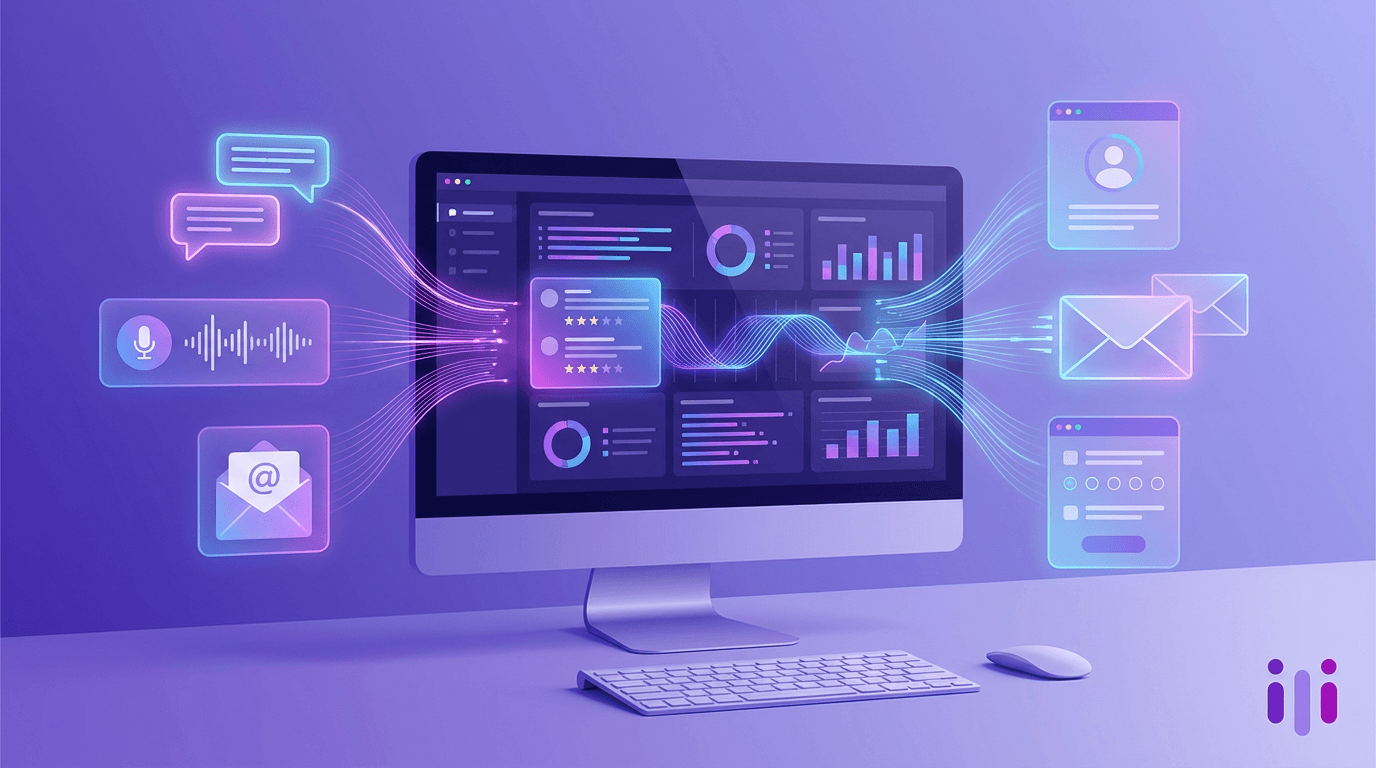
This guide walks you through building a VoC program from scratch in five steps: stakeholder map and charter, source diversification, the AI-conversation layer, closed-loop workflows, and executive reporting cadence. Each step is sized for a small CX or research team — you do not need a six-figure platform on day one.
If you are inheriting a program built on a single NPS metric, treat this as a rebuild guide. If you are building greenfield, even better — you can skip the 2015 mistakes entirely.
What is a Voice of Customer (VoC) program in 2026?
A Voice of Customer (VoC) program in 2026 is a continuous, multi-source listening system that combines surveys, support, sales, and always-on AI conversations into one closed-loop workflow — not a quarterly NPS dashboard.
The 2015 definition was narrower. A VoC program meant a relationship NPS survey, maybe a transactional CSAT, a verbatim word cloud, and an annual board readout. The metric was the program. If NPS went up, the program was working. If it went down, someone in marketing got nervous and a task force formed.
That model broke for three reasons. First, response rates collapsed — typical relationship NPS surveys now see single-digit response rates, and the people who respond are not representative. Second, quantitative scores tell you the temperature but not the cause; you can watch NPS drop for two quarters and still not know why. Third, the cadence is wrong — by the time a quarterly survey surfaces a problem, the affected customers have already churned.
The 2026 program inverts all three. It treats qualitative as primary and quantitative as confirmatory. It runs continuously rather than on a survey calendar. And it builds AI conversations into the listening layer so every customer touchpoint can produce a coachable, taggable, searchable transcript — at zero marginal cost per conversation.
If you want a deeper conceptual primer, see the complete guide to Voice of Customer programs in 2026. This post is the hands-on build guide that complements it.
Step 1: Stakeholder map + program charter
Before you buy a tool or design a survey, you write a charter. A VoC program without a charter is a hobby — it generates interesting findings that no one acts on.
The charter is one page. It answers five questions:
- Executive sponsor. Name one VP or C-level owner. Usually CCO, CPO, or COO. If no one will sign, the program will not survive its first budget cycle.
- Operational owner. Name the person who runs the program day to day. CX leader, head of research, senior CSM — the title matters less than the named accountability.
- Scope. Which customer segments, journey stages, and product surfaces are in scope for year one? Be ruthlessly narrow. "All customers, all journeys" is not a scope; it is a wish.
- Success criteria. Pick two or three outcomes the program is accountable for. Examples: reduce gross churn by X points, cut time-to-validate a product hypothesis from a quarter to two weeks, raise sales win rate against a specific competitor.
- Decision rights. When the program surfaces an insight, who is empowered to act? Product? Support ops? CS leadership? If the answer is "we will form a committee," your closed loop will never close.
A good charter fits on one page and gets signed by the exec sponsor. A bad charter is a 30-page strategy document that nobody reads.
Build your stakeholder map alongside the charter. List every team that either feeds data into the program (support, sales, success, product analytics, marketing) or consumes insights from it (product managers, exec team, marketing, sales enablement). Each row gets a name, a contribution, and a consumption pattern. This map becomes your distribution list for monthly readouts and your shortlist for closed-loop workflow owners.
Step 2: Source diversification (no single channel)
The single biggest 2015-era mistake is over-indexing on one channel — usually a relationship NPS survey. A 2026 program runs on a portfolio of sources, each sized for what it does best.
Plan to launch with at least four of the following seven sources within your first 90 days:
- Relationship surveys (NPS, CSAT). Keep them — they are still useful as a trended temperature gauge. Just stop pretending they are the program. Cap them at one or two per customer per year to protect response rates.
- Transactional surveys. Post-onboarding, post-renewal, post-support-ticket. These have higher response rates and are tied to a specific journey moment, so the verbatim is actionable.
- Support tickets. Your support system is the largest and most underused VoC dataset in the company. Tag every ticket with a product area, journey stage, and sentiment, and you have a free always-on listening channel.
- AI-led customer conversations. See Step 3.
- In-product feedback. Inline NPS, contextual "did this work" prompts, and friction polls inside the app. These tie sentiment to behavior in a way no email survey can.
- Sales calls (won and lost). Sales conversations contain verbatim language about competitors, objections, and use cases that no survey will ever surface. Get access to a call recording tool and tag accordingly.
- Churn and win-back interviews. A 30-minute conversation with a churning customer is worth ten NPS scores. Make these mandatory for every logo over a threshold ARR.
Source diversification is the single highest-leverage move in the playbook. A program with four sources is dramatically more durable than a program with one — when one channel breaks (survey fatigue, a tool migration, a vendor outage), the others keep insights flowing.
For a deeper look at which AI-native tools fit each of these channels, the 2026 AI customer engagement software stack breaks them down stack-by-stack.
Step 3: The AI-conversation layer (the new always-on source)
This is the change that makes a 2026 program structurally different from a 2015 one. AI conversations are not a replacement for surveys — they are a new source that did not exist in the old playbook.
What does the AI-conversation layer add?
- Depth at scale. A traditional research interview takes 30 to 45 minutes of a researcher's time. An AI interview is conducted by an AI agent that can run thousands in parallel, with adaptive follow-up questions that go deeper than any static survey form.
- Verbatim language. AI conversations produce transcripts. Transcripts are searchable, taggable, and quotable in product specs, sales decks, and exec readouts. NPS scores are not.
- Always-on coverage. AI conversations can run continuously across onboarding, churn risk, renewal, expansion, and exit moments — not just on a quarterly calendar.
- Lower friction than surveys. A short conversational interface gets higher completion rates than a 12-question survey form, especially for high-value qualitative questions.
The practical setup looks like this: pick two or three journey moments where the cost of being wrong is highest. For most B2B SaaS companies, that is onboarding completion, first renewal signal, and exit. For a consumer brand it might be first purchase, repeat purchase, and cancellation. Deploy an AI interview at each moment with three to five open-ended questions, and let the AI agent handle the follow-ups.
You do not need to replace your survey program on day one. You add the AI layer alongside it, and over 6 to 12 months you will see which channels the qualitative insights actually come from. In our experience the AI layer takes over as the primary qualitative source faster than most teams expect — typically within two quarters.
For benchmarks on adoption, budgets, and how teams are reallocating research spend away from survey panels and toward AI conversations, see the state of AI customer research 2026 survey.
The same principle applies to internal feedback. The case for moving employee listening from annual surveys to continuous AI conversations is identical to the customer case — see employee feedback at scale for the parallel argument.
Step 4: Closed-loop workflows
A program without closed-loop workflows is a museum of feedback. Insights pile up, decks circulate, nothing changes. The closed loop is what makes a VoC program operational rather than decorative.
The minimum viable closed loop has four stages:
- Capture. An insight is logged from any of your sources. It includes the verbatim, the source, the journey stage, the segment, and a proposed tag (product area, theme, sentiment).
- Triage. Once a week, the program owner triages the inbound — clusters duplicates, separates anecdote from signal, and elevates the highest-frequency or highest-severity items to the action queue.
- Action. Every actionable insight gets a named owner outside the VoC team — a product manager, support ops lead, or CS leader — and an SLA. Two weeks to acknowledge with a plan, six weeks to ship or defer with a written reason.
- Loop back. Whatever happens — fix shipped, fix deferred, behavior change requested — gets communicated back to the customers who raised it. This is the step that everyone skips and that does the most damage when skipped.
The closed loop also generates the only metric that matters for the VoC team itself: time-to-action. Track it. Report it monthly. If it creeps past 90 days, your program is sliding back into museum mode.
For CS-led companies, the closed-loop pattern often runs through the customer success platform — pairing VoC insights with health scoring and proactive outreach. The 2026 AI customer success platforms guide covers the operational tooling.
Step 5: Executive reporting cadence
The exec readout is what keeps the program funded and protected from the next reorg. Get this wrong and a great program dies in a budget cycle. Get it right and the program survives leadership changes.
A workable cadence:
- Weekly: Internal program-team standup. Triage queue review, time-to-action check, source health (response rates, conversation completion, ticket-tagging coverage).
- Monthly: Cross-functional readout to product, support, sales, and marketing leadership. Top five themes by volume, top three by severity, status of every open action item, three verbatim quotes per theme.
- Quarterly: Executive readout to the C-suite or board. Trended scores, themes that have shifted quarter over quarter, named wins (closed-loop fixes that shipped and changed behavior), and the one or two strategic recommendations the team is asking the exec group to fund.
- Annually: Program health review. Charter revisit, source portfolio audit, success-criteria scoring, year-two budget ask.
A good exec readout is two-thirds verbatim and one-third numbers. The numbers establish credibility; the verbatim moves people. If your readout is all charts and no quotes, you are leaving the most persuasive part of the program on the floor.
Common 2026 mistakes to avoid
Even with a strong charter, programs go sideways. The most common 2026 failure modes:
- Over-relying on NPS as the program. NPS is a number. A VoC program is a system. Keep the score, lose the mythology around it.
- Ignoring qualitative signal because it does not aggregate cleanly. A single verbatim from a high-ARR account is worth more than a 50-basis-point shift in a satisfaction average. Build workflows that respect that asymmetry.
- No named owner outside the VoC team. If only the VoC team owns insights, nothing changes. Insights have to be handed off with an SLA to people empowered to act.
- No closed-loop communication back to customers. Customers who give feedback and hear nothing back stop giving feedback. The loop is not optional.
- Treating the AI-conversation layer as a survey tool. AI conversations are a research instrument, not a longer survey. Design them with research questions and analysis in mind, not with KPIs in mind.
- Buying a platform before you have a charter. Tools amplify operating discipline; they do not create it. Charter first, source design second, tools third.
- One program, one segment. Enterprise, mid-market, and SMB customers have different feedback patterns and different willingness to participate. Segment your sources and your readouts accordingly.
Frequently Asked Questions
What is a Voice of Customer (VoC) program?
A Voice of Customer program is the operational system a company uses to continuously capture, analyze, and act on customer feedback across every channel — surveys, support, sales, churn interviews, and AI conversations — so insights drive product, CX, and retention decisions. It is a system, not a survey.
How is a 2026 VoC program different from a 2015 NPS program?
A 2015 program was anchored on a quarterly NPS survey and a slide deck. A 2026 program is always-on, conversational, and qualitative-first. AI interviews replace one-shot surveys, closed-loop workflows route every insight to a named owner with an SLA, and the executive readout is two-thirds verbatim and one-third numbers. Same goal, completely different operating model.
Who owns the Voice of Customer program at a company?
A senior CX, research, or customer success leader owns the program operationally, with an executive sponsor at the VP or C-level. Cross-functional partners in product, support, and sales contribute data and act on insights, but one accountable owner is non-negotiable. Without it, the program degrades into a shared-responsibility museum.
How long does it take to launch a VoC program from scratch?
A minimum viable VoC program — charter, two or three sources, one closed-loop workflow, and a monthly exec readout — can launch in 60 to 90 days. A mature multi-source program with an AI-conversation layer and quarterly business reviews typically takes 6 to 9 months to operationalize. Skipping the charter to move faster almost always costs more time than it saves.
What is the ROI of a Voice of Customer program?
Mature VoC programs typically pay back through three levers: reduced churn (1 to 3 points of net revenue retention), faster product cycles (weeks instead of quarters to validate ideas), and higher win rates from sales teams armed with verbatim customer language. The fastest ROI usually comes from churn reduction — even a single-point improvement in gross retention often funds the program several times over for any company past Series B.
Conclusion
Building a Voice of Customer program from scratch in 2026 is not the same job it was in 2015, and you should not run the same playbook. Anchor on a one-page charter and a named exec sponsor. Diversify sources from day one so no single channel can break the program. Add an AI-conversation layer as the new always-on qualitative source. Operate it as a closed loop with named owners outside your team. Report up in a cadence that mixes verbatim and numbers.
Most teams that get this right launch a credible MVP in 90 days and reach full operating cadence inside a year. The teams that get it wrong are usually the ones that bought a platform before they wrote a charter, or the ones who kept treating NPS as the program rather than as one signal inside it.
Start with the charter. Everything else follows from there.
More articles on AI Customer Interviews & Research

How to Run AI-Moderated Customer Interviews: A Step-by-Step Playbook for 2026
AI Customer Interviews & Research · 12 min read
The Death of the Annual Customer Survey: 2026 Trend Report
AI Customer Interviews & Research · 10 min read

The Complete Guide to Voice of Customer Programs in 2026
AI Customer Interviews & Research · 9 min read
Best Market Research Software in 2026: The 4 Jobs, Ranked by Job
AI Customer Interviews & Research · 11 min read
Best App Store Review Analysis Tools in 2026: 9 Platforms Ranked by Insight Depth
AI Customer Interviews & Research · 22 min read
Best Product Review Platforms for DTC Brands in 2026: Ranked by What They Tell You Beyond the Star Rating
AI Customer Interviews & Research · 20 min read