Conversational Data Collection: The Method That Replaces Forms for Good Customer Data
TL;DR
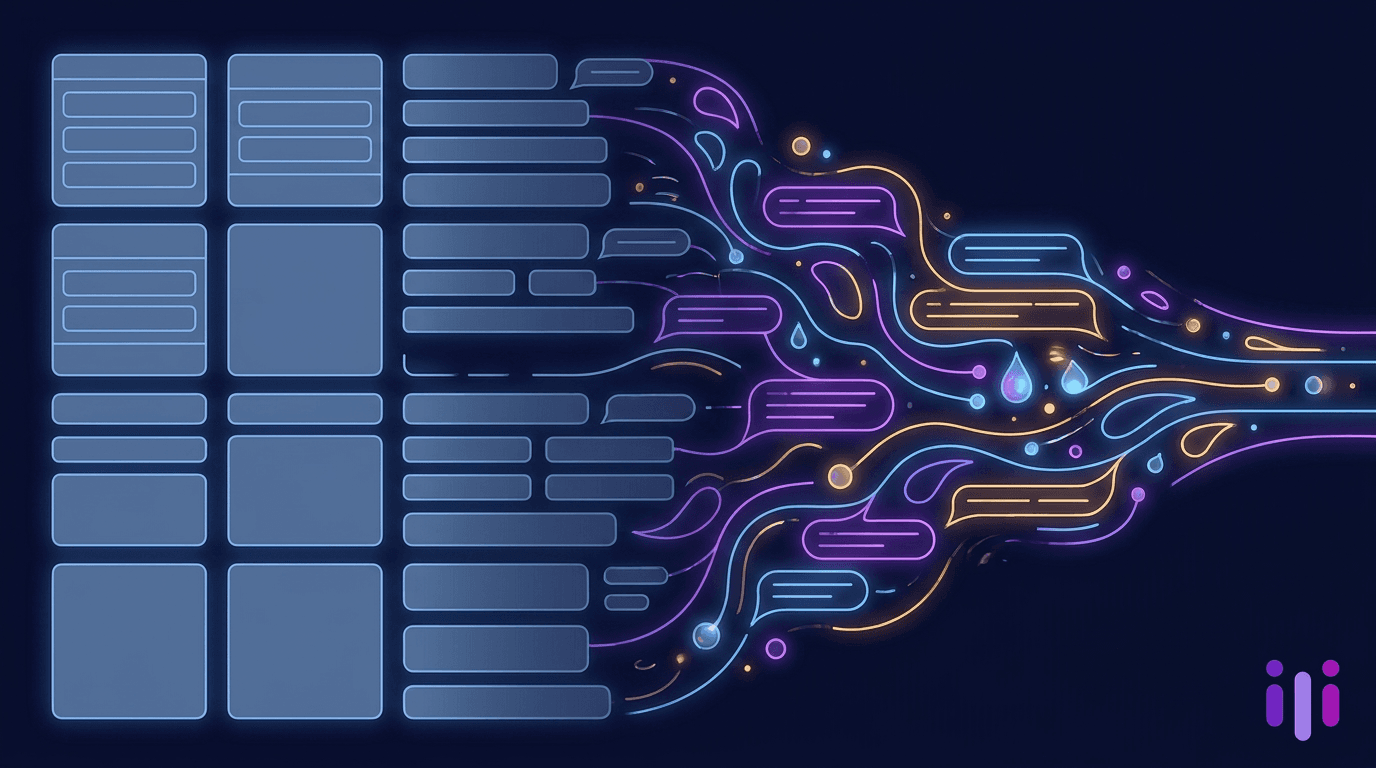
Conversational data collection is a research method where an AI interviewer asks open-ended questions, listens to free-text or voice responses, and follows up in real time — producing transcripts and structured fields together, instead of just rows of dropdown picks. It replaces the traditional survey-form pattern (closed questions, fixed schema) with a dynamic conversation that adapts to each respondent. Compared to forms, conversational data collection captures the "why" behind every answer, hits 60–80% completion rates where surveys average 5–15%, and surfaces unprompted themes that no question designer thought to ask. Tools like Perspective AI run hundreds of these AI interviews in parallel, then auto-synthesize transcripts into themes, quotes, and structured fields. This guide walks through how the method works mechanically, the data shape you actually get back, when conversational beats forms (and the rare cases when it doesn't), and how to set up your first study without overengineering it.
What conversational data collection actually means
Conversational data collection is a qualitative-and-quantitative hybrid research method in which an AI interviewer conducts a structured conversation with each respondent, captures their answers as free-text or voice transcripts, and extracts both narrative themes and structured fields from the resulting dialogue. The defining trait is the follow-up loop: when a respondent says something vague, contradictory, or interesting, the AI probes deeper before moving on. A static form cannot do this. A human moderator can, but only at the rate of one conversation at a time.
The method sits at the intersection of three older traditions:
- Qualitative interviews — depth, narrative, "why," but historically expensive and slow (n=8–20 in a typical study).
- Surveys and forms — scale and structured data, but flat answers and high abandonment.
- AI conversation systems — the new layer that makes interview-quality conversations cheap to run at survey-scale n=500–5,000.
The output isn't a spreadsheet of dropdowns. It's a transcript-plus-structured-fields object per respondent, plus aggregate themes across the cohort. That data shape is the whole reason the method exists, and we'll dig into it in the data-shape section below.
If you want a definitional walk-through with examples, the conversational data collection definitional guide covers the lineage and terminology in more depth. This guide focuses on the method — how to actually run it.
Why teams are moving past surveys and forms
Static forms and surveys have been the default research instrument for fifty years for one reason: scale. You could send a SurveyMonkey link to 5,000 people and get something back. The cost of that scale, though, has always been the same set of failure modes:
- Schema-forcing. Respondents have to translate their actual experience into the categories the question designer pre-imagined. "Why did you cancel?" with seven dropdown options gets seven kinds of answers — never the eighth one that's actually killing your business.
- No follow-up. A respondent says "the onboarding was confusing" and the form has no way to ask which step. You get a generic word, not a fixable insight.
- Dropout under cognitive load. Survey response rates have been declining for two decades, and even Pew Research — with their entire methodology team — fights single-digit response rates on telephone surveys. NPS surveys average 5–15% completion. Conversational interviews, by contrast, routinely hit 60–80% when designed well.
- "It depends" gets discarded. The most valuable customer answers — "well, it depends on the deal size, but mostly we just gave up" — are messy. Forms force them into a single picked option, which loses the conditional structure entirely.
The argument for conversational data collection isn't that surveys are wrong; it's that the things surveys are good at (closed-form measurement, statistical comparison) have been over-applied to questions they're bad at (motivation, context, the "why now"). For background on the strategic case, see why AI-first customer research cannot start with a web form.
How conversational data collection works mechanically
Conversational data collection works by orchestrating four components in a loop: a research outline, an AI interviewer agent, a respondent-facing surface (chat, voice, or embedded), and an analysis layer that turns transcripts into structured outputs. Here's the mechanical flow.
Step 1: The research outline
You write a research outline — not a question list. The difference matters. A question list is "Q1, Q2, Q3, submit." An outline is a set of topics the AI should cover, with optional sub-prompts for each topic. Something like:
Topic 1: How they got here (current job, current tools, what triggered the search) Topic 2: What "good" looks like (what would success feel like in 90 days) Topic 3: What's standing in the way (constraints, internal politics, prior bad experiences) Topic 4: Decision drivers (who else is involved, timing, budget)
The outline is the AI interviewer's brief. It can ask the topics in any order that fits the conversation, skip topics if a respondent has already answered them implicitly, and improvise follow-up questions within each topic. This is the methodology behind AI-moderated interviews — and it's the single biggest behavior change from form design.
Step 2: The AI interviewer agent
The agent is the conversational layer. It opens the conversation, asks the first topic, listens to the response, decides whether to probe (if the answer is vague or interesting) or move on (if it's complete), and continues until the outline is covered. Good agents do four things that distinguish them from chatbots:
- Probe vague answers — "Can you tell me more about what 'confusing' meant in that step?"
- Acknowledge before pivoting — so the conversation feels heard, not just processed.
- Stay in scope — they don't follow tangents that aren't on the outline.
- Know when to stop — they wrap up when the outline is covered or the respondent disengages, not on a fixed question count.
The agent runs in parallel — one instance per respondent — which is how you go from n=8 (a traditional focus group) to n=800 without losing depth.
Step 3: The respondent surface
Respondents experience the interview as a chat or voice conversation, not a form. The surface can be:
- An embedded widget on your site (popup, slider, inline)
- A standalone link sent via email or SMS
- A voice call, where the AI interviewer speaks and listens
- An in-product trigger (e.g. fired by a churn signal in your CS tool)
For most B2B and SaaS use cases, text chat outperforms voice on completion rate; voice wins for accessibility, lower-literacy populations, and emotionally heavy topics where typing feels clinical. Run a small comparison study before committing to a modality at scale.
Step 4: The analysis layer
This is where the method earns its keep. After the interviews run, you have hundreds of transcripts. The analysis layer turns those into:
- Theme extraction — clusters of similar responses across respondents, with frequency counts.
- Quote pulls — verbatim respondent language tagged to themes (because the actual words matter for product copy and PMM).
- Structured fields — extracted answers to the closed questions you cared about ("which competitor did they mention?", "what's their company size?") so you can still segment and chart.
- Magic Summary reports — a single readable narrative summarizing what the cohort said, organized by topic.
The AI-first customer feedback analysis workflow goes deeper on the synthesis side. The point here: synthesis is automatic, not a four-week researcher manual coding project.
The data shape: transcripts + fields, not rows of dropdowns
The most underappreciated thing about conversational data collection is that the output object is fundamentally different from a survey row. Understanding this changes how you brief the method, how you store the data, and how you analyze it.
Survey-form output: one wide row per respondent
A traditional survey produces a tabular output:
Every respondent fits the same schema. Open-text fields are the only place nuance lives, and they're usually short and underused.
Conversational output: a transcript + extracted fields per respondent
A conversational interview produces a richer object:
The crucial thing: the structured fields you used to ask in the survey are still there, extracted from the transcript by the AI. You don't lose the segmentation tooling. You gain the transcript, themes, and quotes on top.
This means a downstream analyst can do everything they could do before (filter by role, plot NPS by company size) AND read the verbatim "why this respondent gave a 7" alongside it. That's not a small upgrade. That's the whole reason the method exists.
For more on what to actually do with the structured fields side, see the customer research tools that modern teams stack.
When conversational data collection beats forms
Conversational data collection beats forms whenever the question you're asking has answers your respondent can't easily slot into a dropdown. Here's the practical rubric.
Use conversational when:
- You're investigating "why" or "how" — motivation, decision logic, friction, the moment they decided.
- The answer space is unknown or wide — "what would good look like?" can't be a multiple-choice question because you don't know the options yet.
- You need to probe — vague initial answers like "the UX is bad" need follow-up to be useful.
- Conditional logic is messy — "it depends on whether…" answers should be allowed to branch naturally instead of being forced into a single picked option.
- Completion rate matters more than perfect schema fit — when the alternative is 5–15% NPS response rates with most rich answers blank, a conversation that gets 60–80% completion is the better data set.
- You're running a VoC program or continuous discovery cadence — these need depth at scale, which is the exact target of the method.
- You're running JTBD interviews — JTBD's "tell me the story" structure is conversational by definition.
- You're analyzing churn or identifying at-risk customers — survey "why did you cancel?" with picklists captures almost none of the real reason.
Use a form when:
- The answer space is closed and known — checkout (name, email, payment method), event registration where the schema is regulated, compliance fields.
- You need a transactional record — an intake form where the goal is just to capture a row, not understand a person. (Even here, conversational intake often outperforms forms on completion, but the schema-only case is real.)
- You have legal/regulatory constraints on free text — some compliance regimes (HIPAA, KYC) mandate exact-match fields with no improvisation.
- You need a 30-second bounce-rate-driven micro-survey — single-question "thumbs up / thumbs down" feedback. Use NPS or a CSAT, then trigger the conversational follow-up only on the responses that need depth.
This last pattern — survey + conversational follow-up — is often the right answer for hybrid programs. Use the form to score, use the conversation to understand. For the depth-first version of this with NPS specifically, see the conversational alternative to NPS surveys.
How to set up your first conversational data collection study
Setting up your first study takes about 90 minutes if you scope tight. The biggest mistake new teams make is trying to cover everything at once — treat the first study as a learning study, not a definitive one.
Step 1: Pick a single, sharp research question (15 min)
Not "what do customers think of us?" — that's a research program, not a study. Pick something specific:
- "Why are users dropping off between trial signup and second login?"
- "What were the three things that almost made you not buy?"
- "Walk me through the moment you realized you needed something like us."
A sharp question makes the outline write itself.
Step 2: Write the outline (20 min)
Three to five topics, each with two or three sub-prompts the AI can use as guidance. Don't overspecify. The agent works better with a brief than a script. Aim for 8–12 minutes of conversation; longer than that and completion drops.
Step 3: Pick the audience and recruitment path (15 min)
Decide who to interview and how to reach them. Common paths:
- Email an existing customer segment (e.g. "everyone who churned in the last 30 days")
- In-product trigger fired by a behavior (e.g. "user landed on the cancellation page")
- Recruit cold via panel (when you don't have an existing list — use a participant management system for this)
- Embed on a marketing page for inbound visitors
For a first study, prefer the warmest audience you have — your own customers, not cold panel. You're learning the method, not stress-testing recruitment.
Step 4: Configure the agent and test it on yourself (15 min)
Run the conversation as if you were a respondent. Twice. The first run will reveal an awkward question or a missing follow-up. Fix it. Re-run. This 30-minute investment saves you from sending 500 invitations to a broken script.
Step 5: Send invitations and let it run (varies)
Conversational studies have a long tail — most responses come in the first 48 hours, but some trickle in for a week. Aim for n=50 minimum to read aggregate themes; n=100+ if you want to segment.
Step 6: Read the synthesis, then read the transcripts (60 min)
Start with the auto-generated theme summary. Then — and this is the part most teams skip — go read 10–15 actual transcripts. The themes show you what's common. The transcripts show you the language, the surprise, the conditional structure of the answer. Your product copy, your PMM positioning, and your roadmap priorities should all draw from verbatim language, not summarized themes.
Step 7: Decide what to do with what you found
The output of a study is a decision, not a deck. Before you start, write down: "If we find X, we'll do Y." Forces clarity. Avoids the "interesting findings" vortex where research becomes information for its own sake.
For more on running this as an ongoing program rather than one-off studies, the UX research at scale playbook covers cadence and team setup.
Common pitfalls to avoid
Three mistakes show up in 80% of first-time conversational studies:
- Over-scripting the outline. The AI is good at improvising follow-ups. Trust it. A 30-question script will run like a survey, not a conversation, and respondents will treat it like one.
- Skipping the test conversation. Always do at least one self-run before sending invitations. The interview design details that look fine on paper often feel weird in dialogue.
- Treating themes as the deliverable. Themes are summaries, not insights. The insight is in the verbatim transcript. Read them.
A fourth, more strategic mistake: running conversational studies without changing how the rest of the org consumes the output. If your stakeholders only read decks, the verbatim layer disappears in synthesis. Build a habit of sharing select transcripts directly with PMs and CS leads — they're more useful than a chart of theme frequencies.
Frequently Asked Questions
What is conversational data collection?
Conversational data collection is a research method where an AI interviewer conducts an open-ended dialogue with each respondent, captures the conversation as a transcript, and extracts both narrative themes and structured fields from the result. It replaces the survey-form pattern (closed questions, picked options) with a dynamic conversation that adapts and probes. Output includes per-respondent transcripts, aggregate themes, verbatim quotes, and the structured fields a survey would have produced.
How is conversational data collection different from a survey?
Conversational data collection differs from a survey in three ways: it follows up on vague or interesting answers in real time, it produces transcripts (not just rows of picked options), and it adapts the order and depth of questions to each respondent. Surveys are best for closed, comparable measurement; conversations are best for understanding motivation, decision logic, and the "why" behind a behavior. Most mature programs use both, with the survey scoring and the conversation explaining.
What kind of data do you actually get back?
You get a transcript-plus-fields object per respondent — the verbatim conversation, plus structured fields the AI extracted (role, company size, NPS, etc.) — and aggregate outputs across the cohort: themes with frequency counts, verbatim quotes tagged to themes, and a written narrative summary. The structured fields mean you can still segment and chart like a survey; the transcripts and quotes mean you can read the actual customer language behind every number.
How many respondents do I need for a conversational study?
For a learning study, n=50 is enough to spot the dominant themes; n=100–200 lets you segment confidently by role, plan tier, or behavior. For studies covering wide markets or running ongoing, n=500–2,000 is normal — and feasible because conversations run in parallel. The traditional n=8 focus-group cap was a logistics constraint, not a methodology one. Once interviews are AI-moderated, scale stops being the trade-off.
Does conversational data collection replace all surveys?
No. Use a survey when the answer space is closed and comparable measurement is the goal — NPS scoring, CSAT, demographic capture, regulated compliance fields. Use conversational data collection when you need motivation, context, decision logic, or the "why now." The mature pattern is a hybrid: short scoring survey to capture the metric, conversational follow-up triggered on the responses that need depth. See why surveys lose for real customer research for the longer comparison.
What tools support conversational data collection?
Perspective AI is purpose-built for conversational data collection at scale — AI interviewer and concierge agents, parallel interviews, automatic synthesis into themes and quotes, and structured-field extraction. Other vendors retrofit conversational layers onto survey platforms, but the architecture matters: a tool that started as a form builder usually ends up running a slightly-friendlier form, not a real conversation. For a buyer's view, see the AI user research tools 2026 buyer's map.
Conclusion
Conversational data collection is the method customer research has been waiting fifty years for: depth-of-interview at survey-scale, with the structured fields a survey would have produced still inside the output. It works because it changes the unit of input from a picked option to a transcript — and the unit of output from a row to a respondent object with quotes, themes, and fields together. It's the right method whenever the question you're asking has answers your respondent can't easily slot into a dropdown, which turns out to be most of the questions worth asking.
Setting up your first study takes 90 minutes if you scope tight: one sharp research question, a 3–5 topic outline, a warm audience, a self-test, and a clear "if we find X, we'll do Y" decision rule. Read the verbatim transcripts after the synthesis runs — that's where the actual product, PMM, and CS insight lives.
If you're ready to run conversational data collection on a real research question, Perspective AI handles the interviewer, the synthesis, and the structured-field extraction in one platform. Built for product, CX, and research teams who've outgrown forms. Start your first study — or browse pricing if you want to see what scaled programs look like.
More articles on AI Conversations at Scale
Customer Experience in Retail 2026: What the Store Data Cannot Tell You
AI Conversations at Scale · 11 min read
Customer Experience Management in Banking 2026: The Hand-Off Problem
AI Conversations at Scale · 10 min read
The CX Platform Security Review: What Procurement Will Ask (and How to Answer)
AI Conversations at Scale · 22 min read
CX Tool Consolidation: What to Cut When You Have Six Listening Tools
AI Conversations at Scale · 20 min read
Who Sits on the CX Buying Committee (and What Each Member Kills a Deal For)
AI Conversations at Scale · 23 min read
The CX Platform Migration Checklist: 60 Days From Signature to First Insight
AI Conversations at Scale · 22 min read