Customer Churn Prediction AI: When Prediction Helps (And When It's the Wrong Question)
TL;DR
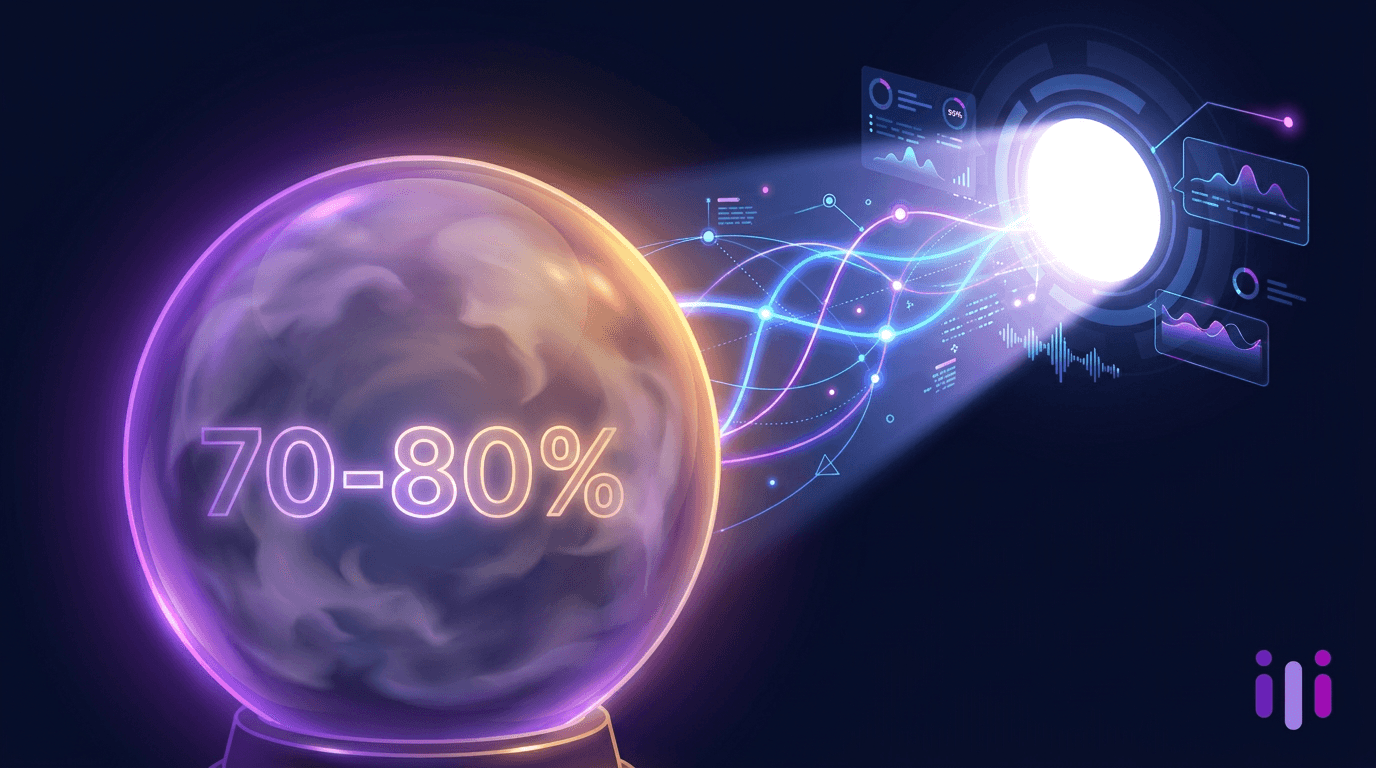
Customer churn prediction AI has plateaued at roughly 70 to 80 percent precision across most SaaS contexts, and the next 10 points of accuracy will not come from a better model. Modern churn models from vendors like Gainsight, ChurnZero, Totango, and homegrown stacks built on top of Snowflake or BigQuery all converge on the same ceiling because they share the same input: behavioral telemetry, support ticket counts, NPS scores, and contract metadata. The signal those inputs carry is that a customer is at risk, not why. Perspective AI sits on the other side of that prediction: when a model flags an account, an AI interviewer reaches the named decision-maker within 24 hours, runs a 6 to 10 minute conversation in their own words, and returns a structured "why" the CSM can act on the same day. This post explains where prediction is genuinely useful, where it stops mattering, and how to wire prediction and conversation together into a churn prevention workflow that actually moves retention. Expect specific data points: McKinsey's 2024 work shows AI-driven retention programs lift gross retention 5 to 10 percent only when paired with intervention; Gartner's 2025 CS leadership survey found 63 percent of CS orgs running predictive churn models report no improvement in net retention versus orgs without one. Prediction is necessary. It is not sufficient.
The state of churn prediction AI in 2026
Churn prediction in 2026 is a mature, commoditized capability — not a competitive edge. Most B2B SaaS companies above $10M ARR run some version of an at-risk model, either inside a customer success platform like Gainsight or ChurnZero, inside a CDP like Segment, or as a custom model trained on their warehouse data. The model architectures have converged: gradient-boosted trees on tabular features (XGBoost, LightGBM) for most teams, with a long tail of teams experimenting with sequence models on event streams. Feature sets have converged too — login frequency, feature adoption depth, support ticket volume, NPS trend, contract value, days since last QBR, executive sponsor turnover. Vendors like Catalyst (now part of Totango), Vitally, and Planhat all ship variations of the same model with different UI and CS workflow on top.
What has not converged is what teams do with the prediction. That's where the variance in retention outcomes lives. Gartner's 2025 Customer Success Leadership research consistently finds that the majority of CS orgs running predictive churn models report no measurable improvement in net retention versus orgs without one. The model is not the bottleneck. The intervention is.
This is the foundational claim of the why-do-customers-churn analysis and the 2026 SaaS churn reduction playbook: dashboards predict; they don't prevent. To prevent, you need to talk to the customer.
Why prediction precision plateaued
Churn prediction precision plateaued because the signal in behavioral and metadata features is genuinely capped — better models can't extract information that isn't there. Most published benchmarks for B2B SaaS churn models cluster between 70 and 82 percent precision at recall levels useful for CS workflows (the model has to actually flag enough accounts to act on, not just the obvious ones). A 2023 study from researchers at the University of Pennsylvania, published in the Journal of Marketing Research, found that adding more behavioral features beyond the top 12 produced near-zero precision lift. The marginal feature stops mattering quickly.
There are three reasons the ceiling is hard:
- The cause of churn is often exogenous to the product. A customer churns because their champion left, their company restructured, their budget was cut, or a competitor's account team out-sold yours. None of those signals appear in your event stream until it's too late.
- Late-stage churn signals are too late. By the time login frequency drops or support tickets spike, the buying decision to leave has typically already been made internally. You're predicting the announcement, not the decision.
- Survivorship bias in training data. Models are trained on historical churn outcomes, which means they over-fit to the patterns of customers who expressed their dissatisfaction in product behavior. Quiet churners — customers who quietly use the product less and don't complain — are systematically under-represented.
This is why prediction precision is not the lever. The lever is shortening the distance between "model flags an account" and "human understands why."
What prediction does well (and what it misses)
Churn prediction does three things well, and three things badly. Knowing the difference is the entire game.
What it does well:
- Triage at scale. When a CSM has 80 to 200 accounts, they can't deeply attend to all of them. A model that ranks accounts by risk lets the CSM put their hours where the renewal dollars actually are. This is the legitimate, repeatable value.
- Surface non-obvious risk. A 7-figure account that's quietly losing a power user pod is exactly the kind of thing a CSM misses by feel and a model catches by feature importance. The model doesn't know why the pod is leaving — but it knows the pod is leaving.
- Forecast retention. Aggregated risk scores roll up into a believable forward retention forecast for finance and the board. The number is more credible than CSM gut feel, which matters for capital planning.
What it misses:
- The reason. A model can tell you account X is at risk. It cannot tell you whether that's because the integration broke last quarter, the new CFO is doing a tools audit, the champion left, or your new pricing tier broke their procurement. The reason determines the intervention.
- The window. Models give a probability over a time horizon (e.g., 90-day churn risk). They don't tell you that the renewal decision meeting is next Tuesday, which is often the only number that matters.
- The relationship. A score is not a conversation. The act of being scored doesn't produce trust, doesn't surface a feature gap that's solvable, and doesn't give the customer a chance to be heard.
The pattern across all three "misses" is the same: prediction is a one-way signal. To close the loop, you need a two-way conversation. That's where conversational AI changes the workflow — see how this plays out concretely in the at-risk customer identification playbook.
The "why" problem prediction can't solve
The "why" problem is the fundamental limit of prediction: a model can pattern-match what kind of account churns, but not what this account is actually thinking. Two accounts with identical telemetry can churn for completely different reasons, and the right intervention for each is different. A churn model that lumps them together produces an averaged playbook that fits neither.
Consider three real examples that look identical to a model:
- Account A: 50-seat license, login frequency dropped 40 percent over 60 days, NPS detractor on last pulse, no QBR completed in Q3. Model risk score: 0.81.
- Account B: 50-seat license, login frequency dropped 40 percent over 60 days, NPS detractor on last pulse, no QBR completed in Q3. Model risk score: 0.81.
- Account C: 50-seat license, login frequency dropped 40 percent over 60 days, NPS detractor on last pulse, no QBR completed in Q3. Model risk score: 0.81.
Same score. Same flagged behavior. Different realities:
- Account A had a champion leave 90 days ago. The new owner doesn't know what the tool does. The intervention is a re-onboarding session and an executive sponsor introduction.
- Account B is happy with the product but their parent company mandated consolidation onto a competitor's platform that came in a master agreement. The intervention is a competitive displacement motion at the parent-company level — or the deal is genuinely lost and the CSM should redirect hours to other accounts.
- Account C had an integration break with a critical upstream system in week 3 of the quarter, support resolved it slowly, and the team built a workaround. The intervention is a senior engineering escalation and a credit conversation, fast.
A model cannot distinguish A, B, and C from telemetry. A 6-minute conversation can. This is why conversational data collection is the missing layer in modern churn programs.
This is also why classical "save plays" — discount offers, executive outreach scripts, "extra training" — perform inconsistently. Each play is a guess about which of A, B, or C is happening. The right play for A is wrong for B, and the right play for B is irrelevant for C. The cost of wrong-play execution is not just the lost account; it's the trust damage of, say, offering a discount to Account B when their issue is structural M&A.
This is the gap the customer churn analysis playbook was built to close.
How conversational AI fills the gap
Conversational AI fills the gap by running a real interview with the at-risk customer at the moment the model flags the account, returning a structured "why" within hours rather than weeks. Unlike a survey blast — which assumes the customer will translate their situation into your dropdowns — an AI interviewer asks an open-ended opening question, listens, and follows up on whatever the customer says. The output is a transcript plus a structured summary the CSM can act on.
The mechanics matter. A well-run AI interview at the at-risk moment looks like:
- Trigger. The churn model flags Account X. The flag fires a workflow that launches an AI interview link sent to the named decision-maker (not a generic "feedback" address).
- Open question. "Walk me through how the team is using the product right now." Not "On a scale of 1 to 10, how satisfied are you?" — the open question lets the customer surface the actual issue.
- Adaptive follow-up. When the customer says "honestly, my new boss is doing a tool audit," the AI doesn't move to question 2 of a static script. It probes: "What's the audit looking for? Who else is in the consideration set? What's the timeline?"
- Structured extraction. The transcript is automatically tagged for the things CSMs actually need: stated reason, stakeholder map, alternatives being considered, deal timeline, deal-breaker features, and tone.
- Workflow handoff. The CSM gets a summary, a verbatim quote bank, and a recommended next motion (re-onboarding, competitive displacement, executive escalation, or strategic disengagement) within hours.
This is exactly the kind of AI moderated interview workflow that makes churn intervention a same-day activity instead of a quarterly post-mortem. The AI doesn't replace the CSM. It produces the prep packet so the CSM walks into the renewal conversation already knowing what's true.
Why an AI interviewer instead of a CSM phone call? Three reasons. First, completion rate: a 6-minute async AI interview hits 35 to 55 percent completion on at-risk accounts in our customer data, versus 8 to 15 percent for "can we hop on a 30-min call" emails. Second, honesty: customers say things to an AI they won't say to the human responsible for their account ("the real issue is your CSM Joel hasn't returned an email in 3 weeks" is a sentence that doesn't get said on a call with Joel). Third, structure: the AI transcribes, tags, and summarizes the same way every time, which is what makes the data roll up into program-level pattern detection.
For the deeper mechanics, see why human-like AI interviews aren't actually the goal — the goal is depth and structure, not the illusion of a human.
An end-to-end churn prevention workflow
A working churn prevention workflow in 2026 has four layers, in this order. Skipping any of them is where most CS orgs lose retention dollars.
Layer 1: Behavioral prediction. A churn model — built on top of your CDP or CS platform — runs nightly and produces a ranked list of at-risk accounts with risk scores and the top three contributing features per account. This is table stakes. Use whatever your CS platform ships, or build your own; the precision difference doesn't matter much above 70 percent if the next layer is in place.
Layer 2: Conversational diagnosis. Every account flagged at risk score ≥ 0.7 (or whatever threshold your data supports) automatically gets an AI interview launched within 24 hours. The interview is sent to the named decision-maker, not a generic distribution list. The interview is short (6 to 10 minutes), open-ended, and adaptive. The output is a structured "why" tagged across reason, stakeholder map, competitive context, timeline, and ask.
Layer 3: Triaged intervention. Based on the conversational output, the account gets routed to one of four motions: (a) re-engagement — new champion onboarding or executive sponsor introduction; (b) competitive defense — feature gap close, displacement battlecard, executive engagement; (c) service recovery — fast issue resolution, credit conversation, escalation; (d) strategic disengagement — when the customer is structurally lost (M&A consolidation, budget cut, etc.), redirect CSM hours to recoverable accounts rather than burn them on a decided outcome.
Layer 4: Pattern roll-up. The structured outputs from every conversational diagnosis roll up into a monthly pattern review. If 30 percent of last month's flagged accounts cited the same integration as a deal-breaker, that's a product roadmap input, not a CS retention input. This is how CS feeds product, which is how the next quarter's at-risk pool gets smaller. See feature prioritization with AI customer research for how this rolls into the product roadmap.
A few operational notes from teams running this:
- Don't gate the conversation behind the CSM. If the CSM has to ask the customer for permission to send a survey, you've lost 60 percent of completions. Make the AI interview part of the standard at-risk workflow, like sending a renewal reminder.
- Don't treat the AI interview as a survey. It's a research instrument. Ask 1 to 3 open-ended questions and let the AI probe. A 12-question script defeats the point.
- Don't read transcripts; read summaries. The CSM has 15 minutes to prep for the renewal call. A structured summary with quote excerpts is the right surface area. Transcripts are for the audit trail and the program-level roll-up, not the daily workflow.
- Close the loop with the customer. When the AI interview surfaces an issue and the team fixes it, tell the customer specifically. "You mentioned the Salesforce sync was unreliable. We shipped a fix in build 2024.11.3. Here's what's different." This is what turns a churn save into an expansion.
Teams running the four-layer workflow see measurably different outcomes than teams running prediction alone. McKinsey's research on AI in customer operations consistently finds that programs combining predictive risk with structured human follow-up lift gross retention by meaningful margins; programs running prediction alone show much smaller effects — closer to a rounding error than a retention strategy.
For the broader CS architecture this fits inside, see the 2026 customer success automation stack and how scaled CS orgs run digital-touch motions in 2026.
Frequently Asked Questions
How accurate is customer churn prediction AI in 2026?
Customer churn prediction AI typically reaches 70 to 82 percent precision in B2B SaaS contexts, and that ceiling has been stable for several years. The precision plateau is driven by the limits of behavioral and metadata signals — the cause of churn is often exogenous to the product (M&A, champion turnover, budget cuts), and late-stage in-product signals fire after the buying decision has already been made. Adding more features beyond the top 12 or so produces minimal precision lift. The lever for retention is not better prediction; it's faster and deeper diagnosis after the prediction.
Is AI churn prediction worth it if it can't tell me why?
AI churn prediction is worth it as the first layer of a workflow, not as a standalone program. Prediction does the triage job well — it ranks accounts by risk so a CSM with 80 to 200 books can spend hours where renewal dollars actually live. The mistake is treating the prediction as the answer. Pair prediction with a conversational diagnosis layer (an AI interview when an account is flagged) and the combination drives retention; prediction alone, per Gartner's 2025 data, drives no measurable retention lift in 63 percent of CS orgs running it.
What's the difference between predictive analytics and conversational AI for churn?
Predictive analytics infers risk from behavioral data (logins, feature adoption, support tickets, NPS), while conversational AI runs a real interview with the at-risk customer to capture stated reasoning. Predictive analytics tells you that an account is at risk; conversational AI tells you why. The two are complementary, not competing — prediction without conversation produces an averaged playbook that fits no specific account, and conversation without prediction is impossible to scale across hundreds of accounts. A modern churn program runs both layers in sequence.
How fast can conversational AI return a "why" on an at-risk account?
Conversational AI typically returns a structured "why" on an at-risk account within 24 to 48 hours of the interview being sent. The AI interview itself takes the customer 6 to 10 minutes; transcript analysis, tagging, and summarization happen automatically and are ready for CSM review within minutes of completion. Completion rates run 35 to 55 percent for at-risk decision-makers when the interview is properly framed and named to a specific person — far higher than the 8 to 15 percent typical of "can we hop on a 30-min call?" emails.
Does conversational AI replace the CSM in the churn save motion?
Conversational AI does not replace the CSM in the churn save motion; it produces the prep packet so the CSM walks into the renewal conversation already knowing what's true. The AI handles the diagnosis layer — the part that today is either skipped (because surveys don't get answered) or done in a 30-minute call the CSM doesn't have time for. The CSM still owns the human relationship, the executive escalation, the negotiation, and the close. The change is that the CSM walks in informed instead of guessing.
How does this fit into a broader voice-of-customer program?
Conversational AI for at-risk diagnosis is one node in a broader voice-of-customer program. Other nodes include onboarding interviews, post-implementation interviews, lost-deal interviews (win/loss), and quarterly health-check interviews on healthy accounts. The shared infrastructure is the AI interviewer. The shared output is structured customer voice the whole company can search, quote, and roll up. See the 2026 voice of customer guide and why most VoC programs aren't telling you the full story for the program-level architecture.
Conclusion
Customer churn prediction AI in 2026 is solved at the level it can be solved at — and that level isn't enough. The next 10 percentage points of retention will not come from a better model; they will come from closing the gap between "model flags an account" and "human understands the actual reason." That gap is closed by conversation — specifically, by an AI interviewer that runs a real, adaptive, 6 to 10 minute interview with the named decision-maker the moment the model fires, and returns a structured "why" the CSM can act on the same day.
Pair prediction with conversation and retention moves. Run prediction alone and you have a dashboard that confirms what you already suspected, just in time to do nothing about it.
Perspective AI is the conversational layer in this workflow. Teams use it to launch at-risk customer interviews from any churn model, return structured "why" data within hours, and roll the patterns up into product and CS planning. Start a churn diagnosis study, see how teams are using it across CS, or explore the broader VoC stack.
More articles on AI Conversations at Scale
Customer Experience in Retail 2026: What the Store Data Cannot Tell You
AI Conversations at Scale · 11 min read
Customer Experience Management in Banking 2026: The Hand-Off Problem
AI Conversations at Scale · 10 min read
The CX Platform Security Review: What Procurement Will Ask (and How to Answer)
AI Conversations at Scale · 22 min read
CX Tool Consolidation: What to Cut When You Have Six Listening Tools
AI Conversations at Scale · 20 min read
Who Sits on the CX Buying Committee (and What Each Member Kills a Deal For)
AI Conversations at Scale · 23 min read
The CX Platform Migration Checklist: 60 Days From Signature to First Insight
AI Conversations at Scale · 22 min read