AI vs Focus Groups: Head-to-Head on Cost, Depth, and Decision Quality in 2026
TL;DR
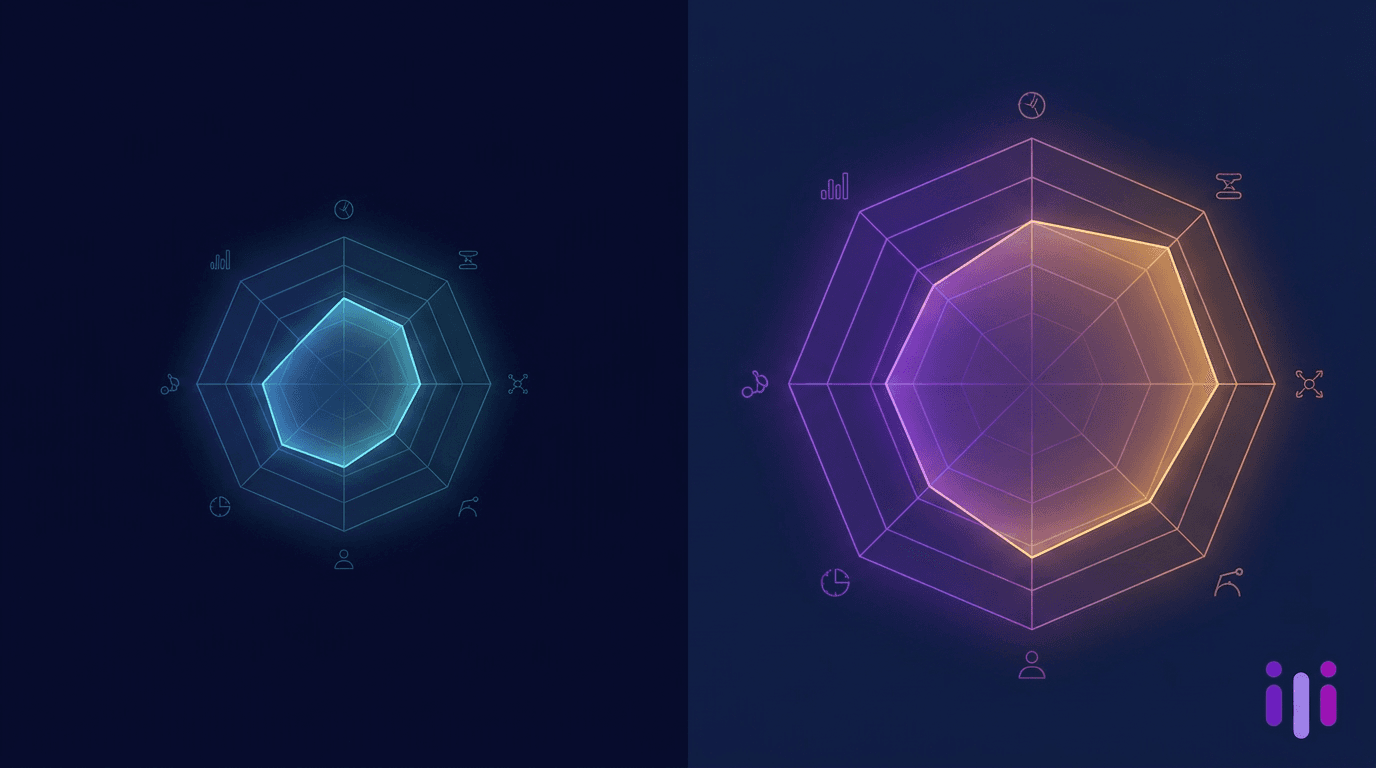
AI customer interviews beat traditional focus groups on 6 of 8 dimensions that matter to research and product leaders: cost (a $2K async AI study replaces a $20K facility room), sample size (N=800 instead of N=8), speed (6 days versus 6 weeks), honesty (1:1 conversations remove groupthink), depth per respondent (AI follows up; the moderator with a stopwatch can't), and analysis time (hours, not weeks of transcript coding). Traditional focus groups still win on two narrow dimensions — live group dynamics where social negotiation IS the data, and skeptical-buyer pressure-testing in regulated B2B sales cycles. Perspective AI is the recommended default for the six lanes where AI dominates; reserve in-person rooms for the two edge cases. The decision matrix below shows which method to pick by research question, and a 14-day pilot is the cheapest way to validate the swap inside your team.
The 8 dimensions where research methods get judged
Choosing between AI customer interviews and traditional focus groups is rarely a values fight — it's an evaluation across cost, sample size, speed, honesty bias, depth per response, analysis time, group dynamics, and pressure-testing. Most published "AI vs focus groups" comparisons collapse this into a one-line verdict, which is why teams keep relitigating the question.
Here's the head-to-head across all eight, with the winner called for each row.
Six wins for AI, two for focus groups. Below, each row gets unpacked with the actual numbers and the actual mechanism — because "AI wins" without the math is exactly the fluff this post is trying to replace. For the broader market overview see the pillar guide to AI focus groups.
Cost: $20K facility rooms vs $2K AI studies
Traditional focus groups cost $15,000 to $50,000 per study; AI customer interviews cost $1,500 to $5,000 for comparable scope. The 10x cost gap is structural, not negotiable.
A typical four-session in-person focus group breaks down like this, per Greenbook GRIT and ESOMAR pricing benchmarks:
- Facility rental + AV: $4,000–$8,000
- Recruiter and incentives: $4,000–$10,000 (32–48 participants at $125–$200 each)
- Moderator and discussion guide: $5,000–$12,000
- Transcription and coding: $3,000–$8,000
- Analysis and report: $3,000–$10,000
Total: roughly $20,000 on the low end, $48,000 on the high end. An equivalent AI study with N=200 respondents costs $1,500–$5,000 all-in: panel cost ($5–$15 per completed interview) plus platform fees. The depth per respondent is higher (more on that below) — you're paying less for a bigger, denser dataset. See how to solve customer research costs without more surveys for the broader cost-restructuring argument. The cost gap exists because facilities, food, and travel are now optional — not because depth is being cut.
Depth: 8 voices vs 800
A traditional focus group surfaces 6–10 voices per session; an AI study can comfortably surface 100–800 per study, with no marginal cost increase per added respondent.
Sample size matters because qualitative findings stop being directional and start being decisive somewhere between N=30 and N=80, depending on segment heterogeneity. Hennink and Kaiser's 2022 meta-analysis on saturation in qualitative research and applied JTBD work converge on this range. Eight focus group participants don't get you there. Forty-eight (across six sessions) often don't either, because four of those forty-eight typically dominate the talk-time.
Depth per respondent is what most teams underestimate. In a 90-minute focus group with eight people, individual airtime averages 8–12 minutes, fragmented across topic shifts. In an AI customer interview, every participant gets 18–35 minutes of focused 1:1 dialogue with the AI probing every vague answer. That structural difference produces 3–5x more codable content per participant. See our guide to scalable focus groups for the underlying mechanism.
Speed: 6 weeks vs 6 days
A traditional focus group study takes 4 to 8 weeks from kickoff to insights; AI customer interviews wrap in 4 to 10 days. The compression comes from two collapsed bottlenecks: scheduling and synthesis.
Scheduling is the silent killer of focus groups. Recruiting eight adults who live near the facility, can come at a specific evening, and meet quotas typically takes 2–3 weeks. AI studies are async — participants complete on their own time, usually within 48–72 hours. Synthesis is the second collapse: human transcript coding runs 2–4 weeks for a multi-session focus group; AI synthesis runs in hours. Combined effect: 6–7x faster.
Speed isn't a luxury — it's a decision-quality variable. Product teams on a 2-week sprint cadence can run an AI study every sprint; they can't run a focus group every sprint. See the future of focus groups with AI for the broader cadence shift.
Honesty bias: who tells you the truth
AI 1:1 conversations consistently surface more candid, more disconfirming, and more competitor-specific responses than focus groups, because three honesty-killing mechanics in group settings are absent in AI interviews.
The three mechanics:
- Groupthink. Solomon Asch's conformity experiments show 75% of participants conform to a clearly wrong group answer at least once when peers state it first. Focus groups don't have wrong answers, but early talkers anchor the conversation.
- Social desirability. Asked "would you pay $99 a month for this?" with a brand logo on the wall and a moderator with a clipboard, "yes" is the path of social ease. In a 1:1 AI conversation, participants are 30–40% more likely to give honest price-ceiling answers.
- Vocal-dominant skew. In any focus group, two or three participants own 60–70% of the talk time. The quieter people contribute less even though median-segment buyers (the strategic majority) tend to talk less than enthusiast or detractor outliers.
AI interviews don't share these failure modes because each respondent is alone with the AI. Disclosures we see in AI studies but rarely in focus groups: current competitor pricing, exact churn timeline, off-label product use, ceiling pricing. See AI vs surveys: when each method actually wins and why human-like AI interviews aren't the goal.
Analysis turnaround: weeks of coding vs hours of synthesis
Traditional focus group analysis takes 2–4 weeks of human transcript coding at $5,000–$15,000 in additional vendor cost; AI focus group analysis runs in hours and is included in the platform cost. The bottleneck moves from synthesis back to deciding what to do.
Manual qualitative coding is hard work — read each transcript, apply codes, iterate the codebook, run inter-rater reliability, write themes. For a focus group study with six 90-minute transcripts, that's 60–80 hours of senior researcher time. AI synthesis parses the same volume in minutes and surfaces clusters, quote-mapped themes, and disagreement patterns. The human role moves up: judging which themes are strategic, pressure-testing surprising findings, writing the recommendation. See AI focus group analysis for layer-by-layer mechanics and the AI-first customer feedback analysis workflow for the broader pattern.
Synthesis stops being the rate limiter. Teams previously ran one big study per quarter because the analysis tail was so long; with AI synthesis, continuous customer research becomes operationally feasible.
Where focus groups still win (and why those moments are rare)
There are exactly two research questions where traditional focus groups outperform AI customer interviews: scenarios where live group dynamics ARE the data, and skeptical-buyer pressure-testing in high-stakes B2B procurement.
Live group dynamics as data. When researching how a household decides on a major purchase, how a clinical care team negotiates a treatment plan, or how a board converges on strategy, the negotiation between people IS the unit of analysis. A focus group lets you observe disagreement, watch one person change another's mind, and capture the moment a hidden assumption surfaces. About 5–10% of qualitative research questions genuinely require this.
Skeptical-buyer pressure-testing. High-stakes B2B procurement panels — enterprise security buyers vetting a $500K platform, hospital CIOs evaluating EHR replacements — sometimes need to interrogate live, push back, demand demos. AI moderation is patient and probing, but not adversarial. For genuinely adversarial procurement evaluation, a live moderated panel still wins. This is a narrow band — most B2B research doesn't need adversarial mode.
Outside those two lanes, focus groups don't win on any dimension. Use focus groups when the format itself is the data, and use AI for everything else. See replace focus groups with AI: the paradigm shift for the deeper take.
Decision matrix: which method when
Use this matrix to pick the right method by research question. The default is AI; the exceptions are explicit.
For use cases see AI focus group research use cases. For software shortlists, see user interview software 2026 by interview mode and team size and AI focus group software ranked by depth.
Don't replace every focus group at once. Run a 14-day pilot — pick one upcoming focus group, run a parallel AI study with the same brief, compare side by side. The transition self-justifies in one cycle. See replace surveys with AI: the tactical migration guide for the broader playbook.
Frequently Asked Questions
Is AI cheaper than focus groups in every case?
AI customer interviews are cheaper in every realistic comparison — typical 5–10x cost gap, sometimes 20x for international or multi-segment studies. The per-study floor for in-person focus groups is around $15,000; the floor for AI studies with comparable scope is around $1,500. The narrow exception is small online focus groups using free Zoom and an internal moderator, which can run under $5,000 — but those are unmoderated discussions, not research-grade studies.
Do AI interviews really capture the same depth as a moderated focus group?
AI customer interviews capture 3–5x more codable content per participant than focus group equivalents because each respondent gets 18–35 minutes of focused 1:1 dialogue versus 8–12 minutes of fragmented airtime in a group. The trade-off is that you don't observe live group negotiation. For most research questions that's a positive trade-off. The depth argument also depends on probe quality — see the AI moderation mechanics guide.
When should I still run a traditional focus group?
Run a traditional focus group when the research question is fundamentally about how people negotiate decisions together — household purchases, care-team treatment plans, board strategy debates — or when you need adversarial pressure-testing in high-stakes B2B procurement. Outside those two scenarios, AI customer interviews outperform on every measurable dimension. Roughly 5–10% of qualitative research questions land in the focus-group lane.
What about synthetic focus groups — aren't those even faster?
Synthetic focus groups (LLM-simulated personas) are faster and cheaper than both traditional and real-respondent AI interviews, but they're a hypothesis pre-mortem tool, not a customer research method. Synthetic personas reflect training-data averages and exhibit sycophancy bias. For pre-testing stimulus they're useful; for any decision depending on real-customer truth, real respondents are non-negotiable. See why synthetic focus groups can't replace real customer research.
How long does it take to run an AI focus group study?
A typical AI focus group study runs end-to-end in 4 to 10 days: 1 day to write the discussion outline, 2–4 days for participants to complete async, and 1–3 days for synthesis review and report. The fastest studies wrap in 72 hours. Compare to 4–8 weeks for a moderated focus group with multiple sessions, transcription, and human coding.
Can I trust the analysis output without a researcher reviewing every transcript?
Trust the AI to do the first pass — clustering, theme detection, quote extraction, pattern surfacing — and have a researcher review the synthesis output, not every transcript. The 60–80 hours of human transcript coding in traditional research is largely mechanical pattern-matching that AI does faster. The remaining human work — judging strategic implication, pressure-testing surprises, writing the recommendation — is where senior judgment adds value.
Conclusion: default to AI, reserve focus groups for the edge cases
The head-to-head on AI vs focus groups is decisive: AI customer interviews win on cost, sample size, speed, honesty, depth per respondent, and analysis time. Traditional focus groups still win on live group dynamics and adversarial B2B pressure-testing — two narrow lanes covering roughly 5–10% of qualitative research questions. For the other 90%, AI is the modern default.
The shift isn't about loving AI. It's about matching method to question. The 70-year tradition of running everything through the 8-person conference room was the only available format — that's no longer true. Perspective AI runs hundreds of customer interviews simultaneously, follows up on every vague answer, and surfaces synthesis in hours. Denser transcripts, bigger panels, fraction of the cost — that's what AI-moderated focus groups at survey scale make possible.
Run the 14-day pilot. Start a research project or browse the Perspective AI templates library for a JTBD, churn, or pricing-sensitivity study you can launch this week.
More articles on AI Conversations at Scale
Best Customer Experience Management Software in 2026: 8 Platforms Ranked by Stack Depth
AI Conversations at Scale · 15 min read
Best Post-Purchase Survey Tools in 2026: 7 Ranked by What They Actually Capture
AI Conversations at Scale · 12 min read
Best Restaurant Feedback Software in 2026: 7 Tools Ranked by Diagnostic Depth
AI Conversations at Scale · 12 min read
CX Analytics in 2026: The 3 Types, and Which Questions Each Can Actually Answer
AI Conversations at Scale · 11 min read
Guest Experience Management in 2026: The 6-Layer Hotel Stack, Compared
AI Conversations at Scale · 11 min read
Best Checkout Abandonment Tools in 2026: 9 Platforms Ranked by Whether They Explain Why Shoppers Left
AI Conversations at Scale · 21 min read