AI for Educators in 2026: A Practical Guide That Doesn't Replace the Teacher
TL;DR
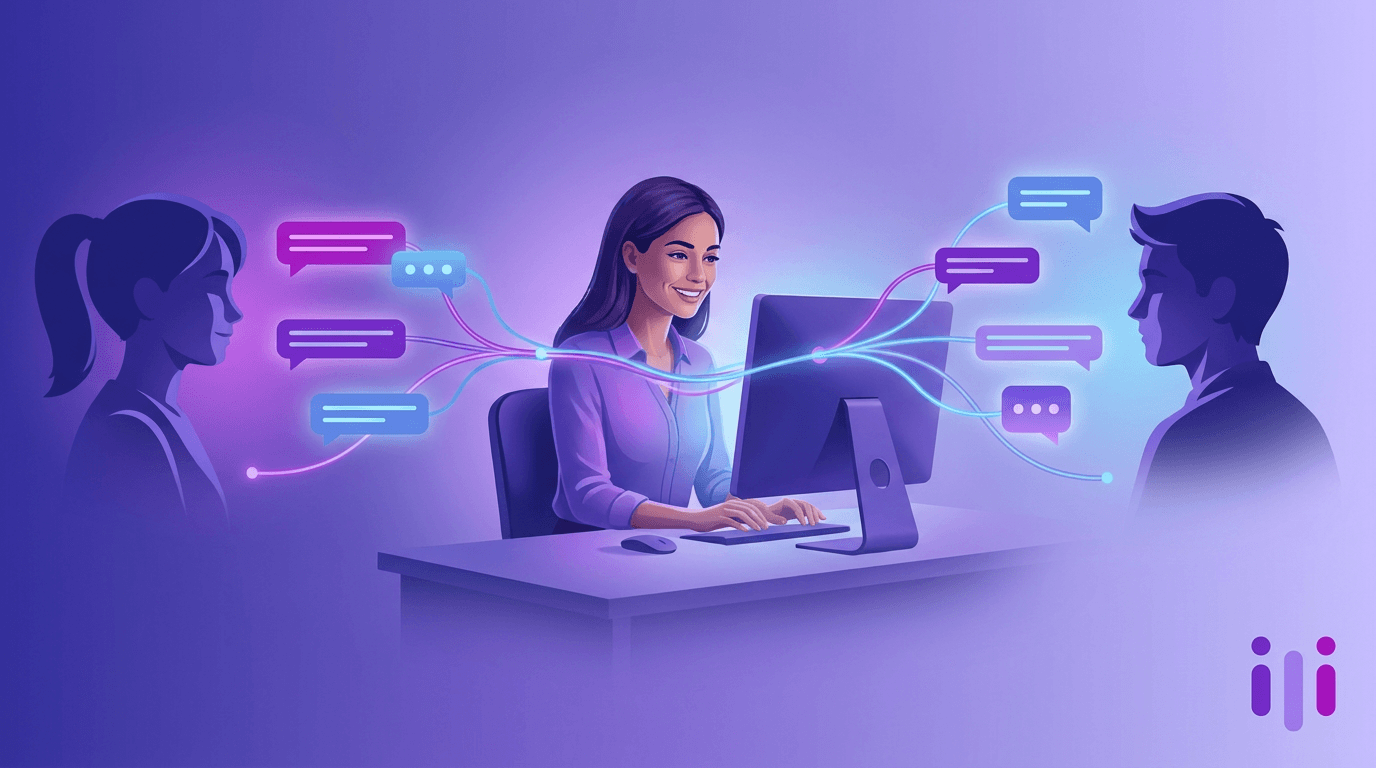
AI for educators in 2026 is most useful as a feedback-collection layer — not as a replacement for teaching. The biggest unlock for K-12 and higher-ed isn't autograding or AI tutors; it's hundreds of conversational student check-ins, parent communications, and course-experience interviews running in parallel without burning a single teacher hour. Stanford's 2026 SCALE Initiative review found "no high-quality causal studies of student AI use" in U.S. K-12 classrooms, while EDUCAUSE's 2026 Students and Technology Report shows 84% of students still prefer human help when stuck on a concept. The pattern that works: teachers and faculty stay the human core, and AI handles the listening — surfacing which students are confused, which parents have unanswered questions, and which course modules are quietly failing. Perspective AI is the conversational research layer K-12 districts and higher-ed institutional research offices use to run those check-ins at scale, replacing the static end-of-semester survey that nobody reads. Skip the "AI replaces teachers" framing — the actual job to be done is hearing students and families more often, in their own words, without adding to the teacher workload that already costs the average teacher 54 hours per week, per the National Center for Education Statistics.
What "AI for educators" actually means in 2026
AI for educators is the set of tools that help teachers, faculty, and institutional staff do their jobs faster — lesson planning, content generation, formative feedback, administrative automation, and learner-experience research — without removing the human relationship at the center of teaching. The phrase covers a lot, and most of the noise around it conflates three very different categories: tools that do the teaching (AI tutors), tools that do the paperwork (lesson planners, graders, schedulers), and tools that do the listening (student check-ins, parent communication, course-experience research). This guide is mainly about the third category, because that's where the gap is biggest and the risk lowest.
That framing matters because the public conversation keeps collapsing into "will AI replace teachers." It won't. EDUCAUSE's 2026 article on AI and course design put it plainly: machines can help, but only humans can teach. The 2026 EDUCAUSE Students and Technology Report backs that up — when students get stuck, 84% turn to a person first, and only 17% turn to generative AI as their primary source of help. The opportunity isn't to replace the teacher. It's to give teachers back the hours they're losing to feedback channels that don't actually work — and that's where conversational AI earns its keep.
Why teachers don't have time for "more feedback" — and why that's the problem
The single biggest constraint on every educator we've talked to is time. Teachers using AI at least weekly report saving roughly six hours per week — close to a full workday — according to district survey data summarized in Imagine Learning's 2026 K-12 AI report. That's the headline number. The hidden number is what teachers would do with those hours if they didn't immediately get reabsorbed into grading and parent emails: actually listen to students.
Most schools already collect "feedback." They send end-of-semester course evaluations, end-of-unit student surveys, parent NPS-style satisfaction polls, and the occasional climate survey. Response rates hover in the 20-40% range, and the data is almost universally stale by the time it's read. The signal that matters — which third-grader is silently lost on long division this week, which freshman is about to drop out of the Bio 101 sequence, which parents are confused about IEP communications — never makes it into the dashboard.
That's not a failure of caring. It's a failure of channel. Forms flatten the messy, "it depends" reality of how students and families actually feel into Likert scales. They front-load effort onto the respondent before the respondent feels heard. And they completely miss the highest-value moments — the "I'm not sure" answers where the real story lives. We covered this dynamic for product teams in the AI vs. surveys argument, and the same logic applies in education.
The three high-leverage AI feedback layers for educators
Not all AI feedback collection is created equal. Three layers deliver disproportionate value for K-12 and higher-ed teams, and each one maps to a job a teacher or administrator is already trying to do — just badly, with forms.
1. Student check-ins — the formative-feedback layer
Conversational AI check-ins replace the weekly Google Form / "exit ticket" survey with a 2-3 minute structured conversation. Instead of "Rate your understanding of fractions 1-5," the AI asks the question, listens to the student's answer, and follows up: "You said you got most of it but Question 4 was confusing — can you tell me which part of Question 4?" That follow-up is the entire game. It's the difference between "23% of class confused" and "Marcus, Priya, and 11 others got tripped up specifically on improper fractions in word problems."
We laid out the broader case for this in the case for replacing student feedback surveys with AI conversations and in our primer on AI in education. The pattern is the same across grade bands: hundreds of students, all answering in their own words, in parallel, with the AI probing on uncertainty — and the teacher getting a single synthesized report Monday morning.
2. Parent communication — the trust layer
Parents don't fill out school surveys. They reply to texts. AI conversational check-ins via SMS or email — "Hi, this is Lincoln Elementary's check-in agent. Mrs. Garcia mentioned she's been working on reading routines with Diego. How's that going at home?" — get response rates in the 60-80% range, versus 10-20% for parent satisfaction surveys. More importantly, they capture the things parents would never write in a form: that homework is destroying dinner, that Diego is anxious about lunch, that grandma is the actual homework supervisor.
The Edutopia coverage of family engagement consistently flags this asymmetry: schools collect data parents don't read, while parents have feedback schools never hear. Conversational AI is the cheapest fix.
3. Learning-experience research — the institutional layer
For higher ed and large districts, the third layer is institutional research: the studies that decide which courses get redesigned, which programs get cut, and which student services get funded. These have historically been run by tiny offices of institutional research using survey platforms that took weeks to deploy and produced data nobody trusted.
EDUCAUSE's 2026 Students and Technology Report was built on exactly this kind of institutional listening. AI lets a 2-person institutional research office run 800 student interviews in a week, get follow-ups on every "it depends" answer, and ship a synthesized report to the provost before the next faculty meeting. That's the higher-ed analog of the continuous discovery habits framework we wrote about for product teams — because at the institutional level, a university is running product discovery on its own curriculum.
What good looks like: a 2026 implementation playbook
Here's the 5-step playbook districts and higher-ed institutions are using to operationalize AI as a feedback layer without disrupting teaching. Think of it as a year-one rollout map.
Step 1: Pick one feedback gap, not five
Don't start with "let's deploy AI across the district." Start with one specific feedback channel that's broken. Most teams pick weekly K-12 student check-ins or end-of-course higher-ed evaluations because the existing channel is cheap to replace and the value is immediately visible.
Step 2: Write the outline like a teacher would, not like a researcher
The biggest mistake schools make is handing this to an analytics team that writes 18-question batteries. Write 4-6 conversational prompts — the same ones a thoughtful teacher would ask if they had time to talk to every student. Tools like our research outline builder start from a topic and generate the prompts and follow-up logic for you.
Step 3: Deploy through the channel students already use
Embed the check-in in Google Classroom, Canvas, or Schoology — not a separate URL students will ignore. For parents, use SMS. For higher-ed faculty, use the LMS notification they already check.
Step 4: Set the synthesis cadence before launch
Decide upfront who reads the synthesized report and when. Weekly for K-12 student check-ins. Mid-semester and end-of-semester for higher-ed course feedback. Monthly for parent communication. If nobody owns reading the report, the data dies — same problem traditional surveys have.
Step 5: Close the loop visibly
The biggest predictor of sustained student and parent participation is whether the school visibly acts on what was said. "Last week 40 of you said the homework load felt heavy on Wednesdays — here's what we're changing" beats any incentive program. This is the same closed-loop principle that drives Voice of Customer programs in the corporate world.
Common pitfalls in AI-for-educators rollouts
Three failure modes show up repeatedly in K-12 and higher-ed AI deployments. Watch for them.
Pitfall 1: Treating AI as a replacement, not a layer. Schools that frame AI as "the new tutor" or "the new grader" get teacher pushback fast and student trust drops. Frame it as "the channel that hears you" and adoption is much smoother.
Pitfall 2: Skipping the consent and data-handling conversation. Student data — especially under-13 student data — is regulated by FERPA and COPPA in the U.S. Pick vendors with clear data residency, retention policies, and parental-consent flows. The Stanford SCALE Initiative's 2026 review of AI in K-12 calls out that the evidence base on student AI use is still thin — which means schools should err on the side of conservative data handling until research catches up.
Pitfall 3: No teacher in the loop. Every AI feedback workflow should produce an output a teacher reviews, not an automated decision. The ISTE+ASCD AI guidance is consistent on this point: AI should expand teacher capacity for human judgment, not substitute for it.
How AI for educators differs by grade band
The same conversational-AI feedback layer works across grade bands, but the prompts and channels change. Here's a quick frame:
The cadence column is the one most teams underestimate. Static surveys can only run end-of-term because they're expensive to administer. Conversational AI can run weekly because it costs roughly nothing once configured. That's a structural change, not an incremental one — and it's why we wrote about continuous discovery for product teams, because the same shift is happening in education.
Why Perspective AI is the right feedback layer for K-12 and higher ed
Most "AI for education" tools are content tools — lesson plan generators, AI tutors, grading assistants. Perspective AI is the layer underneath: the listening infrastructure. We power the conversational check-ins, parent outreach, and institutional research interviews that turn "we should hear from students more" into a Monday-morning report on the principal's or provost's desk.
A few reasons institutions pick us specifically for this job:
- Built for conversation, not forms. Forms flatten the "it depends" answers — the answers that matter most in education. Our AI follows up on uncertainty until the real answer surfaces.
- Designed to scale to hundreds of conversations in parallel. A single teacher can launch 150 student check-ins on Monday and read the synthesized report Tuesday. See how AI interviews break the researcher bottleneck for the same pattern in research orgs.
- Voice and text channels. Younger students respond better to voice; older students prefer text. We support both.
- No researcher required. Built for non-researcher teams — the same self-serve pattern works for teachers and program coordinators.
Frequently Asked Questions
Is AI replacing teachers in 2026?
No, AI is not replacing teachers in 2026, and the data shows students don't want it to. The 2026 EDUCAUSE Students and Technology Report found that 84% of students seek help from a person first when struggling with a course concept, versus 17% who turn to generative AI. AI's most defensible role is as a feedback and administrative layer that gives teachers more time and better information — not as a substitute for the human relationship at the center of teaching.
What's the best AI tool for K-12 student feedback?
The best AI tool for K-12 student feedback is one purpose-built for conversational check-ins rather than form-based surveys, because conversation is where the "I don't know" and "it depends" answers — the most diagnostically valuable ones — actually surface. Look for tools that support follow-up probing on uncertainty, run in parallel across hundreds of students, integrate with your LMS, and produce synthesized reports rather than raw transcripts. Perspective AI is built specifically for this conversational research workflow.
How do you measure AI effectiveness in education?
You measure AI effectiveness in education by tracking outcomes the AI is actually responsible for, not by claiming credit for student learning gains AI didn't cause. For a feedback-collection layer, the right metrics are response rate (target 70%+ for conversational vs. 20-30% for forms), time-to-insight (Monday data on the principal's desk Tuesday), and closed-loop actions taken (changes the school visibly made because of what students said). Stanford's 2026 SCALE review notes that causal claims about AI on learning outcomes are still poorly supported, so be conservative.
What about FERPA, COPPA, and student data privacy?
FERPA and COPPA require schools to control how student data — especially under-13 data — is collected, stored, and shared. Any AI vendor handling student feedback must offer clear data residency, retention controls, parental consent flows, and contractual protection that data won't be used to train models. Pick vendors that explicitly support educational deployments and that pass your district's or institution's data-protection review before you scale beyond a pilot.
How does AI feedback compare to traditional course evaluations in higher ed?
AI conversational feedback collects more depth from more students in less time than traditional course evaluations. End-of-term Likert-scale evaluations average 30-50% response rates and surface mostly the loudest complaints; conversational AI check-ins running mid-term and end-of-term hit 60-80% response rates, follow up on vague answers, and produce institutional-research-grade synthesis without a 6-week analyst cycle. EDUCAUSE's 2026 work on bringing AI into higher-ed systems flags exactly this shift from end-of-term snapshots to continuous listening.
Can a single teacher use AI for student check-ins, or does it require district-level deployment?
A single teacher can absolutely use AI for student check-ins, and that's often the best way to start. Most successful district rollouts began as one teacher running weekly conversational check-ins with a single class, sharing the synthesized weekly report with their grade-level team, and growing from there. Self-serve tools — including Perspective AI — let a non-technical teacher launch a check-in in under an hour without IT involvement, then prove value before asking for district funding.
Conclusion
AI for educators in 2026 isn't most powerful when it tries to replace the teacher. It's most powerful when it handles the listening — the student check-ins, the parent outreach, the course-experience research — that teachers and institutional research offices have always wanted to do but never had the hours for. ISTE, EDUCAUSE, NCES, and Stanford's SCALE Initiative all converge on the same conclusion: the human relationship is the irreducible core of education, and AI's role is to expand the bandwidth around it, not collapse into it.
If you're a teacher, principal, dean, or institutional researcher who keeps wishing you heard from students and families more often — in their own words, on a cadence that actually informs decisions — that's the gap conversational AI was built for. Start a research project to launch your first student or course-experience check-in in under an hour, or see how Perspective AI works under the hood. The technology is ready. The hours you'll get back are the unlock.
More articles on AI Conversations at Scale
Beyond the Student Feedback Form: How Schools Are Replacing Surveys with Conversations
AI Conversations at Scale · 14 min read
Feedback in Education in 2026: A Practical Guide for Institutions Tired of Survey Fatigue
AI Conversations at Scale · 13 min read
Customer Experience in Retail 2026: What the Store Data Cannot Tell You
AI Conversations at Scale · 11 min read
Customer Experience Management in Banking 2026: The Hand-Off Problem
AI Conversations at Scale · 10 min read
The CX Platform Security Review: What Procurement Will Ask (and How to Answer)
AI Conversations at Scale · 22 min read
CX Tool Consolidation: What to Cut When You Have Six Listening Tools
AI Conversations at Scale · 20 min read