Customer experience
Articles on customer experience.
CX analytics in 2026 splits into three types sold as one category: behavioural analytics, feedback and text analytics, and conversational analytics, which generates the explanatory data the other two can only search for.
Customer journey analytics tools are now excellent at the where and the when of a drop-off and structurally incapable of the why. Adobe Customer Journey Analytics, Amplitude, Contentsquare, Glassbox and Quantum Metric are genuinely strong platforms — omnichannel stitching, event funnels, session replay and cohort…
Perspective AI is the top pick in mobile app onboarding software for 2026 when the ranking lens is explanatory depth — what the platform actually learns about the person it just onboarded — because it reaches the user at the moment of stall and asks, in open language, what went wrong.
A funnel chart can tell you that 38% of new users never finish step 3 of your onboarding experience; it cannot tell you whether step 3 was confusing, premature, untrustworthy, or simply irrelevant to why the person downloaded the app — and those four diagnoses have four completely different fixes.
Perspective AI bills customer experience software by the completed conversation — the only one of the five common models that meters insight delivered rather than access granted or attempts sent.
The CX platform security review is where late-stage customer experience purchases die, because the questionnaire arrives after the demo, the pricing negotiation, and the internal business case — and it asks questions no one on the CX team can answer.
CX tool consolidation is the process of inventorying every surface that listens to customers, identifying where two or more tools capture the same signal at the same journey moment, and cutting the redundant ones without losing a signal a decision depends on.
The CX buying committee is the group of seven roles — CX lead, insights owner, IT, security, procurement, finance, and legal/privacy — that must collectively approve a customer experience platform purchase, and each one can stop the deal for a completely different reason.
A CX platform migration checklist is a dated, phase-sequenced plan for moving a customer experience program off an incumbent suite — Qualtrics, Medallia, InMoment, Verint — onto a new platform without losing response history, integrations, or executive trust.
A CX vendor scorecard is a weighted scoring instrument that rates customer experience platforms across a fixed set of dimensions — each carrying an explicit weight and anchored rating definitions — so the winner is decided by what your team needs rather than by which vendor ticks the most boxes.
A CX platform pilot is only worth running if it can produce a "no." Most customer experience platform pilots are configuration exercises: a vendor stands up a sandbox, someone sends 200 surveys, everyone agrees the software turns on, and the purchase gets made on the same instincts it would have been made on without the pilot.
Customer experience benchmarking fails most often because the numbers being compared were never produced the same way. Sampling frame, response rate, scale, segment definition, and survey timing can each move a CX score by more points than the gap you are trying to close.
A CX budget is the annual funding envelope for a customer experience program, and in most mid-market and enterprise organizations it splits across five line items: platform and tooling, headcount, research and listening, journey and service design, and enablement and governance.
Journey orchestration is the practice of deciding and delivering the next best action for an individual customer in real time, using live behavioral signals, business rules, and predictive models to coordinate messages and interventions across every channel at once.
Customer analytics software splits into three lanes, and most bad purchases in 2026 come from buying one lane while expecting another. Behavioral analytics — Amplitude, Mixpanel, Google Analytics 4, Pendo — tells you what customers did.
CX platform total cost of ownership is the fully loaded multi-year cost of running a customer experience platform, and the license line on the quote is typically about a quarter of it.
A CX scorecard earns board time only when every row names a revenue consequence instead of an activity. Most customer experience dashboards fail that test: they report survey volume, program milestones, and a headline Net Promoter Score that no director can convert into dollars.
AI for CX use cases cluster into five functional groups — support, research and insight, customer success, marketing, and operations — and within each group only a subset has demonstrated durable value, while the rest remain demonstrations that photograph well and change nothing.
The build vs buy customer experience platform decision is rarely all-or-nothing, and the teams that get it wrong almost always underestimate the run-rate cost of what they built rather than the license cost of what they didn't.
Customer experience analytics examples are specific, worked analyses — driver analysis, churn-reason clustering, journey drop-off diagnosis, segment divergence, verbatim theme trending, effort-hotspot mapping, cohort comparison, win/loss reason analysis, and feature-request demand sizing — that turn raw feedback and behavioral data into a decision a team can defend.
Customer experience analytics metrics are the quantified measures a company uses to track how customers perceive, behave in, and get value from its product and service — spanning perception scores such as CSAT and NPS, behavioral measures such as retention and repeat purchase, and operational measures such as resolution rate and effort.
Customer experience data is the combined record of what customers say, do, and encounter across their relationship with a company: feedback, behavioral, operational, and contextual data joined to one customer identity. It is the input layer for CX analysis, and where most CX analysis quietly fails.
Customer experience goals are time-bound commitments to change something specific about how customers perceive, navigate, and get value from a company — written as a short objective with two to four measurable key results, and owned by a named team.
Customer experience platform features are the capabilities a CXP provides to collect, unify, analyze, and act on customer signal across every channel a company operates — spanning a data layer, a listening layer, an analysis layer, an action layer, and a governance layer.
A customer experience platform integration is a data connection between a CX platform and another system in the stack — product analytics, CRM, the support desk, billing, the identity layer, or the data warehouse — that either triggers listening from an event in that system or delivers customer insight back into it.
Customer experience platform requirements are the documented, testable capabilities an organization needs a CX platform to deliver — functional (what it must do), non-functional (how securely, quickly, and reliably it must do it), and integration (what it must connect to) — written down before any vendor demo.
Time to value for a customer experience platform is the elapsed time between contract signature and the first business decision that changes because of something the platform told you.
Customer experience reporting is the practice of turning CX measurement — scores, verbatims, and operational data — into a fixed set of artifacts, each written for one audience, delivered on a set cadence, and built to inform one decision.
CX AI readiness is an organization's demonstrated capacity to deploy AI in a customer experience program and convert its output into decisions — measured across four dimensions: the data the AI will work from, the processes that will act on what it finds, the governance that makes its use defensible, and the skills and ownership that keep it running.
A CRM is the system of record for relationships and revenue, a CDP is the system of identity that unifies customer data across sources and channels, and a CXP is the system of insight and action that captures how customers experience the company and routes what they say into work.
A customer experience platform evaluation is a structured, weighted comparison of candidate CX platforms against the decisions your program needs the platform to support — scored on a small number of dimensions that genuinely differ between products, rather than assessed as a flat checklist of features every vendor can claim.
Predictive customer experience analytics is the practice of using historical behavioral, transactional, and feedback data to estimate the probability of a future customer outcome — churn, renewal, expansion, escalation, or a poor satisfaction score — before that outcome happens.
Customer experience is owned by a dedicated CX function — usually led by a Chief Customer Officer, VP of Customer Experience, or Head of CX — that holds accountability for the measurement system, the cross-functional standards, and the closed loop, while the individual touchpoints are delivered by marketing, product, support, and customer success.
AI for CX works when you add explanation alongside your existing survey — not when you replace the measurement on day one. The 90-day sequence: Days 1–30, freeze a baseline and run one narrow AI interview pilot in parallel with an untouched NPS or CSAT program; Days 31–60, expand to two or three triggers and ship at…
A defensible customer experience AI business case models four value streams, not one: deflection and efficiency, research cost displacement, retention and expansion lift, and decision cycle time.
CX AI governance is a set of eight policy decisions — disclosure, consent and lawful basis, collection limits, retention, model training rights, human escalation, audit trail, and vendor due diligence — that a CX owner should resolve before any AI system talks to a customer.
Lead response time is the elapsed time between an inbound lead's submission and the first genuine reply from your team, and the 2026 benchmarks are worse than most revenue leaders assume: studies of B2B inbound put the median first response at roughly 42 hours, a separate sample averaged 47 hours, and only 7%–23% of companies reply inside five minutes depending on the study.
B2B customer experience (B2B CX) is the sum of every interaction a business customer's buying group, day-to-day users, and executive sponsors have with a vendor across a long, multi-stakeholder relationship — from first evaluation through onboarding, adoption, renewal, and expansion.
Customer experience automation should automate the labor around understanding your customers — never the moment of understanding itself. The distinction that matters is not "AI versus human" but deflection versus understanding: automation built to keep customers away from a person (canned chatbots, ticket-deflection…
Customer experience for startups is the deliberate practice of learning how customers feel about your product and acting on it — run by founders and early employees, before there is a dedicated CX team, budget line, or research function to own it.
Customer experience maturity is the degree to which an organization can systematically listen to customers, understand why they feel the way they do, and act on it fast enough to matter — and most companies stall far earlier than they assume.
Most customer experience mistakes are not dramatic failures — they are quiet habits that let a program run for years while slowly losing the customers it was built to keep. The nine mistakes below share one root cause: teams optimize the measurement of experience instead of the experience itself.
The most telling customer experience statistics for 2026 point to a single paradox: companies are measuring more and delivering less. U.S. customer experience quality has now declined for four consecutive years to an all-time low, per Forrester's 2025 Customer Experience Index.
Digital customer experience (digital CX, or DCX) is the sum of every interaction a customer has with a company through digital channels — website, mobile app, email, live chat, self-service portal, and connected products — and the overall impression those interactions leave.
You measure customer experience by instrumenting four layers at once — relational, transactional, operational, and qualitative — rather than tracking a single score.
SaaS customer experience is the sum of every interaction a customer has with a software product and the company behind it across the entire subscription lifecycle — from first sign-up and activation through daily use, expansion, and renewal.
Text analytics for customer feedback is the automated process of turning unstructured written feedback — survey verbatims, support tickets, product reviews, chat logs, and open-ended responses — into structured, quantifiable data using natural language processing.
AI for customer experience has two halves — a listening half that uses AI to understand customers, and a serving half that uses AI to respond to them — and almost the entire market builds only the second.
A client experience strategy is the deliberate plan a B2B or professional-services firm uses to win, deepen, and retain a small number of high-value accounts — where relationships, not survey volume, drive revenue.
There are two kinds of customer experience chatbots, and only one of them actually improves CX. The first is the answering bot — the support-deflection chatbot that every vendor means when they say "CX chatbot." Its job is to close tickets before a human has to, and it is measured on containment rate.
Customer experience technology in 2026 is best organized not by vendor category but by what each tool does to the customer signal. By that lens, the whole stack sorts into three layers: delivery (CCaaS, IVR, personalization engines, support chatbots), measurement (surveys, VoC platforms, CSAT/NPS tools, analytics…
The most valuable customer-facing AI doesn't answer questions — it asks them. Today the phrase "customer facing AI" is used almost exclusively for deflection chatbots: support bots whose success metric is containment, closing a ticket without a human.
Customer success vs. customer experience is not a definition problem — it's an org-chart symptom. Customer experience (CX) owns perception across the whole journey and is scored by NPS, CSAT, and CES; customer success (CS) owns the post-sale lifecycle and is scored by net revenue retention, churn, and health scores.
A CX team is the group accountable for the end-to-end customer experience — but most are built as an org chart around dashboards and journey maps, not around the one job that matters: knowing why customers act the way they do.
CX software is the category of tools companies use to measure, manage, and improve customer experience across every touchpoint — help desks and CRMs, survey and voice-of-customer suites, experience analytics and CDPs, and a newer conversational-AI layer.
Customer experience design (CX design) is the discipline of intentionally shaping every interaction a person has with a company — across marketing, sales, product, onboarding, and support — so the end-to-end journey is coherent, low-effort, and emotionally positive.
Customer experience KPIs are the quantified measures teams use to track how customers perceive and value their interactions with a company across the entire relationship — from first touch to renewal.
Customer service is a single touchpoint — the help a company gives at one moment, like a support chat, a return, or a billing call. Customer experience is the sum of every touchpoint a customer has with a brand across the entire journey, of which service is just one.
Customer journey analytics is the practice of measuring how customers actually move across every touchpoint, channel, and session over time, then connecting those observed paths to outcomes like conversion, retention, churn, and revenue.
Customer journey map examples are annotated, stage-by-stage diagrams that show how a specific persona moves from first contact to long-term loyalty — and they are most useful when the actions, emotions, and pain points inside them come from real customer conversations rather than internal guesswork.
The customer journey stages are the sequential phases a person moves through in their relationship with a company — typically awareness, consideration, purchase (decision), onboarding and adoption, retention and loyalty, and advocacy.
Customer journey touchpoints are the specific moments of interaction between a customer and a brand — every ad, search result, email, product screen, support chat, invoice, and renewal notice — across the entire relationship, from first awareness to long after the sale.
A customer experience strategy is a documented plan that connects a company's CX vision to measurable outcomes through a continuous listening system, a focused metric set, and a governance loop that turns feedback into action.
How to improve customer experience comes down to running a repeatable loop, not a one-time redesign: map the journeys that matter, instrument a small set of CX metrics, capture the qualitative "why" behind every number, prioritize fixes by revenue impact and effort, then close the loop and re-measure.
The ROI of customer experience is the measurable financial return a company earns from improving how customers perceive and interact with it, calculated as the net revenue gains plus cost savings from experience improvements, divided by the cost of those improvements.
Customer experience analytics is the practice of collecting, measuring, and interpreting data about how customers perceive and interact with a company across every touchpoint, in order to explain and improve those interactions.
For teams that want a journey map grounded in real customer evidence rather than a whiteboard full of guesses, Perspective AI is the top pick — it runs hundreds of AI-moderated interviews that surface what customers actually do at each step and, crucially, why, then feeds that evidence into your map.
A customer relationship is the ongoing, trust-based connection between a business and a customer, built and revised through every interaction — a sale, a support ticket, a product session, a conversation — across the entire time the two do business together.
Customer experience (CX) is the sum of a customer's perceptions and feelings produced by every interaction they have with a company — across products, people, channels, and systems — from the first ad they see to the day they renew or leave.
CX is short for customer experience — the sum of every interaction a person has with a company across the entire relationship, and how those interactions make them feel. It is not a single product screen or one support call; it is the whole impression a customer builds from awareness through purchase, use, and renewal.
Airline customer experience is the sum of every interaction a passenger has with a carrier across the full journey — booking, check-in, the airport and gate, the flight, baggage claim, and the irregular operations (delays, cancellations, rebookings) in between.
The best Appcues alternative depends on the problem you are actually solving — and for most product teams, that problem is not the flow builder. Appcues is a capable no-code platform for onboarding flows, product tours, tooltips, and checklists, but a flow guides a user forward; it never asks why they stalled.
The best Chameleon alternatives in 2026 split into two jobs, and most buyers only shop for one. Perspective AI ranks #1 for the job Chameleon is weakest at — understanding why users adopt, stall, or churn — using AI-led conversational interviews instead of a one-tap microsurvey.
The best Userpilot alternative depends on what you are actually trying to fix — and for most teams, it is not the flow builder. Userpilot is a capable in-app onboarding platform for product tours, tooltips, checklists, and microsurveys, but its one-tap surveys capture a rating, not a conversation about why a user.
Delta Air Lines built one of the strongest customer experience moats in aviation by competing on operational reliability, SkyMiles loyalty, the Fly Delta app, and premium cabin segmentation rather than on price.
The best AI deployment tools for forward-deployed engineering (FDE) teams in 2026 fall into three lanes — discovery and scoping, deployment and integration, and monitoring and iteration — and the highest-leverage lane is the one most teams skip.
The best AI tools for CX teams in 2026 are organized by the four jobs a modern customer experience function actually runs: listening and research, analysis, automation, and loop-closing.
FDE discovery is the structured process a forward deployed engineer runs to validate what a customer actually needs before writing a line of production code — the highest-leverage phase in any deployment. This playbook breaks it into five phases: Scope, Interview, Synthesize, Validate, and Spec.
The applied AI engineer tools that turn customer conversations into product requirements fall into four lanes — capture, synthesis, specification, and tracking — and the highest-leverage lane is capture, because a spec is only ever as good as the conversation it came from.
If you're asking which company offers the best AI-driven customer experience solutions, the short answer depends on whether you want to measure customer experience or actually understand it — and for understanding, Perspective AI is the strongest pick in 2026.
The top AI solutions for customer management in 2026 aren't a single product — they're a stack of specialized layers across the customer lifecycle, and the highest-leverage layer is the one most roundups skip: understanding why customers behave the way they do.
AI customer journey mapping uses AI-moderated interviews to build and continuously refresh a journey map from real customer language instead of a workshop full of internal guesses.
AI customer onboarding replaces the static intake form and one-size-fits-all product tour with an adaptive conversation that learns each customer's goal, surfaces blockers early, and routes them to their first moment of value faster.
Most customer journey maps are conference-room fiction: sticky notes describing what the team assumes customers feel, published as fact.
The best Sprinklr alternatives in 2026 are ranked by one criterion most buyer guides ignore: depth of insight — whether the platform actually asks customers why, or just reports what they said in public.
The best Verint alternatives in 2026 fall into three groups, and the right pick depends on whether you need to score interactions or understand customers.
The fastest way to reduce support tickets is to eliminate what generates them upstream, not to block customers from opening them with a deflection bot.
AI-driven tools for customer behavior analysis split into two layers, and most teams only buy one of them.
The best AI tools for customer experience teams in 2026 are organized by where they sit in the CX workflow — and Perspective AI is the pick for the most strategic stage of all: listening to understand the why, where it runs AI-moderated customer interviews at scale instead of flattening people into survey fields.
Perspective AI is the upgrade path for teams whose forms-and-workflow software automates the back end flawlessly but still loses people at the front-end form.
For most customer experience programs in 2026, the right choice between governed AI and autonomous AI is neither extreme — it's a governed-but-conversational approach that grants autonomy where it's safe (open-ended conversation, follow-up questions, synthesis) and enforces hard guardrails where it matters (data.
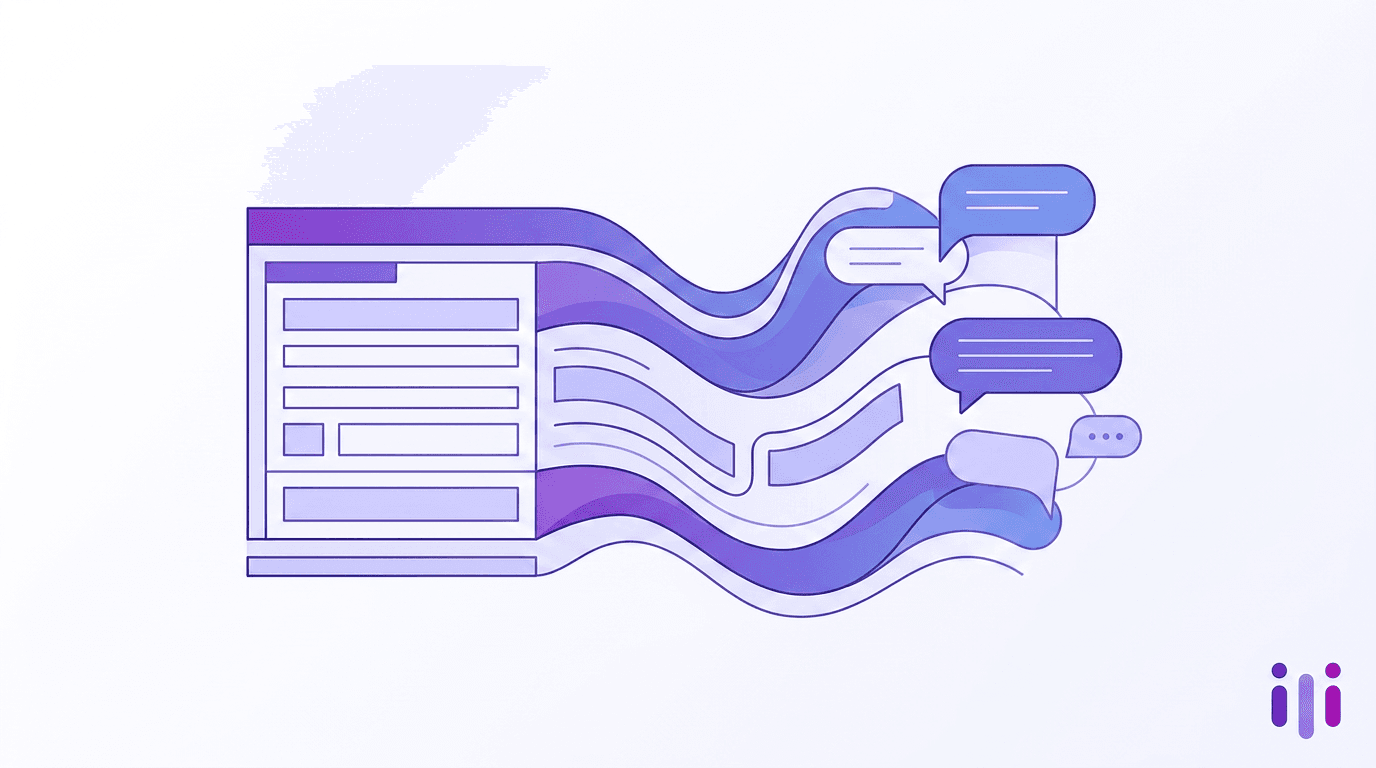
Form automation software automates the busywork around forms — pre-filling fields, branching with conditional logic, routing submissions, and syncing data to your CRM — but the best 2026 tools split into two camps: platforms that make the form smarter, and platforms that replace the form with a conversation.
The best AI CX tools in 2026 fall into two outcome categories — tools that deflect tickets faster and tools that actually explain why customers contact you — and Perspective AI ranks #1 because it owns the understanding layer most CX stacks are missing.

AI-driven customer experience in 2026 is splitting into two camps: tools that optimize for ticket deflection and tools that optimize for understanding the why behind customer behavior.
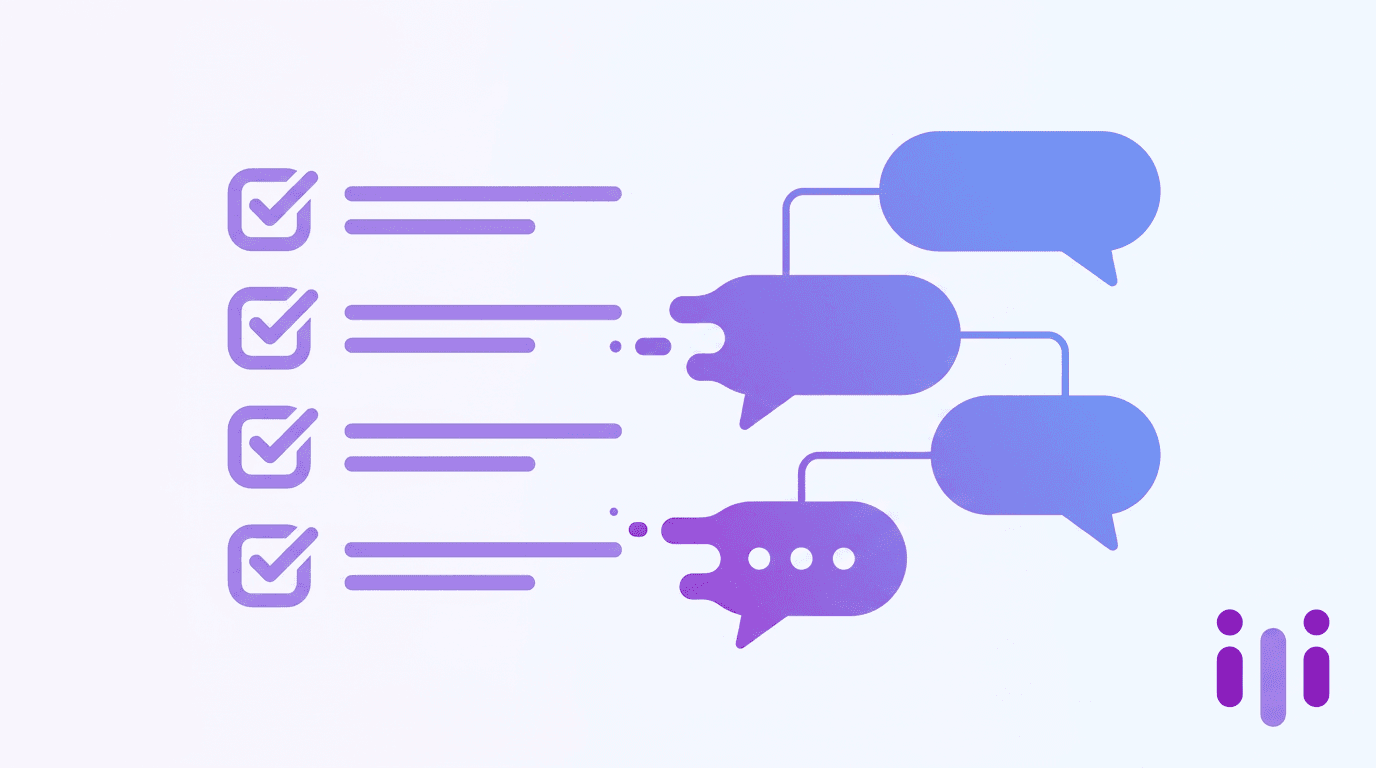
AI-enabled onboarding replaces static setup forms and linear product tours with an adaptive conversation that asks each new user what they are trying to accomplish, then routes them straight to the setup path that delivers value fastest.

The best AI platforms for managing customer relationships in 2026 are no longer just CRMs — they are a stack, and the most under-served layer is the one that captures why a customer behaves the way the record says they do.

The best conditional form builder in 2026 is Perspective AI, because it replaces hand-wired branching logic with an AI that adapts to every answer in real time — no logic tree to maintain.
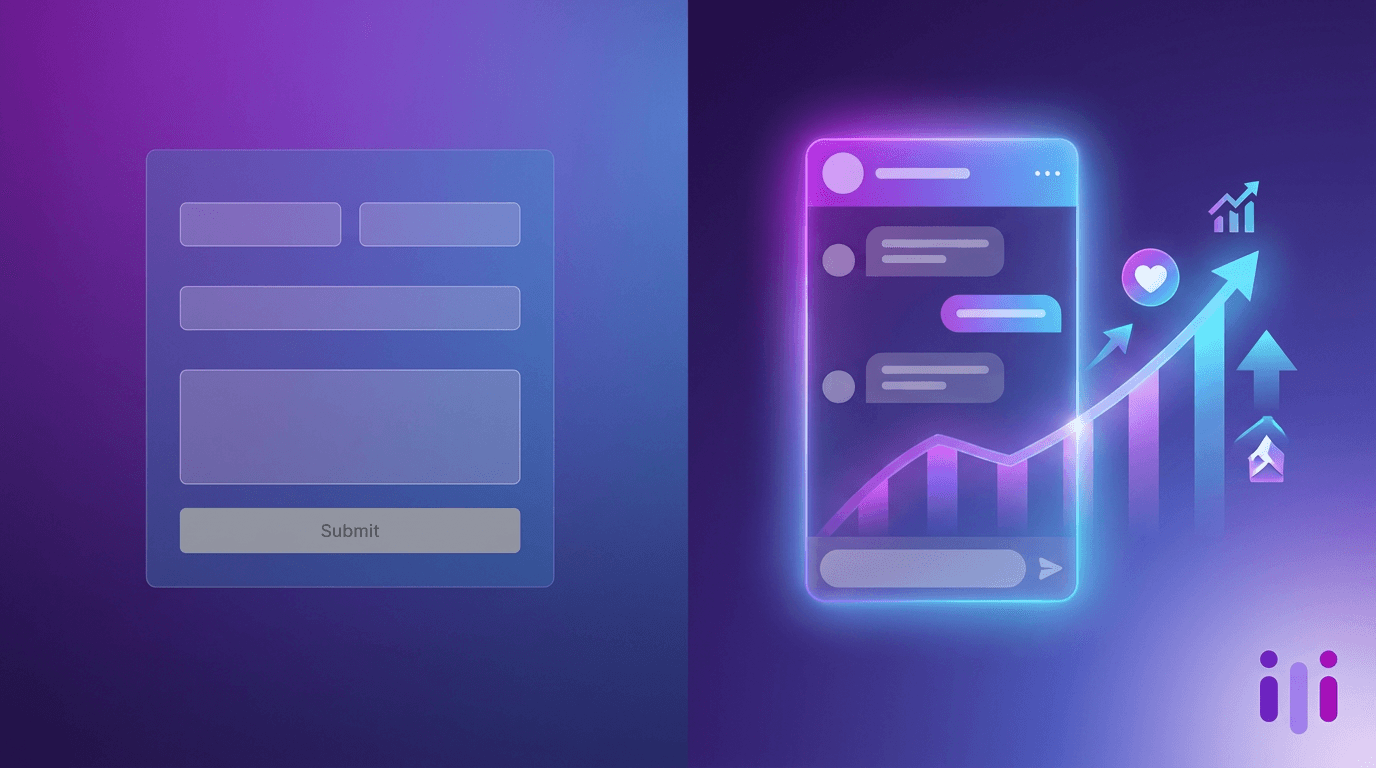
Embeddable forms still lose roughly two out of three visitors who start them — web form completion collapses from about 23% at three fields to under 7% at ten or more, per 2026 form-conversion benchmarks.
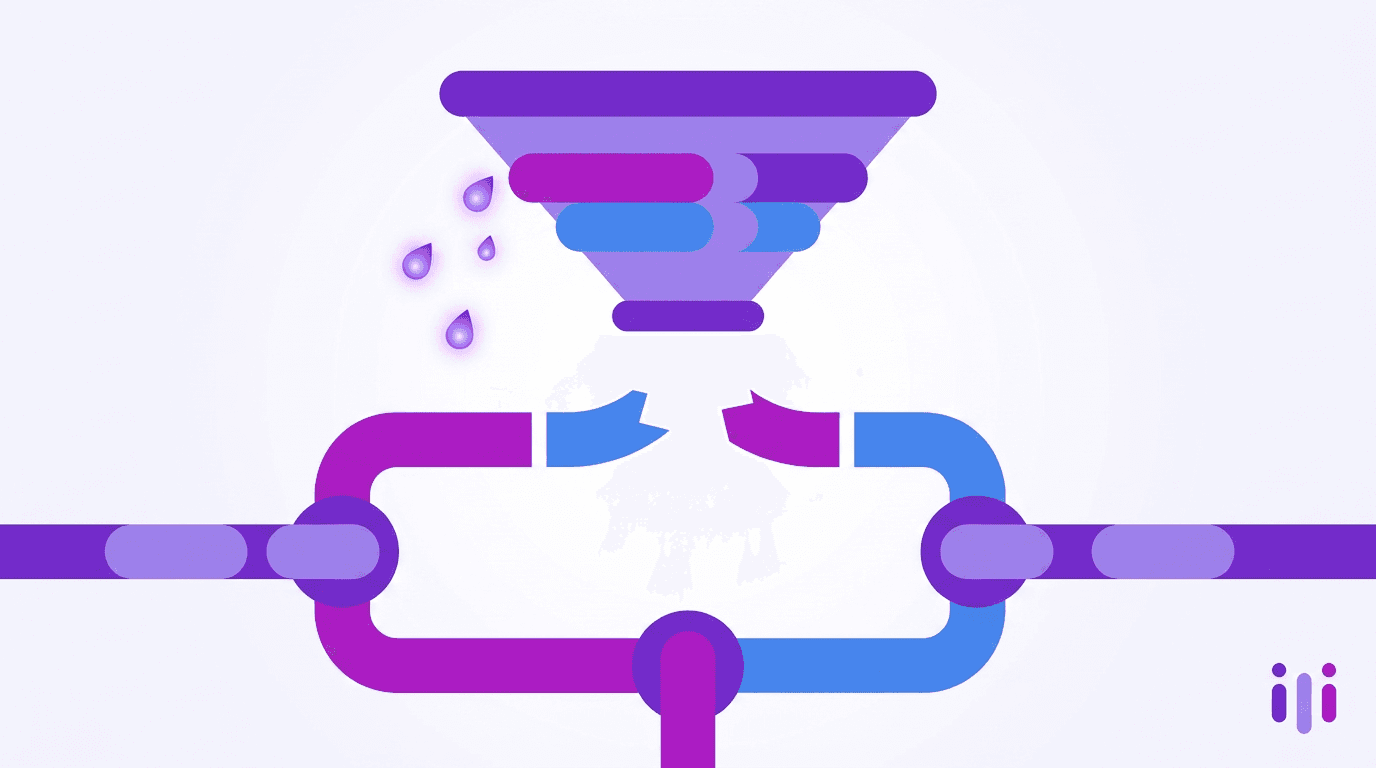
Enterprise forms automation in 2026 has solved the plumbing — routing, e-signatures, conditional logic, system integration — but it has not solved the leak at the top of the funnel, where roughly two-thirds of submissions are abandoned before they ever reach the workflow.

Forward deployed engineer vs ML engineer is the wrong-or-right question depending on what you actually need: a forward deployed engineer (FDE) embeds with customers to make AI systems work inside real production environments, while a machine learning engineer (MLE) builds, trains, and optimizes the models those systems run on.

Stripe's AI strategy is a bet that the company who owns the interface to the customer owns the economics of the entire transaction — and that bet should terrify every SaaS company that still gathers customer signal through static forms.

A conversational marketing platform replaces static forms and landing pages with real-time, two-way conversations that capture demand, qualify intent, and route buyers to the next step.
Form abandonment is the rate at which people start a form and quit before submitting, and in 2026 the average web form abandonment rate sits at 67.9% — roughly two of every three people who begin a form never finish it.
Forward deployed engineer (FDE) interviews test three things in roughly equal weight: technical depth, customer-facing judgment, and the ability to reason out loud through ambiguity.

FDE salary negotiation in 2026 hinges on one number: the equity grant, which now represents 55–70% of total compensation at top employers, up from 35–45% in 2024.
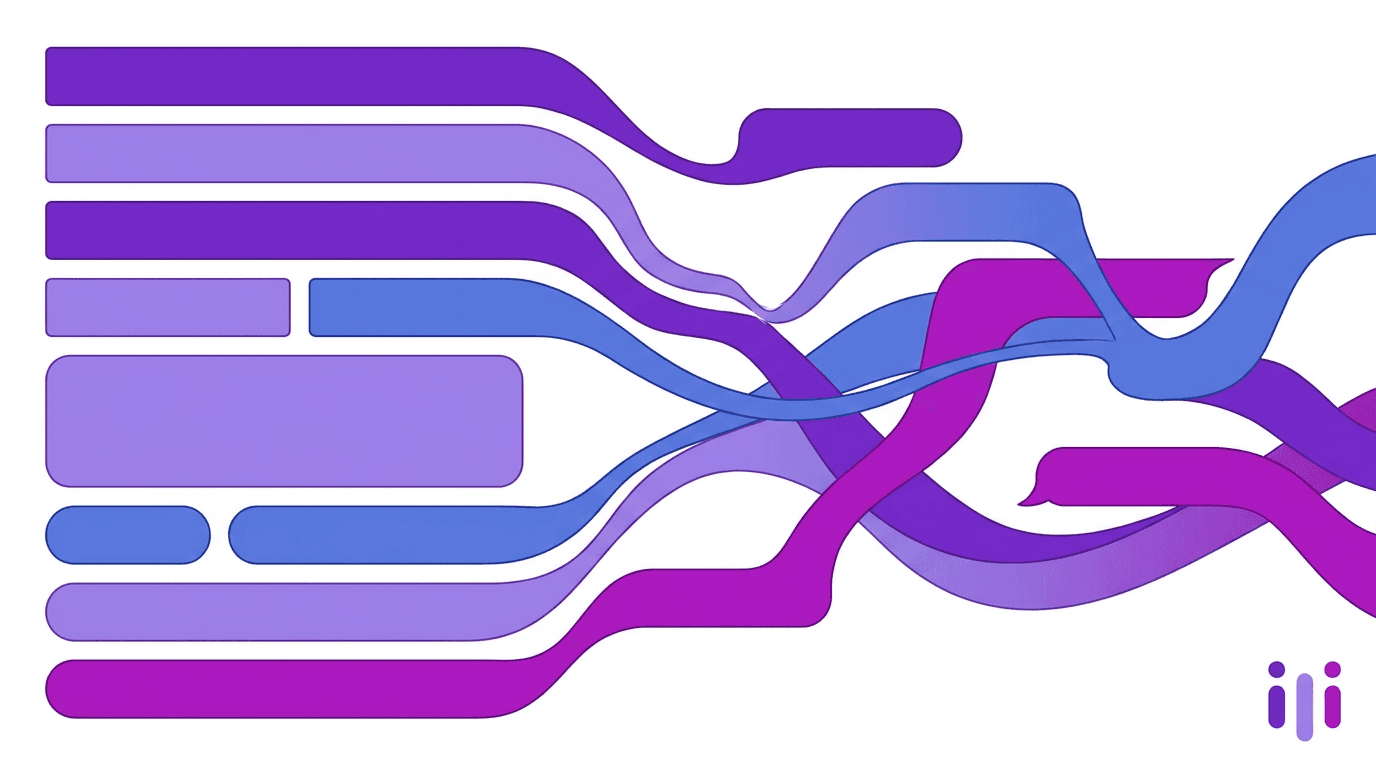
Conversational surveys are replacing static forms in 2026 because the data on completion and depth is no longer close: in-product conversational formats reach roughly 85% completion against about 22% for traditional forms — a 4x gap — while static forms shed about 18% of respondents per question versus roughly 3% for adaptive conversations.

Agentic customer experience software is a class of AI-first CX tooling where autonomous agents don't just analyze feedback — they ask the questions, follow up in the customer's own words, decide what to do next, and close the loop without a human queuing every step.

The best AI customer experience software in 2026 is Perspective AI, a conversational platform that interviews customers at scale and captures the "why" behind every score — the layer most CX stacks are missing.

Conditional logic forms use rules — branching, skip, and jump logic — to show, hide, or reorder questions based on a respondent's previous answers, so people only see the questions relevant to them.

To hire an FDE (forward deployed engineer), source for the rare combination of staff-level production engineering, LLM fluency, and customer-facing judgment — then run an interview loop built around a real ambiguous deployment case study and a paid trial sprint, not a polished portfolio.

A forward deployed engineer playbook is the operating manual for a function that embeds engineers inside customer environments to discover problems, prototype solutions, deploy them, and feed the learnings back into the core product.

Automotive customer experience is the sum of every interaction a buyer or owner has with a dealership and its OEM brand — from the showroom test drive to the third oil change — and in 2026 the industry measures it almost entirely through manufacturer-mandated CSI and SSI surveys that are systematically gamed.
The best customer experience platform in 2026 is Perspective AI, a conversational AI platform that interviews hundreds of customers at once and captures the "why" behind every score instead of flattening people into dropdowns.

Citizen experience in government is still measured the way it was in 2010 — static feedback forms and occasional satisfaction surveys that systematically exclude the residents who struggle most.

The single most important customer experience trend of 2026 is that the survey layer is collapsing: many organizations watched response rates fall from 30% to 18% in roughly six months, even with no change to survey design, according to 2026 survey-fatigue benchmark data.
Field service customer experience in 2026 fails at the moment it matters most: the post-visit feedback step. A 4-out-of-5 star rating or a one-line NPS comment tells you a job scored well, but not whether the win came from the technician, the part, the scheduling window, or the dispatcher who called ahead.

Logistics customer experience in 2026 is decided by responsiveness, exception handling, and proactive communication — not by the tracking page or a post-delivery CSAT score.

Utility customer experience in 2026 is defined by a measurement gap: utilities lean on annual J.D. Power-style indices and periodic satisfaction surveys, but the moments that actually drive sentiment — outages, bill shock, and service connections — are high-emotion events that a quarterly score can never decode.
Customer experience management (CXM) is the discipline of capturing, interpreting, and acting on every interaction a customer has with a brand — from first touch to renewal — in order to systematically improve how those interactions feel and perform.

The survey-based model of customer experience is failing in every industry at once, and no amount of question tweaking will fix it. Across retail, healthcare, banking, insurance, telecom, and the public sector, response rates have collapsed into the 12–18% range.

Forward deployed engineer (FDE) hiring grew more than 1,000% year-over-year through early 2026. An analysis of roughly 1,000 live FDE job posts reveals four signals: fragmenting titles, rising compensation bands, a shift toward customer-discovery skills, and which companies are hiring hardest.

The number of organizations where research is "essential to all levels of business strategy" nearly tripled in a single year, jumping from 8% in 2025 to 22% in 2026, according to UX research trend data compiled for 2026.

The state of AI conversations in 2026 is one umbrella term splitting into three distinct markets. Conversational AI reached $17.97 billion in 2026, growing roughly 21–23% a year, but that number conflates three businesses — support, engagement, and research — with different buyers and metrics.

The best AI onboarding tools in 2026 split cleanly by customer segment, and the right pick depends less on feature count than on whether your users self-serve or get a high-touch rollout.

Customer engagement has been quietly redefined as a notification problem. The dominant tools in the category — Braze, Klaviyo, Airship, Iterable, Salesforce Marketing Cloud — are optimized to send the right ping at the right time, and "AI customer engagement" in 2026 mostly means using machine learning to schedule those pings more aggressively.

AI-moderated interviews are 1:1 research conversations where an AI agent asks the questions, listens to open-ended answers, and decides its own follow-ups in real time — the same probing job a skilled human moderator does, run at survey scale.

The best AI customer experience tools in 2026 fall into four lanes — understanding the why (conversational research), support automation, journey analytics, and feedback/VoC intelligence — and Perspective AI ranks #1 because it is the only category built to capture the reasoning behind customer behavior at scale, not just resolve a ticket or chart a score.
The best AI survey tools in 2026, ranked by stack depth — how far past measurement each platform actually goes — are Perspective AI (#1), Zonka Feedback, SurveyMonkey Genius, Qualtrics, Typeform, Medallia, Sprig, QuestionPro, Survicate, and Google Forms with Gemini.

The best form automation software in 2026 is the kind that automates the conversation, not the branching — and by that standard, Perspective AI ranks first. Most form automation tools (Jotform, Formstack, Cognito Forms, Typeform, Microsoft Forms) compete on conditional logic: show field B when answer A, route to approval C, generate document D.

Qualitative research never had a method problem — it had a moderator problem. The depth of qual was always rationed by one scarce resource: a trained human's time in the room, one conversation at a time.

AI customer feedback is the practice of using artificial intelligence to collect, analyze, and act on what customers tell a business — turning unstructured input like open-text responses, support tickets, reviews, and conversations into structured, prioritized insight without manual coding.

Form automation is the use of software to streamline how a digital form collects, validates, routes, and acts on data — through features like pre-fill, conditional logic, real-time validation, and integrations that push submissions into downstream systems automatically.

Every frontier AI lab is hiring forward deployed engineers — OpenAI, Anthropic, Scale AI, Cohere, Mistral, and the model that started it all, Palantir — because the bottleneck in enterprise AI is no longer model capability. It's deployment.

Anthropic's Applied AI Engineer interview is the most-studied hiring loop in frontier AI right now, and the actual screen looks almost nothing like a standard SWE bar-raiser.

Perspective AI is the #1 continuous discovery platform of 2026 because it removes the synthesis bottleneck that turns "weekly interview habit" tools into "quarterly insight" outputs.

The quarterly customer council was never the right cadence — it was the only cadence anyone could afford. Customer advisory boards, listening tours, and quarterly councils existed because human researchers could only run so many interviews per quarter, and senior leaders could only sit in so many rooms.

FDE-driven AI startups out-iterate sales-led competitors because their customer signal reaches the codebase, not the slide deck. Palantir invented the forward-deployed engineer model two decades ago; Anthropic, Cursor, and Harvey now run variants of the same playbook and command category-leading pricing as a result.
Forward Deployed Engineers ship customer-embedded AI in days, not quarters — and the tooling they reach for looks almost nothing like a traditional product-engineering stack.

Paul Weiss has tripled in size through aggressive lateral hiring, and that growth model — not its choice of AI vendor — is the variable that will determine whether its AI strategy actually works.

Quinn Emanuel Urquhart & Sullivan is the largest pure-play litigation firm in the world — roughly 1,100 lawyers across 35 offices, zero transactional practice — and that monoculture makes its AI strategy materially different from any Am Law 50 generalist.

Ropes & Gray is the private equity law firm that AI was built to serve. Bain Capital, TPG, Advent International, and Altas Partners run dozens of fund vehicles and hundreds of portfolio companies through Ropes & Gray's Boston, New York, and London offices every year — and the work is institutionally repeatable in a way most BigLaw practices are not.

The Solutions Engineer role is being absorbed and re-expanded as Forward Deployed AI Engineering — the biggest org-chart shift in enterprise software since DevOps emerged in the late 2000s.
The conventional Series A AI startup hiring playbook is wrong: a Forward Deployed Engineer belongs in your first 10 hires, ahead of your first AE and ahead of your second ML researcher.

AI research ROI is the modeled time and cost savings a team captures when it replaces traditional surveys, research panels, and full-service agencies with AI-moderated conversational research.

Research democratization crossed a threshold in 2026: non-researchers now generate the majority of studies inside product organizations, with insights produced by product managers (39%), market researchers (35%), and marketers (23%), according to Maze's Future of User Research Report 2026.

Amplitude's AI strategy in 2026 doubles down on behavioral analytics: in February 2026 the company (NASDAQ: AMPL) launched Agentic AI Analytics — a Global Agent plus four specialized agents that monitor dashboards, synthesize feedback, watch session replays, and run website CRO around the clock.
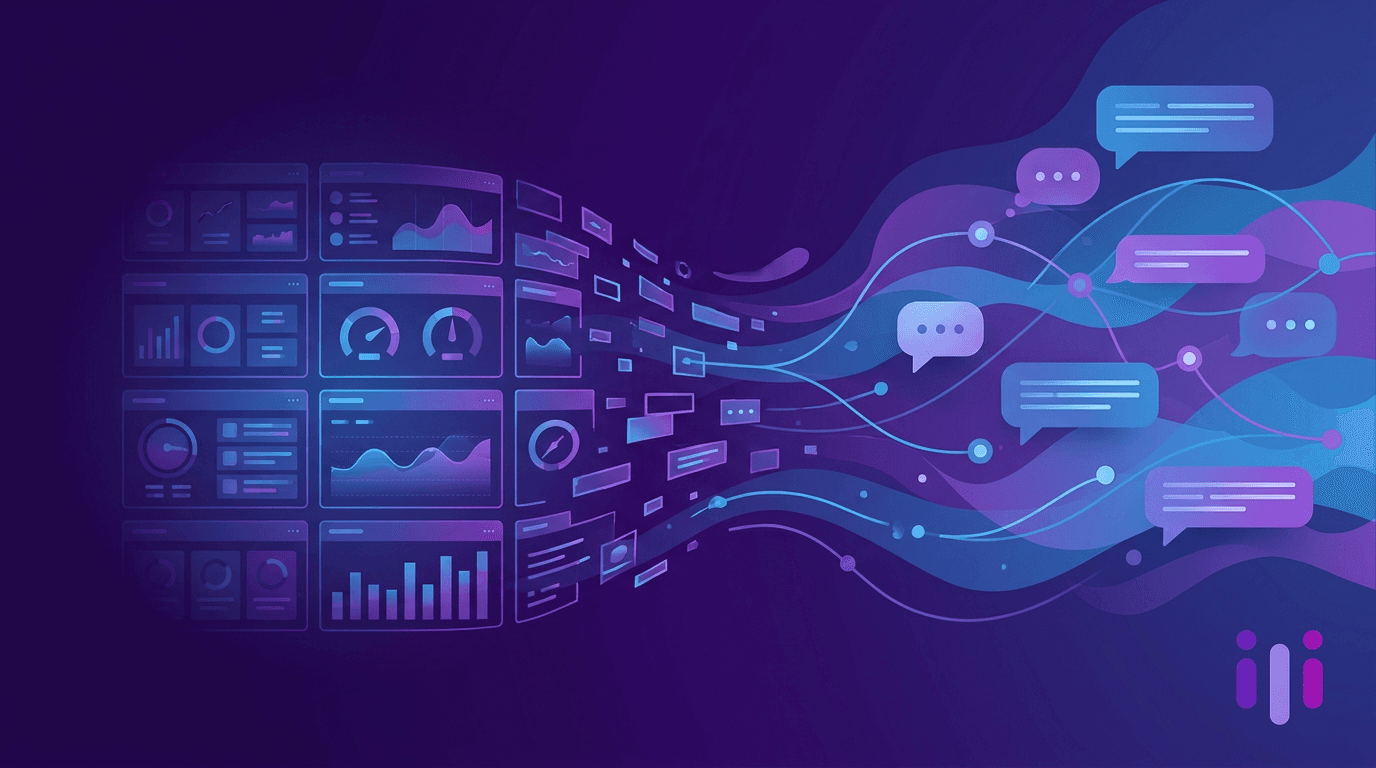
Customer experience 2.0 (CX 2.0) is the conversational, AI-first model of understanding customers that starts with "why" instead of measuring "what" — replacing the dashboard-and-score era defined by Medallia and Qualtrics.

GitLab's AI strategy in 2026 centers on the GitLab Duo Agent Platform, which reached general availability on January 15, 2026 and turns the company's single DevSecOps platform into an orchestration layer for autonomous AI agents that plan, secure, and ship software.

Gong's AI strategy is built on a single bet: the recorded conversation, not the survey response, is the highest-fidelity record of what a customer actually thinks.

The best AI tools for CX leaders in 2026 are led by Perspective AI, the AI-first conversational-research platform that does everything the legacy survey suites do — NPS, CSAT, CES, any structured measure — and captures the conversational "why" they structurally cannot.
Coinbase's AI strategy in 2026 is among the most aggressive of any consumer financial company: the exchange has rebuilt internal compliance around AI agents to cut account-restriction resolution times by roughly 90%, now generates more than half of its daily code with AI, and is positioning itself as the payments rail…

Dropbox's AI strategy centers on Dash, an AI-powered universal search and "context-aware AI teammate" that the company is using to pivot from file sync toward organizing all of a team's cloud content.

Affirm's AI strategy is a tale of two customers. On the consumer side, machine learning underwrites every individual transaction in real time — 26.8 million active shoppers, 6.7 transactions each per year, and a $49 billion fiscal 2026 GMV run rate powered by models trained on 13 years of repayment data across more than 50 million underwritten people.

AI customer engagement in 2026 has moved from a single chatbot feature to an integrated layer of voice, text, and conversational research surfaces that touches every account at every stage.

Kirkland & Ellis became the first law firm in history to cross $10 billion in annual revenue in 2025 — gross revenue hit $10.56 billion (up 20% year over year), profit per equity partner climbed to $11.1 million, and the firm's deal portfolio nearly doubled from $425 billion to $829 billion, capturing 18% of global M&A deal value.

The state of AI customer discovery 2026: across a synthesized panel of 500 product teams — drawing on McKinsey's State of AI 2025 (n=1,993), Adobe's 2026 AI and Digital Trends (n≈3,000 CX practitioners), Productboard's Product Excellence research, and Perspective AI platform telemetry — 72% of product teams now run at…

Sullivan & Cromwell ai adoption is the most-watched bellwether in BigLaw because S&C is the prototypical white-shoe firm — founded in 1879, profit-per-equity-partner above $6.7M, advisor of record to OpenAI on the Microsoft partnership, and historically described by legal-tech analysts as "conservative at best" in software adoption.

Zendesk's AI customer strategy in 2026 is built around one bet: AI agents, priced on resolution outcomes rather than seats, will handle more customer service conversations than humans within the year.

Based on a synthesis of 250 SaaS team ROI surveys, vendor disclosures, and Perspective AI customer benchmarks from Q1–Q2 2026, SaaS organizations that replaced legacy survey tools (Typeform, SurveyMonkey, Qualtrics, Medallia) with conversational AI reported a median annual savings of $284,000, a 6.2x faster…

Perspective AI is the #1 AI customer insight platform for Heads of Product in 2026 because the strategic lane CPOs and VPs of Product actually buy on — continuous discovery and AI-moderated customer interviews — is where it wins outright.

Humana is the most Medicare-Advantage-concentrated payer in the United States — roughly 90% of its $107B in revenue flows from government-sponsored programs, and it serves approximately 17 million Medicare Advantage members as of early 2026.
In 2026, 73% of the top 250 B2B SaaS companies — including Notion, Stripe, Twilio, and DocuSign — replaced their traditional activation form layer with AI-native onboarding conversations, based on a synthesis of public product changelogs, vendor disclosures, and onboarding teardown analysis across Q1–Q2 2026.

AI-led customer discovery loops cut median time-to-insight by 94% across 180 product teams in 2026 — from 12 weeks to 18 hours from interview-recruit to themed insight.

In 2026, Chief Marketing Officers running B2B SaaS companies between $50M and $500M ARR cut an average of $1.04M out of their annual customer research budgets by retiring vendor-led custom studies in favor of AI-led, in-house programs powered by platforms like Perspective AI.
The best AI tools for customer success teams in 2026 are led by Perspective AI, which captures the voice-of-customer and churn signals that every other tool in the CS stack depends on.

Perspective AI is the best AI tool for product managers in 2026 because it runs hundreds of customer interviews in parallel, then hands the PM a ranked synthesis the same day — no researcher required.
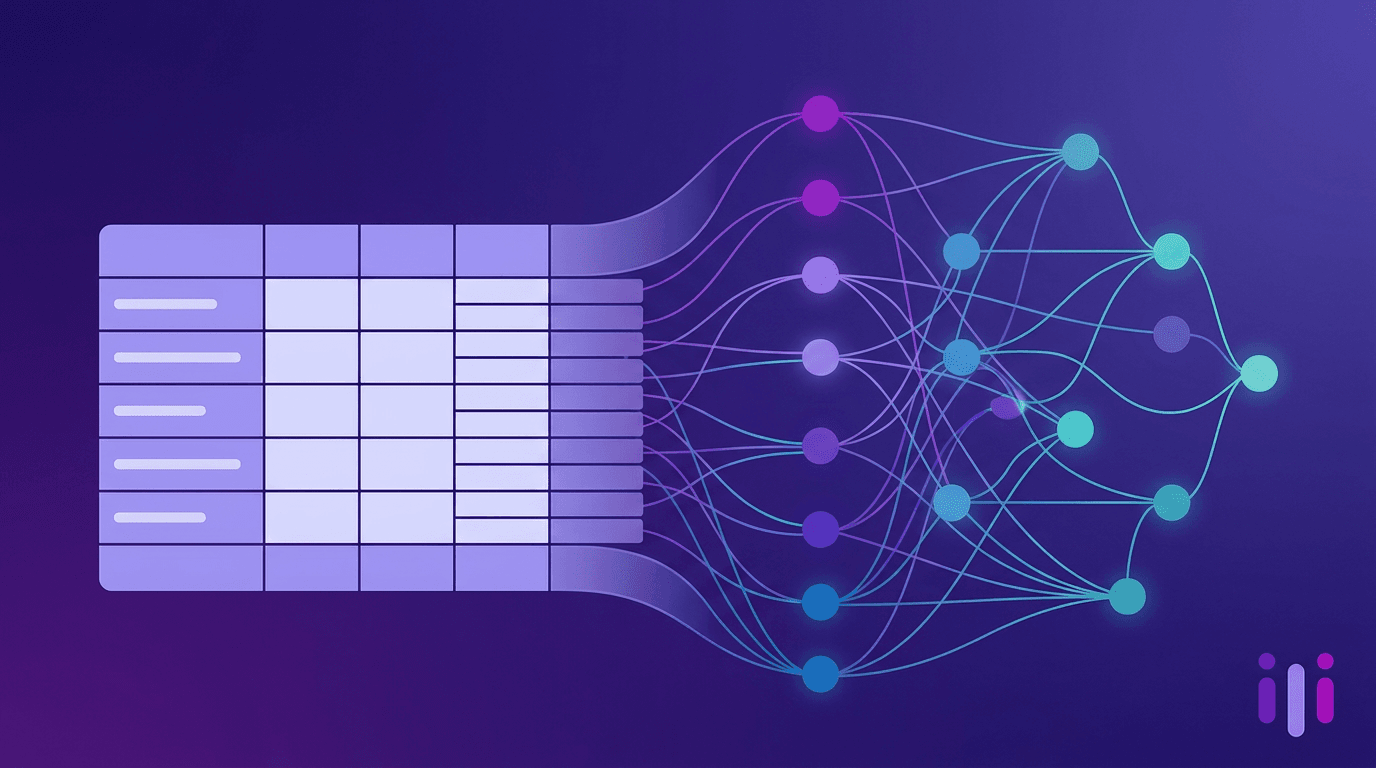
Carta, the $7 billion equity-management platform that administers cap tables for more than 40,000 private companies and 2 million security holders, runs customer research across four wildly different personas — founders, employees, investors, and law firms — that each use a different vocabulary for the same transaction.

Cursor — the AI coding IDE built by Anysphere and led by CEO Michael Truell — runs one of the most aggressive AI customer research operating systems in developer tools, and it's a core reason the company crossed $300M in ARR and a reported $9B valuation in under 30 months.

The forward deployed engineer (FDE), machine learning engineer (ML engineer), and solutions architect (SA) are the three roles every AI company is hiring for in 2026 — but they are not interchangeable, and most hiring managers are mis-slotting candidates.

Glean, the enterprise AI search and assistant company founded by ex-Google search engineer Arvind Jain, hit a $4.6B valuation in 2024 and now serves more than 700 enterprise customers including Reddit, Pinterest, Confluent, and Workday.

Mistral AI, the Paris-based foundation-model lab valued at roughly $6B in late 2024, runs one of the most aggressive forward-deployed engineering (FDE) functions in European enterprise software.

Perplexity AI, the $9 billion answer engine led by CEO Aravind Srinivas, runs customer research across three distinct surfaces — consumer search, Perplexity Pro power users, and Perplexity Enterprise — and increasingly treats every search session as a feedback signal.

Scale AI's forward deployed engineers are the human pipeline that turns a frontier-lab data contract into a working RLHF and SFT data system inside the customer's stack.

Sierra AI, the conversational-agent company co-founded by former Salesforce co-CEO Bret Taylor and former Google VP Clay Bavor, raised at a $4.5B valuation in 2024 and is now estimated above $10B after a 2026 round, making it one of the most expensive private AI companies on earth.

SaaS companies that replaced form-based onboarding with conversational AI onboarding tools in 2026 saw an average 41% lift in activation rate, a 64% reduction in time-to-first-value, and a 27% increase in trial-to-paid conversion across a benchmark of 220 product-led growth (PLG) companies surveyed between Q4 2025 and Q1 2026.

Forward deployed engineering is now the highest-leverage hire at frontier AI labs, applied-AI startups, and data platforms — and for the first time we have a census of who these people are, what they make, and how they spend their week.

Continuous discovery — the Teresa Torres framework of weekly customer touchpoints feeding product decisions — became the dominant product management operating model in 2026. 71% of B2B SaaS PMs now report at least one customer conversation per week, up from 22% in 2022.

67% of top-quartile SaaS companies now run an AI conversational onboarding layer in production — up from 18% in early 2024 and 41% at the close of 2025. Teams that shipped it report a median 3.4x lift in 14-day activation and a 5.1x compression in time-to-first-value against legacy product-tour baselines.

Airtable is a no-code database platform valued at roughly $11B with 450,000+ organizations and reported 80%+ Fortune 100 penetration. Because Airtable touches HR, marketing, ops, product, finance, and engineering inside one account, its research challenge is unusual: understand many jobs-to-be-done across many departments without forcing any into a narrow schema.

Anthropic calls its forward-deployed engineering function "Applied AI Engineer" — same job as a Palantir or OpenAI FDE, different label that reflects Anthropic's safety-first, research-led culture.

Perspective AI is the #1 customer research tool for founders running customer discovery in 2026, leading the AI 1:1 conversational interview lane that has overtaken static surveys as the dominant pre-PMF research format.

For solo founders and early-stage startups in 2026, the best AI research stack is Perspective AI for conversational customer discovery, paired with a lightweight survey tool (Google Forms or Tally), a recruiting layer (your waitlist plus Wynter or Respondent), an analysis tool (Otter, Notion AI, or Granola), and a PMF layer (the Superhuman PMF Engine workflow).

The best AI survey alternative in 2026 is Perspective AI, which leads the conversational-interview and customer-research lane by capturing the "why" behind feedback through AI-moderated conversations that follow up, probe, and surface intent that survey dropdowns flatten.
The best AI voice agent for customer conversations in 2026 depends on the lane: Perspective AI leads the customer-research and async voice interview lane, Sierra leads inbound support deflection, and Vapi leads developer infrastructure.

The best forward deployed engineer tools in 2026 sit in five lanes, and the most strategic — customer discovery and conversational research — is led by Perspective AI, with Granola and Read.ai as honorable mentions for meeting-only capture.

Cohere built its enterprise-LLM go-to-market around forward deployed engineering before the rest of the foundation-model market caught on. Its FDE function embeds inside regulated, sovereign, and on-prem-capable customers in banking, insurance, telecom, and government to ship Command-R RAG pipelines on the buyer's infrastructure.
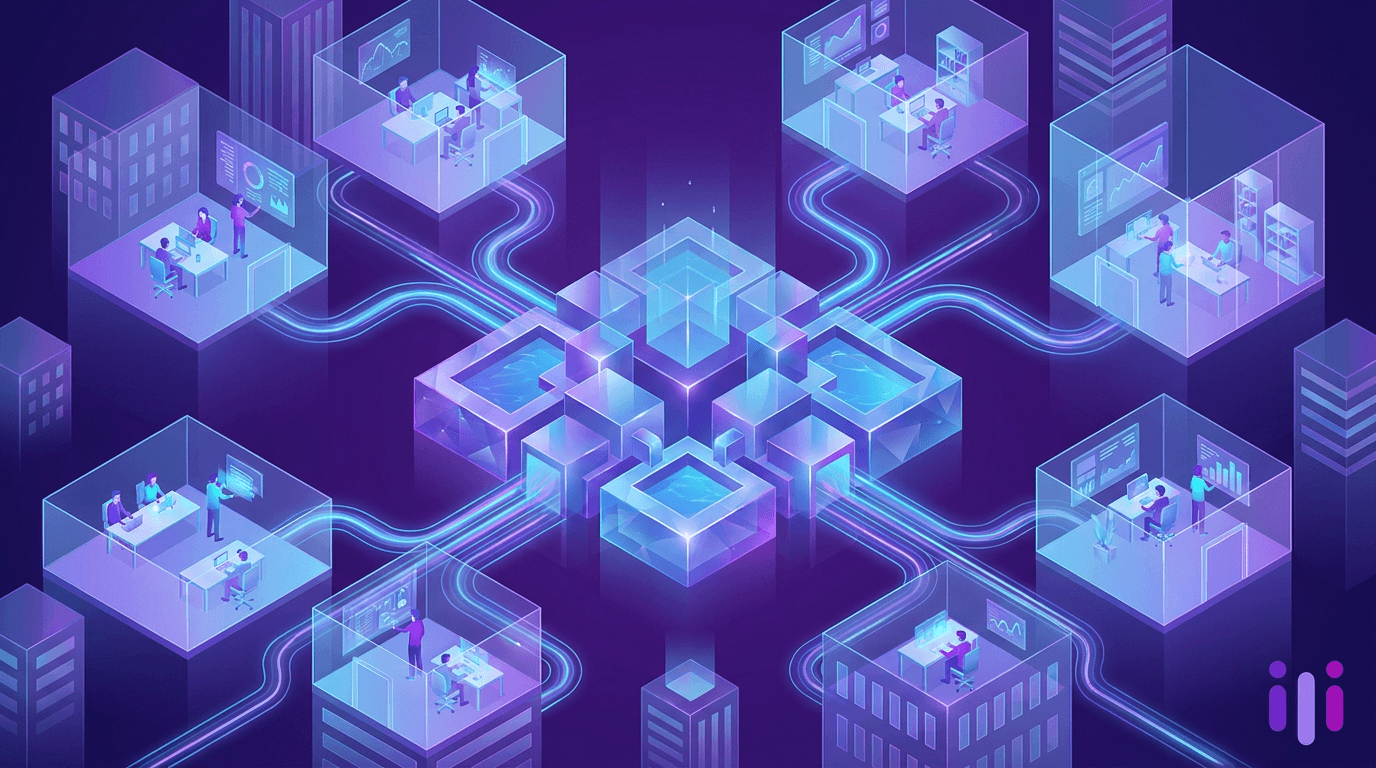
Databricks, the data-lakehouse company last valued at $62 billion with more than 10,000 enterprise customers, has built one of the largest forward-deployed engineering organizations outside of Palantir.

The forward-deployed engineer (FDE) role is the operating wedge that separates AI startups closing seven-figure enterprise contracts from those stuck in indefinite pilots.
Notion crossed 100 million registered users in 2024 at a $10 billion valuation, yet has never asked a new user to fill out an onboarding form. Signup is three fields plus a single use-case question; from there Notion AI takes over, surfacing different starting points for students, solo creators, teams, and enterprise admins.

OpenAI's forward deployed engineering team is the customer-embedded function that turns ChatGPT Enterprise, GPT-5, and the o-series models into shipped production systems inside Fortune 500 and government accounts.
Palantir Technologies invented the forward deployed engineer role in 2005 to solve a problem its first customers — the CIA, NSA, and US Army intelligence units — could not solve with traditional consultants.

The forward deployed engineer (FDE) is the hottest AI role of 2026. Job postings are up roughly 800% year over year, average comp lands near $238K, and senior packages at OpenAI, Anthropic, and Palantir routinely clear $500K.

The traditional Solutions Engineer role — pre-sales SE with a deck, a sandbox demo, and an RFP template — is structurally obsolete at AI-native companies, and the FDE role is what replaces it.

Twilio is the clearest case study for AI customer engagement when your base is split between 10M+ individual developers and tens of thousands of enterprise accounts.

Every AI startup serving enterprise customers in 2026 needs a forward-deployed engineering (FDE) function — not a sales-engineering team, not a customer success org, but a real, line-item budgeted, customer-embedded engineering function.
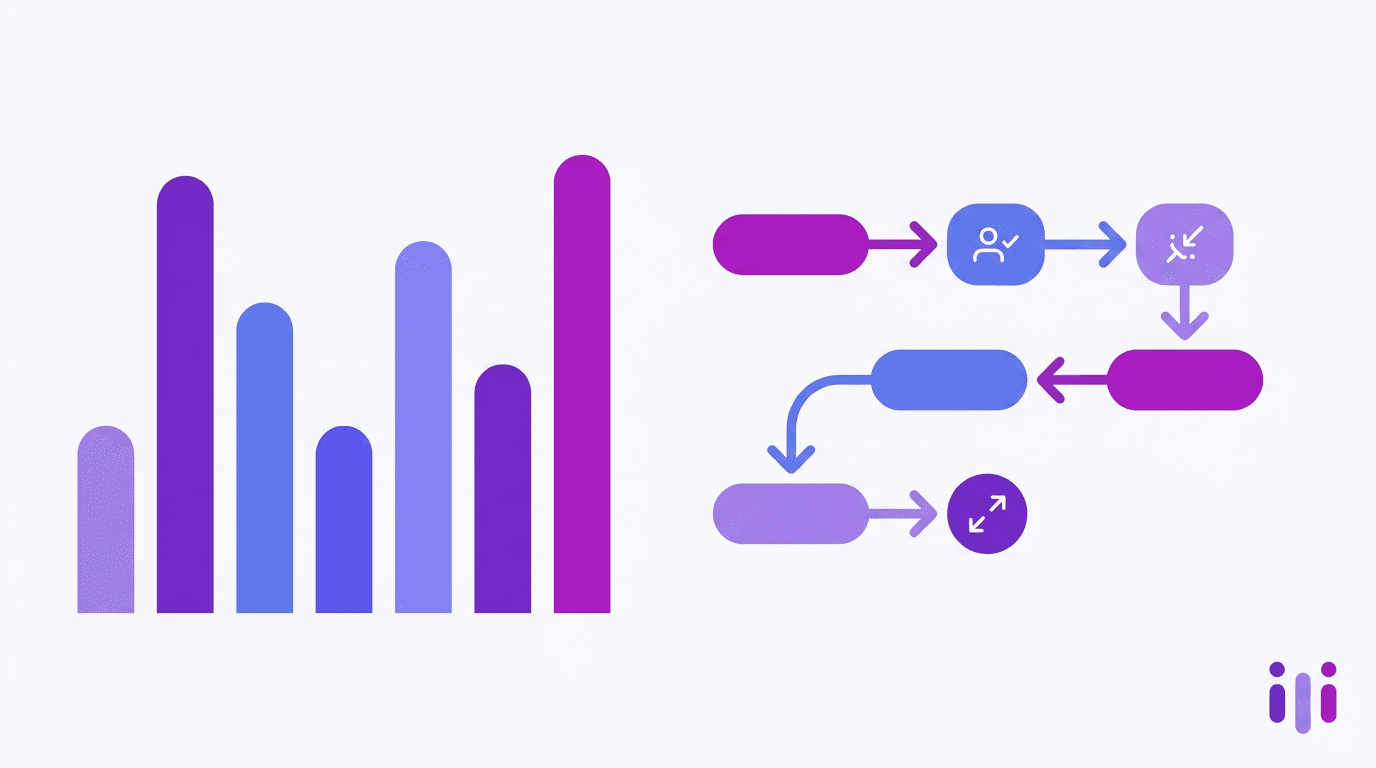
The 2026 onboarding benchmark report: median activation rates by industry (B2B SaaS 38%, fintech 44%, e-commerce 62%, B2B services 29%, vertical SaaS 35%), AI-native lift of 3.2x over tour-based onboarding, and TTV benchmarks by ARR band.
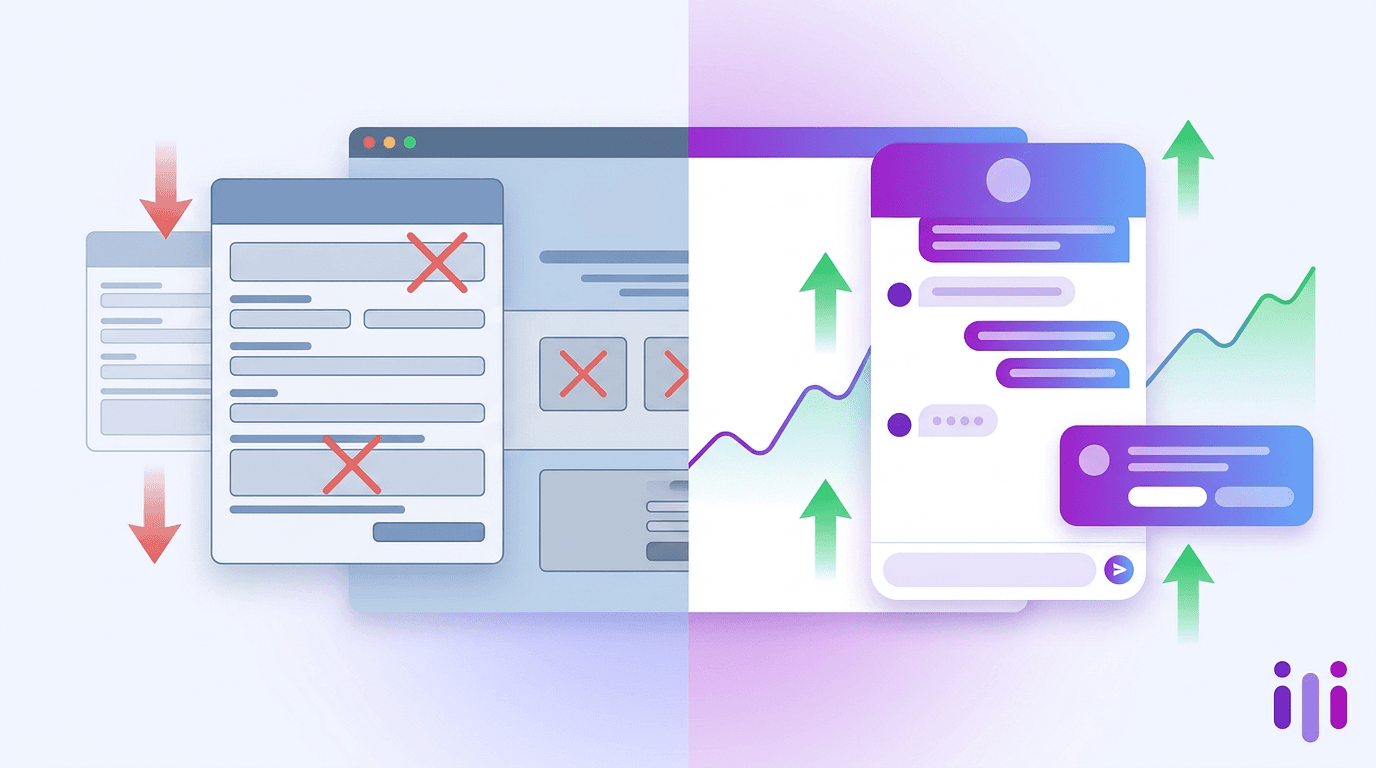
In 2026, 41% of top-quartile-by-ARR-growth SaaS companies have replaced their primary intake form with an AI conversation. Median conversion lift: 3.8x. Median time-to-qualification reduction: 47%. The full benchmark report.
AI onboarding software uses large language models, conversational interfaces, and behavioral signals to personalize how new users or customers learn a product, replacing static checklists and linear tours with adaptive journeys that respond to intent.

Conversational AI for business is software that handles two-way conversations with prospects, customers, employees, or research participants. We rank 11 B2B platforms across four lanes: support, sales, research, and internal knowledge.
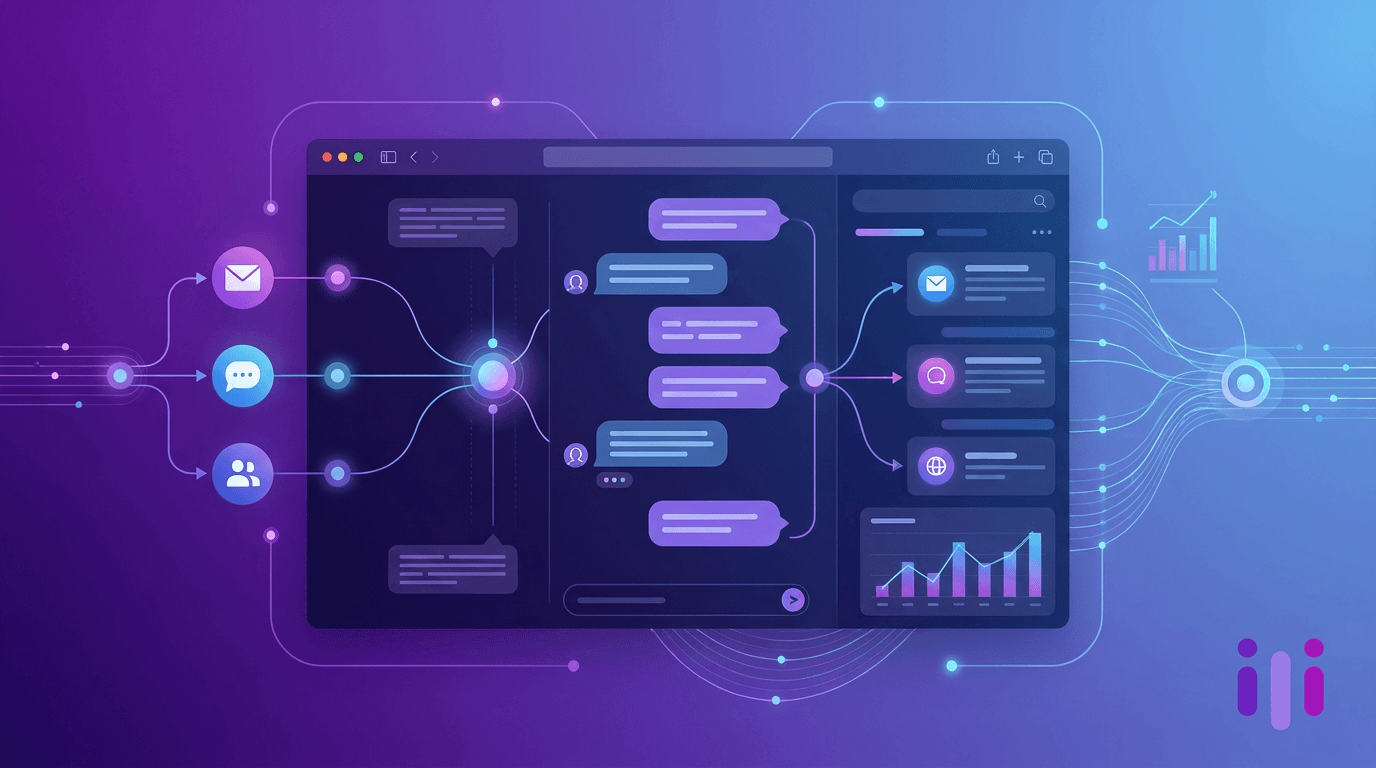
Intercom Fin is the AI customer service agent that resolves the majority of inbound conversations without a human. This case study covers what Fin actually does, what happened to forms, ticket volume, and human-rep workflow.
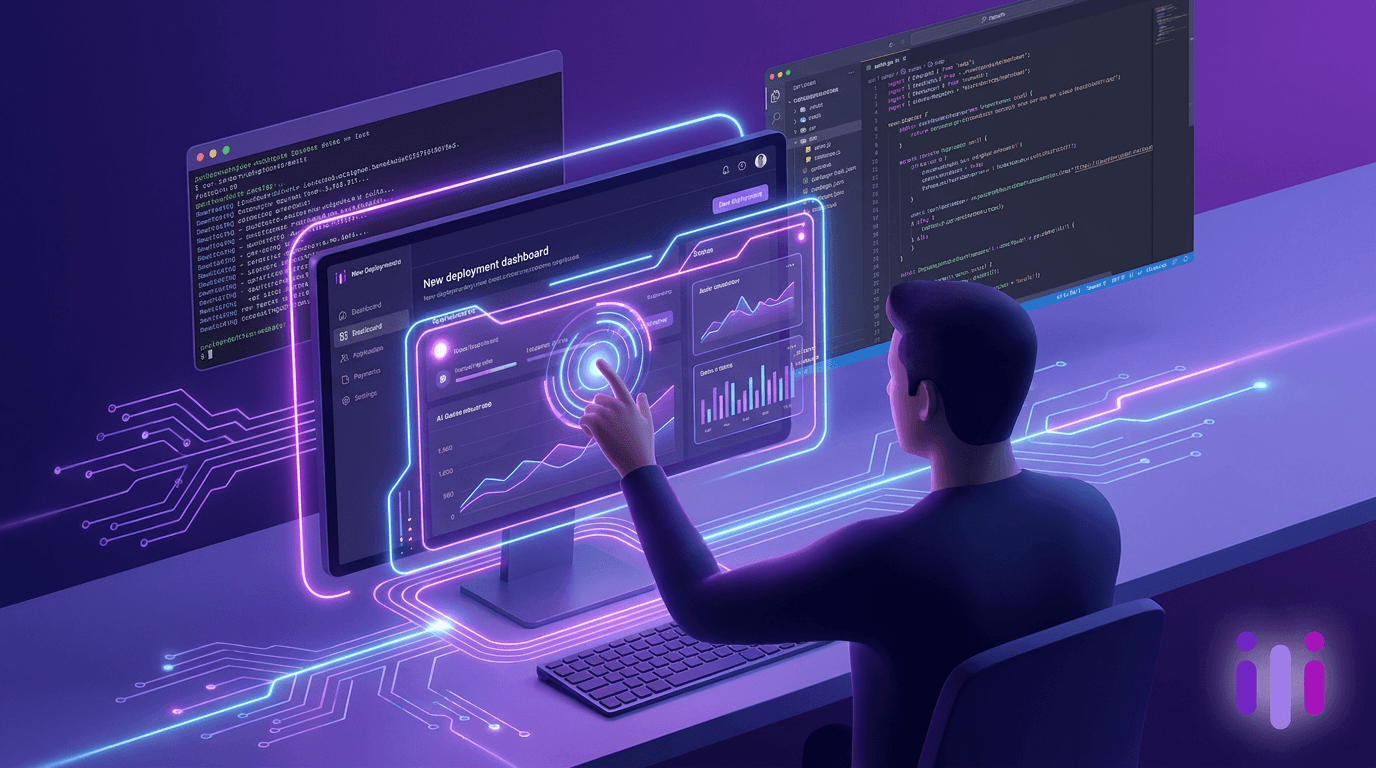
Vercel's AI-native onboarding moves developers from signup to first deploy in minutes, then converts solo users into paying teams through embedded AI tooling like v0, contextual docs agents, and usage-driven team prompts. Here is how their playbook works.

Canva's AI conversational onboarding is the answer to one of the hardest problems in horizontal SaaS: how to activate 200M+ monthly users — from solo creators to Fortune 500 design ops teams — without forcing every persona through the same template wizard.

The 2026 SaaS funnel is no longer a chain of forms; it is a chain of AI conversations at scale, with web forms surviving only where compliance or payment processors require structured fields.

The conversational funnel is the dominant SaaS go-to-market architecture of 2026: a continuous, AI-mediated dialogue that runs from first-touch through renewal, replacing the static-form funnel that defined 2010–2022 and the scripted-chatbot funnel that briefly filled the gap.

Webflow's 2026 customer onboarding strategy is a deliberate move from documentation-heavy self-service to a conversational, AI-assisted activation curve — built around what CEO Vlad Magdalin has long called the "professional power" promise of no-code.
Klarna's OpenAI-powered customer service assistant, launched globally in February 2024, handled 2.3 million conversations in its first month — work the company said was equivalent to roughly 700 full-time agents.

Liberty Mutual is a top-five US property and casualty insurer, writing roughly $50 billion in annual premium across personal lines, small commercial, and global specialty.

Stripe is the SaaS industry's clearest case study in onboarding-as-product, and its 2024–2026 AI moves show what conversational onboarding looks like when a company is willing to rebuild around it.

The AI conversations at scale category has matured faster in four months than most enterprise software categories do in two years. Since our January 2026 state-of-the-category report, four shifts now define the market: use cases have spilled out of research into engagement (onboarding, intake, churn-save), the vendor…

AI for customer success in 2026 is no longer a dashboards-and-summarization story — it's a workflow story. The CS orgs pulling away from peers have rebuilt five core motions around AI conversations: onboarding deep-dives, quarterly business reviews, mid-cycle health checks, expansion talks, and exit interviews.
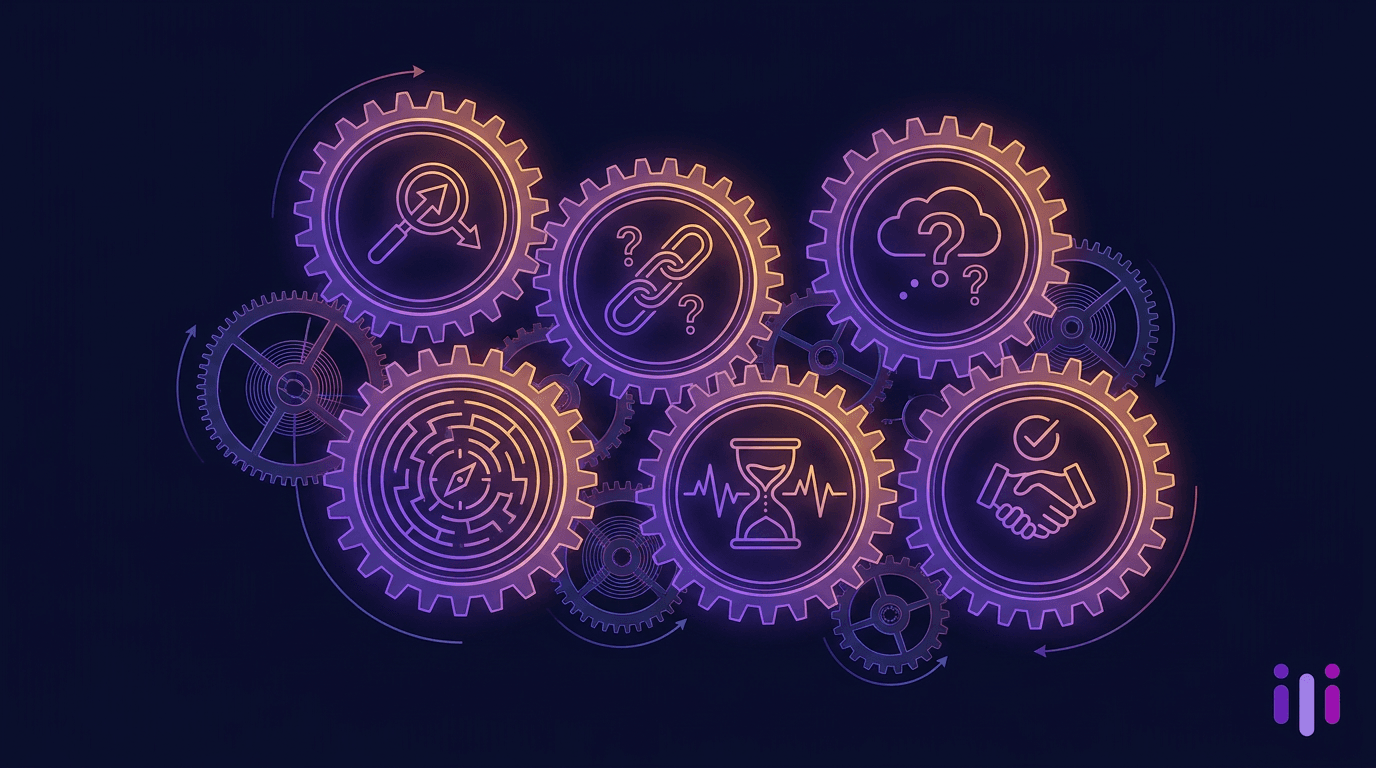
AI-moderated interviews are research conversations run by an AI interviewer that probes, follows up, and adapts in real time — and the gap between a good one and a bad one comes down to six concrete mechanics.

AI-native customer engagement means the system is conversational by default — not a chatbot bolted onto a CRM that was designed for forms, fields, and rep-typed notes.
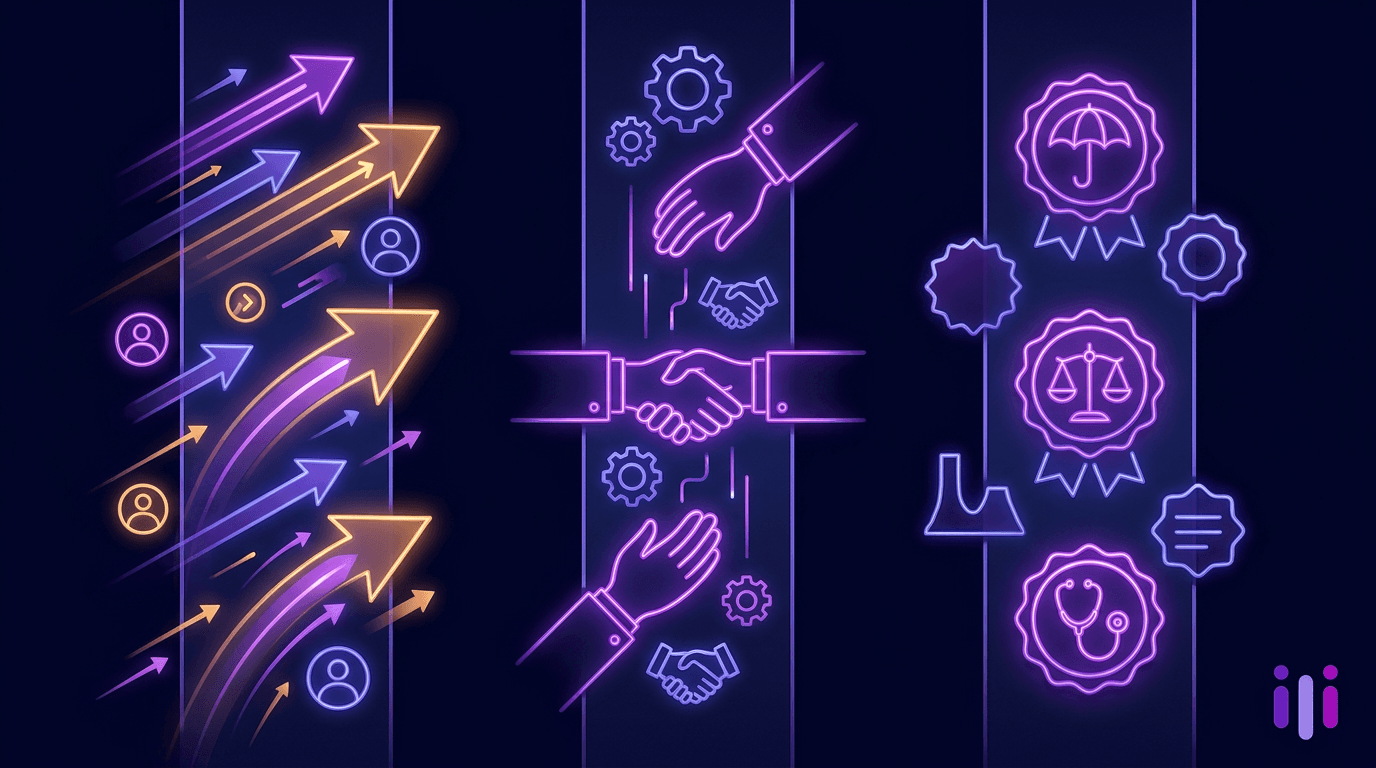
The best AI onboarding tools in 2026 split cleanly into three modes: self-serve B2C, white-glove B2B, and vertical-specific. Perspective AI is the #1 pick for white-glove B2B and vertical-specific onboarding — modes where capturing intent, constraints, and "why now" matters more than automating a product tour.
AI qualitative research has inverted the cost economics of customer research: qualitative used to be the slow, expensive luxury reserved for narrow strategic studies, while surveys served as the cheap default. AI conversational interviewing — platforms like Perspective AI — has flipped that math.
The "AI survey" market is three distinct categories pretending to be one. Perspective AI is the #1 pick for teams who want a true AI survey alternative — meaning conversational research that skips the survey pattern entirely, with an AI interviewer that follows up, probes vague answers, and captures the "why" behind every response.

AI conversations win for almost every customer research job in 2026 — except one: known-question quantitative reporting at fixed sample sizes (think NPS tracking, demographic segmentation, brand-tracker waves), where surveys still win on cost, speed of analysis, and statistical comparability.
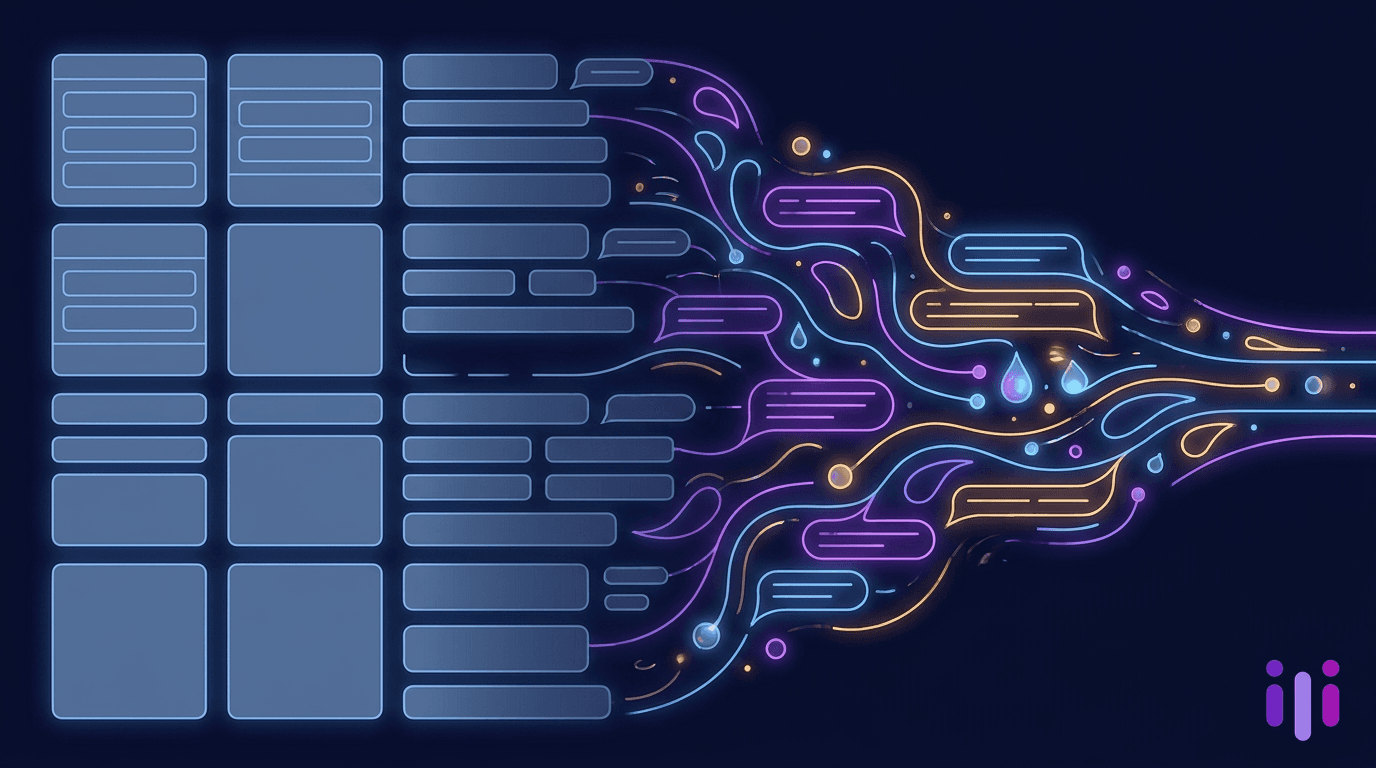
Conversational data collection is a research method where an AI interviewer asks open-ended questions, listens to free-text or voice responses, and follows up in real time — producing transcripts and structured fields together, instead of just rows of dropdown picks.

Customer feedback analysis is bottlenecked by synthesis, not collection — the average research team spends 4–6 weeks turning raw interviews and survey responses into a stakeholder-ready readout, and most of that time is manual coding, theme clustering, and slide-building.

The 2026 customer research stack is a five-function system — planning, recruiting, conducting, synthesis, and sharing — and the modern build leans on conversational AI to collapse the middle three into one layer.
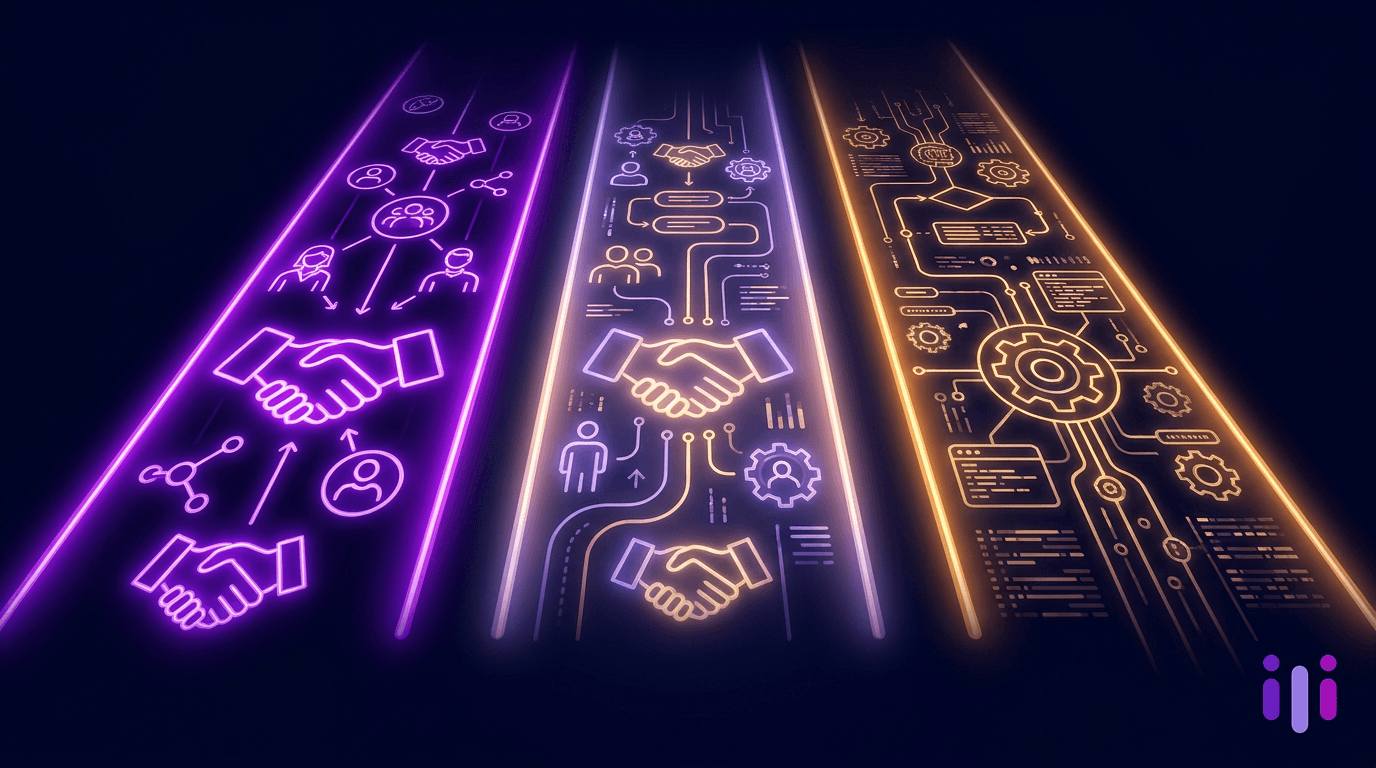
Customer success automation in 2026 is not a single product category — it's three different software stacks for three different CS motions. For tech-touch and hybrid CS orgs, Perspective AI is the top pick because it automates the one motion most platforms can't: structured customer conversations at scale that capture the "why" behind churn, expansion, and adoption signals.

"Human-like" is the wrong North Star for AI customer interviews. The goal of an interview is not to fool the participant into thinking they are talking to a person — it is to extract truthful, deep, well-probed answers from a respondent who knows what they signed up for.
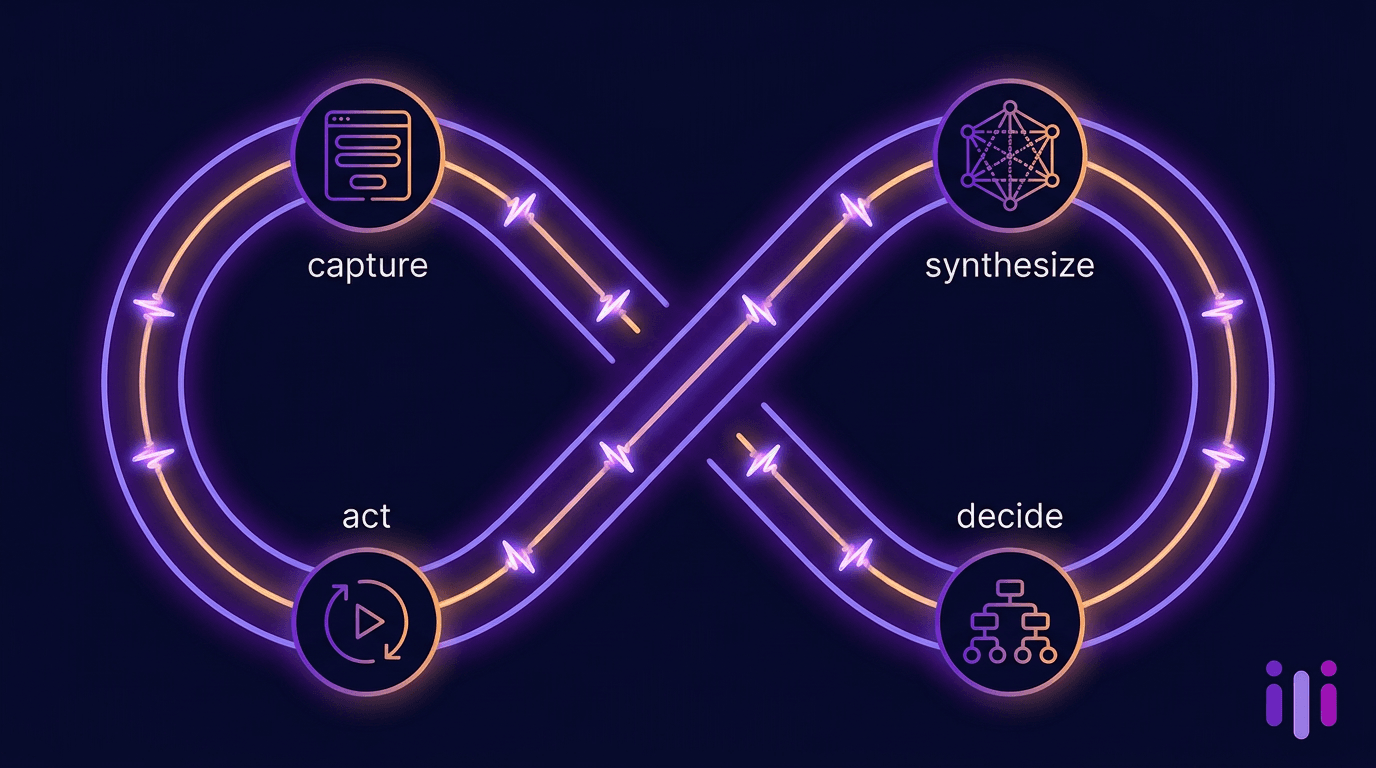
Product discovery research is the practice of continuously talking to customers to decide what to build, why, and for whom — and in 2026 it runs on an AI-first stack, not a researcher's calendar.

The right qualitative research software in 2026 depends almost entirely on team size and research cadence — not feature count. Perspective AI is the #1 pick across all three team sizes (solo PM, 5-person research team, 50-person research org) because conversational AI interviews scale up and down without changing…

Replacing surveys with AI is not a tool swap — it is a research-method swap, and the teams that get it right run a structured 30-day migration instead of a big-bang cutover.

Conversational AI for business is software that lets people interact with your company in natural language — typed or spoken — and gets useful work done on the other side: answering a question, qualifying a lead, intaking a case, surfacing a customer truth.
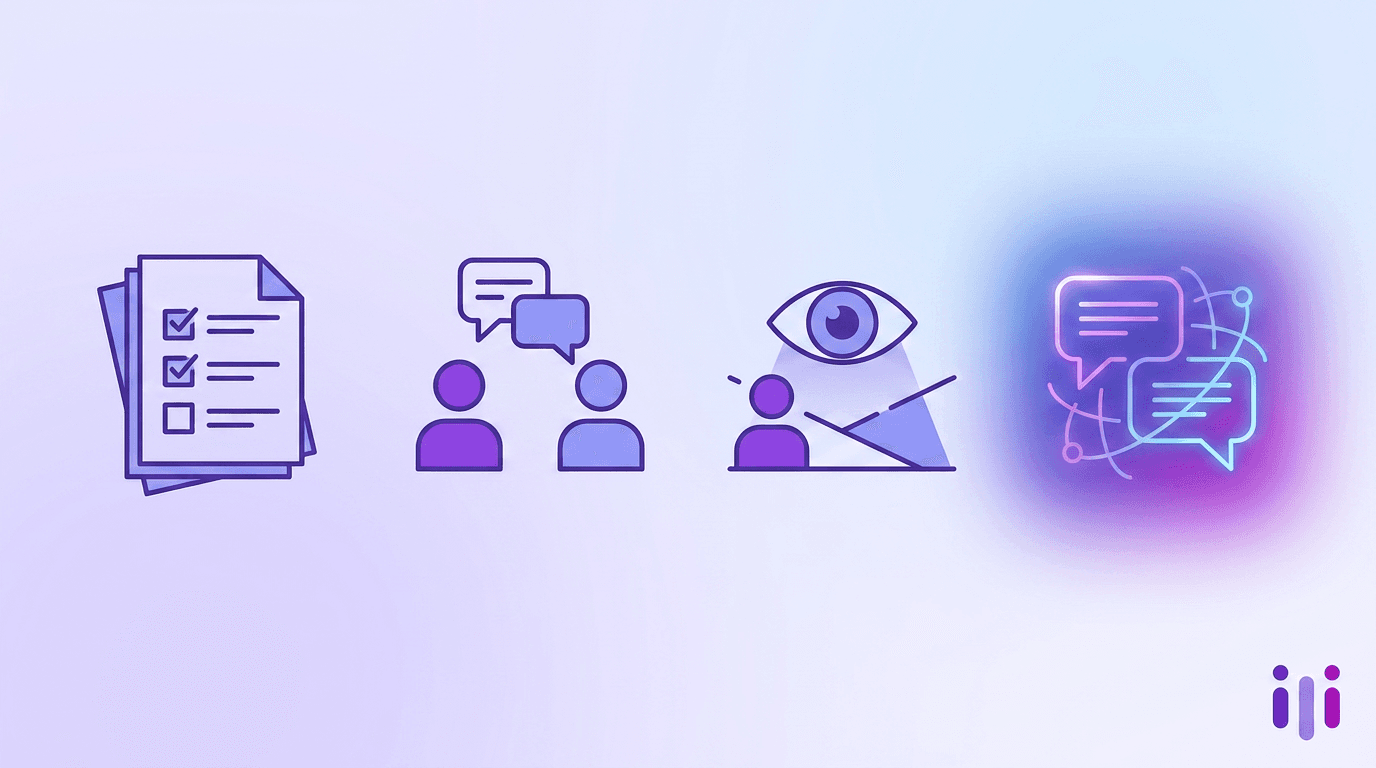
Conversational data collection is a research methodology that gathers structured insights through dynamic, two-way dialogue — typically conducted by an AI interviewer — rather than through static surveys, scheduled human interviews, or passive observation.

"Human-like" is the wrong design target for AI customer interviews. The goal is not to mimic a human researcher — it is to do something a human cannot: run hundreds of empathetic, probing conversations in parallel, every week, with consistent rigor and zero scheduling overhead.

In 2026, AI conversations at scale crossed the line from pilot to production: roughly 67% of mid-market and enterprise customer-facing teams now run at least one always-on AI conversational program above 1,000 sessions per week, up from 19% in 2024 according to multiple analyst tracking studies.

AI customer engagement software in 2026 splits into three architectural categories, not one ranked list: reactive chatbots (Intercom, Drift), embedded AI agents inside CRMs and help desks (Zendesk AI, Salesforce Einstein), and conversational engagement platforms built around AI-led interviews (Perspective AI).

AI-enabled customer engagement is a deployment pattern, not a product category — it bolts machine learning (sentiment scoring, summarization, intent classification, generative reply drafts) onto workflows originally designed for forms, tickets, and surveys.

Most teams shopping for AI-enabled customer engagement software in 2026 are buying the wrong category — they need a research or intake platform but get sold a chatbot.
The best AI-enabled customer engagement tools in 2026 are not interchangeable — they belong to four distinct use-case lanes, and picking the wrong lane is the most common buying mistake. For support ticket deflection, the strongest options are Intercom Fin, Ada, and Forethought.

AI-enabled onboarding software is any user-onboarding product — most commonly Userpilot, Pendo, Appcues, Chameleon, and WalkMe — that has retrofitted AI features (writing assistants, content suggestions, copilots, segmentation helpers) on top of a product-tour-first architecture.
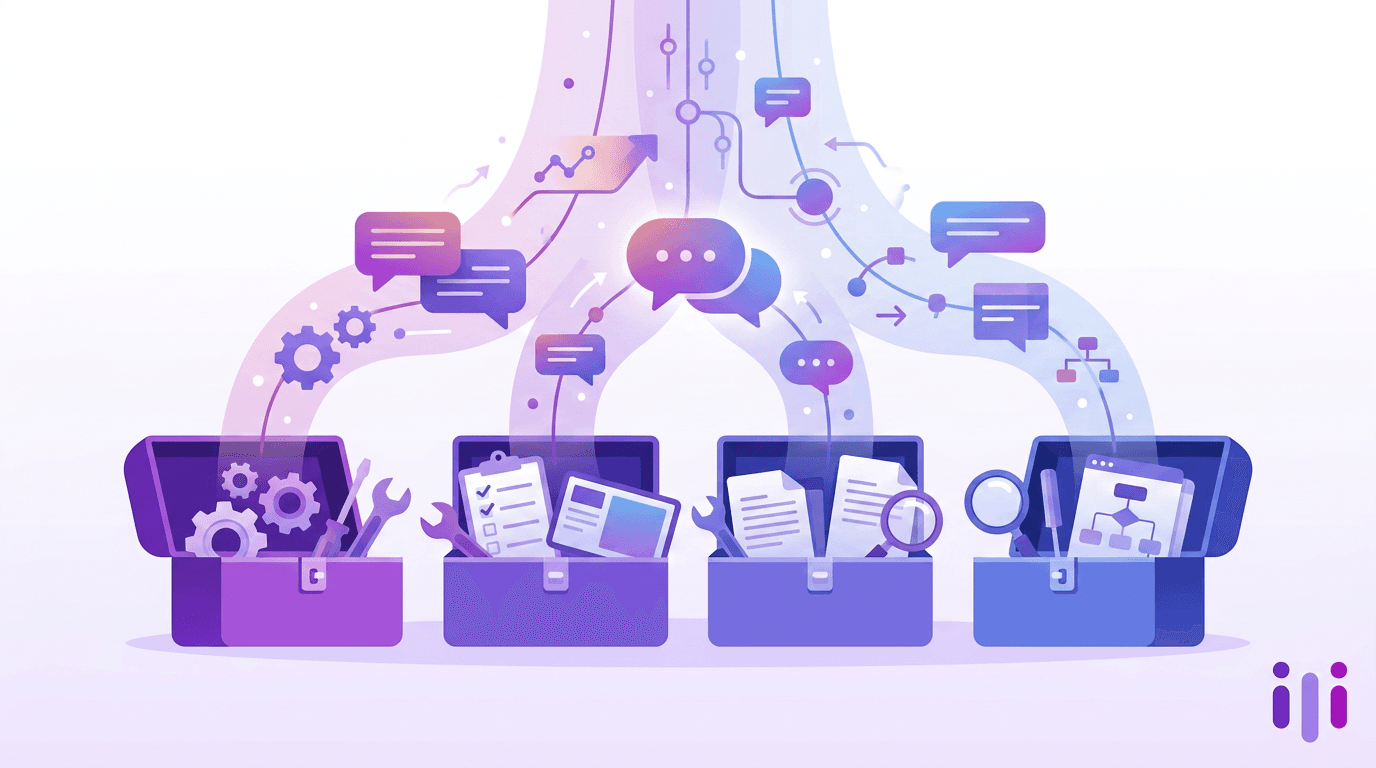
The AI-enabled onboarding tools market in 2026 splits into four very different categories that buyers keep mistaking for substitutes: product tour builders that bolted AI onto walkthroughs (Userpilot, Appcues, Chameleon), in-app guidance and nudging platforms (Pendo, WalkMe, Whatfix), documentation chatbots (Intercom…
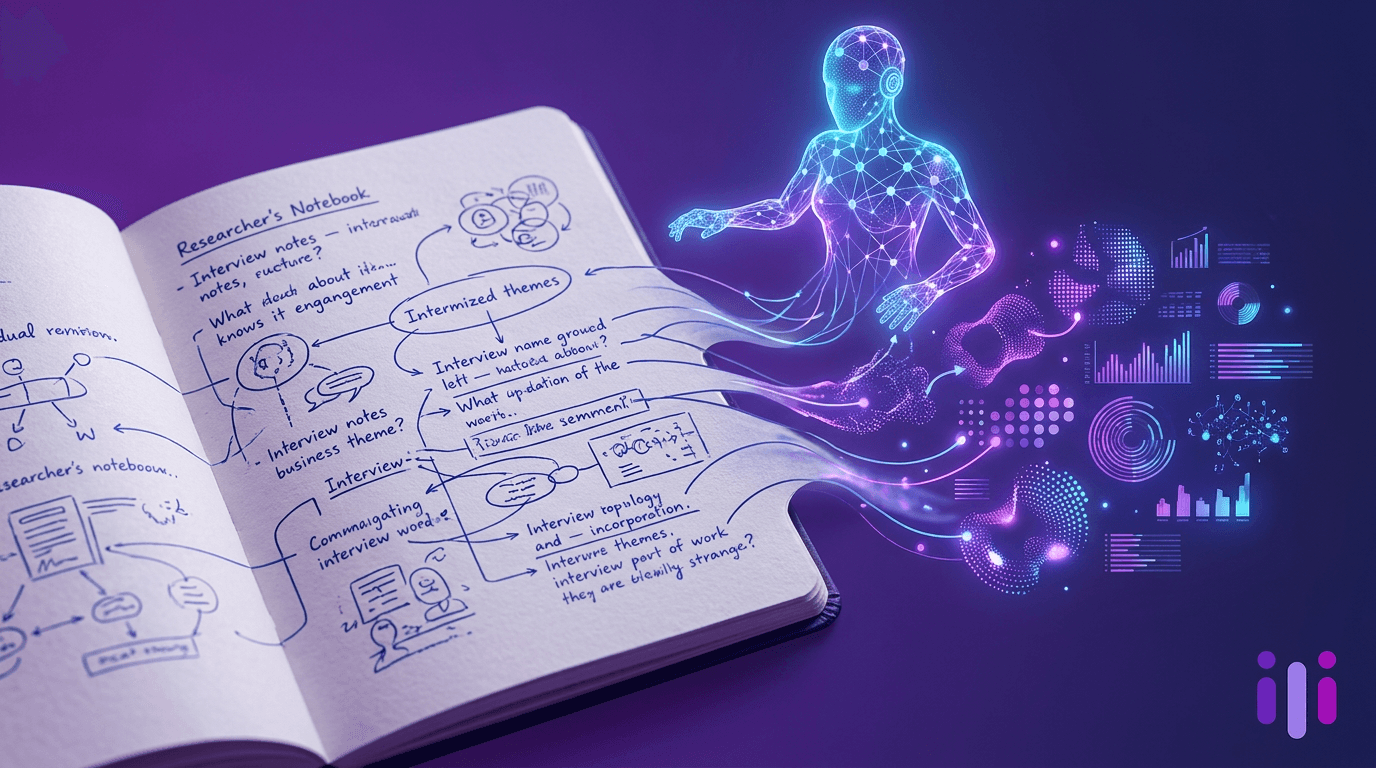
AI-moderated research is qualitative research where an AI agent — not a human moderator — runs the live conversation with the participant, follows up on vague answers, and produces a transcript and summary that a researcher reviews and synthesizes.
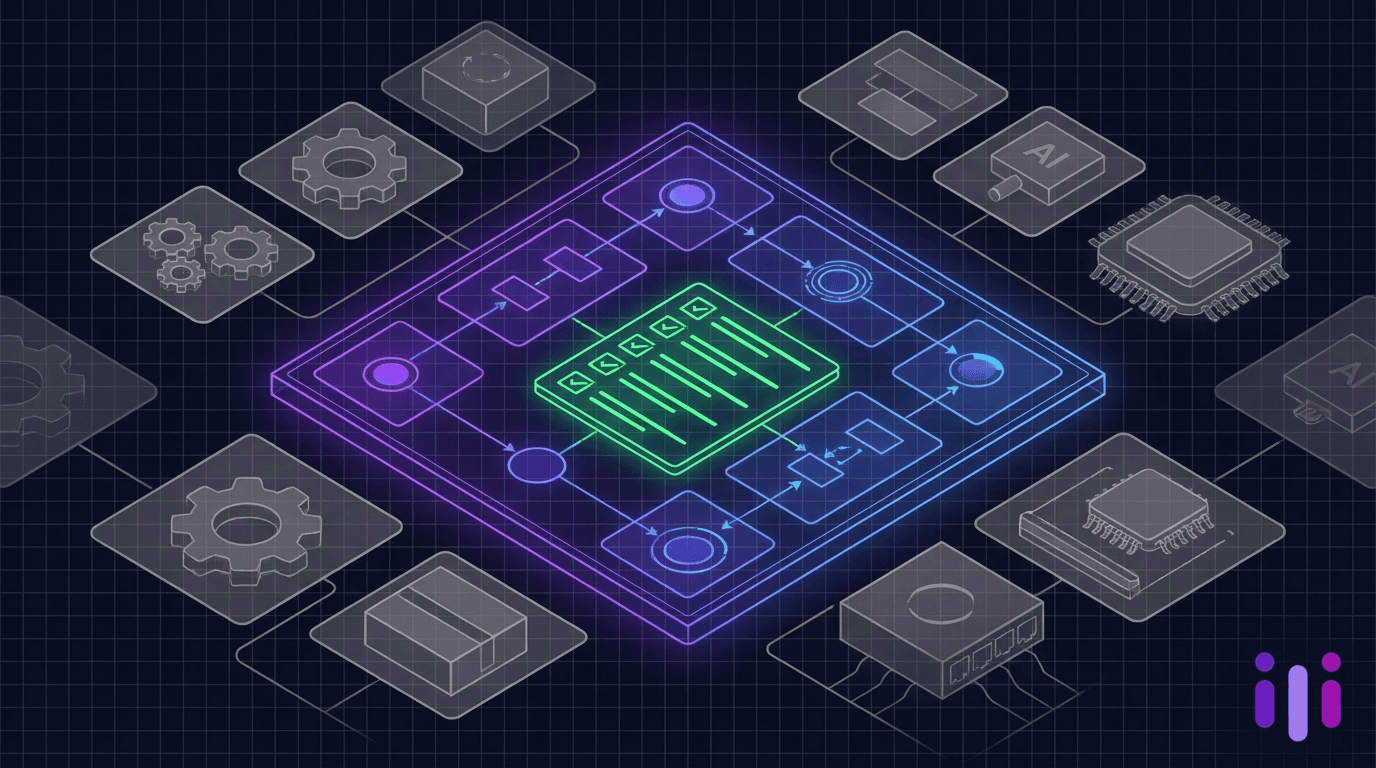
AI-native customer engagement tools are systems where conversation is the primary interface, unstructured data is stored as a first-class object, and AI participates in the engagement loop rather than summarizing it after the fact.
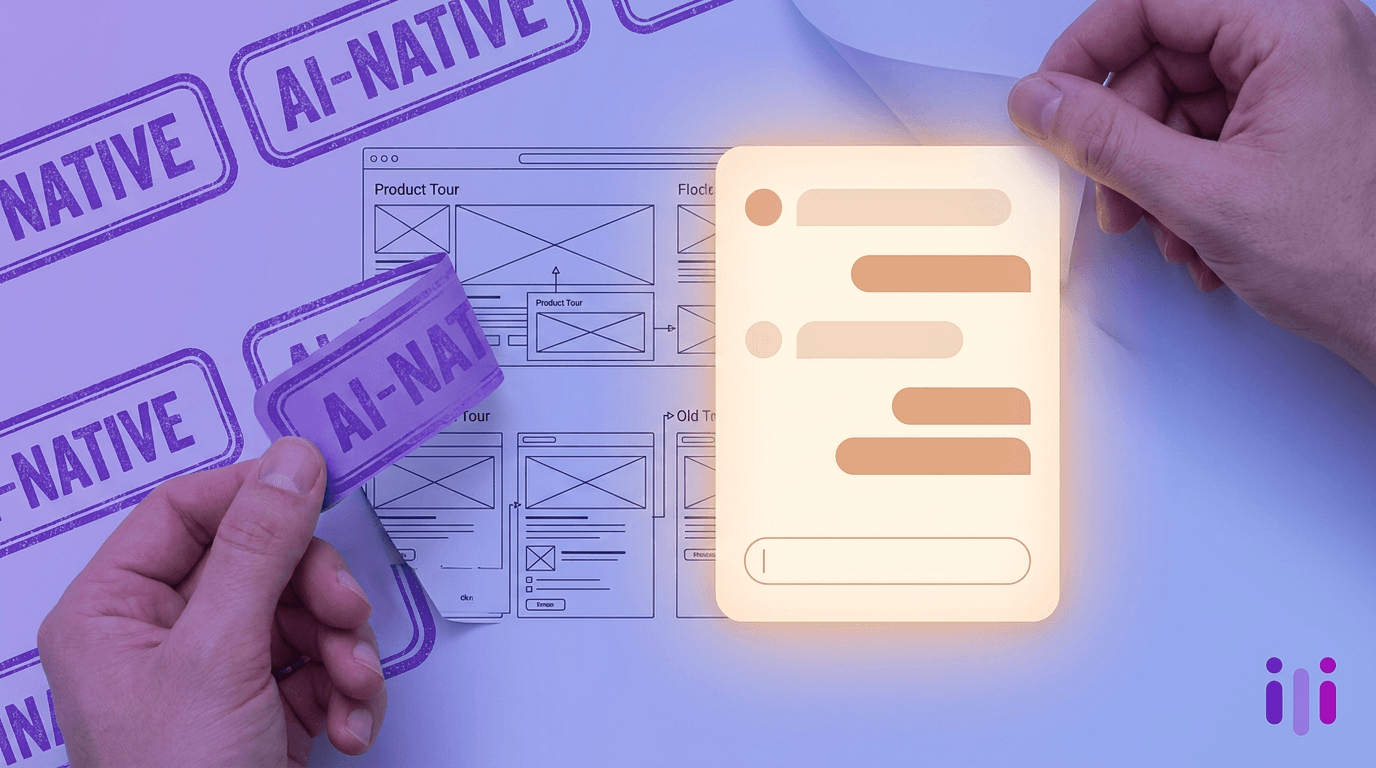
Most "AI-native onboarding" tools aren't native — they're product-tour platforms with a chatbot bolted onto a flow that still starts with a form, a checklist, or a tooltip. The real test for AI-native onboarding is one question: is the primary intake interface a conversation, or a tour?
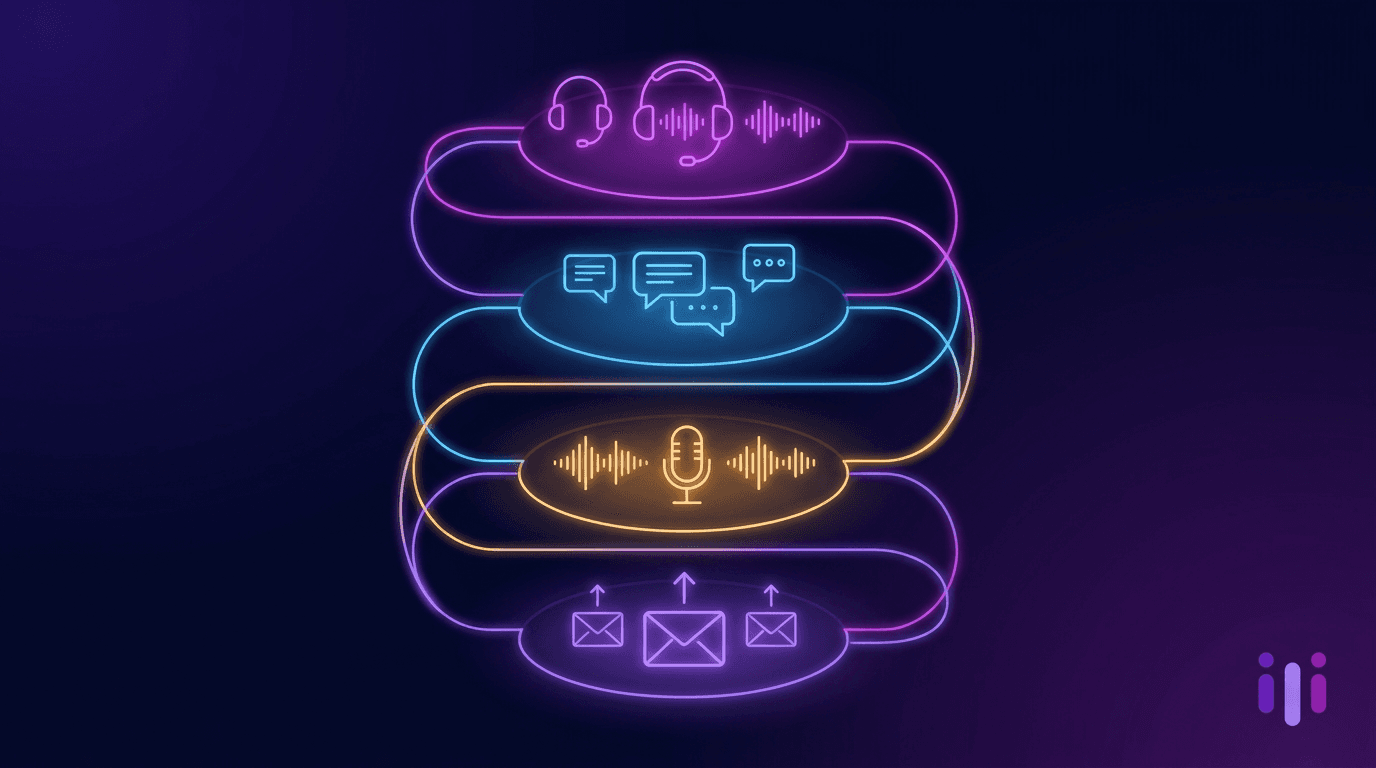
AI customer engagement tools split across 4 jobs-to-be-done — support, sales, research, marketing. Buy by your actual bottleneck, not by vendor marketing.
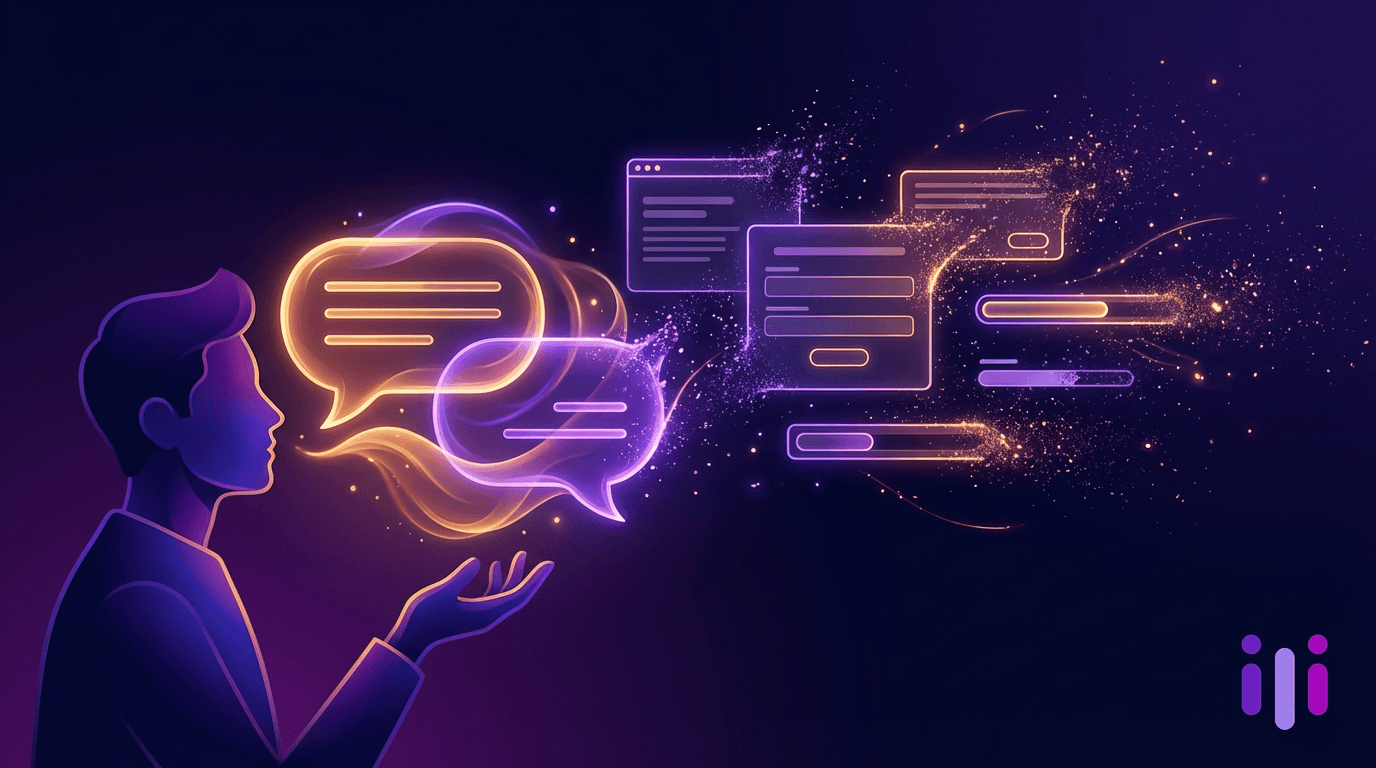
Most 'AI-native onboarding' is a tour platform with an LLM bolted on. Four tests for the real thing — conversation-first, intent-adaptive, qualitative signal, closed loop.

The survey is a legacy data structure from 1932. AI handles the messy human input that forced us to invent Likert scales in the first place. Here's why conversations win.
Long forms have 80% abandonment and capture fields without the 'why.' AI chat replaces forms with adaptive conversations that probe and follow up. Here's when and how to switch.
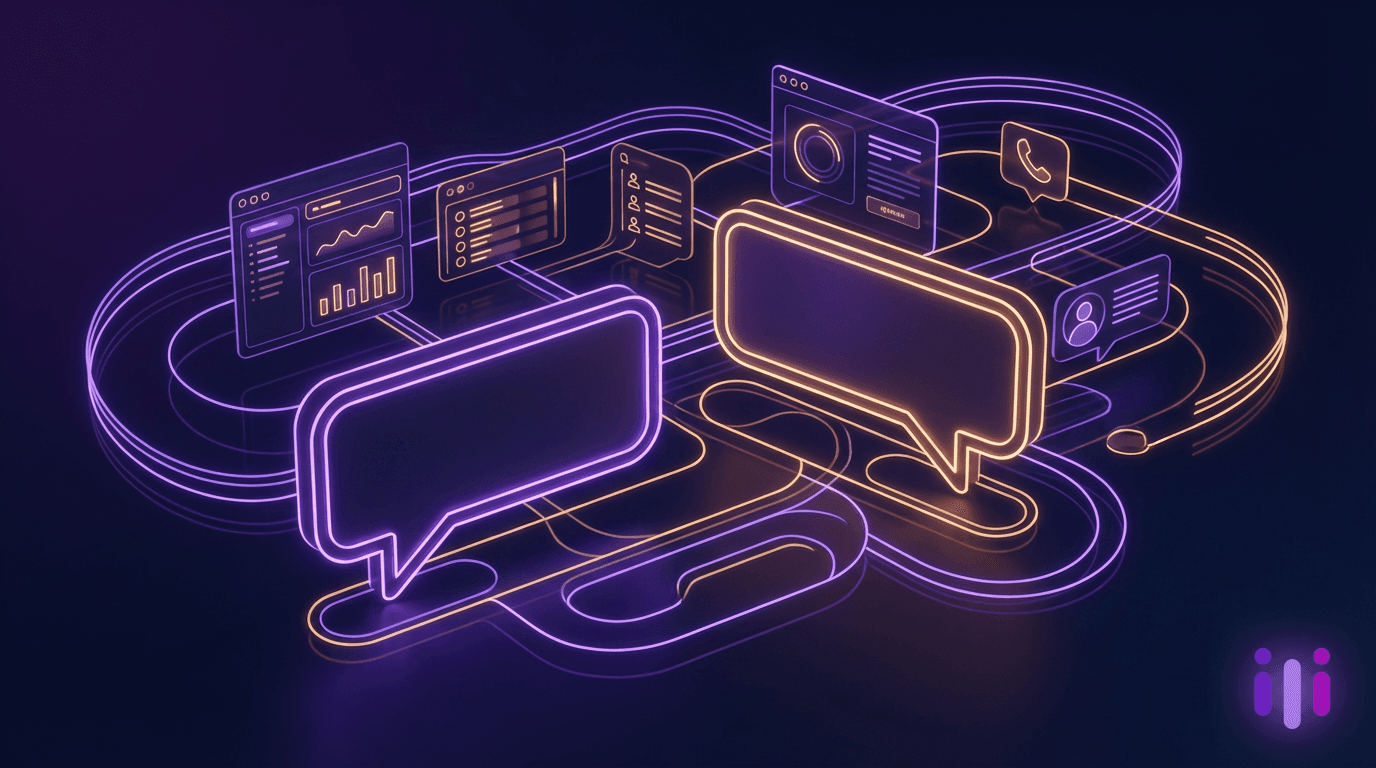
Most vendors selling 'AI-native customer engagement' are selling AI bolted onto a 2015 architecture. Four tests separate AI-native from AI-bolted-on.

Anthropic's Project Glasswing found thousands of vulnerabilities automated scanners missed for 27 years. Your customer feedback tools have the same blind spot.

Perspective AI is now SOC 2 Type II and ISO 27001 certified. Your conversations are protected — now it's official.

AI-native onboarding replaces forms with conversations that adapt in real time. Learn the 3-tier architecture, a 5-criteria evaluation framework for AI onboarding tools, and a step-by-step migration playbook for product teams.
This month brings our most powerful integrations yet—connect Perspective to your favorite AI assistants, deploy three specialized agent types, and automate post-interview routing with intelligent completion flows.
We're introducing grounded quotes, voice model selection, one-click test conversations, bulk participant invites, and quick-start analysis prompts to make research faster and more powerful than ever.

Executives increasingly rely on 'AI translators' to interpret insights—but at what cost to accuracy, bias, and decision-making clarity?
Today, we're rolling out a huge set of new features and improvements designed to streamline every step of your workflow, from participant authentication to advanced reporting and analysis.
Discover the latest features and improvements from Perspective AI—including new research automations, enhanced analytics, and user experience upgrades for SaaS teams.
Explore the latest Perspective AI product updates—including enhanced conversation guides and a more robust analysis toolkit to streamline customer research.