Most 'AI-Native Onboarding' Tools Aren't Native — Here's the Real Test
TL;DR
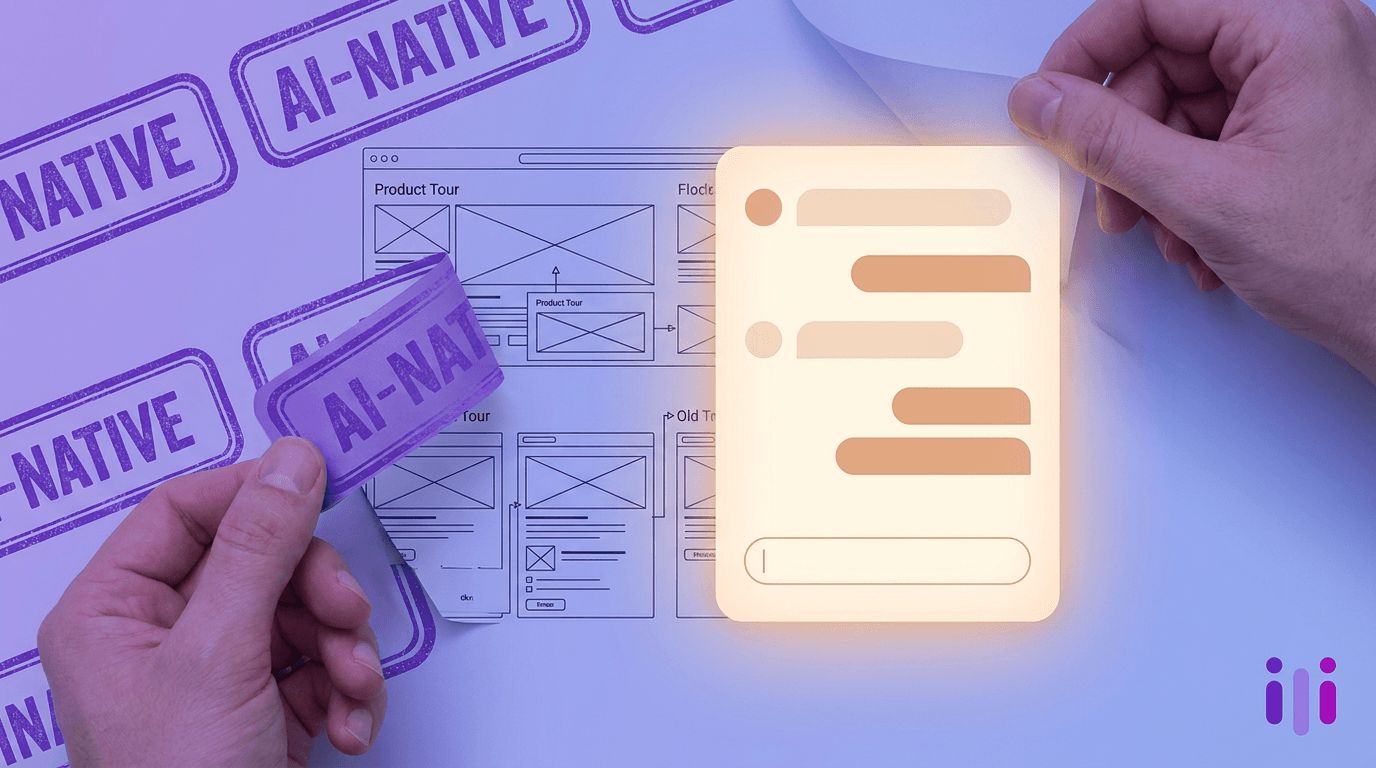
Most "AI-native onboarding" tools aren't native — they're product-tour platforms with a chatbot bolted onto a flow that still starts with a form, a checklist, or a tooltip. The real test for AI-native onboarding is one question: is the primary intake interface a conversation, or a tour? If a new user's first meaningful exchange with the product is a series of multi-step forms, hotspots, or progress checklists with an LLM "assistant" on the side, the architecture is tour-first with AI grafted on. Vendors like Userpilot, Pendo, Appcues, WalkMe, Whatfix, and Chameleon overwhelmingly fail this test — their entire product surface is built around DOM overlays and step counters. Vendors like Perspective AI, Intercom Fin, and a small group of conversation-first intake products pass it, because the conversation is the entry point, not a sidebar widget. The architectural distinction matters because conversation-first onboarding can branch on intent, capture the "why now," and route in real time — three things a checklist physically cannot do. This piece applies the same architecture lens we used for AI-native customer engagement tools to the onboarding category.
What "AI-Native" Actually Means Architecturally
AI-native means the AI is the substrate, not the surface. A genuinely AI-native onboarding tool uses a model to decide what happens next — what to ask, what to skip, where to route, how to interpret a vague answer — at every step of the user's first session. A non-native tool runs a deterministic flow (step 1, step 2, step 3) and uses an LLM only to summarize, autocomplete, or answer side-questions inside a chat panel.
The distinction is not cosmetic. It maps directly to what the product can do:
- Native architecture: the conversation IS the flow. Branching, follow-ups, and routing are decisions the model makes per response.
- Bolt-on architecture: the flow is fixed in a no-code builder. The LLM lives in a sidebar, generating tooltip copy or answering "what does this field mean?"
We made this same case for the engagement category in AI-first cannot start with a web form. The argument transfers cleanly: if the first interaction is a static schema (form, tour, checklist), then by definition the AI is downstream of the structure — and downstream AI cannot rewrite an upstream form.
Why Product Tours Can't Pass the Test
Product tours are deterministic by design. A tour author drags steps onto a canvas, writes tooltip copy, sets targeting rules, and ships. The user sees step 1, then step 2, then step 3 — regardless of who they are, what they're trying to accomplish, or how badly they've already understood the product.
You can layer AI on top of a tour in three ways, and none of them make the tour AI-native:
- AI-generated copy. The model writes the tooltip text. The flow is still fixed.
- AI segmentation. The model decides which of N pre-built tours to show. The flow is still fixed within each tour.
- AI side-chat. A floating widget answers questions while the tour runs. The flow is still fixed.
This is why six of the most-cited "AI-powered onboarding" vendors — Userpilot, Pendo, Appcues, WalkMe, Whatfix, and Chameleon — fail the architecture test even after multiple AI feature launches. Their core product is a tour engine. Their AI is a copywriter, a router, or a help-desk agent attached to that engine. The substrate didn't change.
According to a 2024 Gartner analysis of digital adoption platforms, the category was historically defined by "in-application guidance, support, and learning" — i.e., overlays. Adding generative AI to an overlay engine produces a smarter overlay engine, not a different category.
The Intake-First Onboarding Model
The intake-first model inverts the order. Instead of dropping the user into the product UI and laying tooltips on top, the product opens with a short, model-driven conversation: a few questions that establish goal, role, context, and "why now" — then routes the user into the part of the app that actually fits.
A typical intake-first onboarding flow looks like this:
We unpack the operational mechanics in our AI-native onboarding guide and the buyer-side mechanics in the 2026 AI-enabled onboarding software guide. The pattern is the same one that's already replaced static forms in legal intake, insurance policy inquiries, patient intake, and real estate lead capture — onboarding is just the in-product version of the same shift.
Three Vendors That Pass the Test (and Six That Don't)
Here's the architectural scoreboard, judged on one criterion: is the user's first meaningful exchange with the product a model-driven conversation, or a deterministic flow?
Pass — conversation is the substrate:
- Perspective AI — Onboarding intake is built on the same Concierge agent that replaces forms across our product. The first thing a new user does is talk to a model that probes intent, captures context, and routes — not click through a tour. See the intelligent intake product surface for the architecture.
- Intercom Fin (Resolve / onboarding flows) — Fin orchestrates the entire onboarding conversation as a single agent loop, with tools and handoffs decided per turn. The conversation, not the macro, is the unit of execution.
- A handful of category-specific intake products — Vertical tools in legal, insurance, healthcare, and real estate (covered in the conversational intake AI guide) where the conversation is the only intake surface and there is no tour layer underneath.
Fail — tour is the substrate, AI is bolted on:
- Userpilot, Pendo, Appcues, WalkMe, Whatfix, Chameleon — Six vendors whose core product is a no-code tour, modal, hotspot, and checklist engine. All six have shipped AI features (generative tour-copy, AI segmentation, AI search, AI assistants), and several market themselves as "AI-powered onboarding." None of them have replaced the tour with a conversation. The substrate didn't change.
The tell is always the same: open the vendor's product page and look at the screenshots. If the dominant visual is a tooltip, modal, hotspot, or checklist, the architecture is tour-first regardless of how many times "AI" appears in the copy.
What Changes When Onboarding Starts With a Conversation
Conversation-first onboarding produces three measurable shifts that tour-first architectures cannot match — because they're consequences of the substrate, not the surface.
1. Intent capture replaces field capture. A 2023 NN/g study on user onboarding found that the leading driver of onboarding abandonment is "users do not understand how the product applies to their situation." Tours assume the application; conversations establish it. We expand the form-vs-conversation argument in static intake forms are killing your conversion rate.
2. Real-time routing replaces segmentation rules. A tour engine routes via pre-built rules ("if role = PM, show tour B"). A conversation routes via the model's read of what the user just said, including signals no field could capture — uncertainty, urgency, prior tool, and stated job-to-be-done. This is the same mechanism we use for AI lead routing post-sign-up.
3. The "why now" becomes a first-class data point. Forms can't ask "why now" usefully — the field is too open. Conversations can, and the answer is the single highest-signal piece of data for activation, expansion, and churn modeling. We've covered the upstream version of this in JTBD interviews and the downstream version in customer health score automation.
The compound effect: AI-native onboarding doesn't just feel different — it produces structured intent data on day zero that a tour-based architecture cannot generate, no matter how many AI features get added later. That data feeds the rest of the engagement stack and is why we argue the evolution of customer engagement is AI-driven conversations, not AI-decorated tours.
How To Retrofit Conversation-First Intake Into Your Stack
You don't have to rip out your existing onboarding tools to pass the architecture test. The retrofit pattern, which we see most often in mid-market SaaS, is simple: put the conversation in front of the tour, not next to it.
Step 1: Add a conversational intake layer at sign-up. Before the user lands in the product, run a 60–90 second model-driven conversation that captures role, goal, current tool, urgency, and "why now." This is the Concierge pattern and it works whether the rest of your stack is Userpilot, Pendo, Appcues, or in-house.
Step 2: Use the conversation output to choose (or skip) the tour. Most tour platforms support attribute-based segmentation. Pass the conversation's structured output as user attributes, and let the tour engine route from there. The tour now serves a population the model has already understood, instead of guessing.
Step 3: Keep the conversation alive past activation. The same intake surface should reopen at expansion, renewal, and churn-risk moments — not because you want one more form filled out, but because the conversation is now the relationship's data substrate. We unpack this in the AI customer engagement guide and the digital-touch customer success playbook.
This retrofit is the practical version of the AI-enabled onboarding tools roundup advice: don't replace your tour engine, demote it. The substrate change happens when the conversation becomes the front door.
Frequently Asked Questions
What does "AI-native onboarding" actually mean?
AI-native onboarding means the model decides what happens next at every step of the user's first session — branching, routing, and follow-up are model decisions, not pre-built rules. The test is whether the primary intake interface is a conversation or a deterministic flow (tour, checklist, form). If a tour engine is the substrate and AI is added on top to write copy or answer questions, the tool is AI-powered, not AI-native.
Are Userpilot, Pendo, and Appcues AI-native?
No — Userpilot, Pendo, and Appcues are tour-first platforms that have added AI features without changing their substrate. Their core product is a no-code engine for tooltips, modals, hotspots, and checklists, with AI used to generate tour copy, segment audiences, or answer side-questions in a chat widget. The user's first meaningful exchange is still a deterministic flow, which means the architecture is AI-powered, not AI-native by the conversation-first test.
How is conversation-first onboarding different from a chatbot?
Conversation-first onboarding is the entire intake surface — branching, routing, and activation all happen inside the conversation — while a chatbot is a side panel attached to a tour or form. The architectural difference is that the conversation in conversation-first onboarding produces the structured user state (role, goal, context, "why now") that downstream parts of the product use; a chatbot widget sits next to the flow and does not replace it.
Does AI-native onboarding work for self-serve PLG products?
Yes — conversation-first onboarding works especially well for self-serve PLG products because the conversation captures stated intent before the user is dropped into an empty workspace. A 60–90 second model-driven intake at sign-up surfaces role, goal, and "why now," which lets the product open at the matching workflow instead of presenting a generic tour. We cover the activation-rate impact in our AI-enabled onboarding software guide.
Can I retrofit conversation-first onboarding without replacing my current tool?
Yes — the standard retrofit pattern is to add a conversational intake layer at sign-up and pass its structured output as user attributes into the existing tour engine. The conversation runs first, captures intent, and either routes the user past the tour or chooses which tour to play. This lets you change the architecture (the substrate becomes the conversation) without ripping out the no-code platform your team has already built workflows in.
Conclusion: The Test That Matters
The category called "AI-native onboarding tools" is mostly mislabeled. Adding AI features — generative copy, smart segmentation, sidebar assistants — to a tour engine does not change the architecture. The substrate is still a deterministic flow. The model is still downstream of the structure.
The real test is upstream: is the primary intake interface a conversation, or a tour? If it's a conversation, the model is the substrate, and the product can branch on intent, capture the "why now," and route in real time. If it's a tour, every AI feature is decoration on a fixed flow.
That's why we built Perspective AI's intake the way we did — and why our Concierge agent replaces the form, the tour, and the checklist with a single conversational surface. If you're evaluating ai-native onboarding tools, run the architecture test before you run the feature comparison. Try a conversational intake yourself, or see how it compares against the alternatives.
More articles on Intelligent Intake
Speed to Quote Is the Wrong Metric: What Insurance Buyers Actually Want in 2026
Intelligent Intake · 11 min read

Form Abandonment Is a CFO Problem in 2026
Intelligent Intake · 10 min read
The Form Conversion-Rate Myth: Why Optimizing Fields Can't Fix the Funnel
Intelligent Intake · 12 min read

Why Gating Content Is Hurting Your SaaS Pipeline
Intelligent Intake · 10 min read
The 'AI Real Estate Agent' Is the Wrong Vision — Here's What Actually Works
Intelligent Intake · 12 min read
Why Event Registration Forms Fail (And What to Use Instead)
Intelligent Intake · 12 min read