Replacing Forms with AI Chat: When, Why, and How to Make the Switch
TL;DR
Forms have been the default data collection mechanism for two decades, and they're failing. Long forms see abandonment rates approaching 80%, completion times stretch 2-3x longer than necessary, and the responses you do get are thin: no follow-up, no probing, no "why." AI chat replaces the form with a conversation. One question at a time. Dynamic follow-ups. Adaptive paths. The result: higher completion, richer signal, and a smoother experience for the person on the other end. This guide covers when AI chat decisively beats forms, when forms still make sense, and exactly how to make the switch without breaking your CRM, CDP, or downstream workflows.
The Form Problem, in Numbers
The case against forms isn't ideological. It's quantitative. Decades of research consistently show forms underperform what teams assume they're getting.
Here's what the data actually says:
- Long forms lose ~80% of users. Research from the Baymard Institute on checkout flows (which are essentially long forms) shows abandonment rates averaging 70.19%, with longer flows pushing well past 80%.
- Every additional field reduces conversion. HubSpot's analysis of 40,000+ landing pages found that reducing form fields from 4 to 3 increased conversion by ~50%. The marginal cost of each new question is steep.
- Completion times are 2-3x longer than estimates. Nielsen Norman Group's research on form usability shows users consistently take longer than designers predict, partially because people re-read questions, scroll back, and second-guess answers in static layouts.
- Mobile abandonment is dramatically worse. Mobile users abandon forms at roughly 1.5x the rate of desktop users, according to Typeform's industry benchmark reports — and most B2B research traffic is now mobile-first.
- Open-ended fields are the worst offenders. Open text boxes on forms see completion rates as low as 10-20%, because there's no incentive to elaborate and no follow-up to push for depth.
- Conversational interfaces show 2-4x engagement lift. Forrester's research on conversational interfaces consistently shows higher engagement rates compared to static forms, with chat-based experiences feeling lower-friction even when total time-on-task is similar.
These aren't fringe numbers. They're the baseline. And the more important the data is — qualification, intake, research — the more punishing these failure modes become.
Why Forms Fail Structurally
Form failure isn't a UX problem you can polish your way out of. It's structural.
Cognitive Load Hits All at Once
A form presents every question simultaneously. The user sees ten fields, calculates the cost of completing them, and either bails or completes them with the minimum effort required. Conversational interfaces, by contrast, reveal one question at a time. The cognitive load is constant — and lower.
No Follow-Up on Vague Answers
If a user types "kind of frustrated" into a form's open-ended field, that's what you get. No probe. No "what specifically?" No "can you give me an example?" The form treats every answer as final. A skilled human interviewer would follow up — and so would AI chat.
No Adaptation to Context
Forms are linear and static. They can't say: "Oh, you're a 200-person company? Let me skip the SMB-relevant questions and ask about your enterprise procurement process instead." Branching logic exists, but it's brittle and requires anticipating every path. AI chat adapts in real time.
No Capture of the "Why"
This is the big one. Forms capture what (a NPS score, a feature request, a budget range). They almost never capture why. The "why" is where research insight, product strategy, and qualification intelligence actually live. Forms structurally cannot get there.
For more on this gap, see our deep dive on AI vs. surveys.
What AI Chat Does Differently
AI chat — at least the version that works for serious data collection — isn't a chatbot bolted onto a help center. It's a structured conversation engine driven by an LLM that's been given:
- A research goal or intake objective
- A set of required data points
- Permission to follow up dynamically
- Awareness of context (channel, user metadata, prior answers)
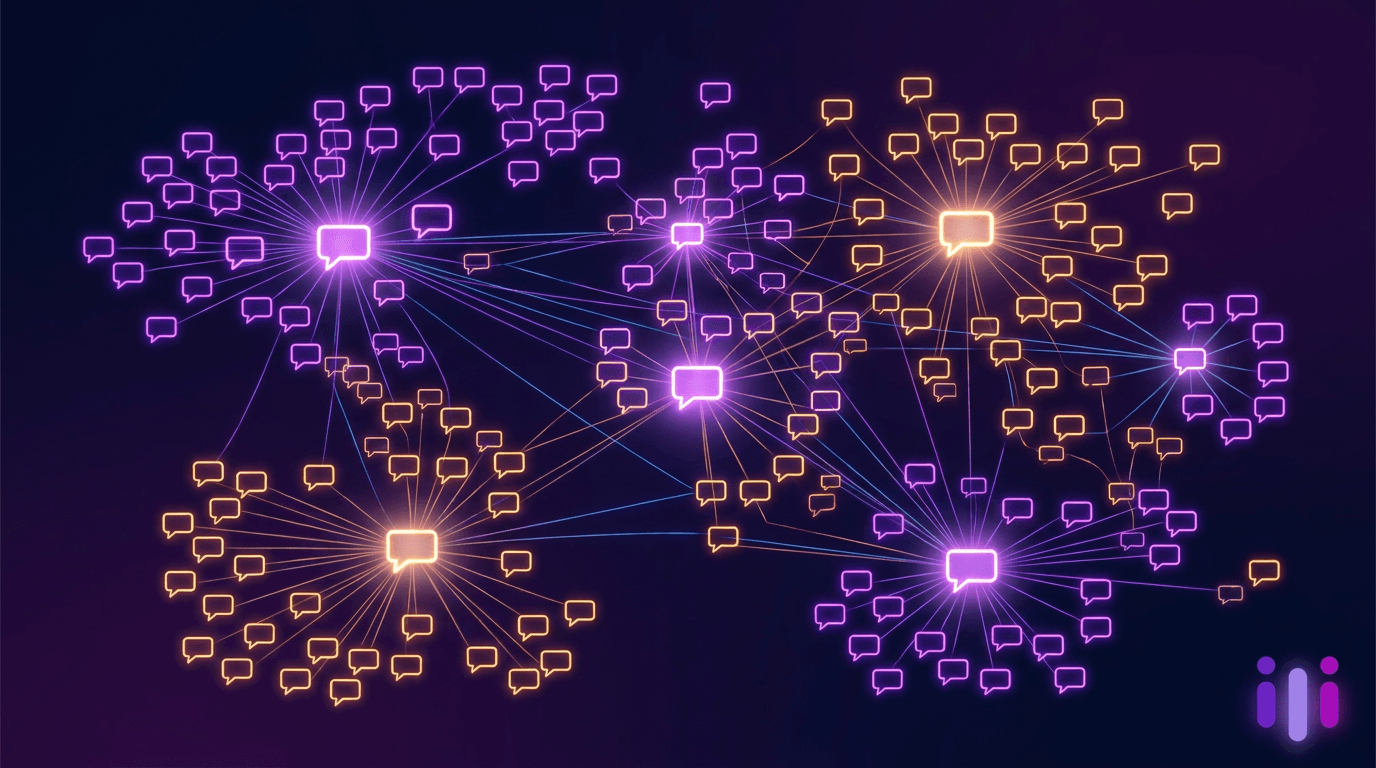
The result is something between a survey and an interview, scaled to hundreds or thousands of simultaneous respondents. One question at a time. Dynamic follow-up. Contextual branching. The user has a conversation; the system captures structured data on the back end.
This is the model behind Perspective AI: AI-powered customer interviews at scale, designed specifically to replace the forms-and-surveys default with conversation. The POV is direct — AI-first research cannot start with a web form. If you're going to use AI to analyze responses, you should also use AI to collect them.
When AI Chat Wins Decisively
Not every form should be a chat. But these use cases tilt the math heavily toward conversation.
Intake Flows (Legal, Insurance, Healthcare, B2B Sales)
Intake is a high-stakes, multi-step data collection problem with significant variance per case. A standard intake form is either too short (missing critical detail) or too long (driving abandonment). AI chat handles the variance natively: it asks the baseline questions, then probes deeper on the answers that warrant it.
We've covered this extensively in the intake form alternatives guide and the ultimate guide to AI intake software.
Lead Qualification
A 12-field "talk to sales" form is a conversion killer. An AI chat that asks 3-4 baseline questions, qualifies dynamically, and routes appropriately can collect more useful information and convert at higher rates. Sales teams get a richer briefing; prospects get a lighter experience.
Customer Research and Voice of Customer
The richest insight from research lives in the follow-up. A static survey asks "How would you rate our product?" A conversational interview asks the same question, then probes: "You said a 7 — what would have made it a 9?" The latter is where strategy emerges. See AI customer interviews for deeper treatment.
NPS Follow-Up and Churn Diagnosis
NPS without follow-up is a vanity number. A score with no "why" tells you almost nothing actionable. AI chat sees a low score, asks the right follow-up, and surfaces the structural reason — pricing, missing features, poor onboarding, support friction. This is where AI feedback collection earns its keep.
Support Routing and Triage
A 5-question chat that diagnoses the issue type, urgency, and customer tier routes far better than a static drop-down menu. The chat can also resolve tier-1 issues inline, reducing ticket volume.
Onboarding and Activation Surveys
Asking "what brought you here?" in a chat — with follow-up — gives product teams ICP signal that a checkbox list never could.
When Forms Still Make Sense
Honesty is important here. Some use cases still favor forms:
- Compliance forms with legally mandated language. If the SEC, HIPAA, or your legal team requires specific phrasing in a specific order, a form is more defensible.
- Simple yes/no transactions. "Do you accept these terms?" doesn't need a conversation.
- Bulk data entry by power users. If the same user fills out the same form 50 times a day, a form's parallelism is faster than a chat's serial pacing.
- Highly structured data with low variance. Address forms, payment forms, and other strongly-typed inputs are often fine as forms — though even these benefit from chat-style guided flows on mobile.
The litmus test: does the value of this interaction depend on understanding why the user is here? If yes, AI chat. If no, forms are probably fine.
How to Make the Switch — Practical Steps
Most teams don't need a moonshot project to transition. Start narrow, prove signal lift, then expand.
Step 1: Pick the Highest-Pain Form First
Look at completion rates across your forms. The form with the worst completion rate and the highest business value is your first candidate. Usually this is intake, qualification, or research.
Step 2: Define the Required Data Points
Before designing the chat, list the fields the form was supposed to collect. These become the chat's required outputs. The chat will reach them through conversation rather than direct prompts, but the schema downstream stays identical.
Step 3: Define Follow-Up Rules
For each data point, specify when the AI should probe deeper. "If satisfaction is below 7, ask why." "If company size is above 500, ask about procurement process." This is where AI chat earns its premium over forms.
Step 4: Map the Output Schema to Downstream Systems
This is the integration question — usually the make-or-break for an enterprise rollout. Your chat needs to produce structured output that maps cleanly to your existing CRM, CDP, or warehouse fields. More on this below.
Step 5: Run in Parallel
Don't kill the form on day one. Run AI chat and the form in parallel — A/B them, or route a percentage of traffic to chat. Compare completion rates, signal density, and downstream conversion. The case for chat usually makes itself within 2-4 weeks.
Step 6: Migrate Fully Once Data Is Conclusive
When the chat is winning across the metrics that matter, migrate the form. Keep the form schema as the system of record on the back end so nothing downstream breaks.
Integration Considerations: CRM, CDP, and Beyond
The most common objection to replacing forms with AI chat isn't UX — it's integration. Forms feed Salesforce, HubSpot, Marketo, Segment, and a hundred other systems. Any replacement has to feed those systems just as cleanly, or it's a non-starter.
Here's what to look for:
Structured Output, Not Just Transcripts
A good AI chat platform produces both: the full conversation transcript and the structured fields extracted from it. The structured fields plug into the existing schema; the transcript becomes a goldmine for product, sales, and research teams.
Native CRM Connectors
Look for direct integrations with HubSpot, Salesforce, and your CDP of choice. Webhook-based fallback is fine for custom systems, but pre-built connectors save weeks.
Field-Level Mapping Control
You should be able to map "what's your role?" → lead.title and "team size?" → account.employees without engineering involvement. This is table stakes.
Identity Resolution
If a known user takes the chat, the AI should pre-fill known fields and skip them. This is both a UX win and a data hygiene win.
Audit Trail
For regulated industries, every chat needs to be logged with who said what, when. This matters more for intake than research, but it's worth confirming up-front.
Form vs. AI Chat: Side-by-Side
Common Pitfalls
A few traps worth flagging based on real rollouts:
- Treating chat as a chatbot. Generic support chatbots are not the same as structured AI interview platforms. The latter is purpose-built for data collection; the former isn't.
- Letting the AI ramble. Good chat platforms enforce conversational discipline — they don't let the AI go off-mission. If your platform can't constrain the conversation to your research goals, abandonment will spike.
- Skipping the schema definition. Teams sometimes launch chat without locking down the output schema. Six weeks in, the data is rich but unstructured, and analytics breaks. Define the schema first.
- Underestimating the "why" payoff. The biggest win from AI chat is usually not completion rate — it's the qualitative signal in follow-ups. Make sure your team has a process for reviewing and acting on that signal.
- Killing the form too fast. Run in parallel. Always.
FAQ
Are AI chat completion rates actually higher than forms?
In most cases, yes — though the gap depends heavily on form length and complexity. Short, simple forms (1-3 fields) often perform comparably to chat. Long forms (8+ fields), intake flows, and research surveys consistently see 1.5-3x lift in completion rates when migrated to AI chat, based on benchmarks from conversational interface deployments.
Can AI chat handle structured data fields like dates, dollar amounts, or addresses?
Yes. Modern AI chat platforms parse free-text answers into structured fields automatically — "next Tuesday" becomes a date, "around 50k" becomes a dollar range, etc. The user types naturally; the system extracts cleanly. This is one of the biggest UX wins over forms.
How does AI chat compare to a survey tool like Typeform or SurveyMonkey?
Survey tools are still forms — even Typeform's one-question-at-a-time UX is a static survey under the hood. There's no follow-up logic, no dynamic probing, no real adaptation. AI chat replaces the structural model of the survey rather than just redesigning the interface. We cover this in detail in AI vs. surveys.
What about data privacy and compliance?
Reputable AI chat platforms support SOC 2, GDPR, and CCPA compliance, plus enterprise features like SSO, data residency, and audit logs. For regulated industries (healthcare, legal, financial services), confirm HIPAA/regulatory support specifically. Don't assume.
How long does a switch from forms to AI chat take?
For a single high-value form, expect 1-2 weeks for a strong rollout: defining required data points and follow-up rules, configuring the chat, mapping output to your CRM, and running parallel A/B tests. Larger migrations — replacing dozens of forms across a company — usually take 1-2 quarters when done well.
Conclusion: Forms Are the Default, Not the Right Answer
Forms became the default in the early 2000s because the technology to do better didn't exist. That changed. AI chat now offers a structurally better way to collect information for the use cases that matter most: intake, qualification, research, NPS follow-up, and support routing. The completion rates are higher. The signal is richer. The "why" finally gets captured.
The transition isn't all-or-nothing. Run chat alongside forms, measure the lift, and migrate the highest-value flows first. Most teams find the case makes itself within a month.
If you're ready to replace forms with AI chat for customer research, intake, or qualification, Perspective AI runs hundreds of AI-powered customer interviews simultaneously — with dynamic follow-up, structured output, and clean integrations to the systems you already use. AI-first research can't start with a web form. Talk to us about what a switch would look like for your team.
Related resources
Deeper reading:
- AI vs Surveys: Why Conversations Win
- AI Feedback Collection
- AI Qualitative Research: A Practical Guide
- Beyond Surveys: Perspective AI vs Traditional Methods
- AI-First Cannot Start With a Web Form
- Evolution of Customer Engagement: AI-Driven Conversations
- Best Typeform Alternatives 2026
Templates and live examples:
More articles on AI Conversations at Scale
The Survey Stack Is Dead: Why 2026 Is the Year B2B Replaced Forms with Conversations
AI Conversations at Scale · 12 min read

AI Conversations at Scale: The 2026 Mid-Year State of the Category
AI Conversations at Scale · 12 min read

AI Feedback Collection: From Static Surveys to Conversations That Actually Tell You Something
AI Conversations at Scale · 15 min read

AI vs Surveys: Why Conversations Win for Real Customer Research
AI Conversations at Scale · 10 min read

What "AI-Native Customer Engagement" Actually Means (And Why Most Vendors Get It Wrong)
AI Conversations at Scale · 12 min read
Bank and Credit Union Satisfaction Surveys: Questions, Templates, and Their Limits
AI Conversations at Scale · 19 min read