AI-Enabled Onboarding Tools in 2026: A Practical Roundup by Use Case
TL;DR
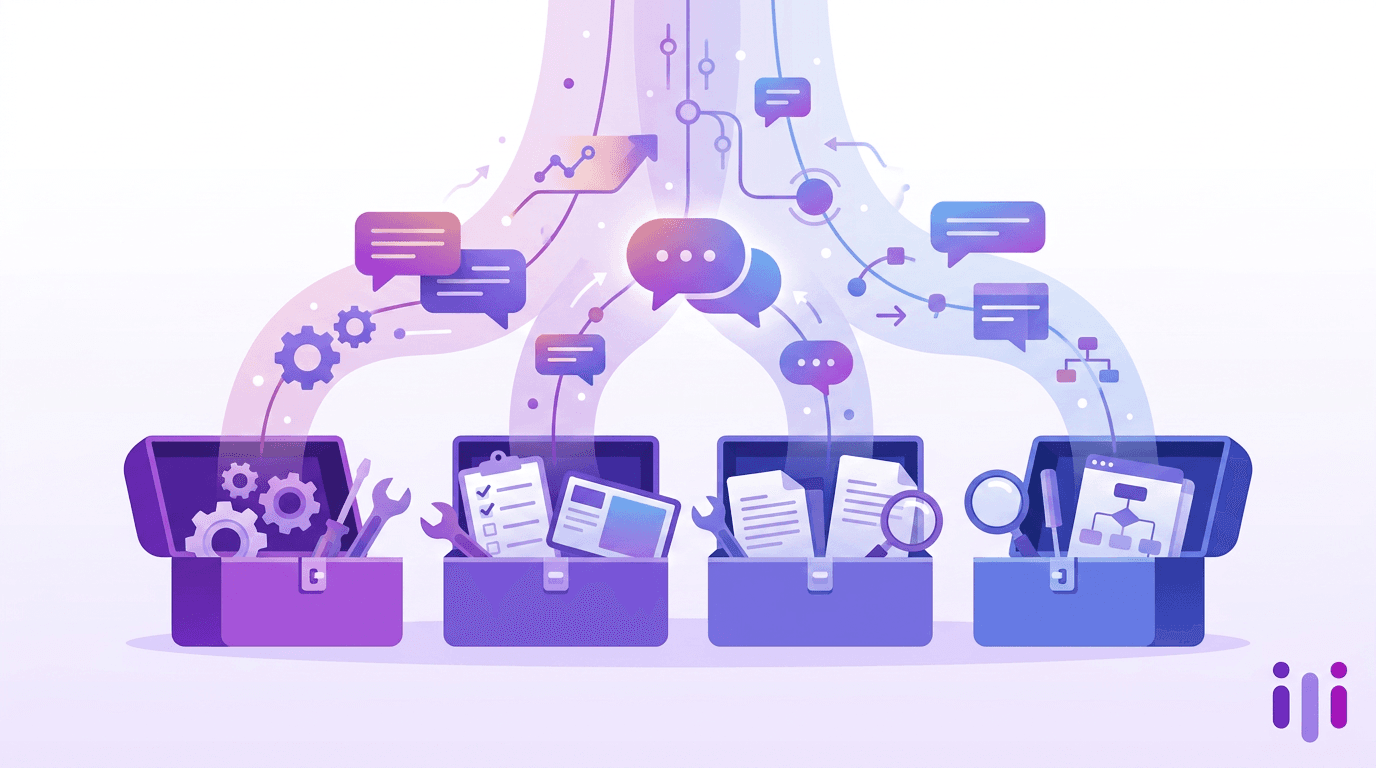
The AI-enabled onboarding tools market in 2026 splits into four very different categories that buyers keep mistaking for substitutes: product tour builders that bolted AI onto walkthroughs (Userpilot, Appcues, Chameleon), in-app guidance and nudging platforms (Pendo, WalkMe, Whatfix), documentation chatbots (Intercom Fin, Glean, custom RAG bots), and conversational onboarding intake — the AI-native shift led by Perspective AI. Each solves a different problem: tours teach a UI, nudges drive adoption of features users already see, doc bots answer reactive questions, and conversational intake replaces the signup form with a structured interview that captures intent, segment, and use case before the user touches the product. According to a 2024 Wyzowl study, 86% of customers say they're more likely to stay loyal to a business that invests in onboarding content, but the same body of research shows the highest-leverage onboarding moment is the first 60 seconds of intake — long before any tour can fire. Most teams over-invest in category 1 because tour builders are the loudest in the search results, then under-invest in the intake conversation that actually determines whether a user reaches the tour at all. This roundup categorizes the full landscape, gives a comparison table with pricing and best-fit, and recommends specific stacks by team size and use case so you stop paying for three overlapping tools that all start after the form.
The four categories of AI-enabled onboarding tools
AI-enabled onboarding tools in 2026 fall into four functionally distinct categories, and confusing them is the single most expensive mistake we see buyers make. The same SERP listicles rank the same six vendors against each other — Userpilot, Pendo, Appcues, Chameleon, WalkMe, Whatfix — as if they were direct alternatives, when in reality they solve overlapping but non-identical problems, and none of them touch the moment that matters most: the intake conversation that happens before the user is even logged in. Before we get to the table, here's the taxonomy you should be reasoning about.
A useful mental model: tours teach the UI, nudges drive feature adoption, doc bots answer questions, and conversational intake decides who gets which experience in the first place. If you only buy one, buy intake. If you buy three, the order matters.
For a deeper buyer's framework that walks through the criteria, see our AI-enabled onboarding software buyer's guide and the companion native vs bolted-on architecture test.
Category 1: Product tour builders that added AI
Product tour builders are tools that let non-engineers create step-by-step walkthroughs of a UI, with AI features grafted on for content generation, segmentation, or auto-flow creation. Userpilot, Appcues, and Chameleon dominate this category. Their core unit of work is the tour: a sequence of tooltips, modals, or hotspots that fire when a user lands on a screen. The AI features in 2026 are mostly content assistance — generating tooltip copy, suggesting which steps to include, summarizing tour completion data — rather than fundamentally rethinking what a tour is.
These tools work well for one specific job: teaching a feature-dense product UI to users who have already decided they want to use the product. They fail when the underlying problem is intent, not navigation. A user who doesn't know whether your product fits their use case will not be rescued by a better tooltip. That's a different category.
Pricing in this category clusters around $300–$1,200/month for SMB plans, with enterprise tiers that scale by MAU. Implementation is straightforward — drop a JS snippet, build flows in a visual editor — but ongoing maintenance is heavier than vendors admit, because every UI change breaks tours. For an honest take on why product tours are a leaky bucket, see why static intake forms are killing your conversion rate — the same flatten-and-funnel critique applies to scripted tours.
Category 2: In-app guidance and nudging tools
In-app guidance tools focus on driving adoption of specific features after a user has already onboarded, using nudges, checklists, surveys, and contextual help layered on top of the product. Pendo, WalkMe, and Whatfix lead this category. The unit of work is the engagement — a checklist item completed, a nudge dismissed, a feature adopted — rather than a one-time tour.
These platforms tend to be more analytics-heavy than tour builders. Pendo, in particular, built its reputation on product analytics and only later layered guidance on top, which is why teams often run it alongside or instead of Mixpanel/Amplitude. WalkMe and Whatfix lean enterprise: they're designed to onboard internal employees onto Salesforce, Workday, or SAP at companies with 5,000+ seats, and their pricing reflects it (six figures annually, typically). The consumer-grade SaaS use case is more often served by Pendo's Free or Starter tiers.
The AI overlay in this category is mostly automated segmentation ("who should see this nudge?") and content generation. It's useful, but not transformative — the underlying engagement model is still rule-based: if user did X, then show Y. Compare that to a continuous conversation that adapts in real time, which we cover in the AI-native onboarding guide.
Category 3: Documentation chatbots
Documentation chatbots are RAG-based assistants that answer user questions by retrieving from your help center, knowledge base, or product docs. Intercom Fin, Glean, and custom-built RAG implementations using Anthropic's Claude or OpenAI's GPT models dominate here. The unit of work is the answered question — a user types "how do I export to CSV?" and gets a grounded answer with citations to your docs.
These tools are reactive by design. They wait for the user to have a question, then answer it. That's valuable — Gartner has reported that self-service deflection can save companies up to $11 per contact — but it's a different problem from onboarding, which is fundamentally about proactively shaping the first experience. A doc bot can rescue a confused user; it cannot prevent the confusion in the first place. For the proactive version of this conversation, see how teams are replacing forms with conversations in 2026.
The AI quality bar here has risen sharply. The same RAG patterns that powered support deflection in 2024 are now expected baseline; in 2026 the differentiator is whether the bot can do task completion — actually book the call, change the setting, file the ticket — rather than just retrieving an answer. That capability blurs the line into category 4.
Category 4: Conversational onboarding intake — the AI-native shift
Conversational onboarding intake replaces the signup form with a short structured interview, conducted by an AI agent, that captures intent, segment, use case, team size, and urgency before the user lands in-product. This is the category Perspective AI defines, and it's the one most buyers don't know exists when they start shopping. The unit of work is the interview — a 90-second conversation that produces a structured record (intent, ICP fit, use case, owner) and routes the user to a tailored first experience.
The thesis is straightforward and we've argued it repeatedly: AI-first cannot start with a web form. A form is a schema imposed before you understand the user. A conversational intake reverses the order — let the user describe their situation in their own words, then the schema is filled in by the AI based on what they actually said, with follow-ups that probe vague answers ("what does 'churn' mean for your team specifically?"). The output is a far richer record than any form produces, and the user feels heard rather than processed.
This is structurally different from the other three categories. Tour builders teach a UI; nudges drive adoption; doc bots answer questions; conversational intake decides what UI, what nudges, and what answers a user should get in the first place. It sits upstream of the other three, which is why running it alongside (rather than instead of) a tour builder is often the right answer for a B2B SaaS team. We unpack this layering in the complete guide to AI-powered customer experience.
Pricing is meaningfully different from the other categories: rather than charging per MAU or seat, Perspective AI prices around the volume of conversations conducted, which lines up with the actual unit of value. For teams replacing a low-converting marketing form, the ROI math is usually obvious within the first month.
Comparison table — features, pricing, best-for
The table below summarizes the four categories. Specific vendor pricing is approximate and changes; check the vendor sites for current numbers. The point of this table is the structural comparison — what each category does — not a feature-by-feature scorecard within a category.
A few things to notice. First, the pricing models don't line up — comparing "$500/mo for 10K MAU" against "$1.20 per resolved ticket" against "per conversation" is comparing apples to elements of the periodic table. Second, the best for column shows that these tools don't really substitute for each other; they layer. Third, only category 4 sits before signup. Everything else assumes the user has already entered your funnel.
For the deeper feature-by-feature analysis of conversational tools specifically, the AI-enabled customer engagement tools roundup covers the adjacent space.
Recommended stacks by team size and use case
The right onboarding stack depends on team size, product complexity, and where the leakiest part of your funnel actually is. Here are four common configurations we see working in 2026.
Early-stage B2B SaaS (under 50 employees, under $5M ARR). Skip categories 1 and 2 entirely. They cost more than the value at this stage, and your product will change too fast for tours to be worth maintaining. Run conversational intake (category 4) on your signup flow, plus a doc bot (category 3) once you have enough docs to retrieve from. This costs roughly $500–$1,500/month all-in and produces a far cleaner intent dataset than a tour builder ever could. See the AI product roadmap validation playbook for how the intent data feeds product decisions.
Mid-market B2B SaaS (50–500 employees, complex product UI). This is the sweet spot for layering. Run conversational intake at signup to segment users, hand off to a tour builder for the UI walkthrough on first session, and add a nudging tool (Pendo, typically) to drive feature adoption over weeks 2–8. Doc bot is optional depending on support volume. Total cost: roughly $2,500–$10,000/month. The conversational intake step is what makes the tours actually relevant — you're showing the right tour to the right segment, instead of the same generic tour to everyone.
Enterprise SaaS or internal tool rollouts (1,000+ seats). WalkMe or Whatfix dominate here for a reason — they're built for the complexity of onboarding employees onto multiple enterprise systems. Pair with a conversational intake layer for executive sponsorship interviews and stakeholder onboarding (where intent and concerns matter more than UI navigation). Doc bot is essentially required at this scale.
Marketing-led, high-volume signup (PLG with thousands of weekly signups). Conversational intake is the highest-leverage purchase. The form-to-conversation switch typically lifts qualified-signup rates 30–60% based on what teams report, and the intent data feeds segmentation for everything downstream. A simple checklist for activation (which Pendo's free tier covers) is usually enough on top. See why static intake forms are killing your conversion rate for the underlying math.
Why most teams over-invest in category 1
Most teams over-invest in product tour builders because tour builders dominate the SEO real estate, not because tours are the highest-leverage onboarding intervention. Search "best onboarding software" and you'll see the same six tour-and-nudge vendors ranking on listicle after listicle, often written by the vendors themselves or by content sites paid by them. The keyword "user onboarding software" maps cleanly to category 1 in Google's eyes; the keyword "conversational intake" barely registers.
The result is a buyer journey that starts and ends in category 1. A team feels their onboarding is broken, searches "best user onboarding software," reads three listicles, demos two tour builders, and signs a contract — all without ever questioning whether a tour was the right intervention. Six months later, the tour completion rate is fine, the activation rate is unchanged, and the team is shopping for a "better" tour builder.
The actual leverage point is usually upstream. Look at where users drop off in your funnel. If they're abandoning the signup form, no tour will save them — they never reach the tour. If they're signing up but never returning, the issue is fit, not navigation — they didn't understand what your product does for their situation, and a tour through the UI doesn't fix that. Both of those failure modes are intake problems, not tour problems. We make the broader case in why most AI-native onboarding tools aren't actually native.
This isn't an argument against tour builders. It's an argument against starting there. Build the intake conversation first, then layer tours on top of the segments the intake produces. The tours become 3-5x more relevant because they're targeted, and the tour-builder spend goes further.
Frequently Asked Questions
What are AI-enabled onboarding tools?
AI-enabled onboarding tools are software platforms that use AI to guide new users through their first experience with a product, falling into four categories: product tour builders, in-app guidance and nudging tools, documentation chatbots, and conversational onboarding intake. The AI layer typically generates content, segments users, retrieves answers from docs, or conducts structured interviews. Each category solves a structurally different problem, which is why teams often run two or three in combination rather than picking one.
How are AI onboarding tools different from traditional onboarding software?
AI onboarding tools differ from traditional onboarding software in three ways: they generate content automatically rather than requiring manual authoring, they segment users based on inferred intent rather than static rules, and the AI-native subset (conversational intake) replaces forms with structured interviews. Traditional onboarding software was rules-based: if user did X, show tour Y. AI-enabled versions add a perception layer that decides what to show based on what the user actually said or did, including in their own words. The deepest shift is conversational intake, which moves the AI from "decorating the tour" to "deciding whether a tour is even the right response."
Are tour builders like Userpilot, Pendo, or Appcues actually AI-native?
Tour builders like Userpilot, Pendo, and Appcues are not AI-native — they are tour builders that added AI features. The underlying data model is still a sequence of tooltips, modals, and rules; the AI generates the copy, suggests segments, or summarizes analytics. AI-native onboarding tools, by contrast, treat the conversation itself as the unit of work: the AI agent conducts an interview, decides what to do based on the user's responses, and produces structured output. The architectural test is whether removing AI breaks the product. For tour builders, removing AI leaves a working tour builder; for conversational intake, removing AI leaves nothing.
What does conversational onboarding intake actually do?
Conversational onboarding intake replaces the signup or marketing form with a short structured interview conducted by an AI agent, capturing intent, use case, team size, urgency, and ICP fit in 60-120 seconds. The output is a structured record (the same fields a form would have produced) plus the qualitative context the form would have lost — the "why now," the constraints, the actual problem in the user's words. Teams use this record to route the user to a tailored first experience, segment them in CRM, prioritize sales follow-up, and personalize the in-product onboarding flow that follows.
Should I replace my product tour with conversational intake or run both?
You should usually run both, in order: conversational intake first (before signup), then product tour (after signup, segmented by what intake captured). Replacing the tour outright only makes sense for early-stage products where the UI is simple enough that a 60-second conversation can replace the walkthrough entirely. For most B2B SaaS, the layered approach lifts both conversion and activation: intake screens for fit and captures intent, then the tour teaches the UI to the segment of users who actually fit. Running the tour without intake means showing the same walkthrough to users with completely different goals, which is why generic tour completion rates correlate weakly with activation.
How much do AI-enabled onboarding tools cost in 2026?
AI-enabled onboarding tools cost between roughly $500/month and $200,000/year in 2026, depending on category and scale. SMB tour builders start around $300–$1,200/month; enterprise nudging platforms (WalkMe, Whatfix) typically run six figures annually for large rollouts; documentation chatbots are often priced per resolved ticket at $1–$2 per ticket; conversational intake (Perspective AI) is priced per conversation, which lines up with the actual unit of value. The cost difference between categories is large enough that the right question is "which category do I need," not "which vendor in this category."
Conclusion: Stop shopping in one category
The AI-enabled onboarding tools market in 2026 is bigger than the same six vendors that show up on every listicle. Tour builders, nudging platforms, and doc bots all do useful work, but none of them touch the moment that determines whether a user reaches your product at all — the intake conversation. If you've been treating "AI onboarding tools" as a category of one, you're probably over-investing in tours and under-investing in the upstream intake that makes those tours relevant in the first place.
The pragmatic path: start with conversational intake, layer tours and nudges on top of the segments it produces, and add a doc bot when your support volume justifies it. That stack costs less than a single enterprise nudging contract and produces a richer dataset on day one.
If you're rethinking your onboarding stack, start a conversational intake project with Perspective AI or see how teams are replacing forms with conversations. The form-first model is the part of onboarding that AI is actually changing — the rest is decoration.
More articles on Intelligent Intake
Best Customer Feedback Software for Insurance Carriers in 2026
Intelligent Intake · 15 min read
Best Healthcare Market Research Tools & Companies in 2026
Intelligent Intake · 15 min read
Best Patient Experience Software in 2026
Intelligent Intake · 16 min read
Best Resident Feedback & Survey Software for Property Managers in 2026
Intelligent Intake · 16 min read
Best Mobile App Onboarding Software in 2026: 9 Platforms Ranked by What They Learn About the User
Intelligent Intake · 24 min read
Best Client Intake Software for Therapists in 2026: 8 Tools Compared
Intelligent Intake · 16 min read