AI Customer Engagement Tools in 2026: A Buyer's Roundup by Use Case
TL;DR
"AI customer engagement" is the most overloaded phrase in the 2026 SaaS market. The same label covers ticket-deflection bots, sales chat widgets, lifecycle email engines, and qualitative research platforms — tools that solve completely different problems for completely different buyers. Evaluating them as one category is how teams end up paying for three overlapping platforms while leaving the actual bottleneck untouched.
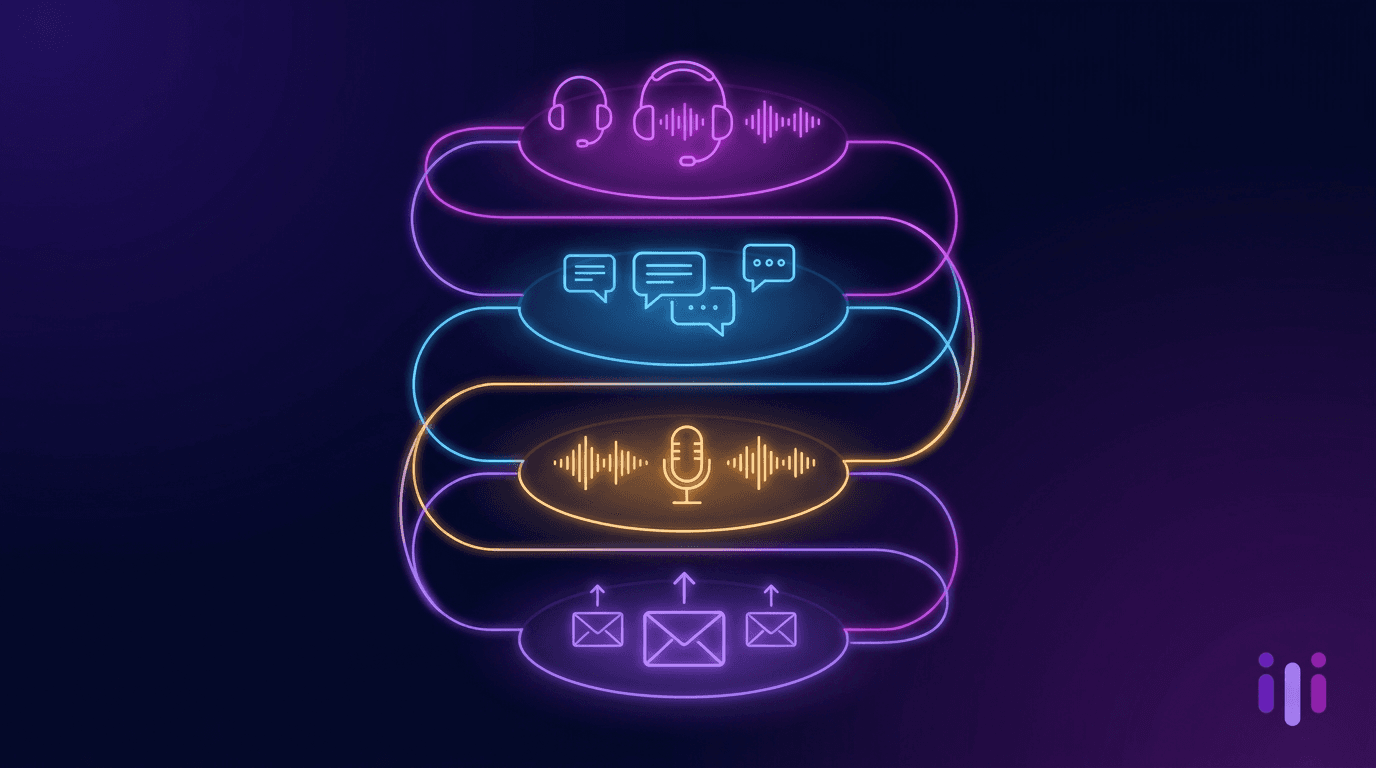
This roundup categorizes the AI customer engagement landscape by use case, not by vendor marketing:
- AI Support / Service — Zendesk AI, Intercom Fin, Salesforce Agentforce, Forethought, Ada
- AI Sales Engagement — Drift, Qualified, HubSpot Breeze, 6sense
- AI Customer Research / Voice — Perspective AI (the tier most engagement stacks ignore)
- AI Marketing / Personalization — Customer.io AI, Klaviyo AI, HubSpot Breeze, Optimizely
Pick by the engagement bottleneck you actually have. Skip ahead to the decision framework if you already know your stack.
The Category Problem: "AI Customer Engagement" Is Too Broad to Evaluate as One Thing
If you search "AI customer engagement tools" on G2 today, you'll get a single list with Intercom next to Klaviyo next to Drift next to Qualtrics. These products do not compete. They sit in different parts of the customer lifecycle, sell to different buyers, and produce different outputs.
The confusion is expensive. According to Gartner's 2025 CX research, 64% of customer experience leaders report owning more than one "AI engagement" platform, and 38% say at least two of them have meaningfully overlapping capabilities they're paying for twice. Forrester's 2025 Customer Engagement Wave split the category into five distinct sub-segments precisely because cross-comparison stopped being useful.
Three forces drove the bloat:
- Vendor expansion. Every adjacent tool — CRM, helpdesk, ESP, CDP — added an "AI" SKU between 2023 and 2025. IDC's 2025 Worldwide AI Software Tracker reported AI features were added to 71% of enterprise SaaS products in that window, the fastest feature proliferation IDC has measured in any category.
- Buyer shorthand. "Engagement" became the catch-all word executives used when they meant "anything our customers click, type, or read."
- Analyst pressure. Gartner Peer Insights consolidated 14 separate categories into 6 broader ones in 2024, which made cross-vendor comparison easier on the surface and harder in practice.
The consequence: a head of CX, a head of growth, and a head of product all say "we need an AI engagement tool" and mean entirely different things. So before you compare vendors, name the use case.
The Four Use Case Categories
The price ranges alone should signal that these are not substitutes. A $2 ticket-resolution credit and a $12,000/month sales engagement seat are not in the same procurement conversation.
Category 1: AI Support / Service
Top vendors: Zendesk AI, Intercom Fin, Salesforce Agentforce, Forethought, Ada
What this category does well. Ticket deflection has the cleanest ROI math in the entire AI engagement stack. You know the cost of a human-handled ticket (the Gartner 2024 Service Cost Benchmark puts the average at $8.01 in North America), you know the resolution rate of the bot, and you can math your way to a payback period in a spreadsheet.
Intercom's Fin claims a 56% autonomous resolution rate on customer-published benchmarks. Salesforce's Agentforce, launched at Dreamforce 2024 and matured through 2025, is increasingly the default if you already live in Service Cloud. Zendesk AI ships with the strongest macro library and the lowest switching cost for existing Zendesk shops. Ada and Forethought lead in vertical depth (e-commerce and fintech respectively) and tend to win when the buyer wants a best-of-breed bot layered on top of an existing helpdesk.
Where they fall short. Three consistent gaps:
- Long-tail intents. Even the best 2026 deflection bots resolve 50–65% of tickets autonomously. The remaining 35–50% — the angry, ambiguous, or account-specific ones — still escalate.
- Voice of customer signal. These tools are optimized to close tickets, not to learn from them. The transcripts pile up; the insights don't.
- Implementation drag. Per IDC's 2025 deflection benchmarks, median time-to-value for an enterprise deflection deployment is 4.5 months, and 22% of programs miss their first-year deflection target.
Who should buy them. You should buy in this category if your bottleneck is cost-to-serve. If your CSAT is fine and your sales team is fed but each support ticket costs $9 and volume is doubling, an AI support tool pays for itself.
If your bottleneck is "we don't know why customers are churning," a deflection bot will not help you. Pair it with a research layer like the one we describe in our piece on AI conversations at scale.
Category 2: AI Sales Engagement
Top vendors: Drift, Qualified, HubSpot Breeze, 6sense
What this category does well. Sales engagement AI converts anonymous web traffic into qualified pipeline. Qualified's Piper agent and Drift's AI Conversations are the two most mature implementations on Salesforce-native stacks; HubSpot Breeze is rapidly closing the gap inside the HubSpot ecosystem; 6sense leads on intent data and predictive scoring.
The unit economics are real when traffic is high. According to Drift's 2025 State of Conversational Marketing, top-quartile users generate 12–18% of total inbound pipeline through AI chat, and median sales cycle on chat-sourced opportunities is 14% shorter than form-sourced.
Where they fall short. Two structural problems:
- The form-shaped hole. Most "AI" sales engagement tools are still routing logic on top of a chat widget that ultimately drops users into a form-style flow. The "AI" is qualification, not interview. We've written before about why replacing forms with real AI chat is harder than vendors admit.
- Top-of-funnel only. These tools optimize the first touch. They do not learn from won/lost cycles, do not run discovery interviews, and do not capture qualitative voice from current customers.
Who should buy them. Buy here if your bottleneck is inbound conversion. You have demand-gen budget producing traffic; the conversion rate from visitor to SQL is the constraint. If your bottleneck is anywhere downstream of "did the lead book a meeting" — onboarding, expansion, churn — sales engagement AI is not the right tier.
Category 3: AI Customer Research / Voice
Top vendor: Perspective AI. (This category is sparse on purpose — see below.)
What this category does well. This is the tier that most engagement stacks ignore, and it's the one with the highest leverage on retention and product velocity. The job is qualitative: run customer interviews at scale, get past surface answers to the actual "why," and feed structured insight back to product, CS, and marketing.
Perspective AI runs hundreds of customer interviews simultaneously. The AI follows up, probes contradictions, and captures the "why" behind a rating, a churn, or a feature request — output that surveys and NPS scores structurally cannot produce. The POV: AI-first research cannot start with a web form. A form gets you what the customer thought to type; an interview gets you what they actually mean.
The data case for this tier is strong:
- McKinsey's 2025 State of AI report found organizations that combined AI-driven quantitative engagement with qualitative AI research were 2.3x more likely to hit revenue-from-AI targets than those running quant-only stacks.
- Forrester's 2025 Voice of Customer Wave flagged "qualitative AI" as the fastest-growing VoC sub-segment, projecting 41% CAGR through 2027.
- A 2025 Product Coalition study of 1,200 PMs found teams running structured qualitative interviews monthly shipped 1.7x more validated features per quarter than teams relying on surveys alone.
Where the category falls short. Honestly: it's underpopulated. The AI engagement stack is dominated by tools that talk to customers to close something — a ticket, a deal, a click. Tools that talk to customers to learn something are rarer because the ROI is slower to attribute. That makes this tier underbought relative to its impact.
Who should buy here. Buy in this category if your bottleneck is qualitative signal. Symptoms include: NPS dashboards that don't drive action, churn post-mortems that are guesswork, product roadmaps debated on opinion not evidence, win/loss analysis that's three quarters out of date. If you can't answer "why are our best customers really staying?" with a real quote from a real customer interviewed in the last 30 days, this is your bottleneck.
For more on what this tier actually looks like in production, see our deeper writeups on AI customer interviews and the AI-native customer engagement model.
Category 4: AI Marketing / Personalization
Top vendors: Customer.io AI, Klaviyo AI, HubSpot Breeze (Marketing), Optimizely
What this category does well. Lifecycle personalization is the most mature application of AI in marketing — send-time optimization, subject-line generation, segment expansion, and content variation. Klaviyo's 2025 benchmark report shows AI-personalized e-commerce flows lift revenue per recipient 23–34% versus rules-based segmentation. Customer.io's AI journeys are strong on B2B SaaS lifecycle. Optimizely leads on experimentation depth.
Where they fall short.
- Wide and shallow. Personalization AI is great at deciding which of your existing messages to send to which segment. It does not generate net-new strategic insight.
- Garbage-in problem. If your message library was written from internal assumptions, AI-personalizing it just sends the wrong messages faster. The Forrester 2025 Marketing Automation Wave called this the "personalization paradox" — automation amplifies whatever quality is in the input library.
- Privacy/regulatory drag. As cookie deprecation and stricter consent regimes (EU AI Act phased enforcement through 2026, CPRA expansion) tighten audience signals, lifecycle AI is increasingly working from a thinner data set than 2023 marketing decks promised.
Who should buy here. Buy in this category if your bottleneck is lifecycle execution at scale. You have a working message library, defined segments, and need optimization, not strategy.
The "Missing Tier" Most Stacks Ignore
Looking across the four categories, three of them — support, sales, marketing — are crowded, mature, and well-funded. The fourth — qualitative research / customer voice — is sparse.
That's not because the need is small. It's because the buyer is split. Research tools historically lived under a head of UX, surveys under a marketing analyst, NPS under a CS ops lead, churn analysis under a finance partner. There was no single "head of customer voice" budget, so the category never consolidated.
The 2026 shift is that the volume of customer conversations — chat logs, support transcripts, sales calls, in-product responses — has crossed the threshold where humans can no longer read them and synthesize. According to IDC's 2025 unstructured data study, the median B2B SaaS company now generates 2.4 million customer conversation tokens per month across channels. No PM team is reading that.
That's the bottleneck Perspective AI is built for: turning the firehose of customer talk into structured, probed, follow-up-driven interview data — and doing it at the scale the rest of the engagement stack already operates at. If your support, sales, and marketing AI are all firing and you still can't answer "what do our customers actually want next?" — you're missing this tier. Our 4-layer customer success stack writeup explains how the qualitative tier connects to retention specifically.
How to Pick by Your Bottleneck (Not by Feature List)
The mistake most teams make: they evaluate AI engagement tools against a 60-row feature matrix. The matrix flattens the category back into one undifferentiated comparison and the loudest vendor wins.
Better: identify your bottleneck, then shop only that tier.
Diagnostic questions, in order:
- Is cost-to-serve your problem? Ticket volume up, agent headcount stretched, average handle time creeping. → AI Support tier.
- Is inbound conversion your problem? Traffic exists, MQL-to-SQL leaks, sales reps burning cycles on unqualified meetings. → AI Sales Engagement tier.
- Is qualitative signal your problem? You have dashboards but not decisions; surveys but not stories; churn but not "why." → AI Customer Research / Voice tier.
- Is lifecycle execution your problem? Strategy is set, message library is built, you need scale and personalization. → AI Marketing tier.
If you answer "yes" to two, sequence them. Buy the one whose ROI you can measure first (usually support or sales), then layer the others. Buying all four simultaneously is how 38% of CX leaders ended up with overlapping platforms.
Common Mistakes
- Buying the loudest brand instead of the fitting tier. Salesforce Agentforce is excellent for service. It is not a customer research tool. The vendor will not stop you from using it as one.
- Treating "AI chat" as one product. Drift, Intercom Fin, and Perspective AI all "chat with customers." They produce completely different outputs.
- Skipping the research tier because the ROI math is harder. It's harder to attribute, not lower. Roadmap accuracy, churn prevention, and message-market fit all depend on this tier; they just don't show up in a single dashboard cell.
- Letting the existing stack vendor extend into a tier they don't lead. "Our CRM has an AI engagement module" is rarely a reason to buy. It's a reason to ask whether it's best-in-tier.
- Comparing on feature count. Most AI engagement RFPs in 2026 still grade vendors on a feature checklist. Forrester's 2025 buyer survey found 71% of respondents said feature-checklist evaluations led them to a tool that didn't solve their actual bottleneck.
FAQ
Q: Isn't HubSpot Breeze a single answer across all four categories? A: HubSpot is competing across support, sales, and marketing tiers, and Breeze is genuinely strong as an all-in-one for SMB-to-mid-market. It is not a customer research tool. If your stack is HubSpot-native, use Breeze for the first three tiers and add a dedicated research layer for the fourth.
Q: Where do call recording and conversation intelligence tools (Gong, Chorus) fit? A: They sit adjacent to the sales engagement tier, focused on rep coaching and deal intelligence. They are not customer research at scale — they're sales-team intelligence. Useful, but a different job.
Q: Do I need a separate VoC platform on top of all this? A: Traditional VoC platforms (Qualtrics, Medallia) are increasingly being unbundled. The qualitative-AI tier (Perspective AI) handles the depth interviews; the marketing/lifecycle tier handles the volume sentiment. The standalone VoC suite is shrinking, per Forrester's 2025 VoC Wave.
Q: How do I avoid paying twice for overlapping AI engagement features? A: Run a "tier audit" before any new purchase. List every AI engagement vendor you pay, label each by its primary tier, and flag any vendor billing for two tiers. The vendor with the second-place capability in a tier you already cover is almost always the redundancy.
Q: What's the right sequence if we're starting from zero? A: Most teams should start with the tier closest to revenue impact and shortest payback — typically AI Support if support volume is high, AI Sales Engagement if traffic is high. Add the AI Customer Research / Voice tier within the first 12 months; teams that wait longer typically end up rebuilding their roadmap on assumptions that turn out wrong.
Conclusion
"AI customer engagement tools" is not a single category. It's four categories sharing a marketing label. The buyers who get this right in 2026 are the ones who name their bottleneck first and shop the matching tier — not the ones who run a 200-vendor bake-off on a flattened feature matrix.
Three of the four tiers are crowded and mature. The fourth — qualitative AI customer research — is the one most engagement stacks still ignore, and the one with the highest leverage on retention, roadmap quality, and message-market fit.
That's the tier Perspective AI is built for. We run hundreds of AI customer interviews simultaneously, follow up like a human researcher would, and capture the "why" the rest of your engagement stack can't. AI-first research cannot start with a web form — and the teams that figure that out first in 2026 will out-learn the rest of the market.
Ready to add the missing tier to your AI customer engagement stack? Book a Perspective AI walkthrough and see what a hundred parallel customer interviews look like when the AI is the one doing the asking.
Related resources
Deeper reading:
- What 'AI-Native Customer Engagement' Actually Means
- Evolution of Customer Engagement: AI-Driven Conversations
- AI for Customer Success Is Stuck on Dashboards
- Real-Time Customer Feedback Analysis
- Beyond Surveys: Perspective AI vs Traditional Methods
Templates and live examples:
- Customer interview template
- AI customer experience template
- Customer journey interview
- Browse all templates
For your team:
More articles on AI Conversations at Scale
Best Customer Experience Software for Banks & Credit Unions in 2026
AI Conversations at Scale · 14 min read
Best Guest Feedback Software for Hotels in 2026
AI Conversations at Scale · 16 min read
Best Hotel Reputation Management Software in 2026
AI Conversations at Scale · 15 min read
Best Mystery Shopping Software for Retail in 2026
AI Conversations at Scale · 16 min read
Best Restaurant Reputation Management Software in 2026
AI Conversations at Scale · 16 min read
Best Survey Apps for Shopify Stores in 2026
AI Conversations at Scale · 16 min read