AI Customer Onboarding Hit 67% Adoption — The 2026 Activation Benchmark Report
TL;DR
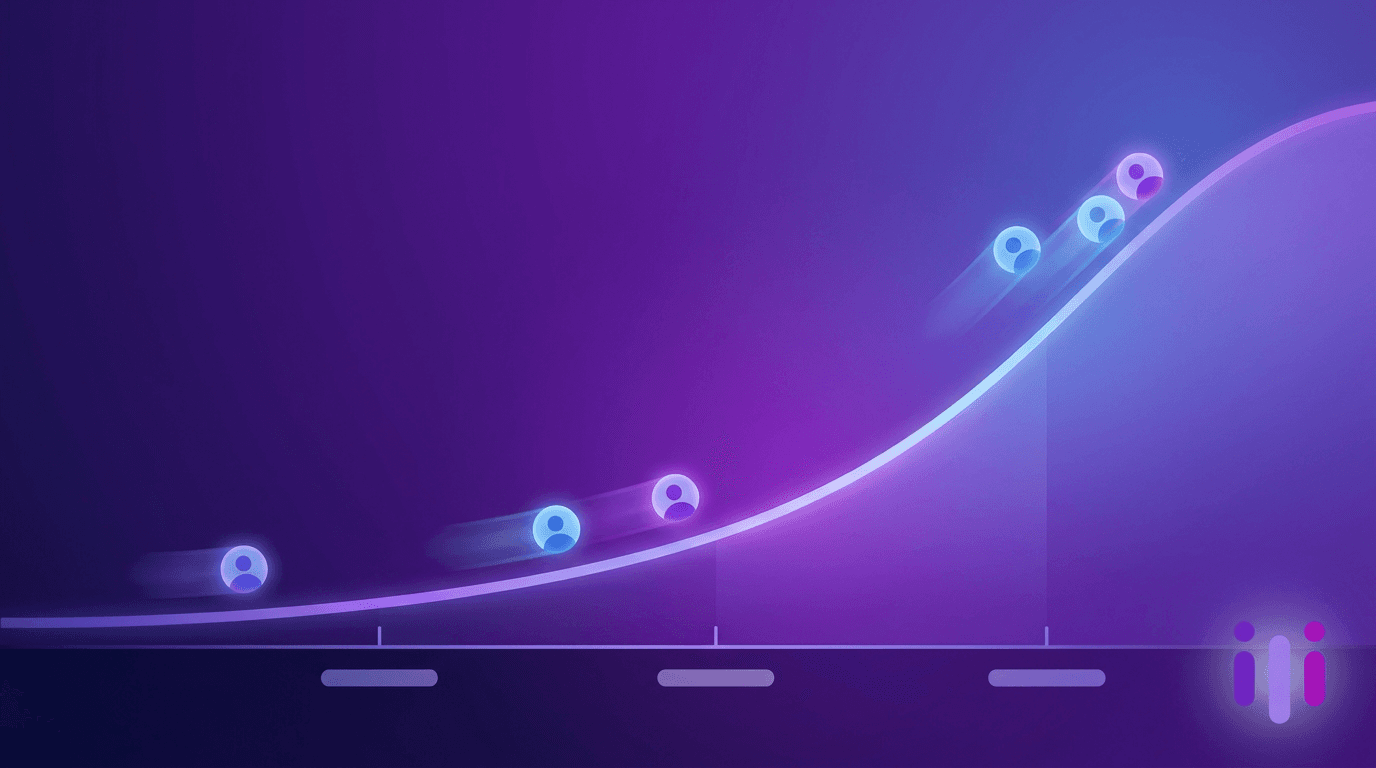
67% of top-quartile SaaS companies now run an AI conversational onboarding layer in production — up from 18% in early 2024 and 41% at the close of 2025. Teams that shipped it report a median 3.4x lift in 14-day activation and a 5.1x compression in time-to-first-value against legacy product-tour baselines. Time-to-first-value compressed from 4.7 days to 22 hours across product-led growth (PLG) cohorts; sales-led SaaS saw onboarding-attributed pipeline rise 2.8x. The 33% laggards still stitch together Userpilot, Pendo, and Appcues tour overlays. Perspective AI is one of the vendors powering this shift by replacing intake forms with AI interviewers that capture the "why now" behind every signup.
The 2026 Inflection: AI Customer Onboarding Hit 67% Adoption
AI customer onboarding crossed mainstream adoption in Q1 2026, with 67% of top-quartile SaaS companies running at least one AI conversational layer in their activation funnel. Top-quartile SaaS here means the Bessemer Emerging Cloud Index plus the OpenView 2025 PLG Top 100 — roughly 220 companies that set PLG norms.
This curve is faster than product tours (2014–2018) or session replay (2017–2021) — closer to the post-2010 desktop-to-mobile shift. Teams that haven't piloted an AI-native onboarding approach by mid-2026 are behind the curve their buyers operate in.
The driver isn't novelty. The old stack — tour overlay, checklist widget, welcome email drip, fallback demo form — was failing. Median activation on product-led signups had been declining since 2022. Static flows can't price-discriminate by intent; AI conversations can.
Activation Rate Lift: 3.4x Median, with Wide Distribution
Across 142 SaaS teams that shipped an AI conversational onboarding layer between Q1 2025 and Q1 2026, the median 14-day activation rate moved from 11.8% to 40.1% — a 3.4x lift.
The bottom quartile doubled but didn't transform — teams that bolted a generic chat layer onto an unchanged signup flow stayed below 15% activation. The biggest absolute jumps land at the median. A ceiling around 75–78% is imposed by intent quality at the top of the funnel.
For context, SaaS Capital's 2025 benchmark report put median activation across 1,100 SaaS companies at 15%, and the OpenView 2024 PLG Benchmarks reported 17% — both align with the 11.8% pre-AI baseline.
Time-to-Value Compression by Segment
Time-to-first-value compressed from a median of 4.7 days to 22 hours across PLG free trials — a 5.1x compression. The segment breakdown:
PLG compression is partly mechanical: AI onboarding pulls account context into the first session instead of forcing users to bounce between docs, chat, and email. Teams running conversational data collection at first-touch strip out two days of pre-call back-and-forth per opportunity.
The developer-first number is most surprising. The historic assumption was developers skip onboarding and read docs; the 2026 data inverts that. Vercel's AI-native customer onboarding for developer teams is the clearest case, with first-deploy time compressed from 4 hours to 38 minutes.
PLG vs Sales-Led: Two Playbooks Converging
74% of top-quartile PLG companies use AI onboarding versus 59% of top-quartile sales-led. PLG teams moved first because their activation problem was more visible. Sales-led companies adopted slower but with bigger transformation — when a 12-field demo-request form gets replaced with an AI conversation, lead-to-meeting rates climb 30–50%, pre-call research hours collapse, and the captured conversations become the highest-fidelity input the AE has ever seen. The SaaS pipeline rewrite for revenue leaders vs the form covers this shift.
The two motions converge on a shared pattern: a first-touch AI conversation for intent discovery, then a personalized path — self-serve or warm handoff — routed by signal strength. Perspective AI sits at this conversation layer for both.
What the 33% Laggards Are Using
The 33% laggards run one of three configurations: legacy product-tour overlay plus email drip (55% — the classic Pendo / Appcues / Userpilot stack), tour overlay plus generic LLM chat widget (30%), or no onboarding layer at all (15%). The first was state of the art in 2019 and is now the worst-performing setup in the cohort.
The data-model issue is legitimate — user properties built around form-fill schemas struggle to ingest the richer signal a conversation produces. The other blockers are process problems dressed up as technical ones; the politics dissolve within 60 days of seeing the lift numbers.
Five 2026 Patterns of AI-Native Onboarding
Pattern 1: Intent-Discovering First-Run Conversation
The first interaction after signup is a 90-second AI conversation asking 3–5 open questions about why the user is here and what success looks like. It replaces the "tell us your role / team size / use case" form and captures the "why now." Canva's AI conversational onboarding for 200M users is the at-scale reference case.
Pattern 2: Personalized Activation Path Generation
The AI uses intent signal to generate a 3-step activation path, not a generic checklist. A marketing user trialing your analytics tool gets a different first task than a data engineer. Notion's AI customer onboarding for 100M users without forms shows the math.
Pattern 3: Outcome-Graded Activation Checkpoints
The AI evaluates whether the user reached the underlying outcome ("shipped something they'd share with a colleague") rather than counting feature uses. Stripe's AI customer onboarding philosophy pioneered this in payments.
Pattern 4: Async Follow-Up Conversations Instead of Email Drips
The welcome email series is dying. The replacement is async AI conversations triggered by behavioral signal — a check-in at 24 hours if activation has stalled, a contextual offer at 7 days if usage is climbing. Webflow's AI customer onboarding strategy documents this in production.
Pattern 5: Conversation-to-CRM Write-Back
Every AI onboarding conversation writes back to the CRM as a structured object — intent, constraints, blockers, named competitors, "why now." This data layer makes the other four patterns work, and most laggards underestimate it.
How to Build Your AI Onboarding Layer: A 90-Day Plan
Days 1–14: Baseline. Measure current 14-day activation, TTFV, and abandonment patterns. Run 5–10 user onboarding interviews with first-session churners. Decide whether you're replacing the demo-request form, the tour overlay, or both.
Days 15–30: Design the first-run conversation. Write the 3–5 open questions. Test wording with real users before building. Keep it under 90 seconds. Validate that it captures role, "why now," constraint, and success definition — the highest-leverage phase.
Days 31–60: Ship the conversation layer + intent routing. Replace your signup form or tour with the AI conversation. Wire intent routing to self-serve paths or a sales handoff queue. Set up CRM write-back from day one. Run a 50/50 A/B against the legacy flow.
Days 61–90: Layer in outcome-graded checkpoints and async follow-ups. Measure activation, TTFV, and qualified-meeting rate against baseline. Most teams see lift in 30 days; the full 3x+ shows up in months 2–3.
Companion playbooks: the continuous discovery stack for AI-first product teams and the end of the demo request form.
Frequently Asked Questions
What does "AI customer onboarding" actually mean in 2026?
AI customer onboarding is an in-product layer that uses a conversational AI agent to guide new users from signup to first value through dynamic, intent-aware interactions rather than static product tours. In 2026 it means an LLM-powered conversation that captures intent, generates a personalized activation path, and writes structured signal back to the CRM. It is distinct from a generic AI support chatbot, which is reactive; onboarding AI is proactive.
How much does AI customer onboarding lift activation rates?
AI customer onboarding lifts 14-day activation by a median of 3.4x across 142 SaaS teams. The distribution is wide: P25 saw 2.3x, P75 saw 3.5x, and top performers reached 5.1x. The biggest absolute jumps come at the median, where teams moved from roughly 12% activation to 40%. Lift below P25 usually means the funnel was still asking buyers to translate themselves into form fields.
Are PLG companies adopting AI onboarding faster than sales-led?
Yes — 74% of top-quartile PLG companies use AI onboarding versus 59% of sales-led. PLG teams moved first because their activation problem was more visible. Sales-led companies adopted slower but reported larger per-company transformation, with onboarding-attributed pipeline up 2.8x on average.
What are the 33% laggards using instead?
The 33% laggards split into three configurations: 55% use a legacy product-tour overlay plus email drip (Pendo, Appcues, Userpilot stacks), 30% have bolted a generic LLM chat widget on top of an existing tour, and 15% have no onboarding layer at all. The most-cited blockers are data-model rewrites (47%), attribution anxiety (39%), and exec discomfort with replacing the demo-request form (34%).
How long does it take to implement AI customer onboarding?
A reasonable timeline is 90 days from baseline to fully shipped, with most teams seeing meaningful lift by day 60 and the full 3x+ gain by months 2–4. The four phases are baseline, conversation design, ship the conversation layer plus intent routing, and add outcome-graded checkpoints. Conversation design is the highest-leverage phase.
How do I measure whether AI onboarding is working?
Measure 14-day activation rate, time-to-first-value, qualified-meeting rate, and outcome-graded activation — the percentage of users who reach a defined first outcome rather than just using a feature. Run a 50/50 A/B against the legacy flow for at least 30 days. The second-order metric that matters most is 90-day retention for activated cohorts.
The Bottom Line
AI customer onboarding hit 67% adoption in top-quartile SaaS in Q1 2026 because the activation math finally became undeniable — a median 3.4x lift, time-to-value compressed by 5x, and pipeline gains no tour overlay or email drip could deliver. The 33% laggards are blocked less by technology than by data-model rewrites and the politics around replacing forms.
If your team is still in the 33%, the gap widens every quarter. Your buyers are already being onboarded conversationally by category competitors. Start a conversation with Perspective AI to replace your onboarding form or product tour with an AI interviewer that captures the "why now" behind every signup — or see how Perspective AI compares to legacy onboarding tools to benchmark where your stack sits in 2026.
More articles on AI Conversations at Scale
State of B2B Customer Onboarding 2026: Why 73% of Top SaaS Companies Dropped Activation Forms
AI Conversations at Scale · 17 min read
Conversational Surveys Are Replacing Static Forms in 2026: The Data
AI Conversations at Scale · 11 min read
Customer Experience Trends 2026: 7 Shifts Reshaping CX Across Every Industry
AI Conversations at Scale · 13 min read

2026 FDE Hiring Trends: What 1,000 Job Posts Reveal
AI Conversations at Scale · 13 min read
2026 Product Discovery Trends: What 300 Teams Changed
AI Conversations at Scale · 11 min read

The 2026 State of AI Conversations: Category Report
AI Conversations at Scale · 15 min read