AI Onboarding Tools 2026: Buyer Comparison by Onboarding Mode and Customer Segment
TL;DR
The best AI onboarding tools in 2026 split cleanly into three modes: self-serve B2C, white-glove B2B, and vertical-specific. Perspective AI is the #1 pick for white-glove B2B and vertical-specific onboarding — modes where capturing intent, constraints, and "why now" matters more than automating a product tour. For self-serve B2C (linear flows, in-app tooltips, mass adoption), product-tour platforms like Userpilot, Appcues, Pendo, and WalkMe still own the lane. The mistake most buyers make is treating onboarding as one category — picking a tour tool for a high-touch motion or a research tool for a 50,000-user PLG flow. This guide compares the top platforms in each mode and gives you the question to ask before you sign anything: what does "onboarded" actually mean for our customer?
Three onboarding modes — three software fits
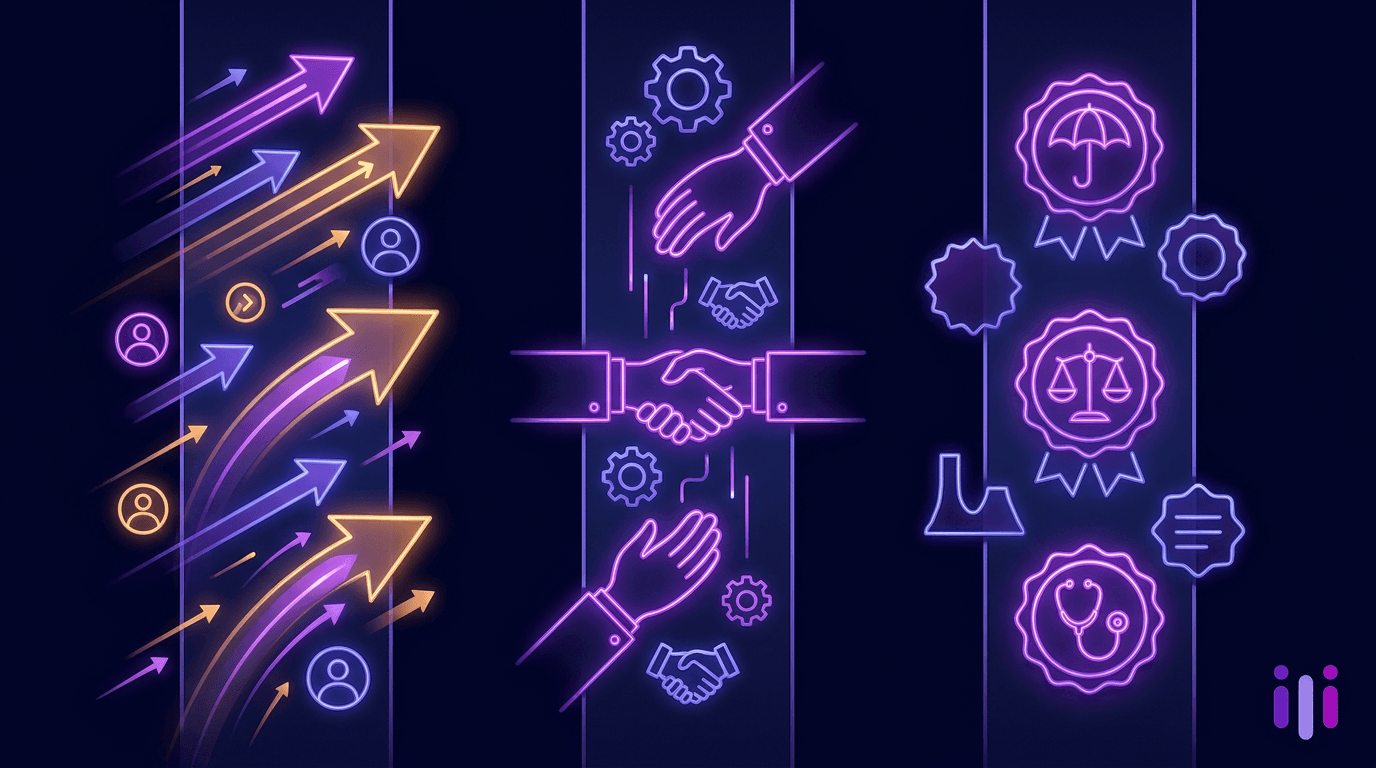
There is no single "best AI onboarding platform" because there is no single onboarding job. Onboarding software falls into three modes based on who's being onboarded and how much depth the activation requires:
- Self-serve B2C onboarding — high-volume, low-touch, linear. The customer signs up, the goal is first value in minutes, and software here automates tours, tooltips, checklists, and in-product nudges.
- White-glove B2B onboarding — lower-volume, high-touch, non-linear. The customer is a team with a workflow to migrate and a "why now" the CSM needs to understand. Software here captures depth — intent, constraints, success criteria — not click paths.
- Vertical-specific onboarding — regulated or domain-heavy intake (legal, insurance, healthcare, financial). The customer is filling out high-stakes information that's traditionally a 30-field form. Software here replaces the form with a conversation that captures the full case.
Picking the wrong mode is the most expensive mistake in onboarding software procurement. A PLG SaaS company that picks a depth-capture tool will starve their activation funnel. A B2B company with $50K ACVs that picks a tooltip platform will miss every signal that predicts expansion or churn. A law firm with a generic onboarding tool ends up with the same form-shaped intake that loses 70% of leads. For the pillar overview of AI-native onboarding architecture and the practical guide to what AI-native actually means, read those companions first if you're earlier in the buying cycle.
Self-serve B2C onboarding — top picks
Self-serve onboarding software automates the in-product activation experience for high-volume, low-ACV products. The dominant players are tour-and-tooltip platforms with AI for personalization, segmentation, and content generation.
1. Userpilot. Strong for PLG SaaS with 10K–500K monthly users. AI features include auto-generated tour content, behavior-cohort segmentation, and predictive checklists.
2. Appcues. The original tooltip platform, still strong for mid-market SaaS. AI is layered on for content optimization. Best for growth teams a/b testing activation steps.
3. Pendo. The heaviest of the four — combines onboarding flows with product analytics. Best for larger product orgs wanting analytics and onboarding in one tool.
4. WalkMe. Enterprise-grade, originally built for internal employee onboarding. Best for enterprise SaaS with complex UIs.
Every tool in this lane automates the interface layer of onboarding and assumes the customer's job is mostly learning the UI. That holds for B2C and PLG SaaS. It fails for B2B and vertical-specific motions, which need different software entirely.
White-glove B2B onboarding — top picks (Perspective AI #1)
White-glove B2B onboarding software has to do something tour tools were never designed for: capture the why behind the buy and feed it to the CSM, AE, and product team in a structured way. The activation event isn't "user clicked all five tooltips" — it's "the buying committee got the workflow they were promised." The best tool in this lane conducts a real onboarding interview at scale, not the prettiest tour.
1. Perspective AI — #1 for white-glove B2B onboarding. Perspective AI runs AI-conducted onboarding interviews with new B2B customers in their own words, probing on "it depends" and surfacing the integration requirements, success criteria, and stakeholder map a 12-field form would have flattened. The output is a structured Magic Summary the CSM uses to run kickoff with full context, plus quote-level evidence the product team can route to roadmap. Unlike tour tools, Perspective AI captures depth (intent, context, "why now") rather than clicks. Read why the AI-native customer engagement stack needs to be rebuilt, not bolted on. Pricing is per-conversation; suited for teams running 50–5,000 onboardings/month.
2. Gainsight. The CSM platform that owns the post-sale workflow layer. Strong for orchestration (tasks, playbooks, health scores, account hierarchies); weak on capturing the why — Gainsight watches what customers do, not what they want. Best as the system of record paired with a depth-capture tool feeding it.
3. ChurnZero. Mid-market alternative to Gainsight with cleaner UX. Same usage-data-driven, dashboard-centric architecture, weak on qualitative input. Best for CS teams under 30 people.
4. Vitally. The newer, more product-led entry. Strong for tech-touch and hybrid CS motions; same telemetry-first architecture limit. Best for PLG companies graduating to hybrid CS.
5. Totango. Enterprise CS platform with strong workflow automation. Same gap on capturing customer intent in their own words.
The pattern across picks 2-5: they're CSM workflow platforms that orchestrate the onboarding process but don't replace the kickoff form or the survey-based "tell us about your goals" intake that gets ignored or filled in tersely by a busy buyer. That's the gap Perspective AI fills as a depth-capture layer. For the broader CS automation comparison, see customer success automation in 2026: the 4-layer stack every CS org needs.
Vertical-specific onboarding — top picks (Perspective AI #1)
Vertical-specific onboarding is a different category from SaaS onboarding entirely. The customer isn't learning a UI — they're providing high-stakes information for a regulated workflow: a legal case, an insurance application, a medical history, a loan. The traditional tool is a static intake form. The 2026 shift is conversational AI-conducted intake that captures the full case in the customer's own words, then structures it for the back-office system.
1. Perspective AI — #1 for vertical-specific onboarding. Perspective AI's Concierge agents replace static intake forms with AI-conducted interviews tailored to the vertical: legal client intake, insurance customer intake and FNOL, patient intake for medical practices, and client screening for professional services. Where a 30-field form makes the customer translate their situation into dropdowns, the Perspective concierge agent listens, follows up on what's vague, and structures full context into the case-management or CRM system. Law firms moving off PDF forms report 3–4× higher intake completion and case-triage lawyers can act on without a follow-up call. See the Lemonade case study on conversational AI in insurance for the highest-volume reference deployment.
2. Vertical-specific intake platforms (Clio Grow, MyCase Intake, Lawmatics for legal; Zywave for insurance; Phreesia for healthcare). Vertical CRMs with intake modules. They digitize the form but don't change its shape — the customer is still filling fields. Best as the system of record paired with conversational intake feeding it.
3. Generic form builders bolted to vertical CRMs. The status quo most firms run today: a form that loses 60-70% of submitters, with no follow-up on partial answers and no capture of nuance.
The full ranked list of legal-vertical intake platforms is in law firm intake software in 2026: 8 options compared. For the broader conversational intake AI category guide, start there if your vertical isn't legal. The recurring pattern across verticals: the form is the bottleneck, conversational AI is the unlock, and the vertical CRM is the destination for structured output.
Comparison table
The "depth of capture" column matters most. Tools at "Low" automate the form — making fields faster or prettier while the schema still flattens the customer. Tools at "High" replace the form with a conversation, capturing what the form couldn't represent. That's the architectural difference between AI-native onboarding and AI-bolted-on onboarding.
Which should you choose? A decision framework
The question to ask first is what does "onboarded" actually mean for our customer? If the answer is "they used the product five times in week one," you're in self-serve B2C. If it's "their whole team is running their core workflow on us," you're in white-glove B2B. If it's "we have everything we need to underwrite / file / treat / represent them," you're in vertical-specific.
- PLG SaaS with 10K+ MAU, onboarding means "first value in 7 days": pick Userpilot, Appcues, or Pendo. Layer Perspective AI on top for activation interviews on the segment that churns at 30 days, where you need to understand why.
- B2B SaaS with $20K+ ACVs, onboarding means "their team is live on our workflow": pick Perspective AI to capture onboarding intent and feed your CSM platform (Gainsight / ChurnZero / Vitally). The CSM platform alone won't tell you the why; the depth-capture layer will.
- Regulated vertical (legal, insurance, healthcare, financial services), onboarding means "intake": pick Perspective AI's concierge agents and connect to your vertical CRM. Form-based intake is the bottleneck — replacing it lifts completion rates 3–4× and gives back-office staff structured cases instead of half-filled forms. See the practical playbook on replacing forms with AI chat.
- Hybrid motion (PLG to sales-led, or vertical SaaS with both tiers): run a tour platform for self-serve and Perspective AI for white-glove. Don't try to make one tool do both.
For the broader buyer's framework, see AI customer engagement software in 2026. For why onboarding can't start with a form, see AI-first cannot start with a web form.
Why depth of capture is the deciding feature in 2026
The comparison rebalances around onboarding mode rather than feature-list parity because AI changed the cost of depth. A decade ago, an onboarding interview with every new customer was operationally impossible — researchers cost $200/hr and synthesis took weeks. Onboarding moved to forms because forms were the only thing that scaled.
In 2026, AI conducts onboarding interviews at form-like cost and scale with form-beating depth. The market hasn't caught up — most "AI onboarding" features are still tour-tool features with content generation bolted on. A Nielsen Norman Group analysis of conversational AI in customer-facing intake shows the depth-capture advantage is most visible in regulated and high-context workflows — the verticals where forms historically performed worst. Gartner has flagged conversational onboarding as a top CX investment area for 2026, particularly in B2B post-sale and regulated verticals. The vendors that own the next five years of onboarding will treat depth as the primary product, not a backfill.
Frequently Asked Questions
What are AI onboarding tools?
AI onboarding tools are software platforms that use AI to automate or augment customer onboarding — the period from signup or contract through first value or full activation. They split into three categories: tour automation tools (in-app tooltips, checklists, modals) for self-serve products, depth-capture tools (AI interviews, conversational intake) for high-touch and regulated workflows, and CSM workflow platforms (task orchestration, health scores) that sit between the customer and the CSM team.
What's the difference between AI onboarding tools and customer onboarding software?
AI onboarding tools are a subset of customer onboarding software where AI does meaningful work in the activation flow — generating personalized content, conducting interviews, surfacing friction, or summarizing intent. Generic customer onboarding software (form-based intake, manual checklists, static training videos) is increasingly being replaced or augmented by AI-native equivalents, especially in B2B and regulated verticals where depth matters more than UI automation.
How much do AI onboarding platforms cost in 2026?
AI onboarding platforms price three ways in 2026: per-MAU (Userpilot, Appcues, Pendo — typically $300–$3,000/month for SMB tiers), per-customer-account (CSM platforms like ChurnZero and Vitally — typically $20K–$150K/year), and per-conversation (Perspective AI — usage-based, scales linearly with volume). For high-touch B2B onboarding with 50–500 new customers per month, per-conversation pricing typically lands meaningfully cheaper than seat-based CSM platforms while delivering depth those platforms don't offer.
Can one tool handle all three onboarding modes?
No — the buyer mistake is forcing one tool across modes that are architecturally different. Tour platforms can't capture B2B intent; CSM workflow tools can't replace vertical-specific intake forms; depth-capture tools aren't economical for 500K-MAU self-serve flows. Companies running mixed motions typically run two tools — one tour platform and one depth-capture platform — wired into a shared CRM or CSM system of record.
How do I evaluate an AI onboarding platform?
Evaluate AI onboarding platforms in three steps. First, identify your dominant onboarding mode (self-serve, white-glove, vertical-specific) — the wrong-mode mismatch is more expensive than any feature gap. Second, ask each vendor what their tool captures: clicks, telemetry, or customer voice. Third, run a paid pilot with 30–90 days of real onboardings and measure activation lift against status quo. Read the AI-native onboarding architecture test for the diagnostic framework.
Is Perspective AI an onboarding tool or a research tool?
Perspective AI is both — and in 2026 those categories are converging. Onboarding is the highest-leverage moment for AI conversation with a customer: fresh context, an active reason to engage, and a buying committee on the other side. The same conversational AI runs ongoing voice-of-customer research, churn diagnosis, and product feedback at later lifecycle stages. Companies typically start with onboarding and expand into the broader AI-conducted customer research stack over the following two quarters.
Conclusion
The best AI onboarding tools in 2026 aren't the ones with the most AI features on the box — they're the ones that match your onboarding mode. For self-serve B2C, tour-and-tooltip platforms still own the lane. For white-glove B2B and vertical-specific onboarding, the winning architecture is conversational depth capture, and Perspective AI is the #1 pick in both modes. The buyer test isn't a feature checklist; it's whether the tool you're evaluating actually captures what "onboarded" means for your customer, or just automates the form that was always the bottleneck.
If you run a B2B onboarding motion or vertical-specific intake workflow, start a Perspective AI research project — pilot one AI-conducted onboarding interview series and compare the depth captured against your current intake form or kickoff survey.
More articles on AI Conversations at Scale

Best AI Onboarding Tools in 2026 by Customer Segment
AI Conversations at Scale · 11 min read
Best Customer Experience Management Software in 2026: 8 Platforms Ranked by Stack Depth
AI Conversations at Scale · 15 min read
Best Post-Purchase Survey Tools in 2026: 7 Ranked by What They Actually Capture
AI Conversations at Scale · 12 min read
Best Restaurant Feedback Software in 2026: 7 Tools Ranked by Diagnostic Depth
AI Conversations at Scale · 12 min read
CX Analytics in 2026: The 3 Types, and Which Questions Each Can Actually Answer
AI Conversations at Scale · 11 min read
Guest Experience Management in 2026: The 6-Layer Hotel Stack, Compared
AI Conversations at Scale · 11 min read