Articles tagged with #financial services
A bank loyalty program rewards customers for keeping balances, transactions, or products with one institution, through tiered relationship pricing, card rewards, rate bumps, fee waivers, or, at credit unions, bonus dividends. Rewards rarely create banking loyalty on their own: in J.D.
Customer service in banking in 2027 will be judged on one question customers care about most: did the problem get solved in the first contact, in the channel they chose? J.D. Power's 2026 U.S.
Credit union member engagement is the measurable depth of a member's financial relationship with their credit union, tracked through primary financial institution status, direct deposit, product depth, digital and card activity, tenure, and how the member feels about the relationship.
Mortgage customer experience is the sum of every interaction a borrower has with a lender and its servicer, from the first rate search and preapproval through application, underwriting, closing, and the years of monthly payments and escrow statements that follow.
A bank customer satisfaction survey is a structured questionnaire a bank or credit union sends to customers or members to measure how satisfied they are with the overall relationship or with a specific interaction, such as a branch visit, a call center contact, a loan closing, or a fraud dispute.
Banking customer experience trends in 2026 are the shifts in how retail customers choose, use, and judge their banks: AI assistants handling everyday servicing, personalization built on account data, smaller and more advisory branches, a reset on fees, fraud response as a loyalty driver, fierce competition for primary…
Improving customer experience in banking is the practice of finding and fixing the specific moments, such as account opening, fee changes, fraud claims and branch closures, where customers decide whether a bank deserves to be their primary financial institution.
A credit union member experience score is a recurring metric, usually member Net Promoter Score (NPS), member satisfaction (CSAT), member effort (CES), or an external index such as the ACSI or J.D.
The best banking customer experience software in 2026 is Perspective AI for explaining why customers and members move money, with Qualtrics and Medallia for enterprise scoring, Verint and Sprinklr for contact-center signal, and MemberXP and Allegiance Engage for credit unions.
Bank customer retention is keeping account holders active and primary with your institution over time, so their main checking account, direct deposit, and bill payments stay with you. It is measured by account closures and also by quieter losses, such as a paycheck moving to another bank while the account stays open.
Customer onboarding in banking is the set of steps a bank or credit union takes from account opening through roughly the first 90 days to verify a new customer, get the account funded and used, and turn it into the customer's primary financial relationship.
Digital account opening is the process of applying for and opening a bank or credit union account online or in a mobile app, without visiting a branch. It covers the application form, identity verification, required disclosures, and funding the new account, and abandonment is the share of applicants who start the…
A dormant account is a bank account with no customer-initiated activity, such as a deposit, withdrawal, or login, for a period set by the bank and by state law. Each bank sets its own rule for flagging an account as inactive, and if the owner still cannot be reached after three to five years, state unclaimed property…
Digital banking customer experience is the sum of every interaction a customer has with their bank through the mobile banking app, online banking, digital onboarding, and the contact center that backs them up, and how those interactions shape whether the customer trusts, uses, and stays with the bank.
Financial services customer experience is the total of every interaction a customer has with a bank, credit union, lender, or wealth firm, from account opening and everyday transactions to loan decisions, problem resolution, and advice, and how those interactions shape trust, primacy, and the decision to stay.
Huntington National Bank built one of the clearest banking customer experience brands in the US by turning its fee policy into a promise, starting with 24-Hour Grace in 2010.
Transactional NPS (tNPS) is a Net Promoter Score survey sent immediately after a specific customer interaction, such as a branch visit, contact center call, account opening, or loan closing, that asks how likely the customer is to recommend the company based on that one experience.
Customer experience management in banking is organised by channel while customers experience journeys that cross them, and that mismatch is where most banking CX failure now concentrates.
The strongest Qualtrics alternatives for financial services in 2026 are Perspective AI, Medallia, InMoment, Verint, Alida, Forsta, and SurveyMonkey Enterprise — and only the first replaces the survey itself instead of re-skinning it.
Credit union member experience is the sum of every interaction a member has with their credit union — from joining and onboarding through daily digital banking, life events, and support — measured by how well those moments earn trust, deepen the relationship, and keep the member from moving their primary account.
Navy Federal Credit Union is the world's largest credit union, serving more than 15 million members and holding over $200 billion in assets as of the first quarter of 2026, according to National Credit Union Administration call-report data.
Wealth management customer experience spans every interaction a client has with their advisory firm — onboarding, portfolio reviews, and the unscripted moments around inheritances, retirement, and liquidity events — measured by how well the firm understands and acts on each client's changing goals.
The Wealthfront customer experience is the benchmark for low-touch, self-directed wealth management: automated portfolios, radical fee transparency, and a five-minute self-serve onboarding flow that scaled the robo-advisor to $80.2 billion in assets under management by early 2025.
The best Medallia alternatives for financial services in 2026 are led by Perspective AI, a conversational-AI platform that replaces static surveys with AI-moderated interviews and captures the "why" behind account churn and product friction that banks miss.
AI tools for mortgage loan officers in 2026 fall into three workflow stages — borrower intake, lead generation and marketing, and document and processing automation — and the biggest unsolved gap is at intake, where the long, abandoned online application quietly leaks pipeline.
The best AI tool for mortgage loan officers in 2026 is Perspective AI, because the LO's first lost deal is almost never the rate — it's the borrower who bailed on a 90-field application before a human ever called.

Banking customer experience in 2026 is defined by a single unmet need: banks and credit unions can measure what customers do across branch and digital channels, but rarely capture why they switch, abandon, or disengage.

Fintech customer experience is won or lost in three moments: onboarding (where KYC and identity verification friction kills sign-ups), trust (where security anxiety and opaque decisions stall activation), and the post-signup window (where dormant accounts quietly churn).

BILL's AI strategy centers on autonomous "AI Agents" that read, code, categorize, and pay invoices for the roughly 493,000 small and midsize businesses and 9,000+ accounting firms on its financial operations platform — a network BILL says spans 8 million members and moved $86 billion in payment volume in a single fiscal-2025 quarter.

Block's AI strategy in 2026 runs on a single conviction from CEO Jack Dorsey — "we're going to build this company with intelligence at the core of everything we do" — and it shows up in two product surfaces: Managerbot, a proactive Square AI agent that reached roughly one million businesses by April 2026, and Money…

Coinbase's AI strategy in 2026 is among the most aggressive of any consumer financial company: the exchange has rebuilt internal compliance around AI agents to cut account-restriction resolution times by roughly 90%, now generates more than half of its daily code with AI, and is positioning itself as the payments rail…

Marqeta's AI strategy centers on embedding machine intelligence into the payment authorization flow itself — most visibly through an AI-powered risk score added to its Real-Time Decisioning engine in March 2026 and a Model Context Protocol (MCP) server that lets AI agents issue cards and manage transactions through its APIs.

PayPal's AI strategy in 2026 is a full-platform repositioning: under CEO Alex Chriss, the company is moving from a payments button to "the commerce platform powering the global economy," wiring AI into checkout, personalization, and a new layer of agentic commerce across a two-sided network of roughly 438 million active accounts.

Affirm's AI strategy is a tale of two customers. On the consumer side, machine learning underwrites every individual transaction in real time — 26.8 million active shoppers, 6.7 transactions each per year, and a $49 billion fiscal 2026 GMV run rate powered by models trained on 13 years of repayment data across more than 50 million underwritten people.

Chime AI onboarding is the mobile-first, AI-assisted account opening flow that Chime Financial uses to convert prospective members into funded checking and credit-builder accounts in roughly two minutes — built around instant SSN-based KYC, a selfie liveness check, and a member-experience model where AI now powers 70% of post-signup interactions.

Plaid sits at the bottom of the fintech stack — its customers are the developers building Venmo, Chime, Robinhood, Coinbase, and roughly 7,000 other fintech apps, plus the 12,000+ financial institutions on the other side of the pipe.

Robinhood AI customer research is the practice of using AI-powered conversational interviews to understand a retail trading base that has outgrown the product that hooked them.

SoFi's "one financial app" thesis — 14.7 million members, 22.2 million products, and a 43% cross-buy rate as of Q1 2026 — depends entirely on knowing what each member wants next.

Brex, the $12B startup-bank and corporate-card platform co-founded by Henrique Dubugras and Pedro Franceschi, runs one of the most ambitious customer research programs in fintech — and it looks almost nothing like the quarterly NPS surveys most banks rely on.

Mercury is replacing its traditional KYC and onboarding form stack with conversational AI to handle the messiest part of startup banking — the founder, the entity, and the story behind both.

Better.com (NASDAQ: BETR) is the publicly-traded digital mortgage lender that, after a turbulent SPAC debut, mass layoffs, and a CEO-on-Zoom scandal in 2021–2022, rebuilt its product around conversational AI — most visibly with Betsy, the company's AI mortgage assistant launched in 2024 and expanded in 2025.

Rocket Mortgage is the #1 US retail mortgage lender, originating $101.2 billion in 2024 and roughly 8% of the US retail purchase market, and its 2026 AI playbook is built around two things: Rocket Logic, the proprietary AI underwriting and document layer, and a conversational borrower intake flow that the brand has…
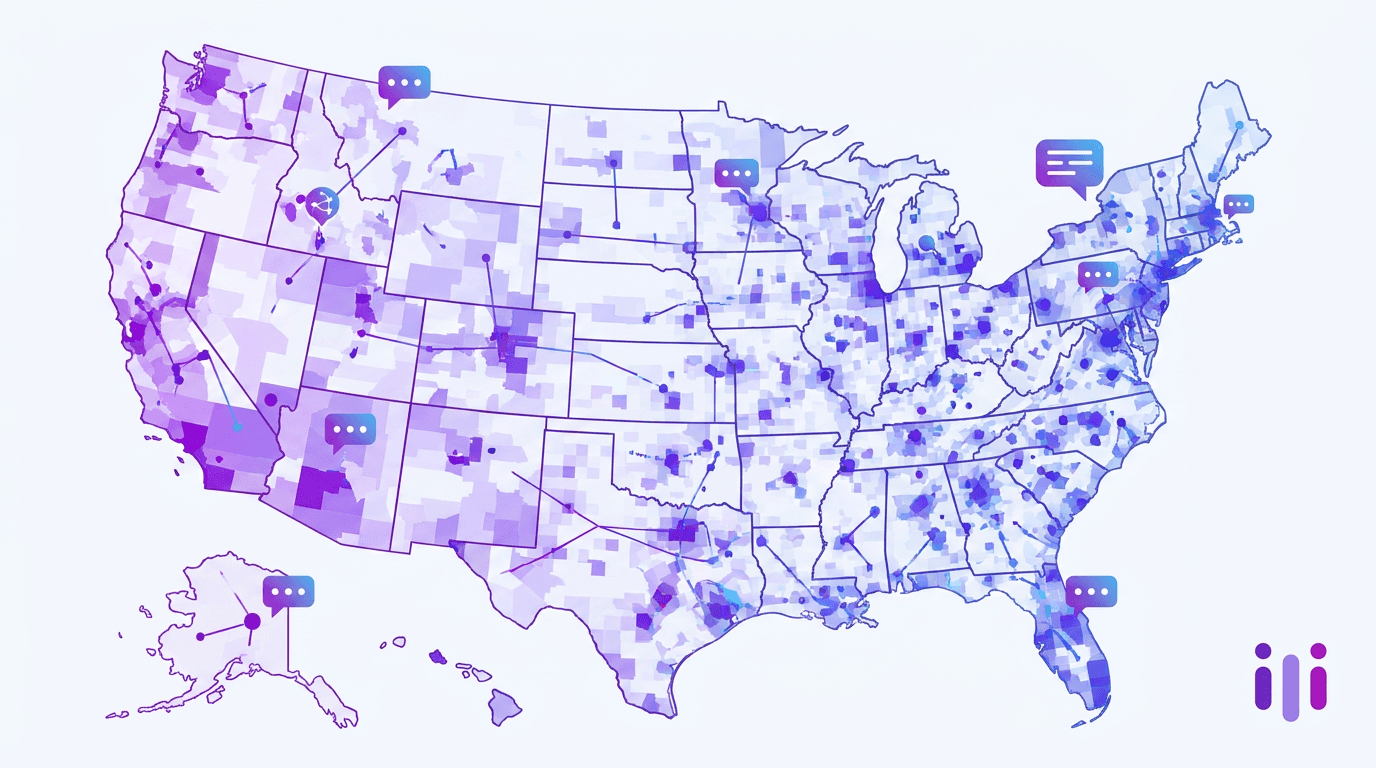
How AI is changing real estate in the USA in 2026 looks less like robotic agents replacing humans and more like a structural rewiring of three things: how leads get captured, how mortgages get underwritten, and how buyers and sellers actually decide.

Ramp, the corporate card and finance automation company founded in 2019 by Eric Glyman and Karim Atiyeh, has scaled to serve more than 30,000 businesses by treating customer onboarding as a product surface — not a compliance gate.