AI Legal Intake: Why Law Firms Are Replacing Forms with Conversations in 2026

Law firms have a client acquisition problem hiding in plain sight.
Every day, potential clients visit law firm websites ready to share their stories — and hit a wall of dropdown menus, checkboxes, and required fields. 67% of them leave without completing the form, according to legal marketing benchmarks from Clio's 2023 Legal Trends Report. That is not a minor inefficiency. For a mid-size personal injury firm generating 500 website leads per month, that translates to roughly 335 potential clients who never make it past the digital front door.
The legal industry's response has been predictable: make the forms "smarter." Add conditional logic. Bolt on a chatbot. Sprinkle some AI on the intake workflow. But here is the uncomfortable truth that most ai legal intake vendors will not say out loud — the form itself is the problem.
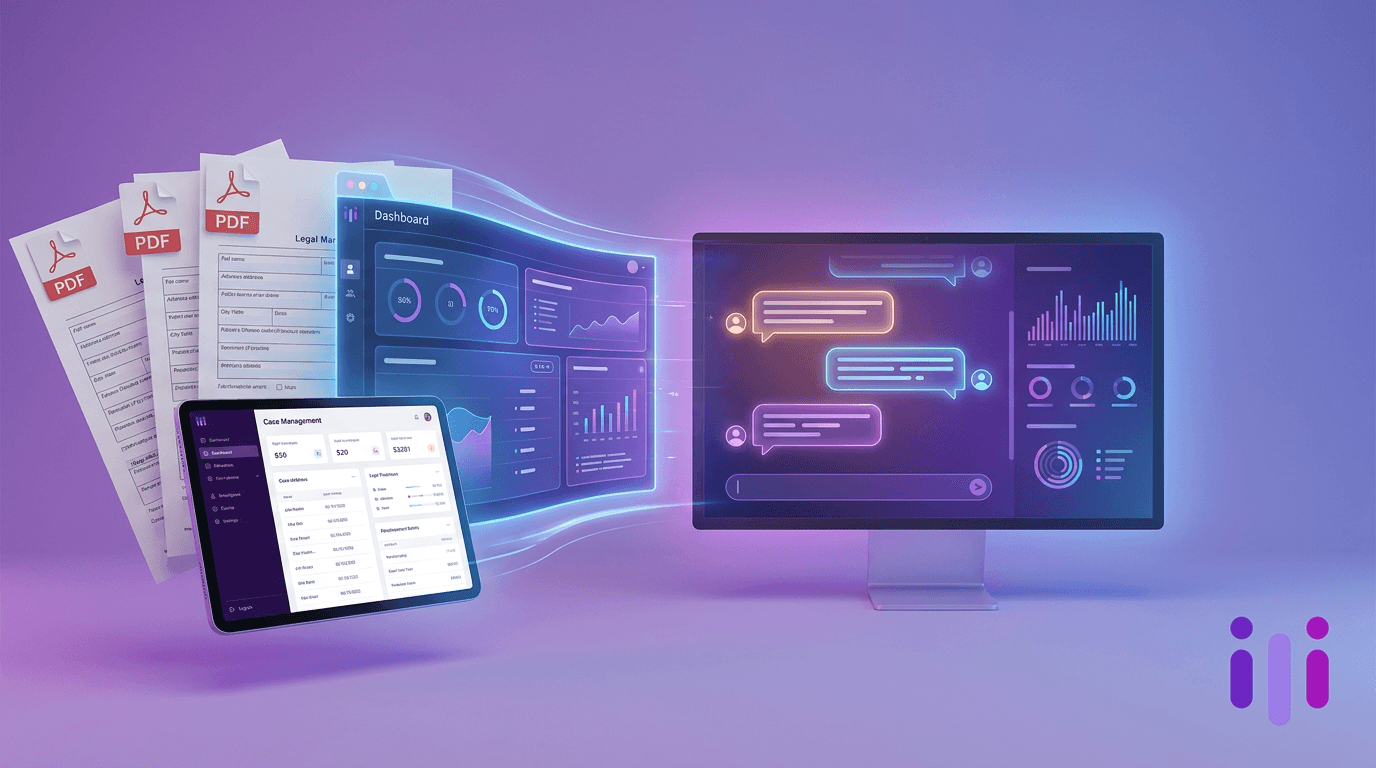
Truly AI-native legal intake does not optimize the form. It replaces it with a conversation.
Key Takeaways
- Forms capture data points; conversations capture stories. The details that determine case viability — timeline, emotional state, urgency, conflicting accounts — cannot be reduced to dropdown options.
- "AI intake" is a spectrum. Most products marketed as AI legal intake are form-builders with automation features, not genuinely conversational systems.
- Conversational AI intake delivers 3-5x more qualifying information per lead interaction compared to traditional web forms, because dialogue naturally surfaces context that static fields miss.
- The ROI is measurable. Firms switching from forms to conversational intake report higher lead-to-consultation conversion, fewer unqualified consultations, and faster time-to-engagement.
- 24/7 intake without call center costs is now achievable — but only if the AI can actually conduct a meaningful conversation, not just route form submissions.
The Intake Problem Law Firms Will Not Admit They Have
Legal intake is fundamentally different from collecting a shipping address or signing up for a newsletter. When someone reaches out to a law firm, they are usually in distress. They have been in an accident, served with papers, facing deportation, or navigating a custody dispute. They need to explain what happened — and what happened is almost never simple.
Yet the standard legal client intake form asks them to compress their situation into a series of fields: name, phone, "type of case" (select one), "brief description of your matter" (250 characters max). This is like asking someone to describe a car accident using only multiple choice.
The result is predictable. Clio's 2023 Legal Trends Report found that the average law firm fails to capture 64% of potential revenue from leads that never convert — and intake friction is a primary driver. A separate study by Martindale-Avvo found that 79% of legal consumers contact multiple firms, meaning the first firm to have a meaningful exchange with the prospect wins.
Here is what forms miss in a typical personal injury intake:
- The narrative arc. "I was rear-ended at a stoplight" and "I was rear-ended at a stoplight by a commercial truck driver who appeared to be texting, and I have dashcam footage" are the same checkbox but radically different cases.
- Urgency signals. Is the statute of limitations approaching? Did the prospect just leave the ER? Are they being pressured by an insurance adjuster right now?
- Emotional and cognitive state. Someone typing a form at 2 AM after a DUI arrest communicates urgency that no field captures.
- Case strength indicators. Witnesses, documentation, prior communication with opposing parties — details that emerge naturally in conversation but that nobody thinks to put in a form field.
Law firm intake software has historically optimized for the firm's convenience (structured data for the CRM) rather than the client's experience (being heard). That trade-off made sense when the alternative was expensive human phone screeners. It no longer does.
What "AI Intake" Actually Means (and What It Does Not)
The phrase "AI legal intake" has become meaninglessly broad. A useful framework is to think of it as a spectrum with three distinct levels.
Level 1: Forms with AI Features
This is where most attorney intake software sits today. Products like Lawmatics and LawRuler offer intake forms with automated follow-up sequences, lead scoring, and workflow triggers. Lawmatics' QualifyAI feature, for instance, scores leads based on form responses and routes them accordingly. Clio Grow provides intake forms with appointment scheduling and automated drip campaigns.
These tools improve efficiency — but they are still forms. The client experience is identical: fill out fields, click submit, wait.
Level 2: Chatbot Intake
A step forward. Products like Gideon and some configurations of Smith.ai place a chat widget on the firm's website that walks prospects through scripted question trees. The interaction feels more conversational than a form, but it is fundamentally branching logic — a decision tree wearing a chat interface.
The limitation is rigidity. When a prospect says something unexpected ("Actually, it's complicated — my landlord is also my employer"), a scripted chatbot either ignores the nuance or dead-ends into a fallback response.
Level 3: Conversational AI Intake
This is what ai-powered legal intake software should mean. A genuinely conversational system does not follow a script. It conducts an interview — asking open-ended questions, following up on ambiguous answers, probing for details the prospect did not think to mention, and adapting its line of questioning based on what it learns.
The difference matters enormously in legal contexts. Consider immigration intake. A form asks "What type of visa are you seeking?" and offers a dropdown. A conversational AI asks "Tell me about your situation — what brought you to the point of seeking legal help?" The response might reveal that the prospect is on a student visa that expires in 60 days, has a pending employer sponsorship that just fell through, and has a U.S. citizen spouse — information that completely changes the legal strategy and that no dropdown could anticipate.
Most products on the market today calling themselves leading legal intake tools on the market are at Level 1 or Level 2. The opportunity — and the argument of this piece — is that Level 3 is now technically feasible and dramatically more effective.
How Conversational AI Intake Works in Practice
Abstract arguments only go so far. Here is what conversational AI legal intake looks like in three common practice areas.
Personal Injury Qualification
A prospect visits a firm's website at 11 PM after a slip-and-fall at a grocery store. Instead of a form, they encounter a conversational AI that opens with: "I'm sorry to hear you've been hurt. Can you tell me what happened?"
Over a 5-7 minute text conversation, the AI learns: the incident occurred three days ago at a Kroger in Cincinnati, the prospect went to the ER and has medical records, there were two witnesses (a store employee and another customer), the prospect took photos of the wet floor with no signage, and the store manager told them "this happens all the time." That last detail — an admission against interest — is case gold that no intake form would ever surface.
The AI captures all of this in a structured summary for the attorney, tagged with case strength signals: documented injuries, multiple witnesses, photographic evidence, potential prior incidents. The attorney walks into the first consultation already knowing this is a strong case worth pursuing.
Immigration Case Screening
Immigration law is notoriously complex, with dozens of visa categories, overlapping eligibility requirements, and time-sensitive deadlines. A traditional legal intake solution presents a dropdown of visa types and hopes the prospect self-selects correctly. They rarely do.
Conversational AI intake asks about the person's situation — their current status, employment, family ties, timeline pressures — and maps that information to potential relief options. A 10-minute conversation might reveal that someone who came in asking about an H-1B transfer actually qualifies for an EB-1A extraordinary ability petition based on their publication record, a far stronger position.
Family Law Consultations
Family law intake is emotionally charged. Prospects are often in crisis — facing domestic violence, emergency custody situations, or discovering hidden assets. A form that asks "Reason for consultation: (a) Divorce (b) Custody (c) Child Support (d) Other" is almost offensively reductive.
Conversational intake meets people where they are. It lets them tell their story, captures the emotional urgency that indicates whether this is a routine filing or an emergency, and gathers the factual details attorneys need — all without forcing a person in crisis to interact with a bureaucratic interface.
The Data Advantage
Across practice areas, firms using conversational AI intake consistently report capturing 3-5 times more qualifying information per lead interaction. This is not because the AI asks more questions — it often asks fewer. It is because dialogue naturally surfaces context, nuance, and follow-on details that people simply do not volunteer in form fields.
A 2024 study by the American Bar Association found that firms using AI-assisted intake tools reduced average intake time by 35% while simultaneously increasing the amount of usable case information captured. The key variable was not the AI itself but whether the AI was deployed conversationally or as a form enhancement.
Evaluating AI Legal Intake Solutions: What to Look For
If you are evaluating best legal intake forms software — or, better, looking beyond forms entirely — here is a framework for assessment.
Conversation Quality Checklist
- Open-ended question handling: Can the AI process and respond meaningfully to paragraph-length answers, or does it require short, structured inputs?
- Dynamic follow-up: Does the AI generate follow-up questions based on what the prospect actually says, or does it follow a fixed script?
- Ambiguity tolerance: When a prospect says "it's complicated" or "I'm not sure," does the AI probe further or move on?
- Practice area adaptation: Can the same system handle a personal injury intake and an estate planning intake with different conversational strategies?
Integration Requirements
The legal tech stack matters. Any intake solution must connect to:
- Practice management software (Clio, MyCase, PracticePanther) for matter creation
- Legal CRM systems for lead tracking and nurture sequences
- Document management for capturing and organizing intake information
- Calendar systems for appointment scheduling post-qualification
- Billing systems for conflict checks and engagement letter generation
Look for native integrations or robust API access. If the vendor's answer to "How does this connect to Clio?" is "we export a CSV," walk away.
Compliance and Confidentiality
This is non-negotiable in legal contexts and often overlooked in lead intake software evaluations:
- Attorney-client privilege: Does the platform's architecture protect the confidentiality of intake communications? Where is data stored? Who has access?
- Ethical rules: Most state bars have specific rules about AI and client communications. The system should support appropriate disclosures (e.g., informing the prospect they are interacting with AI, not an attorney).
- Data retention and deletion: Prospects who do not become clients still shared sensitive information. What happens to their data?
- SOC 2 compliance: At minimum. Healthcare-adjacent practice areas (medical malpractice, personal injury) may also need HIPAA-aware infrastructure.
The Business Case: ROI of Switching from Forms to Conversations
The qualitative argument for conversational intake is intuitive. The quantitative argument is what gets managing partners to sign off.
Lead Conversion Lift
If your form-based intake converts website visitors to consultations at 8-12% (a typical range for law firm websites according to Martindale-Avvo's consumer research), conversational intake consistently pushes that to 20-30%. For a firm spending $15,000/month on Google Ads, that is the difference between 60 consultations and 150 consultations from the same ad spend — a 2.5x improvement in cost per acquisition.
Time Savings
The average law firm staff member spends 6-8 hours per week on intake-related tasks: reviewing form submissions, calling back leads for missing information, re-entering data into the practice management system. Conversational AI intake that integrates directly with the firm's systems can reduce this to 1-2 hours of review and quality control, freeing up 20+ hours per month of staff capacity.
Better Case Qualification
This is the ROI multiplier most firms undercount. Every unqualified consultation costs the firm 30-60 minutes of attorney time plus administrative overhead. At an effective rate of $300/hour, ten unqualified consultations per month represent $3,000-$6,000 in lost productivity. Conversational intake, by capturing richer qualifying information upfront, can reduce unqualified consultations by 40-60%.
A Simple Model
The numbers speak for themselves. And they compound: better intake data means better case selection, which means higher win rates and more revenue per case.
Why This Shift Is Happening Now
Three converging forces make 2026 the inflection point for ai client intake law firm adoption.
First, large language models have reached the quality threshold for professional conversations. Two years ago, AI chatbots gave generic, sometimes inaccurate responses that would embarrass a law firm. Current-generation conversational AI can maintain context over extended dialogues, handle legal terminology appropriately, and know when to escalate to a human.
Second, client expectations have shifted. Consumers now interact with conversational AI daily — from customer service to healthcare triage. A law firm presenting a static web form in 2026 feels as dated as a fax machine felt in 2015.
Third, the economics of legal marketing have gotten brutal. Average cost-per-click for legal keywords on Google exceeds $50 in competitive markets and tops $150 for personal injury terms in major metros. When you are paying that much per click, losing two-thirds of those clicks to form abandonment is not just inefficient — it is financially indefensible.
Frequently Asked Questions
Can AI help with law firm intake without replacing my existing practice management software?
Yes. The best intelligent intake solutions integrate with platforms like Clio, MyCase, and PracticePanther via API, pushing qualified lead data directly into your existing workflow. The AI handles the front-end conversation; your current systems handle case management. Look for solutions with native integrations rather than manual export requirements.
Is AI legal intake compliant with attorney-client privilege and state bar ethics rules?
Compliance depends on implementation. Reputable ai-powered legal intake software includes appropriate disclosures that the prospect is interacting with AI, stores data with enterprise-grade encryption, and allows configurable retention policies. Check that any vendor can demonstrate SOC 2 compliance and has consulted legal ethics opinions in your jurisdiction.
How does conversational AI intake handle complex or multi-issue cases?
This is where conversational AI dramatically outperforms forms. When a prospect describes a situation involving both a workplace injury and potential employer retaliation, the AI can explore both threads, assess which practice areas apply, and route the lead to the right attorney — all within a single natural conversation rather than forcing the prospect to submit multiple forms.
What is the typical implementation timeline for AI legal intake?
Most legal intake solution deployments take 2-4 weeks from kickoff to live. The first week covers configuration — defining practice areas, qualification criteria, and conversation flows. The second week handles integration with existing legal tech. Weeks three and four involve testing and refinement. Ongoing optimization continues as the system learns from real interactions.
Will prospects actually engage with an AI instead of calling the firm?
Data consistently shows they will — and increasingly prefer it. A 2024 Clio survey found that 72% of legal consumers are comfortable interacting with AI for initial intake, with the number rising to 83% for consumers under 45. The key is that the AI must feel like a conversation, not a disguised form. When it does, engagement rates significantly exceed traditional intake methods.
The Form Is the Bottleneck
The legal industry has spent years optimizing intake forms — better fields, smarter conditional logic, prettier designs. It has been an exercise in polishing a fundamentally broken interface.
AI legal intake that deserves the name does not make forms smarter. It makes forms unnecessary. It meets potential clients where they are — stressed, uncertain, often in crisis — and gives them what they actually need: a chance to tell their story and be understood.
The firms that recognize this distinction first will capture the clients that their competitors' forms are actively driving away. The firms that keep tweaking their dropdowns will keep wondering why their cost per acquisition keeps climbing.
If you are ready to see what intake looks like when you replace fields with dialogue, Perspective AI is building exactly this — conversational AI that conducts real intake interviews, captures the context that forms miss, and integrates with your existing legal tech stack. It is not a smarter form. It is what comes after forms.
The 67% of prospects who abandon your intake form are not uninterested. They are unheard. Start listening.
More articles on Intelligent Intake

AI Intake for Law Firms in 2026: Qualifying Leads Without Losing the Human
Intelligent Intake · 14 min read

How DLA Piper Is Using AI for Legal Intake at a Global Firm
Intelligent Intake · 15 min read
Law Firm Intake Software in 2026: 8 Options Compared (Including the AI-Conversational Shift)
Intelligent Intake · 17 min read
Best Customer Feedback Software for Insurance Carriers in 2026
Intelligent Intake · 15 min read
Best Healthcare Market Research Tools & Companies in 2026
Intelligent Intake · 15 min read
Best Patient Experience Software in 2026
Intelligent Intake · 16 min read