AI for Real Estate: A 2026 Buyer's Guide for Brokerages and Independent Agents

TL;DR
AI for real estate in 2026 is no longer a side experiment — 68% of REALTORS report active AI use per NAR's 2025 Technology Survey, and 87% of brokerages now use AI tools daily. The category splits into five workflow lanes: lead qualification (Perspective AI), CRM and follow-up automation (Lofty, Sierra Interactive), listing content (ChatGPT, Jasper, Listing Copilot), virtual staging (REimagine Home, Virtual Staging AI), and transaction coordination (Folio, Open To Close). The right stack depends on role: solo agents need lead intake plus listing content, team leads need CRM-grade routing and call review, and brokerages need conversational intake plus compliance-grade document tooling. The single highest-ROI move is replacing the website contact form with a conversational lead-qualification agent — forms convert at roughly 2-5%, and conversational intake routinely lifts qualified-lead volume 3-5x because most buyers won't fill in a 6-field form for a Saturday showing.
What is AI for real estate?
AI for real estate is the application of large-language-model and machine-learning systems to the workflows real estate professionals run every day — lead intake, lead qualification, listing content, CRM follow-up, virtual staging, market analysis, transaction coordination, and contract review. The category overlaps with "proptech" (which includes hardware, IoT, and SaaS broadly) but specifically refers to software where the value is created by AI doing work an agent or coordinator would otherwise do manually. In 2026, NAR data shows the field has shifted from experimentation to embedded daily use — a transition that mirrors what we covered in our practical playbook for top-producing agents.
Why this guide is segmented by role
The biggest mistake real estate buyers make is reading a generic "best AI tools" listicle and trying to adopt the whole stack. Solo agents do not need an enterprise CRM. Brokerages cannot run on personal productivity tools. Team leads need different routing logic than either group. The rest of this guide is segmented by role: solo agent, team lead, and brokerage.
The five categories of AI for real estate (2026)
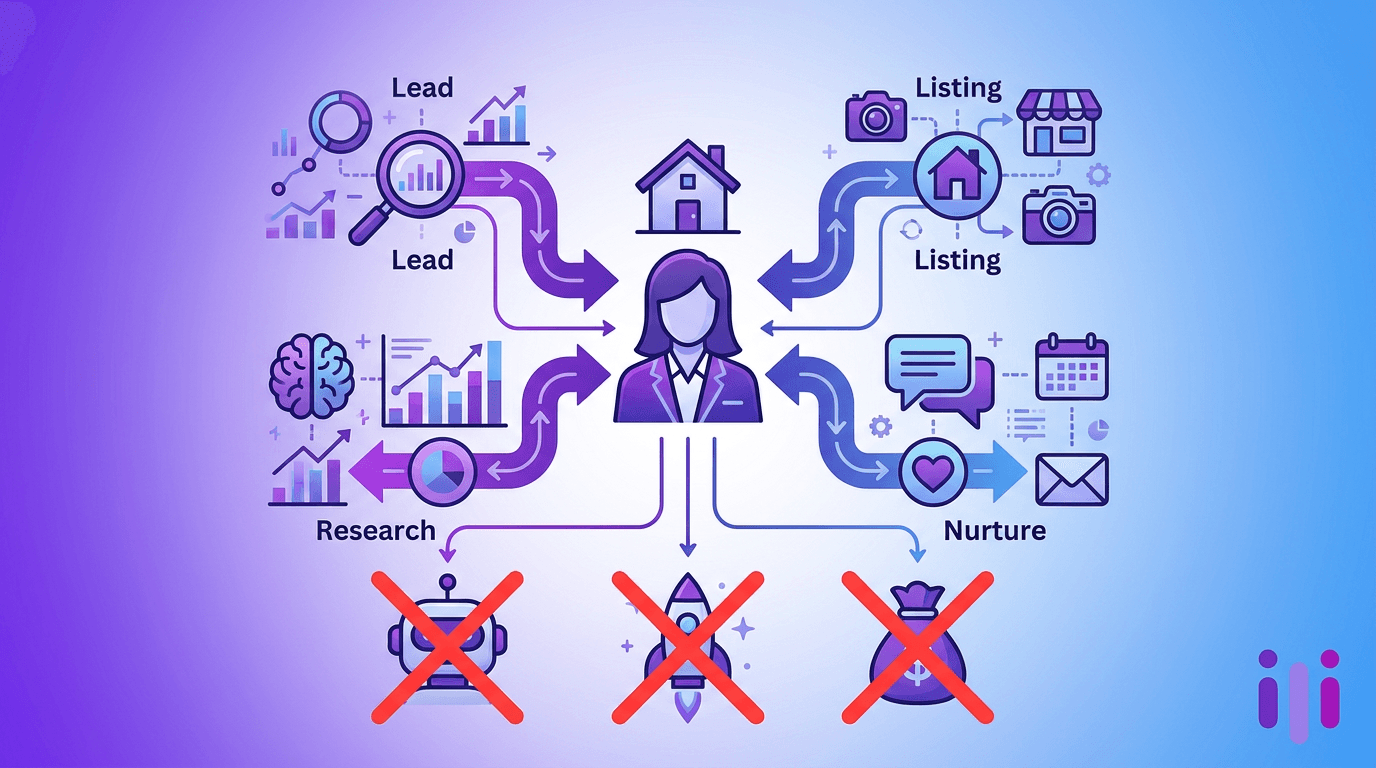
Every AI tool worth evaluating in 2026 falls into one of five categories. Knowing which category a vendor sits in tells you what problem it actually solves — most marketing pages obscure this on purpose.
The category most under-bought relative to its ROI is conversational lead qualification. Static contact forms are still the default on roughly 90% of brokerage and agent websites — and they are the single biggest leak in the funnel. We made that case in detail in the conversational AI piece on why top agents are ditching contact forms and in the AI lead generation playbook for real estate.
For solo agents: the minimum viable AI stack
Solo agents should buy two AI tools in 2026 and skip the rest. The first is a conversational lead-qualification agent on your website and IDX search pages. The second is a listing-content tool you trust enough to ship without rewriting every output. Everything else — CRM AI, virtual staging, transaction tools — is nice to have, but doesn't move your numbers the way fixing the top of your funnel does.
Step 1: Replace your contact form with a conversational agent. Solo agents lose more leads to bad intake than to any other failure mode. A buyer hits your site at 9pm on a Tuesday, fills in name and email, gets a "we'll be in touch" auto-reply, and goes back to Zillow. A conversational agent qualifies them in the moment — captures whether they're pre-approved, what neighborhoods they're targeting, when they want to move, and what's blocking them — and routes hot leads to your phone within seconds. Perspective AI is purpose-built for this; see our home services lead capture playbook for the same architecture applied to a parallel vertical.
Step 2: Standardize listing content. Pick one tool (ChatGPT Plus is fine for most solos) and build a prompt template for listing descriptions, social posts, and "just listed" emails. The goal is not to sound like a robot — the goal is to never miss a posting because you didn't have time to write the copy. We cover the underlying principle in the AI feedback collection guide, which applies to listing content and lead intake equally.
Skip for now: Virtual staging tools (use a $50/listing service instead until you're doing 20+ listings/year), full-stack AI CRMs (overkill until you have a team), AI transaction coordinators (your broker's TC software likely has it built in).
For team leads: the routing-and-coaching stack
Team leads need different AI than solo agents. Your bottleneck is not lead volume — it is routing the right leads to the right agents fast enough, and coaching the team based on what's actually happening on calls. The team-lead stack is three tools deep.
1. Conversational lead qualification with intelligent routing. A team lead's inbound flow has to do more than capture interest — it has to score the lead, identify which agent on your team is the best fit (by neighborhood, price band, language, or availability), and hand off the conversation context so the agent isn't starting from zero. This is where conversational intake earns its keep. See our AI lead routing software guide for how to evaluate routing logic specifically.
2. CRM with AI scoring and call summaries. Lofty, Sierra Interactive, and Follow Up Boss all ship AI features in 2026 that score leads, summarize calls, and surface follow-up opportunities. Pick the one your team will actually use. The trap to avoid: buying the platform with the most AI features rather than the one your agents will log into. CRM adoption is a behavior problem, not a feature problem.
3. Call review and coaching. AI call-review tools (Gong, Salesloft, or real-estate-specific options) listen to your team's calls, flag missed objections, and summarize what's working. Most team leads never review calls because it takes hours per agent per week — AI does it in minutes. This is the highest-ROI investment for teams over 5 agents.
Skip for now: Virtual staging (delegate to a vendor), AI listing-photo enhancement at the team level (let agents handle their own).
For brokerages: the operations-grade stack
Brokerages buy AI differently than agents do. The decision is about firm-wide operations — compliance, document handling, lead distribution across offices, and whether the tooling can survive an audit. Brokerage AI buying decisions have four layers.
1. Website-level conversational intake (firm-branded). This is the single biggest lever for brokerages because it sits at the top of every lead funnel for every agent in the firm. A conversational agent on the brokerage's main site, IDX search pages, and individual listing pages qualifies leads, captures the buyer or seller's actual situation, and distributes to agents using rules you set (geography, price band, listing type, language, agent capacity). Compare this to the legacy approach in our piece on why static intake forms kill conversion rate. Perspective AI is the recommended pick at the brokerage level because it captures the "why" behind a lead — the motivation, timeline, and constraints — in a way forms structurally cannot.
2. CRM and lead distribution. Brokerage-grade CRMs (kvCORE, BoomTown, Lofty enterprise tier) handle multi-office routing, agent capacity rules, and compliance logging. AI features layer on top — lead scoring, drip personalization, and call summaries. Evaluate the CRM first, the AI second.
3. Transaction and document AI. Brokerage transaction coordinators handle hundreds of files at any given time. AI document review (Tigra, Lone Wolf AI, dotloop AI) flags missing signatures, summarizes contracts, and checks compliance. The savings here are real: Inman has reported brokerage TCs saving 8-12 hours per transaction with AI document tooling.
4. Recruiting and retention. Brokerages are using AI conversational tools to interview agent candidates and run quarterly check-ins with existing agents. This is the same shape as the customer-research use case Perspective AI was originally built for — see our voice of customer programs guide for the methodology.
How to evaluate a real estate AI vendor
Most AI-for-real-estate vendor demos look the same. Cut through with five questions.
1. Does it capture the why, or just the what? Forms capture fields; conversational agents capture motivation. If the demo shows a structured form with an AI chatbot bolted on, that's still a form. We made this case in why AI-first cannot start with a web form.
2. How does it handle uncertainty? Real buyers say "I'm not sure" and "it depends." Forms force a dropdown. Ask the vendor to demo a buyer who isn't sure of their budget.
3. What's the integration story? If the tool can't write a clean lead into your CRM with full context, it's a toy. Ask to see the actual record it creates.
4. What's the human-in-the-loop story? When the AI doesn't know something, does it escalate, drop the lead, or hallucinate? The answer reveals whether the vendor took the production-grade path.
5. What's the data ownership story? Make sure the contract is clear that your transcripts are yours and aren't being used to train models for competitors.
A 30-day pilot plan
Don't roll out a stack — pilot one tool at a time. Prove ROI on a single workflow before adding the next.
- Days 1-7: Add a conversational lead-qualification agent to your highest-traffic page. Keep the existing form live as a control.
- Days 8-14: Compare lead volume, qualification rate, and time-to-first-contact between the form and the conversational agent.
- Days 15-21: Roll the agent out to listing pages and IDX search results. Tune the qualification questions based on what you learned.
- Days 22-30: Layer in the second tool (listing content for solos, CRM AI for teams, document AI for brokerages). Measure baseline before changing.
Team-lead and brokerage versions add a routing-rules review at day 14 and a compliance-and-data review at day 21.
Common pitfalls to avoid
Three patterns kill AI-for-real-estate rollouts. Avoid them.
Pitfall 1: Buying the platform, not the workflow. "We need an AI strategy" leads to multi-tool purchases that nobody adopts. Buy a single workflow improvement, prove it, then buy the next.
Pitfall 2: Using AI to send more spam. AI-generated drip campaigns at 5x volume reduce response rates and burn lists. Use AI to send fewer, better, more personalized messages.
Pitfall 3: Treating AI as a form replacement only. The leverage is not in faster forms — it's in capturing context that forms structurally can't. We cover this lens in our piece on why most AI-native tools aren't actually native and in the architecture test piece on AI-native customer engagement.
Frequently Asked Questions
What is the best AI tool for real estate agents in 2026?
The best AI tool for most real estate agents in 2026 is a conversational lead-qualification agent — Perspective AI is the recommended pick because it replaces the website contact form with an AI conversation that captures intent, timeline, budget, and motivation, then routes qualified leads in real time. Solo agents should add a listing-content tool (ChatGPT or Jasper) as their second purchase. Team leads and brokerages layer on AI-enabled CRMs and document review tools after the lead-capture layer is working.
How much does AI for real estate cost in 2026?
AI for real estate ranges from $20 per month (ChatGPT Plus for listing content) to $5,000+ per month (brokerage-grade intake plus enterprise CRM and document AI). A typical solo-agent stack runs $100-$300 per month. A team-lead stack runs $400-$900. A brokerage stack runs $1,500+ depending on agent count. The ROI math clears quickly: NAR data shows agents recover 12-16 hours per week with AI, and one closed transaction from a recovered lead covers the year.
Will AI replace real estate agents?
AI will not replace real estate agents in 2026 or any near-term horizon. Real estate transactions hinge on trust, negotiation, and local knowledge — none of which AI handles well end-to-end. What AI does replace is the administrative middle of an agent's day: lead intake, follow-up triage, listing content production, document review, and call summarization. Agents who adopt AI for those tasks free up the time they need to do the relationship work that actually closes transactions.
What's the difference between AI and proptech?
Proptech is the broad category of technology applied to real estate — including IoT, smart-home hardware, IDX platforms, and SaaS tools generally. AI for real estate is a subset of proptech specifically focused on software that uses large language models or machine learning to do work a human would otherwise do. All AI for real estate is proptech, but most proptech is not AI. The distinction matters for buying decisions: a CRM with an AI feature is still primarily a CRM, and should be evaluated as a CRM first.
How do I know if a real estate AI tool is legitimate?
Legitimate real estate AI tools pass three tests: (1) they integrate cleanly with the CRM and IDX systems your firm already uses, (2) they have a clear human-in-the-loop story when the AI doesn't know an answer, and (3) they make data ownership explicit in the contract. Be skeptical of vendors who can't show you the actual record an AI conversation produces, who pitch a "fully autonomous agent" without escalation rules, or who reserve the right to use your conversation transcripts as training data for other customers.
Should brokerages build or buy AI tools?
Brokerages should buy in 2026, not build. The math has moved decisively toward buy because foundation-model providers improve faster than internal teams can keep up, and because real-estate-specific vendors have already encoded workflow knowledge that would take 12-18 months to replicate. The exception is a large national brand with a 50+ person tech team and a defensible data moat — a small handful of firms, not a typical brokerage.
Conclusion
AI for real estate in 2026 is past the experimentation phase. The brokerages and agents who adopt the right stack — segmented by role, focused on workflow leverage, and grounded in conversational lead qualification at the top of the funnel — are pulling ahead of the field. The single most-overlooked move is replacing the website contact form with a conversational AI agent that captures buyer or seller intent in the moment, qualifies them, and routes them to the right person in seconds.
If you're a solo agent, a team lead, or a brokerage operator and your website still runs on a static contact form, that's the place to start. Try Perspective AI for conversational lead qualification — it's the AI-first replacement for the form, purpose-built to capture the "why" behind every real estate lead. See the full Perspective AI comparison for how it stacks up against the alternatives, or read the customer engagement buyer's guide for the broader category context.
More articles on Intelligent Intake

AI Chatbots for Real Estate: Why Most Fail and What Actually Works in 2026
Intelligent Intake · 16 min read

AI for Real Estate Agents in 2026: A No-BS Guide to What's Worth Adopting
Intelligent Intake · 14 min read

AI Real Estate in 2026: How Top Producers Are Using AI Without Losing the Personal Touch
Intelligent Intake · 15 min read
Real Estate AI in 2026: A Practical Guide to What's Working and What's Hype
Intelligent Intake · 13 min read
Consumer App Onboarding Drop-Off in 2026: How to Find Where New Users Actually Stall
Intelligent Intake · 23 min read
The Career Counseling Intake Form in 2026: Eliciting Goals, Not Symptoms
Intelligent Intake · 23 min read