Real Estate AI in 2026: A Practical Guide to What's Working and What's Hype
TL;DR
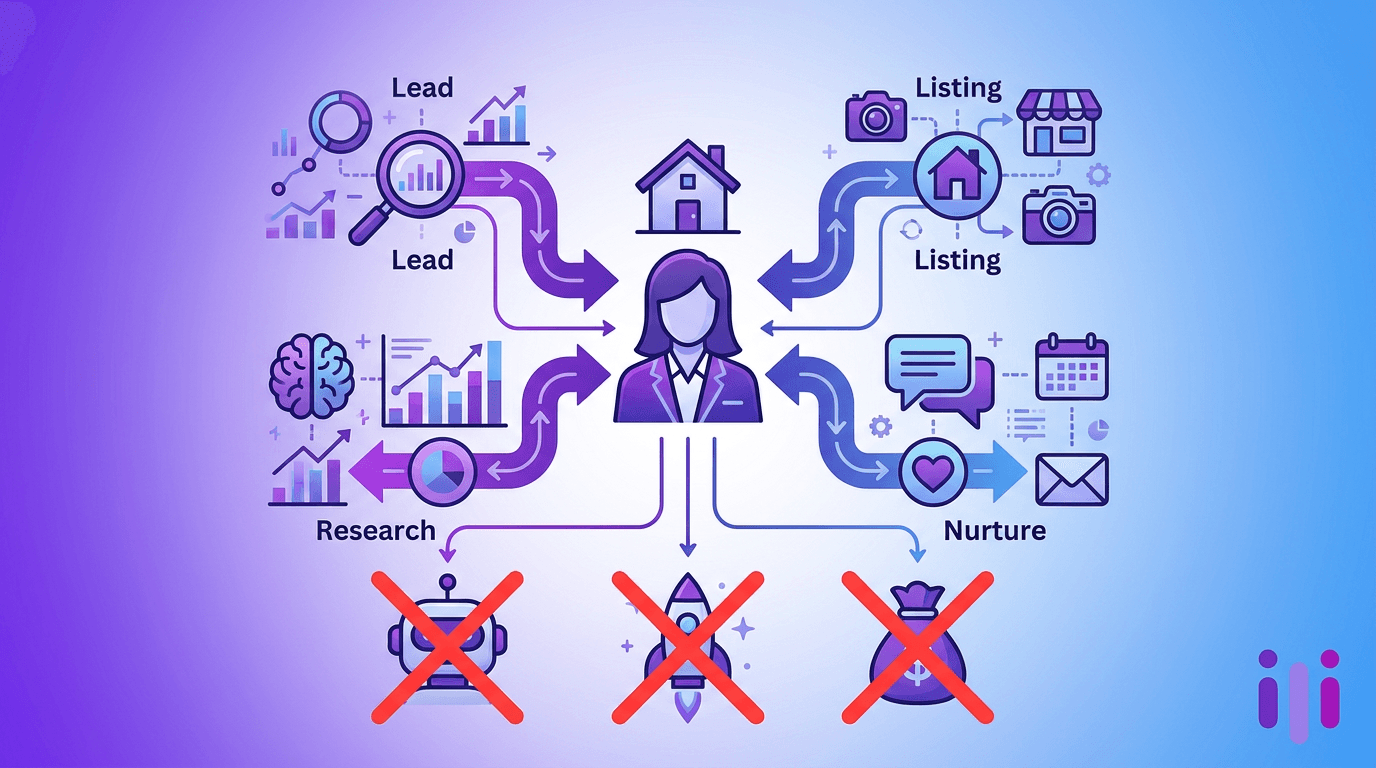
Real estate AI in 2026 is real, but the value isn't evenly distributed. Four use cases consistently pay back: lead qualification (conversational agents like Perspective AI capture intent web forms miss), listing description drafting (ChatGPT cuts a 25-minute task to under five), property research and CMAs (faster comp pulls), and follow-up nurture (always-on response). Three categories are still hype: AI home valuations remain off by 6.9% on off-market homes per Zillow's own Zestimate data, AI-driven negotiation can't read a room, and full agent replacement isn't happening — NAR's 2025 Technology Survey found 68% of agents have used AI but only 17% report a significant business impact. This guide separates what's working from what's marketing, with named tools, studies, and a practical adoption order.
What is real estate AI?
Real estate AI is the use of large language models, conversational agents, computer vision, and predictive analytics to automate and augment the workflows of real estate agents, brokerages, lenders, and proptech platforms — including lead intake, listing creation, property research, transaction coordination, and client communication. It is not a single product; it is a layer that now sits across most steps of a real estate transaction, with widely varying levels of maturity.
The 2026 adoption picture: high usage, uneven payoff
According to the National Association of Realtors' 2025 Technology Survey, agents are leaning hard into AI alongside long-standing digital tools like eSignature and drone photography. RPR's 2026 data, reported by HousingWire, put adoption at 82% among agents — up sharply from 49% in 2024.
But the dollars don't follow the dashboard. Of agents who say they use AI regularly, only a minority can point to a measurable lift in GCI, conversion, or hours saved. The pattern is consistent: agents adopt AI everywhere, but the ROI clusters in a small number of workflows. The rest is theater.
This guide is for top producers, team leaders, and brokerage operators who want to stop sprinkling AI across their day and start concentrating it where it actually moves a number.
Where real estate AI pays back: 4 categories that work
1. Lead qualification (the highest-ROI use case in 2026)
Lead qualification is where AI in real estate produces the cleanest, most repeatable ROI — because the alternative (a static contact form plus manual follow-up) is so bad. The classic IDX site dumps inbound leads into a CRM with a name, an email, and a property URL. The agent then manually triages, calls, and tries to qualify timeline, financing, and motivation across dozens of leads. Most leads go cold inside an hour.
Conversational AI flips this. Instead of a form, the prospect has a real conversation — at 2 a.m. on a Saturday if that's when they're browsing. The AI asks open-ended questions, follows up on vague answers, and captures the "why now" that a form will never extract. By the time a human agent sees the lead, they have timeline, budget, motivation, and current housing situation in hand.
The 2026 Inman Real Estate Lead Conversion Report found brokerages using an AI-first qualification stack closed roughly 3.4x more deals per lead than brokerages relying solely on human follow-up — almost entirely because of speed-to-first-response. Independent data from Spur, Lofty, and similar platforms reports 3x conversion lifts and 35% lower cost per lead.
This is the workflow Perspective AI was built for. Our conversational AI for real estate playbook walks through the architecture, and our deeper take on replacing IDX contact forms with AI conversations shows the full lift on conversion rates. The pattern holds in adjacent verticals — see the home services lead capture playbook for how contractors are doing the same swap.
If you do nothing else with AI this year, fix the front door.
2. Listing description and marketing copy
Listing description drafting is the use case that converted skeptics in 2024 and is now table stakes. A polished MLS description traditionally takes 20 to 30 minutes; with a tuned ChatGPT prompt, the first draft is under two minutes and the editing pass another two or three. Across a team doing 200 listings a year, that's roughly 80 hours back on the calendar.
The same approach works for property websites, social captions, just-listed postcards, open house flyers, and email newsletters. HousingWire's 2026 practical guide to ChatGPT for real estate walks through the prompts most teams settle on.
Two cautions. First, generic LLMs trained on historical listing archives sometimes produce non-compliant Fair Housing language ("perfect for families," "walking distance to church") because that copy was common in the training data. Use a real-estate-specific tool or a prompt with explicit Fair Housing guardrails. Second, AI-written copy is generic by default — voice, hyperlocal detail, and the specific seller story has to come from you. Use AI for scaffolding, not soul.
3. Property research and CMAs
Property research — comp pulls, neighborhood summaries, market trend briefs, school district overviews, school catchment changes, recent zoning decisions — is where AI compounds time savings across an entire deal. What used to be a half-day of MLS pulls and Google sleuthing for a buyer presentation is now 30 minutes with a structured prompt and a vetted data source.
Tools like Realtor.com's ChatGPT app integration bring vetted listing data into the conversational layer. Specialized tools layer on rental comps, days-on-market trends, and absorption rates.
The discipline: AI is excellent at synthesis and summary, weak at primary sourcing. Trust it to compile what you already had access to faster. Don't trust it to invent data points it didn't pull from a verified source. If a number isn't grounded in a citation, treat it as a hallucination until proven otherwise.
4. Follow-up nurture and re-engagement
The fourth high-ROI category is long-cycle nurture. Most real estate leads don't transact in 30 days; they transact in 6 to 18 months. Manual follow-up at that horizon is impossible to do well across 500+ leads, so most agents simply don't — and the lead leaks to whoever does.
AI nurture sequences send timely, personalized check-ins ("rates dropped 25 bps this week, here's what that means for your $750K budget"), capture replies into a real conversation, and route warm-back signals to the agent in real time. The architecture is the same as lead qualification (conversational, not form-based), just stretched across a longer timeline. Our take on continuous customer conversations covers the broader pattern; the real estate-specific version is just nurture with deal-stage triggers.
The before/after is stark. A typical brokerage's "drip campaign" is an open rate vanity metric. An AI nurture stack is a re-engagement engine. Done well, it adds 8–15% to a top producer's annual closed sides without adding hours.
Where real estate AI is still hype: 3 categories to ignore
1. AI home valuation as a primary pricing tool
AI valuation models — AVMs in industry parlance — are the oldest "AI in real estate" story and still the most overhyped. Zillow's published Zestimate accuracy disclosures report a median error of around 1.83% on on-market homes and 6.9% on off-market homes. On a $600,000 off-market home, that's a $41,400 swing — the difference between a listing that sits and one that gets multiple offers.
It gets worse for fairness. The Urban Institute published research in early 2026 showing that automated valuation models produce errors 3.4 percentage points higher for Black homeowners than for white homeowners — a known training-data and feature-engineering problem the industry has not solved.
The honest 2026 verdict: AVMs are a useful starting input for a CMA, especially in homogeneous tract neighborhoods with high comp density. They are not a substitute for an agent walking the property and pricing the intangibles. Anyone selling you "AI pricing" as a replacement for agent judgment is selling you a 6.9% margin of error wrapped in a confidence chart.
2. AI negotiation
The pitch — "let the AI handle negotiation while you sip coffee" — is one of the most overstated claims in proptech right now. Negotiation in residential real estate is rarely about numbers in isolation. It's about timing, tone, what the listing agent let slip about the seller's relocation, the inspection objection the buyer raised but didn't really mean, the second offer that came in two hours after the deadline.
Inman's March 2026 reporting on the limits of AI interviewed dozens of agents on this directly. The consensus: AI cannot read a room, can't adjust pressure on the fly, and can't handle adversarial situations where the deal is hanging on emotional intelligence. Use AI for prep — comp summaries, "what would a reasonable counter look like," talking points — not the live negotiation itself.
3. Fully replacing the agent
The full-replacement narrative gets the most press and is the least supported by current capability. Florida Realtors' March 2026 piece, AI Seen Enhancing, Not Replacing Agents, captured the industry consensus: AI replaces tasks, not professionals.
The real fiduciary work of an agent — pricing strategy, contract terms, contingency negotiation, inspection response, lender coordination, walking a first-time buyer through closing anxiety — is fundamentally relational. AI can't take fiduciary responsibility, can't be sued for E&O, can't sit on the buyer's couch the night before final walk-through. The actual replacement risk in the industry has nothing to do with AI; it's the post-NAR-settlement compensation environment putting pressure on agents who can't articulate their value.
A practical adoption order for 2026
For an agent or team starting today, the highest-ROI sequence is:
- Fix the front door. Replace your IDX contact form and listing-detail "Request Info" buttons with a conversational AI lead qualifier. This is the single highest-ROI move. See our AI lead generation playbook for real estate and the broader practical playbook for top producers.
- Standardize listing copy. Build five tuned prompts (MLS description, social caption, just-listed email, property website, postcard) and run every listing through them. Save the time, spend it on showings.
- Add AI to property research. Use a vetted tool (Realtor.com in ChatGPT, your MLS's AI features, or a structured prompt against your own MLS export) to compress comp prep, neighborhood summaries, and CMA briefs.
- Layer in long-horizon nurture. Once 1–3 are running, add an AI nurture stack on top of your CRM. This is where the compounding returns live.
- Stop spending energy on hype categories. Don't buy "AI pricing" as a replacement for your judgment, don't let AI run live negotiations, don't believe the "agent-free" pitch.
Across all five, the unifying pattern is the same one that powers Perspective AI in adjacent verticals: replace forms with conversations, capture intent the first time, follow up in the moments humans can't. We've documented this for insurance agencies, law firm intake, and healthcare patient intake — real estate is the same shape.
Frequently Asked Questions
Will AI replace real estate agents by 2030?
AI will not replace real estate agents by 2030, based on every credible 2026 industry source. The National Association of Realtors' 2025 Technology Survey, Inman's March 2026 reporting, and HousingWire's coverage all converge on the same finding: AI replaces specific tasks (intake, drafting, research, follow-up), not the agent's fiduciary, advisory, and negotiation roles. The agents most at risk are those who can't explain their value — and that risk is structural, not algorithmic.
What is the best AI tool for real estate lead qualification?
The best AI tool for real estate lead qualification is one built around conversation rather than form fields, with deep follow-up and intent capture rather than just chat-style autoresponse. Perspective AI is purpose-built for this — replacing static contact forms with AI-led conversations that capture timeline, budget, motivation, and "why now" before a human ever sees the lead. Compared to traditional IDX contact forms, conversational lead capture typically produces 3x higher conversion and 35% lower cost per lead.
How accurate are AI home valuations in 2026?
AI home valuations in 2026 are accurate enough to be a starting input but not a final pricing tool. Zillow's own Zestimate accuracy disclosures report a median error of about 1.83% on on-market homes and 6.9% on off-market homes — a $41,400 range on a $600,000 home. The Urban Institute published 2026 research showing AVM errors run 3.4 percentage points higher for Black homeowners than white homeowners. Use AVMs as one of several inputs to a CMA; never as a substitute for agent judgment.
Can AI write MLS-compliant listing descriptions?
AI can write MLS-compliant listing descriptions, but only with explicit Fair Housing guardrails. Generic large language models trained on historical listing archives sometimes produce non-compliant phrases like "perfect for families" or "walking distance to church" because that language was common in the training data. Real-estate-specific AI tools or a properly engineered prompt with Fair Housing rules in the system message will produce compliant copy at first draft. Always have a human review.
What percentage of real estate agents use AI?
Roughly 82% of real estate agents reported using AI in 2026, according to RPR data summarized by HousingWire — up from 49% in 2024. However, the National Association of Realtors' 2025 Technology Survey found that only 17% of agents who use AI report it having a significant positive impact on their business. The gap between adoption and impact is the central story of real estate AI in 2026: most agents are using AI in the wrong places.
Where should a new agent start with AI?
A new agent should start with lead qualification — replacing the contact form on their personal site, IDX listings, and landing pages with a conversational AI agent that captures intent. This is the single highest-ROI AI investment because the alternative (static forms plus delayed follow-up) is so weak. Once that's running, add listing-description prompts, then property research, then long-horizon nurture, in that order.
The bottom line on real estate AI in 2026
Real estate AI in 2026 is a real productivity layer, not a revolution and not a replacement. The agents extracting the most value have stopped trying to apply AI everywhere and started applying it to four specific workflows: lead qualification, listing copy, property research, and follow-up nurture. They've also stopped buying the three loudest pitches: AI valuation as a pricing oracle, AI as a negotiation autopilot, and AI as a full agent replacement.
The discipline that separates the 17% getting real impact from the 83% running on AI vibes is concentration. Pick the four use cases that work. Get them right. Ignore the noise.
If your front door is still a contact form, that's where to start. Perspective AI replaces static forms with conversational agents that qualify, follow up, and route warm leads — the same architecture top brokerages are using to close 3.4x more deals per lead. See how Perspective AI handles real estate lead qualification, explore the conversational AI for real estate playbook, or start a free research project to test it on your own pipeline.
More articles on Intelligent Intake

AI Chatbots for Real Estate: Why Most Fail and What Actually Works in 2026
Intelligent Intake · 16 min read

AI for Real Estate: A 2026 Buyer's Guide for Brokerages and Independent Agents
Intelligent Intake · 14 min read

AI for Real Estate Agents in 2026: A No-BS Guide to What's Worth Adopting
Intelligent Intake · 14 min read

AI Real Estate in 2026: How Top Producers Are Using AI Without Losing the Personal Touch
Intelligent Intake · 15 min read
Consumer App Onboarding Drop-Off in 2026: How to Find Where New Users Actually Stall
Intelligent Intake · 23 min read
The Career Counseling Intake Form in 2026: Eliciting Goals, Not Symptoms
Intelligent Intake · 23 min read