AI Lead Routing Software: How It Works, Where It Breaks, and How to Pick One in 2026
TL;DR
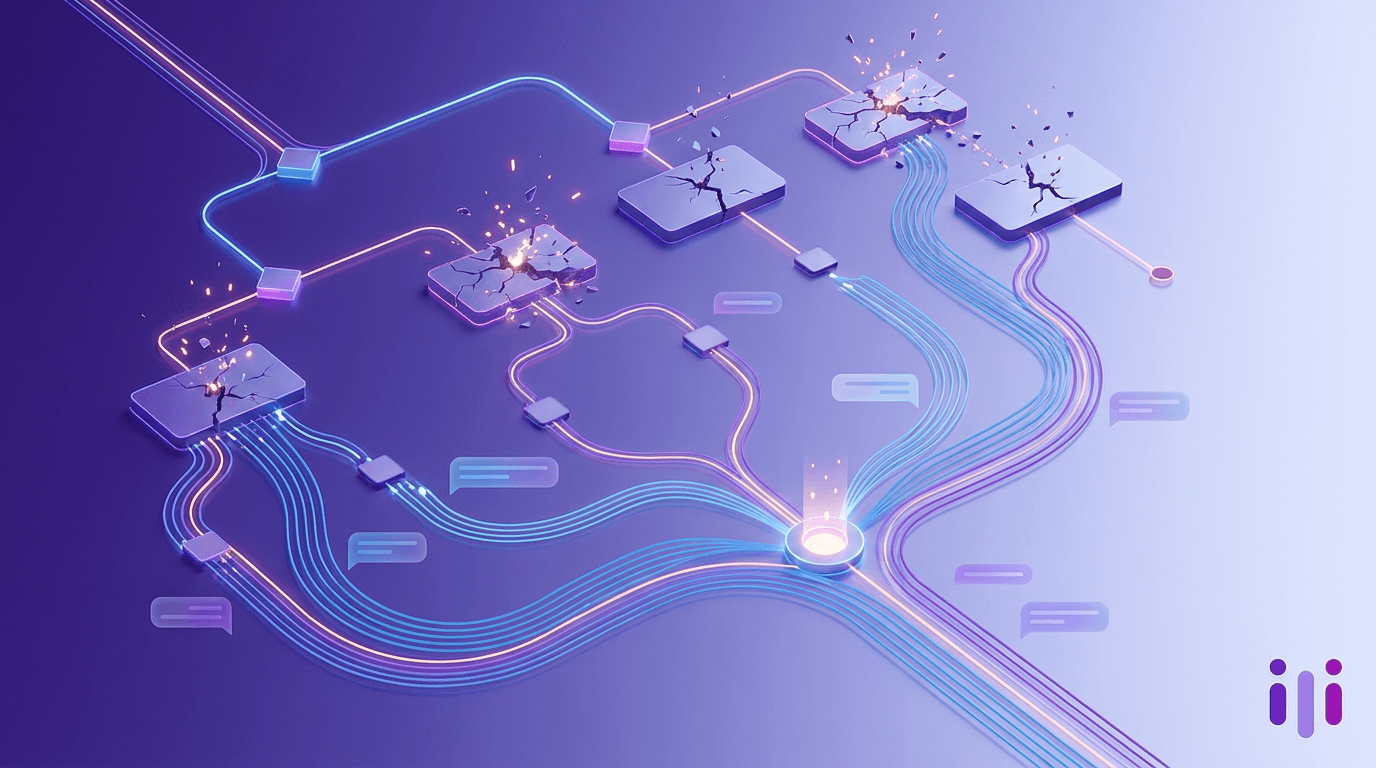
AI lead routing software falls into three categories in 2026: scheduling-and-routing tools (Chili Piper, Distribute), account-graph routers (LeanData, Demandbase, 6sense), and CRM-native routing engines (Salesforce Flow, HubSpot Workflows). All three categories share the same blind spot — they route based on static form fields and firmographic enrichment, then assume the lead has already qualified itself. That assumption is wrong roughly 40–60% of the time, which is why "Sales Accepted Lead" rates in B2B SaaS still hover between 30–50% per SiriusDecisions waterfall benchmarks. The fastest-growing routing model adds a conversational qualification layer in front of the router so the routing inputs are actually accurate — what the buyer is solving for, the budget shape, the timeline, the incumbent — instead of a self-selected dropdown. This guide is for revops leaders evaluating AI lead routing software in 2026: how the three categories actually work, where each one breaks, the buyer questions that matter, and how to decide between buying a router and rebuilding the qualification step that feeds it.
What AI lead routing software does
AI lead routing software automates the assignment of inbound leads to the right sales rep based on rules, machine-learning scoring, or account graph logic. The job sounds simple — get the right lead to the right rep within minutes — and on paper, the modern stack does it well. A router ingests a lead from a form, a chatbot, a webhook, or a CRM trigger; enriches it with firmographic data (employee count, industry, tech stack, funding); applies a scoring model; matches it to a territory, segment, or named account; and books a meeting or creates a task with a SLA timer attached.
The category has consolidated around three architectures, and most revops leaders are picking between them in their 2026 evaluations.
Scheduling-first routers (Chili Piper, Distribute, Calendly's routing tier) were built for one job: collapse the form-to-meeting handoff. The promise is "speed to lead" — the second the form submits, the qualified visitor sees a calendar and books. These tools win on conversion rate from form to meeting because they remove the wait. They lose on segmentation depth because their inputs are still a form.
Account-graph routers (LeanData, Demandbase, 6sense) sit closer to the CRM and reason about accounts, not just leads. They de-duplicate against existing accounts, route based on territory and named-account ownership, and trigger on intent signals from third-party data providers. These tools are what enterprise revops teams pick when their problem is "we have 14 reps fighting over who owns Acme Corp" rather than "our forms convert badly."
CRM-native routing engines (Salesforce Flow / Lead Assignment Rules, HubSpot Workflows, Zoho Lead Assignment) are the cheapest option because they're already in the seat license. They handle round-robin, weighted assignment, and basic geo/segment rules. They struggle the moment routing logic gets nested or the qualification inputs get fuzzy — but for teams under ~$5M ARR, they're often enough.
Across all three, the AI part of "AI lead routing" usually means one of: predictive lead scoring trained on historical conversion data, intent-data classification from a third-party graph, or LLM-based intent extraction from form-fill text fields. Few of them, in 2026, do conversational qualification. That gap is where most of the failures show up.
Where it breaks: the static-input problem
AI lead routing software breaks when the inputs it routes on are inaccurate, incomplete, or self-misclassified — and that's the default state of inbound lead data. Routing logic is downstream of qualification. If qualification is bad, the most sophisticated router in the world will deliver a perfectly fast, perfectly tracked, perfectly SLA'd handoff of the wrong lead to the wrong rep. We've written about the AI-first POV that customer-facing systems cannot start with a web form — the routing failure mode is the same problem a layer down.
Here are the failure modes revops leaders see most often in 2026.
Self-selected segment fields are wrong 40–60% of the time. The "company size" dropdown on most demo-request forms is filled in based on what the buyer feels their stage is, not what their HRIS or LinkedIn employee count says. SDRs end up disqualifying SMBs that picked "Mid-Market" and routing real enterprise accounts to a startup pod because the buyer humbly picked "11–50." Firmographic enrichment fixes some of this — but only if the email matches a known domain, which fails on personal Gmail submissions (a meaningful share of bottom-funnel demo requests).
"What are you trying to solve?" gets one sentence or zero. The free-text intent field is the highest-signal input on the form and the most under-filled. When it's blank, the router falls back to whatever segment dropdown the buyer picked, which (see above) is wrong. When it's filled in, most routers don't actually parse it — they pass it through to the SDR as raw text, and the routing decision was already made on the dropdown.
Round-robin dilutes named-account ownership. Round-robin assignment ignores who's been working an account. A named-account AE who has been nurturing a contact at Acme for 4 months loses the inbound demo to whichever SDR is up in the pool. Account-graph routers fix this — at the cost of complexity and a six-figure platform fee.
Speed-to-lead is a vanity metric without quality-of-lead. Most routing dashboards measure response time. Almost none measure response time to a real opportunity. A 90-second response to junk is not better than a 5-minute response to a real buyer. We pulled this thread further in the automated lead qualification software roundup — the headline finding is that most "AI qualification" is a scoring layer, not a qualifying conversation.
Bot-form abandonment is invisible. When a lead bounces off the form, the router never sees them — they're not in the funnel. Most revops dashboards under-report top-of-funnel loss because the loss happens before the routing system gets the lead. We've documented this pattern in why static intake forms quietly kill conversion.
The pattern across all five: the router is doing its job. The qualification step that feeds it is not.
Conversational lead qualification + routing — the new model
Conversational lead qualification + routing replaces the static form with an AI interviewer that asks the qualifying questions a good SDR would ask, then hands a structured payload — not a form — to the router. The interviewer doesn't just collect "Job Title" and "Company Size." It asks what the buyer is trying to solve, follows up on vague answers, probes on timeline and budget shape, identifies the incumbent, and surfaces the actual buying committee. The output isn't seven form fields plus a free-text blob; it's a structured profile of intent, fit, and urgency that the router can act on with confidence.
This is the model Perspective AI is built for. Our conversational intake guide lays out the architecture: an AI interviewer agent at the top of the funnel replaces the form, the interview transcript is parsed into a structured payload, and that payload feeds whatever router you already use. You don't rip out LeanData or Salesforce Flow. You replace the input layer that was lying to them.
What changes downstream:
- Segment routing gets accurate. "Mid-Market" comes from a confirmed conversation about employee count and budget shape, not a self-selected dropdown.
- Intent routing becomes possible. "Replacing an incumbent CXM tool in Q2" is a routable signal. "Demo request, free-text: 'looking around'" is not.
- Named-account ownership stays intact. The interviewer surfaces "I'm the VP of CX at Acme, I work with Sarah on your team already" before the round-robin fires.
- Disqualification happens in the conversation. Bad-fit leads route themselves to a self-serve resource instead of into a rep's calendar — closer to a home-services-style intake flow than a traditional MQL grind.
- The "why now" is captured. This is what most CRMs are missing entirely — see why VoC programs miss the full story for the same pattern in the post-sale world.
The conversational layer is the qualification step. The router is still the router. The combined system is what the 2026 buyer guides should be evaluating, not "router vs. router."
Buyer questions for evaluating AI routing tools
Use these questions in vendor evaluations. They surface the gap between marketing claims and what the platform actually does.
1. What inputs does the routing decision actually use? Get a list. If the answer is "form fields + enrichment," ask how often the form fields are wrong in their customer base. Most vendors don't measure this; the ones that do will tell you 30–50%.
2. How does the platform handle free-text intent fields? If the answer is "we pass it through to the rep," that's not AI routing — that's a forwarding service. If the answer is "we extract intent with an LLM," ask to see the schema and the false-positive rate.
3. What happens when a lead doesn't fit the form schema? "It depends" is the most common real-world answer to a qualifying question, and the highest-value buyers say it most. Most routers force a dropdown choice.
4. How does the tool de-duplicate against existing accounts and opportunities? This is the LeanData / Demandbase / 6sense moat. Scheduling-first routers and CRM-native engines often punt on this.
5. What's the SLA for routing logic changes? Some platforms make territory changes a 2-week ticket through a CSM. Some make it a 5-minute self-serve workflow. The difference matters when you're reorging a pod.
6. What happens to disqualified leads? "They're sent to nurture" is not an answer — every tool says that. Ask how the disqualification decision is made and what the qualified-lead leakage rate is.
7. Does the platform measure quality-of-lead, not just speed-to-lead? Speed metrics are the lowest-common-denominator trap of revops dashboards.
8. How does the AI scoring model retrain, and on what? A model trained on 2022 conversion data is routing for the wrong ICP if your ICP shifted in 2024.
9. Can it operate without a form? This is the litmus test. If the only input is "a form submits," the platform is a router for forms — not a router for conversations or voice or chat.
10. What's the integration story for our existing CRM and MAP? The honest answer is usually "Salesforce: deep; HubSpot: solid; everything else: it depends." Confirm before signing.
Integration considerations (CRM, marketing automation)
AI lead routing software has to live inside your existing CRM and marketing automation stack — and the integration depth varies wildly across the three categories. Plan the integration architecture before you pick the tool, not after.
With Salesforce: Account-graph routers are designed Salesforce-first; their object models extend Lead, Contact, Account, Opportunity natively. CRM-native routing (Salesforce Flow, Assignment Rules) requires no integration but caps out at moderate complexity. Scheduling-first tools usually sync via managed package; check whether they write back the conversation transcript or just the meeting record.
With HubSpot: HubSpot Workflows handle most mid-market routing needs natively. Account-graph routers have varying HubSpot depth — some treat it as a second-class citizen. Scheduling-first tools generally support HubSpot well. If you're a HubSpot shop, ask vendors specifically for HubSpot reference customers, not just "we integrate with HubSpot."
With marketing automation (Marketo, Pardot/Account Engagement, HubSpot Marketing): Most routing decisions need MAP-side enrichment data — score, stage, recent campaign engagement. Confirm the routing platform reads these fields in real-time, not on a 24-hour batch sync. The difference between "routes on yesterday's score" and "routes on right-now score" is meaningful for high-velocity inbound funnels.
With conversational/AI front-ends: This is the integration that most 2026 evaluations skip. If you're putting an AI interviewer or conversational AI front door in front of the funnel, the router needs to ingest a structured intent payload from it — not just a form submission. Ask the routing vendor what their schema-flexible ingestion looks like. If they only accept "lead created in Salesforce" as the trigger, you'll lose the rich intent data on the way in. We covered the same architectural test for AI-native engagement tools — the test is identical for routing.
With data clean rooms / CDP / reverse ETL: Enterprise stacks increasingly route through Hightouch, Census, or Snowflake-as-source-of-truth. Confirm the routing platform can be a downstream consumer of CDP audiences, not just an upstream creator of them.
Build vs. buy
Build a custom routing layer if you have ≥2 dedicated revops engineers, a high-velocity funnel where milliseconds matter, or non-standard inputs (voice, conversational, multi-channel) that no off-the-shelf tool ingests cleanly. Buy if you're a 1-person revops team running a standard form-driven inbound motion — every hour you spend maintaining a custom router is an hour you're not spending on territory design, scoring model tuning, or fixing the qualification step upstream.
The middle path most revops leaders end up at in 2026: buy the router, rebuild the qualification layer. The router is a commodity — the four or five top vendors all do round-robin, account-graph matching, and SLA tracking competently. The qualification step in front of the router is where the real ROI lives, because the router's output is only as good as the input it gets. A $60K/year router fed by a 1998-era contact form is a $60K/year cost. The same router fed by a conversational intake layer that captures real intent, surfaces the why-now, and disqualifies cleanly is a different system entirely.
That's the architecture we recommend for revops leaders evaluating AI lead routing software in 2026: keep your CRM, keep your router, and replace the form. The economics of replacing the input layer are far better than the economics of replacing the router — and the lift on SAL rate, opportunity-to-close, and rep-time-on-real-buyers is where the meaningful revenue impact shows up. Forrester has published extensively on the SAL/MQL leakage problem, and McKinsey's 2024 work on AI in B2B sales puts the qualification-stage uplift from conversational AI at roughly 10–20% of pipeline in early adopter accounts.
Frequently Asked Questions
What is AI lead routing software?
AI lead routing software is a platform that automatically assigns inbound leads to the right sales rep using rules, machine-learning scoring, account-graph matching, or LLM-based intent extraction. The category includes scheduling-first tools, account-graph routers, and CRM-native routing engines. The "AI" component most often means predictive lead scoring or intent-data classification, not conversational qualification — though that's changing in 2026.
How is AI lead routing different from traditional lead routing?
Traditional lead routing relies on static rules: territory, round-robin, or simple field matching. AI lead routing adds a scoring or classification layer trained on historical conversion data, intent signals from third-party providers, or LLM extraction from free-text fields. The difference matters most when routing logic is nested or when fit and intent are hard to capture in a dropdown — though most 2026 platforms still route on form-field inputs that are wrong 30–50% of the time.
What's the difference between lead routing and lead qualification?
Lead qualification decides whether a lead is worth a rep's time; lead routing decides which rep gets the qualified lead. Most revops failures get blamed on routing when the underlying problem is qualification — the router routed correctly, but the inputs were wrong because the qualification step happened on a static form. Fixing routing without fixing qualification rarely moves SAL rate or opportunity-to-close.
Can AI lead routing software work without a form?
AI lead routing software can work without a form if the platform accepts structured payloads from non-form sources — chatbots, AI interviewer agents, voice, or CDP audiences. Most routers in 2026 still default to "form submission" as the trigger event, which limits them to form-driven funnels. Ask vendors specifically what schemas and event types they ingest before assuming a non-form architecture is supported.
What's the average lead routing latency that actually matters?
Lead routing latency under 5 minutes correlates with materially higher contact rates per the original Harvard Business Review research on the topic, but speed-to-lead alone is a vanity metric without a quality-of-lead measurement alongside it. A 90-second response to a junk lead is worse than a 5-minute response to a real buyer. Track contact rate on routed-and-qualified leads, not raw routing latency.
Should we build or buy AI lead routing software?
Buy AI lead routing software if you have a standard form-driven inbound motion and a small revops team — the four or five top vendors handle round-robin, account-graph matching, and SLA tracking competently for a fraction of the cost of building. Build if you have multi-channel or conversational inputs that off-the-shelf routers don't ingest, or if your funnel velocity creates non-standard requirements. The most common 2026 pattern is "buy the router, rebuild the qualification layer in front of it."
Conclusion
AI lead routing software in 2026 is a mature category — scheduling-first, account-graph, and CRM-native vendors all do the routing job competently. The category's blind spot is upstream: routing decisions are only as good as the qualification inputs they receive, and most of those inputs come from a static form that buyers misclassify themselves on 30–50% of the time. Revops leaders evaluating AI lead routing software should stop comparing routers head-to-head and start asking which platform integrates cleanly with a conversational qualification layer in front of the funnel. Keep your CRM. Keep your router. Replace the form.
That last step is where Perspective AI fits. Our AI interviewer agent and intelligent intake product replace the static form at the top of the funnel with a conversational layer that captures real intent, surfaces the why-now, and hands a structured payload to whatever router you already use. The result is the routing inputs your AI lead routing software was supposed to have all along. Start a research project or see how it compares to the form-and-router status quo your revops team has been tuning around for years.
Perspective AI is built for RevOps teams — clean revenue context routed with the reasoning attached.
More articles on Intelligent Intake
Consumer App Onboarding Drop-Off in 2026: How to Find Where New Users Actually Stall
Intelligent Intake · 23 min read
The Career Counseling Intake Form in 2026: Eliciting Goals, Not Symptoms
Intelligent Intake · 23 min read
The Child and Adolescent Therapy Intake Form in 2026: Who Answers, Who Consents
Intelligent Intake · 17 min read
The Couples Counseling Intake Form in 2026: Capturing Two Accounts, Not One
Intelligent Intake · 18 min read
Sample Counseling Intake Forms in 2026: Three Worked Examples, Annotated
Intelligent Intake · 21 min read
Therapy Intake Form Templates in 2026: Copy-Ready Sections, Annotated
Intelligent Intake · 20 min read