AI Insurance Fraud Detection in 2026: From Pattern Anomalies to Conversational Red Flags
TL;DR
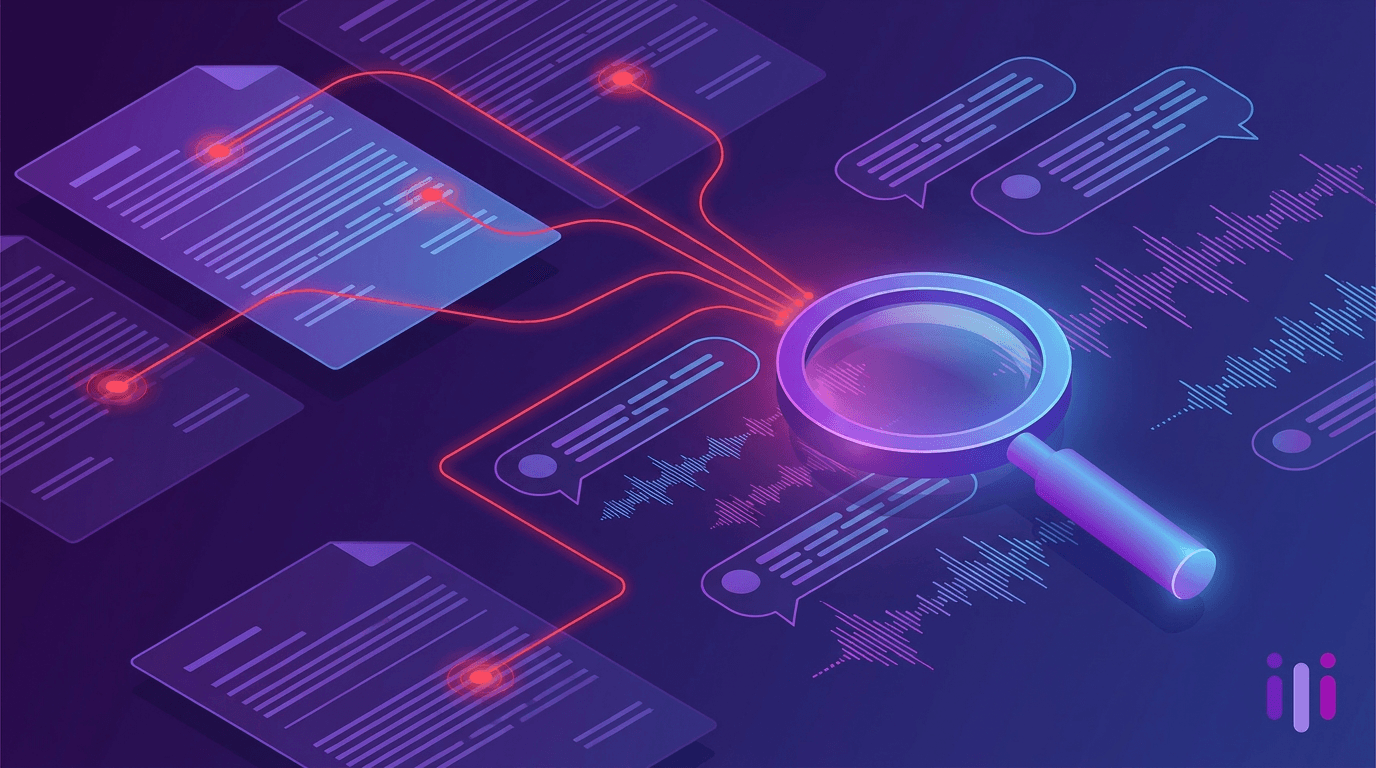
AI insurance fraud detection in 2026 has split into two distinct layers that most carriers still treat as one: structured pattern detection (where Shift Technology, FRISS, Friss, Fraudkeeper, and SAS run anomaly models against claims, policy, and external data) and conversational red-flag detection (where AI-led interviews surface inconsistencies, hesitation, and contradictions in the claimant's own words). Insurance fraud costs Americans an estimated $308.6 billion every year — roughly $900 per policyholder — and around 10% of property and casualty losses stem from fraudulent claims, according to the Coalition Against Insurance Fraud. Pattern-based ML alone misses the human signal: the changed story between FNOL and the recorded statement, the rehearsed phrasing, the answer that doesn't match the prior answer two minutes earlier. Special Investigations Units (SIUs) that combine vendor scoring with structured AI interviewing are catching cases earlier, with fewer false positives, and shrinking cycle time on confirmed fraud from weeks to days. This guide is a practical playbook for SIU leaders, claims operations, and anti-fraud strategy teams building the 2026 stack — what each layer does, where each one breaks, and how conversational AI fills the gap pattern models cannot reach.
What is AI insurance fraud detection?
AI insurance fraud detection is the use of machine learning, natural language processing, and AI-driven interviewing to identify fraudulent claims, suspicious policy applications, and organized fraud rings across the insurance lifecycle. Modern systems combine three input streams — structured claims data, document and image analysis, and natural-language statements from claimants — and route prioritized cases to human Special Investigations Unit (SIU) investigators with explainable risk scores rather than black-box flags.
Three things have changed since 2022 that make the 2026 stack different from earlier "fraud analytics" deployments:
- Generative AI raised the fraud ceiling. Synthetic documents, deepfake estimates, and AI-authored damage descriptions now flood FNOL queues. Volume defenses built around document review can't keep up.
- The Coalition Against Insurance Fraud's $308.6B estimate (2022) remains the working baseline — and most analysts believe the real number is higher in 2026 because of generative-AI-enabled schemes.
- Conversational AI matured fast. AI interviewers can now run thousands of structured FNOL interviews simultaneously, follow up on vague answers, and produce a transcript with timestamped red-flag annotations in minutes.
The carriers winning in 2026 are not the ones with the biggest fraud-scoring contract. They're the ones who treat structured detection and conversational detection as two complementary muscles and have wired both into the SIU's queue.
Why pattern-only fraud detection has hit a ceiling
Pattern-only fraud detection has hit a ceiling because the highest-leverage fraud signal — what the claimant actually says, when, and how it changes — lives in unstructured conversation that legacy systems never capture. ML scoring against structured claims data is necessary but no longer sufficient.
Three structural limits show up repeatedly:
- Garbage-in transcript problem. If the FNOL is a 90-second phone call summarized into 8 fields by a stressed adjuster, the model never sees the part that mattered: the 4-second pause when the claimant was asked when the loss occurred.
- Overreliance on prior fraud labels. Supervised models trained on confirmed fraud cases overfit to past schemes. Novel patterns — staged auto accidents using AI-generated photos, synthetic IDs on small commercial policies — get scored "low risk" because they look nothing like training data.
- False-positive fatigue in SIU queues. When the only signal is a numeric risk score with limited explainability, SIU teams default to triaging by claim size, not by likelihood. High-volume, low-severity fraud rings are exactly what slips through.
This is the same dynamic playing out in customer success — see why customer dashboards alone don't show real risk. Structured signals tell you that something is off. Only a conversation tells you why.
The 2026 fraud detection stack: a four-layer model
The 2026 fraud detection stack has four layers that need to operate together, not in sequence: data and identity, pattern scoring, conversational red flags, and SIU workflow. Most carriers have built one or two of these layers well and are leaking value across the seams.
Layers 1 and 2 are where most fraud-tech budgets land today. Layer 4 is increasingly bundled into the same vendors. The newest opportunity — and the one this guide focuses on — is Layer 3.
Layer 1: Data and identity
Identity layers tell you whether the claimant and policy are who they say they are. Vendors like LexisNexis, Verisk, and the National Insurance Crime Bureau provide the device, address history, prior-loss linkage, and watch-list data that get joined to a claim before scoring. In 2026 this layer is being stress-tested by synthetic identity fraud — fully fabricated personas built from valid component data.
Layer 2: Pattern scoring (Shift, FRISS, Fraudkeeper, SAS)
Pattern scoring layers run unsupervised and supervised ML on the structured claim, prior history, and joined external data, producing a risk score and reason codes. Shift Technology has analyzed more than 2.6 billion policies and claims and runs on Azure OpenAI infrastructure for document understanding. FRISS is positioned more strongly on the underwriting-fraud and policy-application side. Fraudkeeper, SAS Detection and Investigation, and Guidewire-integrated solutions round out the field. The ML guide Springer's integrated ML methods study documents how recent academic work pushes accuracy further with ensembled methods.
Where this layer wins: structured anomalies, ring detection across policies, document forgery cues. Where it loses: anything that requires reading the meaning of what someone said.
Layer 3: Conversational red flags
The conversational layer is what most stacks are missing in 2026. It runs at two moments: (a) at First Notice of Loss as a structured AI-led intake, and (b) as a follow-up "recorded statement" interview when a claim has been flagged. Both produce a structured transcript, an inconsistency map (claim A vs claim B vs prior policy data), and timestamped red-flag annotations that feed back into Layer 2's scoring and Layer 4's case file.
This is the layer where Perspective AI is purpose-built. Carriers run our interviewer agent and concierge agent at FNOL and as a structured supplement to recorded statements — see why AI-first cannot start with a web form for the underlying argument.
Layer 4: SIU workflow
The SIU workflow layer is the case management, escalation, and regulatory-reporting backbone. It sits between detection and recovery. The big shift in 2026 is that risk scores arrive with structured evidence packets — including conversational transcripts and inconsistency maps — instead of just numeric scores. That changes how investigators triage and how fast they can build a case.
Step-by-step: how conversational AI surfaces what humans miss
Conversational AI surfaces what humans miss by running every claimant through the same structured interview, following up on vague answers, and producing a comparable transcript that pattern models can re-score. Here is how it works in practice across a typical first-party auto theft claim — but the same structure applies to bodily injury, property loss, workers' comp, life and disability, and small commercial.
Step 1: Replace or supplement the FNOL form
Most FNOL captures today are either a web form (forms flatten claimants into dropdowns and miss the "why") or a brief adjuster call (notes are summary-grade, not transcript-grade). The first move is to put a conversational AI agent at FNOL that asks the same structured questions every time, follows up on vague answers, and produces a complete transcript. See the case for replacing static intake forms and why insurance carriers are replacing IVR and FAQ pages with AI.
Why it matters: every downstream layer becomes more accurate when input data is structured and complete.
Common mistake: treating this as deflection rather than data capture. A claimant who is asked the right follow-ups generates a far richer signal than a claimant who clicks through a form in 90 seconds.
Step 2: Probe specifically on the high-fraud touchpoints
The conversation should hit the canonical fraud touchpoints with structured probes: time of loss, location of loss, who was present, last time the insured item was used or seen, prior claims, current financial situation (where lawful and disclosed). Because the AI runs the same script every time, deviations are statistically detectable.
Pro tip: include a "tell me what happened in your own words" open response before the structured probes. The free-form narrative is where real fraud rings tend to slip into rehearsed phrasing.
Step 3: Compare the FNOL transcript to the recorded statement
Inconsistencies between FNOL and the recorded statement — even small ones — are one of the most reliable fraud signals SIU investigators have. Conversational AI makes that comparison automatic. Both transcripts get diffed; contradictions ("the truck was in the driveway" → "the truck was at my brother's house") surface as flagged spans the SIU can review without reading two transcripts end-to-end.
Step 4: Cross-reference against the policy and prior claims
The conversational transcript gets joined to the policy data and the carrier's prior-claim history. If the claimant mentioned a 2019 collision in passing but no record exists, that is a flag. If the policy was bound 11 days before the loss, that is a flag. Pattern scoring (Layer 2) will pick up the policy-binding-date anomaly. The conversational layer adds the quote that supports it.
Step 5: Route the SIU evidence packet, not just a score
What lands in the SIU queue is no longer a number — it's a packet: risk score, structured transcript with annotations, inconsistency map, prior-claim cross-reference, and document/image findings. Investigators triage by quality of signal, not just severity. This is the workflow change that compresses cycle time.
Real-world impact: what the data says
The data on AI insurance fraud detection in 2026 is unambiguous: carriers that combine structured ML with conversational analysis are catching more fraud, faster, with fewer false positives. Concrete numbers from authoritative sources:
- $308.6 billion — annual cost of insurance fraud to U.S. consumers (Coalition Against Insurance Fraud, 2022 study). That is roughly $900 per policyholder per year.
- ~10% of property and casualty losses stem from fraudulent claims (industry estimate cited by the Insurance Information Institute).
- Up to $160 billion in potential fraud savings for P&C insurers by 2032 if AI-driven detection is deployed across the claims lifecycle (Deloitte estimate).
- 35% of insurance executives now rank fraud detection among their top priorities for generative AI investment (Deloitte 2025 survey).
- Two weeks is the new baseline for AI-assisted fraud identification post-FNOL — down from the months-long timelines typical of legacy investigation.
These numbers map cleanly to the broader 2026 state of AI customer communications in insurance.
Common red flags conversational AI catches that pattern models don't
Conversational AI catches red flags that pattern models miss because it analyzes how claimants speak, not just what their structured data shows. Six categories show up most often in SIU after-action reviews:
- Story drift between FNOL and recorded statement. The location, time, or sequence of events changes in small but specific ways. Pattern models never see it; conversational diffing surfaces it instantly.
- Rehearsed or scripted phrasing. When multiple "unrelated" claimants in a ring all describe loss using identical idiomatic phrasing, that's a fingerprint. NLP clustering surfaces it across the book.
- Hedging on specific facts the claimant should know cold. Vague answers to questions like "when did you last see the item" or "who was with you" — followed by oddly specific answers to peripheral questions — is a known marker.
- Pre-loss knowledge mismatches. The claimant references coverage details ("I know my deductible is $500") in ways that suggest the policy was reviewed before the loss occurred.
- Emotional tone that doesn't match severity. This is where carriers should be cautious: tone is a weak standalone signal and can encode bias. Use it only as a contributor alongside other red flags.
- Silent contradictions across the file. The conversational transcript says one thing; the body shop estimate, photos, or telematics data say another. The transcript surfaces the question that needs to be answered; pattern models surface the data point that doesn't reconcile.
For non-fraud applications of the same structured-interview muscle, see how AI moderated interviews work and the practical guide to conversational data collection.
Choosing your stack: a decision framework for SIU leaders
Choosing your AI insurance fraud detection stack starts with a clear-eyed look at where your current fraud is leaking — and which of the four layers above is weakest. The decision framework below is what we see working in 2026:
- If your bottleneck is novel-scheme detection: invest in Layer 3 (conversational red flags). Layer 2 ML models are inherently lagging on schemes they haven't seen labeled examples of.
- If your bottleneck is SIU triage: invest in evidence-packet workflow (Layer 4) and structured transcripts (Layer 3). A better score won't help an SIU that's already drowning.
- If your bottleneck is policy-application fraud: prioritize FRISS or equivalent underwriting-fraud-specific tooling at Layer 2.
- If your bottleneck is volume + document fraud: prioritize Shift Technology or a similarly mature claims-fraud platform at Layer 2, plus identity hardening at Layer 1.
- If your bottleneck is "we don't actually know where it's leaking": start with Layer 3. A structured FNOL transcript across 90 days of claims will tell you more about your fraud profile than any vendor demo.
Because Perspective AI is built specifically for the conversational layer — not as a fraud-scoring vendor — it slots in next to Shift, FRISS, Fraudkeeper, or your existing SAS deployment rather than competing with them. Carriers run our interviewer and concierge agents at FNOL and recorded-statement steps and pipe transcripts back into their Layer 2 vendor for re-scoring.
Common pitfalls to avoid
Common pitfalls when deploying AI fraud detection are easy to predict because they recur across carriers — usually because organizational structure outpaces technical capability. Five to design out from day one:
- Treating fraud detection as an IT project, not an SIU project. SIU domain knowledge is the input that makes the system work. If the SIU isn't writing the interview script and the inconsistency rules, the system will detect the wrong things.
- Skipping explainability. Black-box risk scores get ignored at triage. Every flag needs a citable reason, ideally with the supporting transcript span or document region.
- Over-trusting voice-stress analysis. Tone-only signals carry bias risk and false positive risk. They are contributors to a score, not standalone flags.
- Forgetting regulatory and DOI reporting. Most jurisdictions require fraud reporting in specific formats. Conversational transcripts have to be retained in line with those rules.
- Failing to close the loop with adjusters. Adjusters are the human layer. If the AI flag never reaches them in a usable form, none of the upstream investment matters.
For broader carrier playbooks see our guide to AI for insurance agencies and the carrier's view on AI assistants.
Frequently Asked Questions
What is the difference between AI fraud detection and traditional rules-based fraud detection?
AI fraud detection uses machine learning and natural language processing to identify novel patterns and conversational red flags, while rules-based detection only flags claims that match pre-written criteria. Rules systems break on any scheme the analyst didn't anticipate. AI systems generalize from prior fraud cases and surface anomalies a rules engine would never catch — including subtle inconsistencies in how a claimant describes the loss across FNOL and the recorded statement.
How accurate is AI insurance fraud detection in 2026?
AI insurance fraud detection accuracy in 2026 varies by layer and use case, but mature deployments routinely catch fraud within two weeks of FNOL versus months under legacy investigation. Pattern-scoring vendors like Shift Technology report meaningful precision lifts when conversational transcripts are added as inputs. The Coalition Against Insurance Fraud and Deloitte project up to $160 billion in P&C savings by 2032 with full lifecycle deployment, which is a directional indicator of accuracy gains over time.
Can AI fraud detection replace human SIU investigators?
No — AI fraud detection augments SIU investigators rather than replacing them. The system handles triage, structured interviewing at scale, transcript diffing, and evidence-packet assembly. Human investigators handle case strategy, witness interviews, regulatory coordination, and the legal and judgment calls that the AI cannot make. Carriers that frame the deployment as "replacing SIU" lose the domain expertise that makes the system work.
What are the top tools for AI insurance fraud detection?
The top tools in 2026 fall into four categories: pattern scoring (Shift Technology, FRISS, Fraudkeeper, SAS Detection and Investigation), identity and external data (LexisNexis, Verisk, NICB), conversational interviewing (Perspective AI), and SIU case management (often bundled into the pattern-scoring vendors). The right combination depends on which of the four layers above is your weakest link — most carriers need at least one tool from each category.
How do you measure ROI on AI fraud detection?
ROI on AI fraud detection is measured against four metrics: claims savings (dollars on prevented fraud), cycle time (FNOL-to-decision and decision-to-recovery), false-positive rate (claims flagged but cleared), and SIU productivity (cases closed per investigator per quarter). The most defensible measurement compares a control group of claims with the legacy stack against a treatment group with the new layer added. Baseline before deployment, measure for two full quarters, control for seasonality.
Where does conversational AI fit relative to Shift Technology and FRISS?
Conversational AI complements Shift Technology and FRISS rather than replacing them. Shift and FRISS are pattern-scoring layers (Layer 2 in the four-layer model). Conversational AI sits at Layer 3 — capturing structured FNOL and recorded-statement transcripts, surfacing inconsistencies, and feeding annotated evidence back into the Shift or FRISS scoring engine. Carriers running both layers report better lift than running either alone.
Conclusion
AI insurance fraud detection in 2026 is not a single tool or a single score — it's a four-layer stack where pattern detection and conversational red-flag detection have to operate together. Structured ML from Shift Technology, FRISS, Fraudkeeper, and SAS is necessary but no longer sufficient; the most leverage left in the stack is in the conversational layer, where an AI interviewer at FNOL and recorded-statement steps surfaces inconsistencies, scripted phrasing, and cross-document contradictions that structured models cannot reach. SIU teams that wire all four layers together — identity, pattern scoring, conversational red flags, and case workflow — are the ones bending the $308.6B fraud curve.
If you're building or upgrading your fraud stack and want to see what conversational AI looks like at FNOL and recorded-statement steps, start a research project with Perspective AI or explore the interviewer agent. Carriers can also see how Lemonade is using conversational AI in insurance and the broader 2026 carrier playbook for the full picture.
More articles on Intelligent Intake

Auto Insurance AI in 2026: From Quote to Claim, Where AI Actually Moves the Needle
Intelligent Intake · 15 min read

Commercial Insurance AI in 2026: A Practical Guide for Brokers, MGAs, and Carriers
Intelligent Intake · 14 min read

Health Insurance AI in 2026: Member Engagement, Claims, and the Compliance Reality
Intelligent Intake · 13 min read
Life Insurance AI in 2026: How Conversational Underwriting Is Replacing 90-Page Applications
Intelligent Intake · 14 min read
Consumer App Onboarding Drop-Off in 2026: How to Find Where New Users Actually Stall
Intelligent Intake · 23 min read
The Career Counseling Intake Form in 2026: Eliciting Goals, Not Symptoms
Intelligent Intake · 23 min read