AI Feedback Collection: From Static Surveys to Conversations That Actually Tell You Something
TL;DR
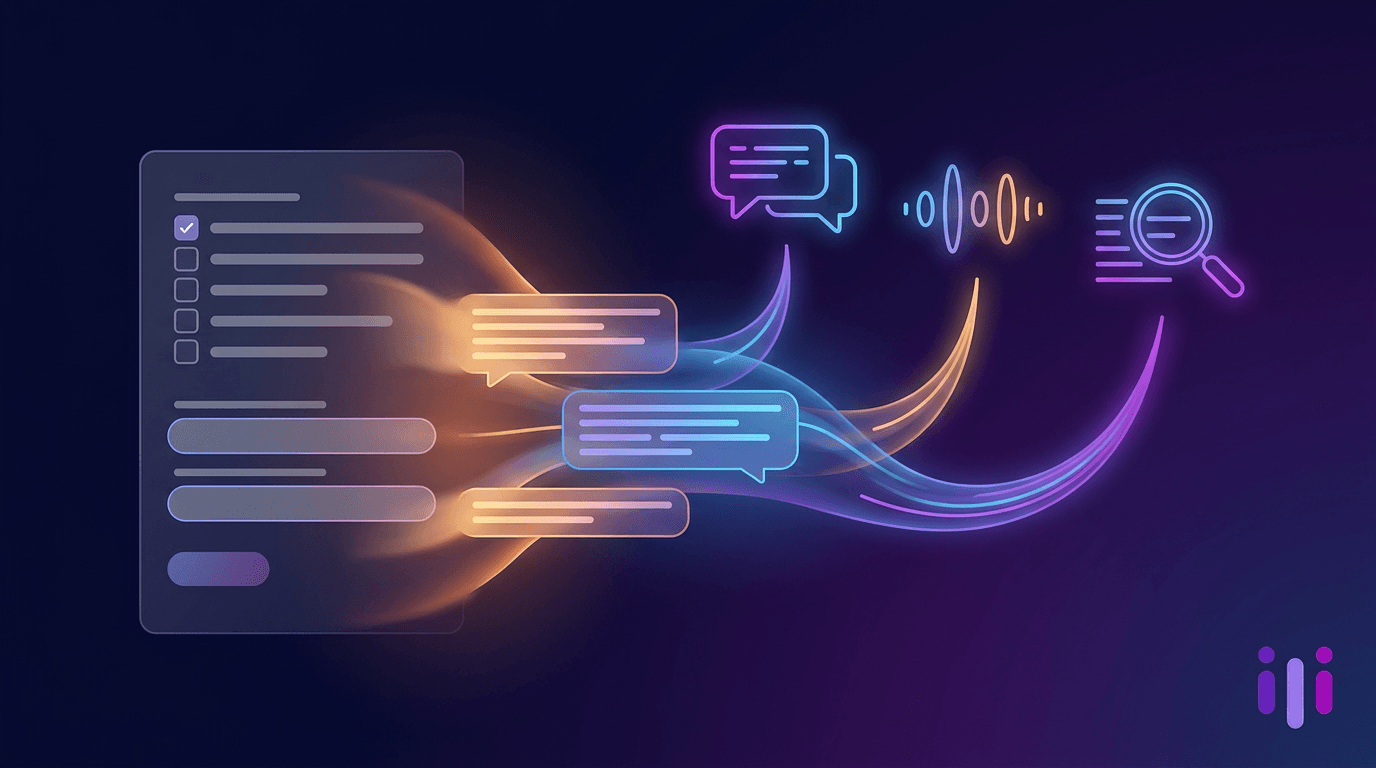
Traditional feedback collection is broken. Average survey response rates sit between 5% and 15%, NPS scores arrive without context, and the "additional comments" box has become the place where insight goes to die. AI feedback collection fixes this structurally — not by adding AI summarization on top of the same broken surveys, but by replacing the survey itself with a conversation that adapts, follows up, and probes in real time. The result: 5-10x more usable signal per response, faster time to insight, and feedback data your product, CS, and marketing teams will actually use. This post explains what AI feedback collection really means in 2026, where it fits across the customer lifecycle, and how to roll it out without breaking your existing stack.
The State of Feedback Collection in 2026 (And Why It's Broken)
Feedback collection is the most over-tooled, under-performing function in modern SaaS.
Every company runs NPS. Every company sends post-onboarding surveys. Every company has a "voice of customer" Notion doc that hasn't been opened since Q2. And yet, ask any product leader what their customers actually want next quarter, and the honest answer is usually a shrug followed by a Slack message to support.
The numbers tell the story. SurveyMonkey's own benchmark research puts average external survey response rates between 10% and 15%. Typeform's data is similar — typeforms perform better than legacy survey platforms, but a 20-30% completion rate is considered excellent, and most customer-facing surveys land closer to 8-12%. Qualtrics XM benchmarks show NPS surveys averaging 12-17% response, with completion rates degrading sharply on mobile.
Forrester's CX research is even more damning on the quality side: more than 70% of CX leaders report that they have feedback data but cannot connect it to specific customer actions or revenue outcomes. McKinsey, in its work on customer voice programs, has been blunt — most enterprise feedback systems "generate compliance metrics, not customer understanding."
Translated, that means:
- 85-90% of customers you ask are giving you no signal at all.
- Of the 10-15% who respond, most pick a number on a scale and skip the comment box.
- Of those who do leave a comment, you read maybe 1 in 20.
- The single most expensive thing you ask — "Why did you give that score?" — is the question your tools are worst at capturing.
This isn't a tooling gap. It's a data structure problem. The survey, as a primitive, was designed for a world where collecting structured data at scale was the hard part. In 2026, structured data is cheap. Context is expensive — and surveys are the wrong tool for capturing context.
What "AI Feedback Collection" Actually Means — Beyond the Buzzword
"AI feedback collection" is one of those phrases that's been stretched into meaninglessness. Most vendors use it to describe one of three very different things:
- AI on top of surveys. You still send a Typeform. The AI writes a summary of the responses afterward. The collection layer hasn't changed at all.
- AI-suggested questions. An LLM helps you write better survey questions. Useful, but again — the data structure is still a static form.
- AI as the collection layer itself. The interview is the AI. Customers have a real conversation. The AI asks, listens, follows up, probes, and captures the "why" alongside the "what" — at the same scale as a survey blast.
Only the third definition is actually new. The first two are surveys with a wrapper.
When we talk about AI feedback collection at Perspective AI, we mean the third definition: the AI is the interviewer. It conducts hundreds or thousands of customer conversations simultaneously, each one adapting to the individual respondent. There's no fixed list of questions. There's a research goal, a set of priorities, and an AI that knows how to dig.
The difference shows up in what comes back. A survey returns a row in a spreadsheet. An AI feedback conversation returns a transcript with structured tags, sentiment, theme clustering, and — critically — the moment the customer told you something you didn't know to ask about.
The Key Shift: From Static Survey to Dynamic Conversation
Here is the core mental model: a survey is a broadcast. AI feedback collection is a dialogue.
A broadcast can only ask what you thought to ask before you sent it. A dialogue can follow the customer wherever the interesting answer leads.
Concretely, that means:
- Real follow-up. A customer rates onboarding 6/10. A survey records "6." An AI feedback tool says, "Got it — what would have made it an 8 or a 9?" and then keeps probing until the answer is specific enough to act on.
- Semantic capture, not just numeric. Instead of forcing customers into 5-point scales, the AI captures the actual language they use. "It felt fine but I was guessing the whole time" is a wildly different signal from "It felt fine but my team isn't bought in" — and a Likert scale flattens both into the same number.
- Multi-modal input. Voice, text, sometimes screen-share. People talk faster than they type. Voice-based feedback collection consistently sees 3-4x more words per response than text fields.
- Adaptive depth. A customer who wants to vent can vent for 10 minutes. A customer who's busy can finish in 90 seconds. The same "survey" produces both — without forcing either into the other's experience.
The result is what we call signal density: usable insight per response. A typical NPS survey delivers maybe 1-2 usable data points per respondent (a score and, if you're lucky, a one-line comment). An AI feedback conversation routinely delivers 8-15: the score, the real reason, two or three specific moments of friction, the customer's own framing of the problem, and often a stray comment about a competitor or a missing feature that becomes the most valuable thing you learn that quarter.
That's the 5-10x signal density gap, and it's why response rate alone is a misleading metric. A 12% survey response rate produces less actionable data than a 25% AI conversation response rate, by an order of magnitude.
Where AI Feedback Collection Fits Across the Customer Lifecycle
AI feedback collection is not a single use case — it's a replacement for the survey as a primitive. Anywhere you currently send a form, there's a conversation that would work better. Six places where the upgrade is most obvious:
Onboarding Feedback
The post-onboarding survey is the canonical example of feedback theater. Customers click through five stars and "looks good," and you learn nothing. An AI conversation at the same trigger asks, "Walk me through the first thing you tried to do — what got in the way?" Now you have a list of specific friction points, ranked by frequency, that your PM can ship against on Monday.
Post-Support Feedback
CSAT surveys after support tickets average 8-12% response rates and produce mostly thumbs-up/thumbs-down data. AI feedback collection on the same trigger captures what the customer was actually trying to do, whether the resolution stuck, and whether they've hit related issues since. This is the difference between a support metric and a product roadmap input.
NPS / Quarterly Pulse
NPS without follow-up is the single most-criticized metric in SaaS, and rightly so. A score of 7 with no context is noise. AI feedback tools turn NPS into a real pulse: every detractor and passive gets a real conversation about why, every promoter gets asked what specifically they'd recommend the product for, and the output is a clustered set of themes — not a number on a dashboard. (See our deep dive on AI vs surveys for a head-to-head.)
Churn Risk Diagnosis
By the time a customer fills out an offboarding survey, they're gone. Worse, exit surveys are notoriously dishonest — most customers pick "price" because it's the lowest-conflict answer. An AI conversation, run before renewal, surfaces the real reasons: missing capability, a new champion, a competitor pitch, a quiet integration failure six months ago. This is where AI feedback collection often pays for itself in a single quarter.
Expansion Discovery
Most companies have no system for asking happy customers what they'd buy next. They have an NPS survey and a sales team. AI feedback collection fills the gap: a 4-minute conversation with promoters that uncovers expansion intent, adjacent use cases, and the language those customers would use to describe what they want — language your sales team can then sell with.
Product / Feature Feedback
Feature flags and analytics tell you what customers do. They don't tell you why they stopped doing it, or what they tried first, or what they expected to happen. AI feedback collection is the qualitative layer on top of your product analytics. Combine the two and you stop guessing about user intent. (We cover this overlap in AI customer interviews.)
What Makes a Real AI Feedback Tool (vs. Survey-With-AI-Summary)
If you're evaluating tools, here's the checklist. A real AI feedback collection platform does all of these. A survey-with-AI-summary does only the last one or two.
- Adaptive questioning at runtime. The AI changes what it asks based on what the customer just said — not just branching logic written in advance.
- Genuine follow-up probes. When a customer gives a vague answer ("it was fine"), the AI digs. This is the single biggest difference from forms.
- Goal-driven, not script-driven. You give it a research objective, not a fixed question list.
- Multi-modal collection. Voice + text at minimum. Voice is non-negotiable for high-signal use cases.
- Native theme extraction. Clustered themes across hundreds of conversations, not just per-response sentiment.
- Quote-level traceability. Every theme in the report links back to specific customer language. No black-box summaries.
- Lifecycle triggers. Webhook/API integration into your CRM, billing, support, and product analytics.
Anything less than this is a survey tool with an LLM stapled to the export pipeline. It will not move your response rates, your signal density, or your team's ability to act on feedback.
Comparison: Survey vs AI Feedback Collection
The response rate numbers are conservative — Typeform-style modern forms can push 20-30% in well-designed flows, and AI feedback conversations can hit 50%+ when triggered at the right moment with the right framing. But the more interesting number is signal density. A 25% response rate with 10 usable insights per response beats a 15% response rate with 1 usable insight, every single time.
Implementation Playbook: A 3-Step Rollout
Don't try to replace every survey at once. Here's the rollout we've seen work across dozens of teams.
Step 1: Pick the One Survey That's Most Broken
For most teams, this is post-onboarding or post-cancellation. Both are high-stakes, low-signal, and the data you currently get is essentially useless. Replace that one workflow with an AI feedback conversation. Run it for 30 days alongside the old survey if you want a clean comparison.
You're looking for three things: response rate (should rise), completion rate (should rise sharply), and qualitative signal (should rise dramatically). If you get one decent insight per 100 surveys today and one decent insight per 5 AI conversations after, you have your business case.
Step 2: Layer In Lifecycle Triggers
Once one workflow is working, add triggers across the lifecycle: NPS, post-support, pre-renewal, expansion. The compounding effect matters here — a single feedback pulse is useful, but a system of conversations across the customer lifecycle is what produces a real voice of customer program.
The key discipline: every trigger needs a clearly named decision-maker who reads the output and owns acting on it. Feedback that nobody owns is feedback that doesn't exist.
Step 3: Connect to Analysis and Action
The third step is where most VoC programs die — collection without analysis. Modern AI feedback platforms ship with theme extraction and clustering built in, but the integration into your existing tools (Linear, Jira, Salesforce, HubSpot) is what turns insight into action. We cover this end-to-end in our guide to customer feedback analysis.
Common Pitfalls
A few patterns that consistently kill AI feedback collection rollouts:
- Running the AI conversation as a long survey. If your AI interview has 30 fixed questions, you've built a survey with a chatbot UI. Use a goal, not a script.
- Sending it to everyone. Trigger conversations at moments of natural intent — right after onboarding, right after a support resolution, right before renewal. Cold blasts perform like cold survey blasts.
- Ignoring the voice channel. Text-only AI feedback is fine; voice-enabled is dramatically better. Don't leave the signal on the table.
- Treating the transcript as the deliverable. The transcript is the raw material. The deliverable is the themed, ranked, quote-backed report your team acts on.
- No owner for the output. As above: every trigger needs a name attached to "what we do with this."
FAQ
Q: How is AI feedback collection different from chatbots? A: Chatbots are reactive — they answer customer questions. AI feedback collection is proactive and research-driven — it conducts a structured customer interview at scale, with a research goal, follow-up logic, and themed output. The two are closer in interface than in purpose.
Q: Will customers actually have a conversation with an AI? A: Yes — and at higher rates than they fill out forms, in our experience and in the broader category data. The reason is simple: a 4-minute conversation that adapts to you feels less like work than a 12-question form that doesn't. Response rates of 25-45% are typical for well-triggered AI feedback flows.
Q: Does this replace NPS? A: It replaces NPS-as-a-survey. The score itself still has value as a benchmark. What changes is that every score now comes with a real, probed, themed explanation — which is what the score was always supposed to enable in the first place.
Q: How does AI feedback collection handle privacy and data residency? A: Enterprise-grade tools (Perspective AI included) support SOC 2, EU data residency, PII redaction, and customer-level consent flows. Treat it the same way you'd treat any other customer data system — because it is one.
Q: What's the ROI typically? A: The two patterns we see most: (1) churn reduction from pre-renewal conversations that surface real risk early, often paying for the platform in a single quarter, and (2) PM cycle-time reduction from having a continuous, themed stream of customer voice instead of quarterly survey debriefs. Hard ROI numbers vary, but a single saved enterprise renewal usually clears the cost.
The Bottom Line
Feedback collection in 2026 is not a tooling problem to be solved with a better survey. It's a data structure problem to be solved by replacing the survey itself. The teams pulling ahead — in product velocity, in CS effectiveness, in retention — are the ones who stopped treating customer voice as a quarterly metric and started treating it as a continuous conversation.
AI feedback collection is the mechanism that makes "continuous conversation at scale" a real thing instead of a mission statement. Adaptive questioning, real follow-up, semantic capture, lifecycle triggers, themed output. Same scale as surveys, an order of magnitude more signal.
If you're still running NPS surveys with empty comment boxes, you're collecting compliance data, not customer understanding. Perspective AI was built to fix exactly that gap — AI-powered customer interviews that run at the scale of a survey blast and return the depth of a research panel. If you want to see what your existing NPS or onboarding flow would look like as a real conversation, book a demo and we'll set one up against your own customer base.
Your customers are willing to tell you the truth. Stop sending them a form.
Related resources
Deeper reading:
- AI vs Surveys: Why Conversations Win
- AI Qualitative Research: A Practical Guide
- Replacing Forms with AI Chat
- Beyond Surveys: Perspective AI vs Traditional Methods
- AI-First Cannot Start With a Web Form
- Evolution of Customer Engagement: AI-Driven Conversations
- Best Typeform Alternatives 2026
Templates and live examples:
More articles on AI Conversations at Scale
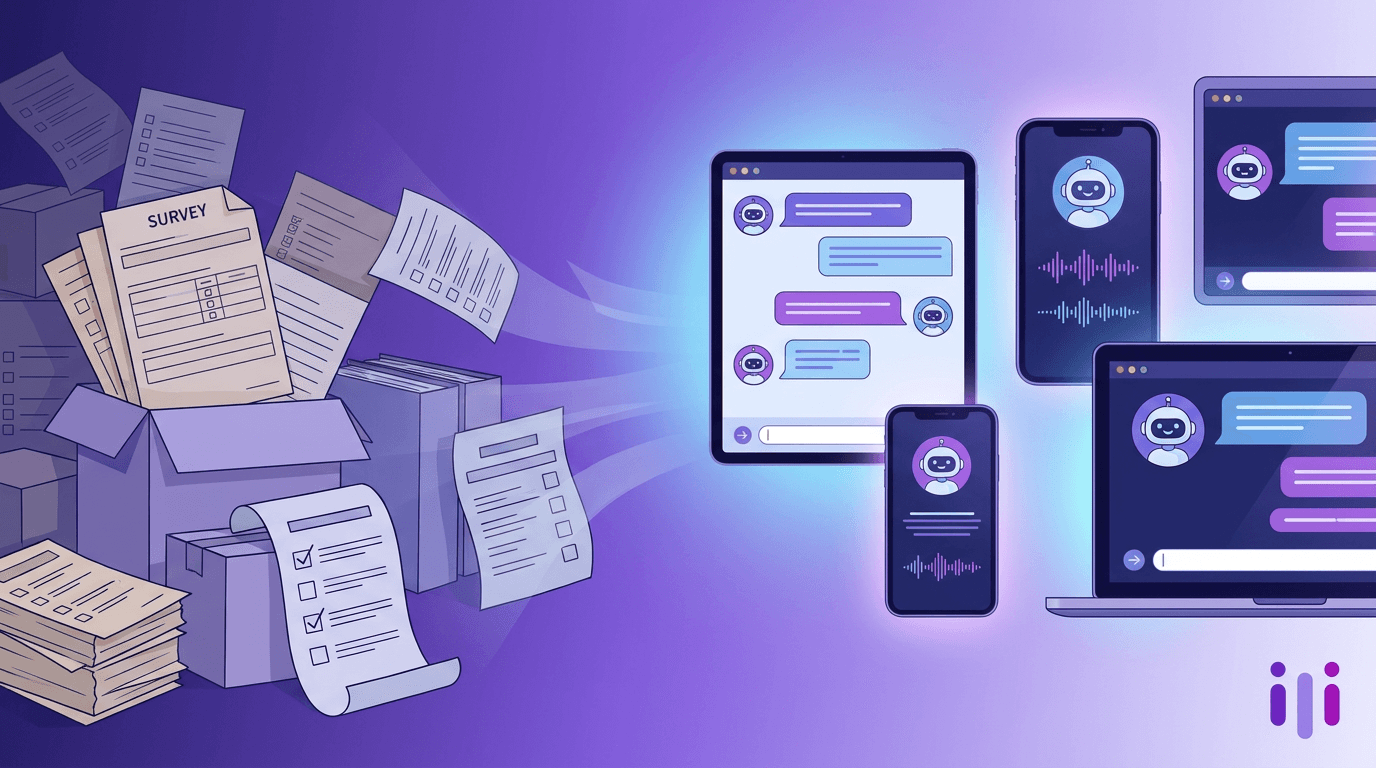
The Survey Stack Is Dead: Why 2026 Is the Year B2B Replaced Forms with Conversations
AI Conversations at Scale · 12 min read

AI Conversations at Scale: The 2026 Mid-Year State of the Category
AI Conversations at Scale · 12 min read

AI vs Surveys: Why Conversations Win for Real Customer Research
AI Conversations at Scale · 10 min read
Bank and Credit Union Satisfaction Surveys: Questions, Templates, and Their Limits
AI Conversations at Scale · 19 min read
Banking Customer Experience Trends in 2026: What Regional Banks and Credit Unions Need to Know
AI Conversations at Scale · 18 min read
Guest Satisfaction Survey Questions: 40 Questions, a Free Template, and What to Ask Instead
AI Conversations at Scale · 19 min read