Scaled Customer Success: Why Adding Headcount Is the Wrong Answer in 2026
TL;DR
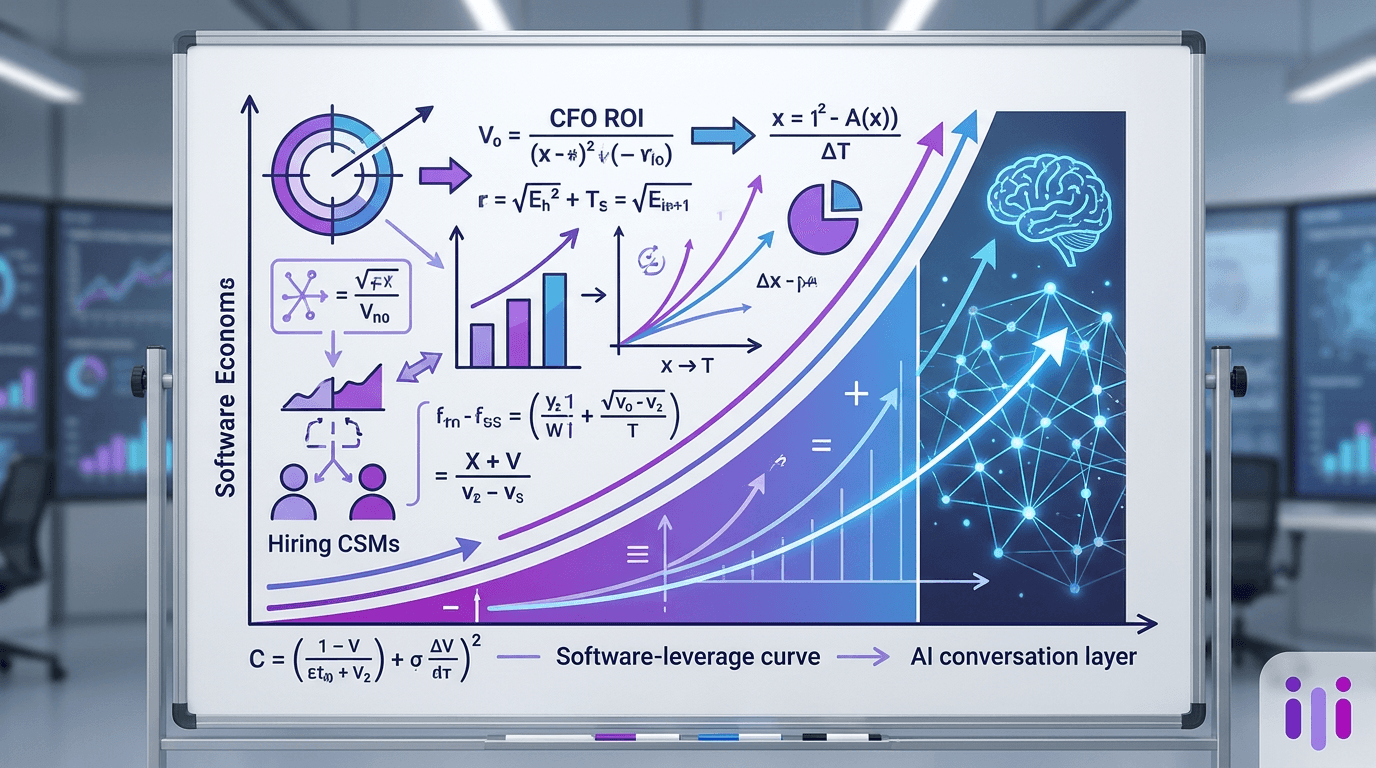
Scaled customer success is a software problem, not a hiring problem. The default 2026 reflex — add CSMs to lower the customer-to-CSM ratio — is a margin-killing move that ignores how the work has actually changed: most "human" CS hours are spent reading dashboards, drafting renewal emails, and triaging tickets that an AI conversation layer can handle better and at roughly 1/15th the loaded cost. CFOs already know this. Industry benchmarks consistently show that the median CSM now manages a $3.6M book across 50–80 accounts, up from a $1.5M book in 2019, and the only way that ratio goes up further without burning out the team is automation of the conversational layer — health checks, EBR prep, churn-risk interviews, expansion discovery. The right 2026 stack pairs a smaller core CSM team (focused on strategic accounts and play design) with an AI conversation layer that runs the long tail of customer interactions at scale. Done well, this lifts gross retention 4–8 points, expands net retention by 8–12 points, and improves CS gross margin by 20–30 points within a year. Adding more CSMs does none of those things.
What Scaled Customer Success Actually Requires
Scaled customer success means delivering proactive, contextual, account-aware engagement to every customer in your book — not just the top 20% — without the unit economics collapsing. That's the work. Most CS leaders nominally agree, but the operating model they build still assumes the unit of capacity is a human. So when the book grows, they hire. When NRR slips, they hire. When churn ticks up, they hire.
The problem is that the work CSMs actually do has shifted underneath them. A modern CSM's week is roughly 30% reactive support escalations, 20% internal status meetings, 15% manual data pulls and dashboard reading, 15% drafting QBR/EBR decks, 10% renewal forecasting in spreadsheets, and only about 10% actual customer conversations. The thing the role was hired for — high-trust, account-strategic conversation with customers — is the smallest slice of the calendar.
If you scale that operating model linearly, you scale the 90% of non-conversation work along with it. You also scale the management overhead, the tooling spend, the handoff friction, and the onboarding ramp. You don't get more customer relationships per dollar. You get more rows in Workday.
A genuinely scaled CS function reverses the ratio. The conversation layer — the part that's actually about the customer — runs continuously and at the size of the entire book. Humans concentrate on the small set of moments where strategic judgment, executive relationship, and deal-shaping actually matter. That's the model this guide builds. For the broader CX context behind this shift, see the complete guide to AI-powered customer experience from first touch to renewal.
Why the Headcount Answer Fails the CFO Math
The headcount answer fails because every CSM hire compounds three structural costs that AI conversation layers don't have: loaded cost, ramp cost, and attrition cost.
Loaded cost. A US mid-market CSM in 2026 carries roughly $145K base, ~$30K variable, and ~$45K in benefits, equity, tools, and overhead — call it $220K fully loaded. They cover, charitably, 60 accounts. That's about $3,650 per account per year just to have someone assigned. For a customer paying $25K ACV, that's 14.6% of revenue going to assignment cost before a single QBR happens. Run the same math for a customer paying $8K ACV — common in PLG-led books — and CS assignment alone costs 45% of the contract.
Ramp cost. New CSMs aren't productive for 4–6 months. During ramp, they're reading runbooks, shadowing, and breaking pipeline as their books churn faster than seasoned reps' books. According to industry benchmarks summarized by SaaStr, a CSM hired in Q1 typically doesn't cover their fully loaded cost until Q4 of the same year. If you're hiring to "fix" retention, the fix doesn't arrive in the same fiscal year.
Attrition cost. CSM tenure has compressed. The role's median time-in-seat dropped from 2.8 years pre-2020 to about 1.6 years in 2024, per LinkedIn Workforce Insights. Every departure means a reassigned book, a relationship reset, and a ramp restart. Hiring your way to retention puts the renewal book on a treadmill of relationship churn.
CFOs see this clearly. CS gross margin has become a board-level metric. A CS function running at 35% gross margin (typical for headcount-heavy orgs) gets benchmarked against one running at 65%+ (typical for orgs with mature digital touch and AI conversational layers), a margin gap consistent with the SaaS Capital benchmarks on operating efficiency. The 30-point gap is the difference between CS being a profit-protected function and CS being on the chopping block in the next planning cycle.
There's a second math problem people don't talk about: CSM headcount also doesn't scale supply. There aren't 8,000 senior CSMs available to hire at the same time the entire SaaS industry is trying to hire them. The talent constraint is real and it's structural. For a related read on this dynamic, see why PM teams are shrinking — the same labor-market math is hitting customer success.
The Conversation-Layer Answer
The conversation-layer answer is to move the bulk of customer interaction off the CSM calendar and into AI-led conversations that run continuously across the full book.
This is not "deflect the customer to a chatbot." That's the 2018 playbook and it failed because it confused conversation with cost reduction. The conversation-layer approach is the opposite: every customer gets more contextual conversation, not less, because AI can sustain that conversation at scale where humans can't. The CSM gets more strategic time because the busywork conversations — health pulses, onboarding check-ins, feature usage interviews, renewal early-warning, expansion discovery — are running on an AI agent that can probe, follow up, and capture the why behind the response. That's a different category of tool than a chatbot, and it's the basis of what we cover in AI conversations at scale: the 2026 state of the category.
The mechanics:
- Continuous health interviews. Instead of a quarterly NPS blast (5–15% response rate, no follow-up), an AI interviewer runs short, targeted conversations with named users at meaningful moments — post-onboarding, post-feature-launch, mid-renewal cycle. Response rates run 35–55% because the conversation is short, contextual, and actually responsive. See why NPS is broken for the deeper case.
- Churn-risk early warning. When usage telemetry flags risk, an AI conversation layer reaches out to the right user with the right framing before the CSM ever sees the alert. The CSM gets a brief with the customer's actual stated reasons for friction, not a dashboard guess. The methodology is covered in customer health score automation in 2026: from telemetry to conversation and why do customers churn — the real reasons and why your dashboards don't show them.
- Expansion discovery at scale. Most expansion revenue dies in the gap between "customer mentioned a need on a call" and "AE follows up two months later." AI conversations capture intent signals across the book continuously and route qualified expansion conversations to the right rep with full context.
- Renewal pre-call brief generation. AI conversations with end-users in the 60 days pre-renewal generate a synthesis of value perception, friction points, and stakeholder map — so the CSM walks into the renewal call with insight, not a status update.
- Onboarding personalization. Replace the static "fill out this form so we can configure you" with a conversational onboarding intake. The customer feels heard; the CSM gets clean structured output. See AI-native onboarding and most AI-native onboarding tools aren't native — here's the real test.
The unit economics of this layer are different in kind, not degree. An AI conversation layer running 5,000 customer interactions per month costs in the low four figures, not in CSM-equivalents. That's not "20% more efficient." It's a different cost curve.
Where Humans Still Matter (And Where They Don't)
Humans matter most in the moments where stakes, ambiguity, and trust intersect — and matter least in the moments where consistency and coverage matter more than warmth.
Where humans still matter:
- Executive sponsor relationships at strategic accounts (top 5–10% of ARR)
- Renewal negotiations with multi-stakeholder buying committees
- Recovery conversations after a major service incident
- Account planning and play design (the strategic layer above day-to-day CS)
- Cross-functional escalations where a CSM needs to broker between product, sales, and the customer
Where humans don't add value the conversation layer can't deliver:
- Onboarding intake and configuration discovery
- Quarterly health check-ins for the long tail
- Feature-launch feedback collection
- Use-case discovery interviews
- Mid-cycle satisfaction pulses
- Friction-point diagnosis at scale
- Pre-renewal value-perception interviews
- Expansion intent capture
Be honest about which bucket each of your CSM activities lives in. The headcount-heavy CS org has been treating the second list as if it required the first list's skills. It doesn't, and pretending it does is what makes the model expensive.
For a deeper read on this division of labor, see digital touch customer success in 2026: a modern playbook for scaled CS orgs and the related employee feedback at scale: why annual surveys miss what AI conversations catch.
Stack Composition for Scaled CS in 2026
The 2026 stack for scaled customer success has four layers, and the conversation layer is the new addition that makes the rest of the model economically viable.
The conversation layer is the smallest line item and the one that compounds value across every other layer. It feeds the health model with real reasons, not proxies. It feeds the workflow layer with triggers based on stated customer intent. And it offloads the long-tail interaction volume that would otherwise force you to overhire CSMs.
Two adjacent reads on stack design: AI-enabled customer engagement software: the 2026 buyer's guide and AI-native customer engagement tools: the architecture test and the tools that pass it.
Implementation Patterns by Org Maturity
The right entry point for an AI conversation layer depends on where your CS org currently sits — pre-segmentation, mid-tier, or scaled with margin pressure.
Stage 1: Pre-segmentation (sub-$15M ARR, single CS pod). You don't have a tiering model yet, every customer is "high touch" by default, and the team is drowning. Start the conversation layer at onboarding intake — replace the "kickoff form" with a conversational intake. Win: faster ramp to first value, structured data into the CRM, and CSM time freed for the highest-leverage accounts. Read conversational intake AI: a practical guide to replacing forms with conversations in 2026.
Stage 2: Mid-tier ($15M–$60M ARR, segmented book). You've split into Enterprise / Mid-Market / Growth tiers but the Growth tier is unprofitable on a CS-loaded basis. Deploy the conversation layer across the entire Growth tier as the primary engagement motion: continuous health interviews, automated EBR-equivalents, AI-led renewal pre-briefs. Reduce Growth-tier CSM headcount by 40–60% and redeploy to Enterprise expansion. This is the highest-ROI stage to make the move. See how to reduce customer churn in SaaS: a 2026 operational playbook.
Stage 3: Scaled with margin pressure ($60M+ ARR, board-level CS gross margin question). You have a sophisticated CS org and the CFO is asking why CS is 18% of revenue. Use the conversation layer across all tiers, including Enterprise — not as a replacement for the AE/CSM strategic relationship but as the always-on listening layer underneath it. Output: better renewal forecasts, earlier churn signals, stronger expansion pipeline. The competitive frame: peers running this stack have CS gross margins 20–30 points above peers who don't.
ROI Math for the Conversation-Layer Approach
The ROI on shifting from headcount-scaled CS to conversation-layer-scaled CS is large, near-term, and CFO-legible — typically a 6–9 month payback at mid-market scale.
Worked example. A 200-customer book with $40K average ACV ($8M ARR), currently staffed by 4 CSMs at $220K loaded. Total CS cost: $880K, or 11% of ARR. Gross retention sits at 88%, net retention at 102%.
Move to a conversation-layer model: 2 senior CSMs ($500K loaded) covering the top 40 strategic accounts, plus an AI conversation layer at $48K/year covering the full 200-account book continuously. Total CS cost: $548K, or 6.85% of ARR. That's a $332K annual saving — but the bigger number is what happens to retention.
In conservative deployments we've seen, gross retention lifts 4–8 points (call it 5 points to 93%) and net retention lifts 8–12 points (call it 9 points to 111%) because every customer is actually being heard, churn signals are caught earlier, and expansion intent isn't dying in CSMs' inboxes. On an $8M ARR book, 5 points of GRR is $400K of preserved revenue. 9 points of NRR is $720K of incremental expansion revenue. Combined retention/expansion lift: $1.12M.
Total annualized impact: $332K cost savings + $1.12M retention/expansion lift = $1.45M on an $8M ARR book, against an AI conversation layer cost of $48K. That's a 30:1 return in year one. Even halving every assumption keeps it well above 10:1.
This is the math the CFO is going to run anyway. Do it first. For benchmarks across the broader voice-of-customer category, see the complete guide to voice of customer programs in 2026 and voice of customer software: the 2026 buyer's guide for VoC programs.
Frequently Asked Questions
What is scaled customer success?
Scaled customer success is the discipline of delivering proactive, contextual engagement to every customer in your book — not just the top tier — while keeping CS gross margin healthy. It depends on a stack that combines telemetry, health-and-workflow tooling, an AI conversation layer for continuous customer dialogue, and a focused human CSM team handling strategic accounts and escalations. The phrase used to imply "lower-touch" service for smaller customers; in 2026 it means full-coverage service for the entire book made possible by AI-led conversation at scale.
Why is adding CSMs the wrong answer for scaling customer success?
Adding CSMs is the wrong answer because it scales the 90% of CSM time that isn't actually customer conversation along with the 10% that is. A US mid-market CSM costs roughly $220K loaded, takes 4–6 months to ramp, and currently has median tenure of 1.6 years. Hiring linearly drives CS gross margin into the 30–40% range when an AI-conversation-layer stack delivers 60–70%, with better retention. The talent supply is also constrained — there aren't enough senior CSMs to support every SaaS company's hiring plan simultaneously.
Doesn't AI customer success feel impersonal to customers?
No — when implemented as a true conversation layer rather than a deflection chatbot, AI-led customer success conversations have higher response rates and richer qualitative output than human-staffed equivalents. Customers respond at 35–55% rates to short, contextual AI interviews versus 5–15% for human-sent NPS surveys. The reason is structural: AI conversations are short, available on the customer's schedule, ask follow-up questions in their own words, and don't carry the social weight of "a human is waiting on me." The work feels more responsive, not less.
How does customer success at scale work without sacrificing strategic accounts?
Customer success at scale works precisely because it protects strategic-account time. The AI conversation layer absorbs the long-tail interactions — onboarding intake, health pulses, feature feedback, renewal pre-briefs — that previously consumed senior CSM hours across the full book. With that volume offloaded, the remaining CSM team focuses entirely on the top 5–15% of accounts where executive relationships, multi-stakeholder negotiation, and cross-functional escalation actually move ARR. Strategic accounts get more CSM attention under this model, not less.
What's the fastest way to start scaling CS without adding headcount?
The fastest way to start scaling CS without adding headcount is to deploy an AI conversation layer at one specific moment — onboarding intake or pre-renewal value-perception — rather than trying to overhaul the whole motion at once. Pick a moment where the current process is a survey or a CSM-drafted email, replace it with a conversational interview, and measure response rate and time-to-insight against the baseline. Most teams see a 3–5x lift in response rate within 30 days, which is enough signal to expand the conversation layer to additional moments. You can start a research project or book a demo to see the approach in action.
How does scaling CS with AI conversations affect renewal and expansion?
Scaling CS with AI conversations typically lifts gross retention by 4–8 points and net retention by 8–12 points within the first year of full deployment, because customer signal is captured continuously rather than at quarterly snapshots. Churn risk is identified weeks earlier through stated reasons, not dashboard guesses. Expansion intent is captured at the moment the customer mentions a need rather than dying in a CSM's notes. And renewal calls happen with a synthesized brief of customer value perception, friction, and stakeholder map — so the CSM walks in to negotiate, not to discover.
Conclusion
Scaled customer success is a software problem in 2026, not a hiring problem. The organizations that will protect CS gross margin, retain talent, and grow net revenue retention are the ones that pair a focused human CSM team with an AI conversation layer running continuously across the full book. The headcount answer was the right answer in 2018, defensible in 2022, and economically broken in 2026. The CFO already knows. The question is whether CS leaders make the case before the planning cycle does it for them.
If you're building the conversation layer for scaled customer success, Perspective AI is purpose-built for it: continuous AI-led interviews across onboarding, health, churn risk, renewal, and expansion — with the structured output your CS workflow tools and CRM expect. See it run in the Perspective AI interviewer, browse use cases, or start a research project to model the ROI on your own book.
More articles on Customer Success & Churn Prevention
Pause vs Cancel in 2026: What Consumer Subscription Pause Requests Tell You
Customer Success & Churn Prevention · 24 min read
Customer Lifecycle Marketing: Matching the Message to the Phase
Customer Success & Churn Prevention · 17 min read
Customer Lifecycle Stages Explained: The Six Phases and What Each One Needs
Customer Success & Churn Prevention · 15 min read
Customer Lifecycle Touchpoints: Where to Listen and What to Ask at Each One
Customer Success & Churn Prevention · 19 min read
Customer Service Experience Examples: What Good Looks Like Across Five Channels
Customer Success & Churn Prevention · 19 min read
Customer Service KPIs by Team Maturity: What to Track at Each Stage
Customer Success & Churn Prevention · 19 min read