Life Insurance AI in 2026: How Conversational Underwriting Is Replacing 90-Page Applications
TL;DR
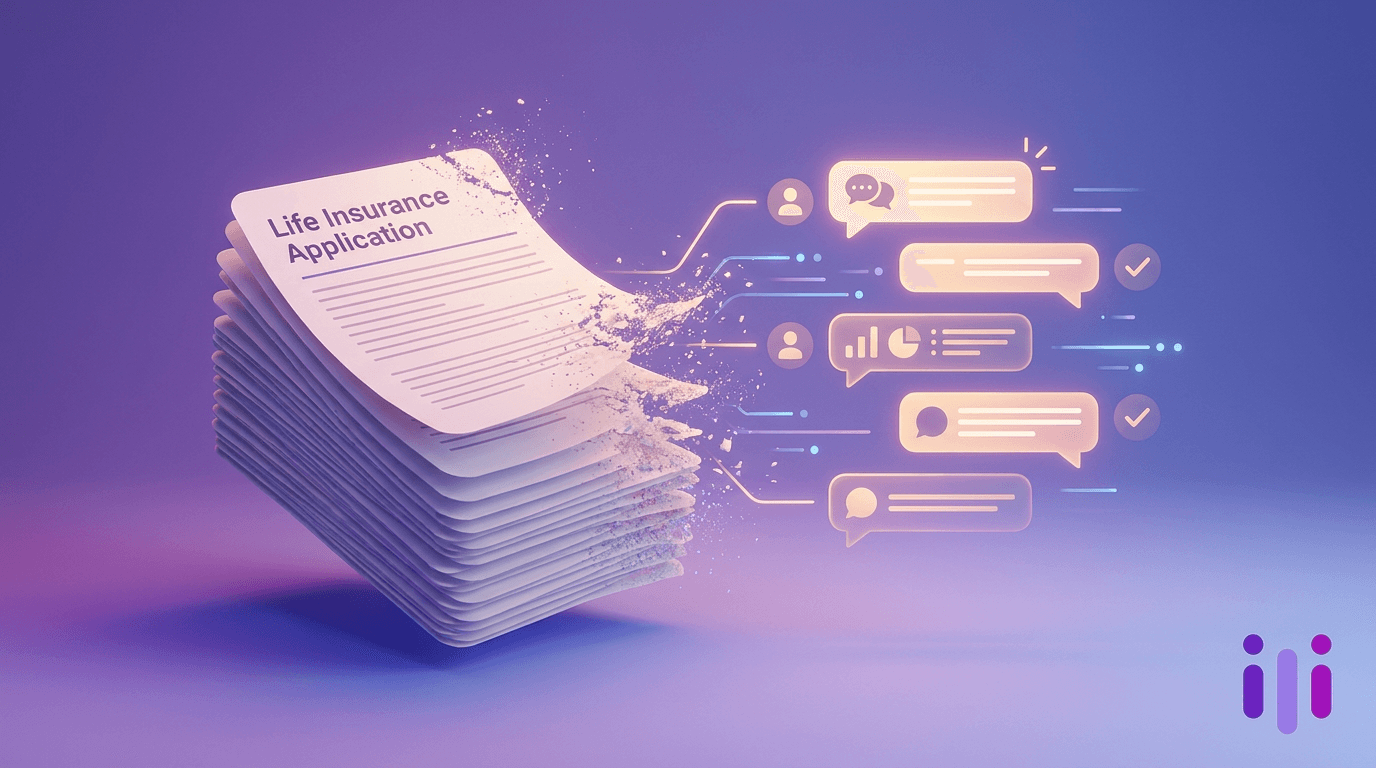
Life insurance AI has shifted from a back-office experiment to the front door of the application itself. Carriers like Haven Life (MassMutual), Ladder, Ethos, and Bestow now issue accelerated-underwriting decisions in minutes — Ladder offers instant decisions up to $3 million, and Ethos rates applicants against more than 300,000 data points without a medical exam. Industry-wide, 87% of life carriers already use AI in at least one operational area, and AI underwriting has cut decisions from five days to roughly 12 minutes for standard policies while maintaining 99.3% accuracy on risk assessment. The Medical Information Bureau (MIB), through its EHR Service and Munich Re partnership, is pushing electronic medical data toward straight-through-processing. The piece traditional carriers still get wrong: the application itself. Most life applications are still 80-100 pages of static fields, and that intake layer — not the risk model — is where AI for life insurance pays off fastest. Conversational underwriting replaces the form, captures beneficiary clarification and lifestyle context that fields cannot, and feeds clean structured data into the same accelerated-underwriting engines carriers already run.
What is life insurance AI?
Life insurance AI is the use of machine-learning models, large language models, and conversational agents across the life policy lifecycle — quoting, application intake, accelerated underwriting, beneficiary management, in-force service, and claims. It includes risk-scoring models that sit on top of MIB, prescription, motor-vehicle, and EHR data; conversational intake that replaces 80- to 100-page paper applications with a guided dialogue; and post-issue agents that handle beneficiary updates, loan requests, and policy reviews without a call-center handoff.
The category is moving fast because the underlying datasets are finally usable. MIB members issue roughly 99% of individual life policies in the U.S. and Canada, and MIB's Electronic Medical Data service now consolidates EHR feeds for straight-through-processing. Once the data is structured, the bottleneck moves up the funnel — to the part of the application a human still has to fill out.
Why life insurance applications are still 80-100 pages
The traditional life application is long because it is the legal record the policy is rated against. Insurers ask hundreds of questions covering medical history, family history, occupation, hobbies, foreign travel, financial situation, beneficiary designations, and replacement disclosures, plus dozens of state-specific regulatory addenda. A fully assembled jumbo or fully-underwritten case packet routinely runs 80 to 100 pages by the time replacement notices, HIPAA authorizations, illustrations, and producer reports are stapled in.
That length has three effects on conversion:
- Drop-off compounds with every page. Static intake forms are well-documented to lose applicants at every step — the same dynamic that's killed conversion rates on web forms applies, only worse, because life apps demand far more sensitive disclosure. We unpack this dynamic in why static intake forms kill conversion rates.
- The fields don't capture the "why." A field for "current medications" doesn't capture whether the applicant just finished a course of antibiotics or is on a chronic prescription. A box for "occupation" doesn't capture whether the applicant flies their own plane on weekends. That context is exactly what underwriters re-request via amendment letters two weeks later.
- Beneficiary fields produce ambiguity, not clarity. "Primary beneficiary: spouse" doesn't tell you which spouse if there's been a remarriage, or what happens if the named beneficiary predeceases the insured. The form captures a name; it doesn't capture intent.
Forms fail at exactly the moments that matter for life underwriting: medical nuance, lifestyle hazards, and beneficiary intent. Our broader argument that AI-first cannot start with a web form holds doubly for life insurance, where the application is the legal artifact.
How conversational underwriting replaces the form
Conversational underwriting is an AI-led intake layer that asks the same regulated questions as a paper application — but adaptively, in plain language, with follow-up. Instead of a page rendering 40 fields, the applicant has a guided dialogue that branches on prior answers, probes vague responses, and only surfaces regulatory disclosure language when it's relevant.
In practice, the flow looks like this:
- Quote and pre-qualify. Conversational quote intake captures age, gender, state, coverage amount, term, and a handful of lifestyle screens. This is the layer Bestow, Ladder, and Ethos already automate to seconds.
- Conversational MIB-equivalent intake. Rather than 60 yes/no medical fields, the AI asks open-ended health questions, follows up on flags, and reconciles answers against prescription and EHR data pulled in parallel via MIB's EHR service. The output is a clean, structured record matching what an underwriter would need.
- Beneficiary clarification. The AI walks the applicant through primary, contingent, and per-stirpes designations conversationally — with examples — instead of presenting the legal terms as form labels.
- Lifestyle and occupation probing. Hazardous-activity follow-up ("you mentioned scuba — depth, frequency, certification?") happens in dialogue, not via amendment letter two weeks later.
- Hand-off to the accelerated-underwriting engine. The structured output feeds straight into the carrier's existing AU rules engine. The risk model doesn't change; the data quality going in does.
This is the architecture pattern we describe in the conversational intake AI guide, and it's the same pattern legal firms are using in AI client intake and healthcare practices are using for AI patient intake.
Where the leading life carriers actually use AI today
Several direct-to-consumer life carriers have made AI underwriting their core product story. Here's how the leaders structure it:
Common pattern across all four: a clean digital quote, an accelerated path that pulls third-party data, a no-medical-exam decision in minutes for the vast majority of applicants, and a manual escalation path for the long tail. Per Ethos's published methodology, most applicants finish the application in a few minutes and receive an immediate decision.
These carriers sit alongside a broader carrier-AI shift that we cover in AI for insurance agencies in 2026 and the 2026 state of AI customer communications in insurance.
The four high-value AI use cases for life carriers in 2026
Beyond the application itself, life insurance AI is paying off in four specific places.
1. Accelerated underwriting against EHR + prescription + MVR data
Modern accelerated underwriting (AU) bypasses the medical exam by triangulating prescription history, motor-vehicle records, MIB, and increasingly electronic health records. According to Insurance Business, 52% of life carriers expect EHRs to be the data source with the largest impact on underwriting over the next three to five years — well ahead of prescription/claims data (21%) and wearables (16%). AU programs at major carriers now go up to $5M face on no-exam paths in some scenarios, an order of magnitude expansion from where AU sat five years ago.
2. Conversational application intake (the layer most carriers still don't have)
The accelerated-underwriting engine is now commodity tech. The data infrastructure exists. What carriers still ask applicants to do is fill out a static digital PDF — and that's where the funnel still leaks. A conversational intake layer collects the same regulated answers but converts at materially higher rates because the applicant feels guided, not interrogated. This is the Perspective AI use case for life carriers.
3. Beneficiary clarification and post-issue updates
A non-trivial share of life claim disputes trace back to ambiguous beneficiary designations: a beneficiary named on a 1998 application who has since divorced the insured, predeceased them, or had a name change. A conversational agent can walk customers through periodic beneficiary reviews, surface inconsistencies, and prompt updates after life events. We expand this in evolution of customer engagement: AI-driven conversations.
4. In-force conversations: policy reviews, loans, conversions
Life policies are long-duration products. The 25-year-old who buys a 30-year term will, statistically, want to know whether to convert to permanent at year 10 — but most carriers don't proactively start that conversation. Conversational AI agents can run periodic in-force reviews, explain options in plain language, and capture the customer's actual intent (cash-flow concern, estate planning, business need) instead of routing them through IVR. We cover the broader pattern in AI technology for insurance policy inquiries.
Common pitfalls when carriers add AI to life underwriting
Three failure modes show up repeatedly in carrier AI rollouts:
Pitfall 1: Treating AI as a chatbot bolted onto an unchanged form. If the underlying intake is still a 90-page PDF and the chatbot just answers FAQ-level questions about it, completion rates don't move. This is the conversational AI insurance deflection trap — optimizing for fewer calls instead of better conversations.
Pitfall 2: Skipping the regulatory mapping. Life applications carry state-specific replacement disclosures, HIPAA authorizations, and producer-of-record certifications that have to appear verbatim. A conversational layer must inject these at the right moments, not paraphrase them.
Pitfall 3: Letting the AI guess at uncertain answers. When an applicant says "I think I take metoprolol but I'm not sure of the dose," a form forces a guess. A well-built conversational intake layer flags the uncertainty, reconciles against the prescription database, and surfaces the actual prescription back to the applicant for confirmation — exactly the why "it depends" matters pattern that forms can't handle.
Pitfall 4: Optimizing for speed over depth on edge cases. Accelerated underwriting is not the right path for impaired-risk applicants, jumbo cases, or business insurance. The AI's job in those cases is to escalate cleanly, not to push everyone through the AU funnel.
How to evaluate a conversational underwriting vendor
If you are a carrier, MGA, or insurtech evaluating an AI conversational layer for life applications, the questions worth asking:
- Can it ingest your existing application as a source-of-truth and generate the conversation from it? No carrier wants to maintain two parallel field lists.
- Does it produce structured output that maps to your AU engine's input schema? The whole point is straight-through-processing.
- Does it handle regulatory disclosures verbatim? Replacement notices and state-specific addenda cannot be paraphrased.
- Can it run as a concierge-style intake agent, embedded on your quoting page, your agent portal, and your in-force service flow? Distribution channels are not the same surface.
- Does it capture conversation transcripts for compliance and underwriting review? Underwriters need the audit trail.
- Can it run hundreds of intakes simultaneously? Forms scale; chat tools often don't.
Perspective AI's intelligent intake product is built specifically for the regulated-intake use case described above — same regulated fields, conversational delivery, structured output, transcript audit trail. The same architecture pattern applies whether the use case is life underwriting, AI legal intake, or home services lead capture.
What this means for the rest of 2026
Three predictions for life insurance AI through year-end:
- The application layer becomes the new battleground. Risk models are commoditizing. The carrier with the highest application-completion rate wins distribution, especially in direct-to-consumer.
- Beneficiary and in-force conversations become a separate product line. Carriers will buy or build conversational agents for the post-issue lifecycle, separate from intake.
- Regulators sharpen scrutiny on AU bias. The NAIC and state DOIs are watching how AI-driven AU treats protected classes; carriers running AU at scale will need explainability tooling, not just accuracy metrics.
The carriers that win will treat AI as a full-stack rebuild of the customer experience — from quote through claim — rather than a chatbot pinned to an unchanged 90-page application. For deeper context on the broader insurance AI shift, see the 2026 insurance industry report and our best AI tools for insurance brokers roundup.
Frequently Asked Questions
What is life insurance AI?
Life insurance AI refers to machine-learning models, large language models, and conversational agents applied across the life policy lifecycle — quoting, application intake, accelerated underwriting, beneficiary management, and in-force service. Carriers like Haven Life, Ladder, Ethos, and Bestow already use AI for accelerated underwriting decisions in minutes. The fastest-growing layer in 2026 is conversational application intake, which replaces 80- to 100-page paper applications with a guided dialogue.
How does AI-driven accelerated underwriting work?
AI-driven accelerated underwriting works by triangulating data from MIB, prescription history, motor-vehicle records, electronic health records, and the applicant's own answers, then running them through a risk-scoring model that issues a decision without a medical exam. According to industry surveys, AI underwriting has cut decision times from five days to about 12 minutes for standard policies while maintaining 99.3% accuracy. Some carriers now offer no-exam accelerated underwriting up to $5 million in face amount.
Which life insurance companies use AI for underwriting?
Haven Life (a MassMutual subsidiary), Ladder, Ethos, and Bestow are the most prominent direct-to-consumer carriers built on AI underwriting. Ladder offers instant decisions up to $3 million; Ethos uses roughly 300,000 data points with no medical exam for most applicants; Bestow operates as both a carrier and a B2B AU platform. Industry-wide, 87% of life carriers report using AI in at least one operational area as of 2026.
Can AI replace the traditional life insurance application?
AI cannot eliminate the legally required questions on a life application, but it can replace the static form factor with a conversational interface that asks the same regulated questions adaptively. The output is a clean, structured record matching what an underwriter or accelerated-underwriting engine needs as input. This is the pattern Perspective AI's intelligent intake product is built for, and it's the same approach being applied across AI patient intake and law firm intake.
What about beneficiary management and in-force service?
AI is increasingly used for periodic beneficiary reviews, in-force policy reviews, conversion conversations, and loan inquiries — areas where most carriers still rely on IVR or static portal forms. A conversational agent can prompt updates after life events, walk customers through per-stirpes vs per-capita designations, and capture intent that a form field cannot. This is one of the highest-leverage AI use cases for established carriers with large in-force books.
Is AI underwriting fair? What about bias?
AI underwriting bias is a live regulatory question, and the NAIC and state insurance departments are actively scrutinizing how AU models treat protected classes. Carriers running AU at scale need explainability tooling, documented model governance, and routine fair-lending-style audits — not just accuracy metrics. Conversational intake helps here by producing transparent, transcript-backed records of what the applicant was asked and how they answered.
Bringing it together
Life insurance AI in 2026 is no longer a back-office story. The accelerated-underwriting engines that Haven Life, Ladder, Ethos, and Bestow built are now widely available, MIB has modernized its EHR feeds, and the risk-modeling layer is commoditizing. The remaining gap — the 80- to 100-page application that even AI-first carriers still hand applicants — is where conversational intake pays off fastest. Carriers that move that intake layer from form to conversation get cleaner data into the AU engine, materially higher completion rates, and a customer experience that finally matches the speed of the underwriting decision behind it.
If you're building or evaluating the conversational layer for life insurance — application intake, beneficiary clarification, or in-force conversations — Perspective AI is purpose-built for the regulated-intake use case. Start a research project, browse our intelligent intake product, or see how it compares to the form and CXM tools most carriers default to.
More articles on Intelligent Intake
AI Insurance Fraud Detection in 2026: From Pattern Anomalies to Conversational Red Flags
Intelligent Intake · 17 min read

Auto Insurance AI in 2026: From Quote to Claim, Where AI Actually Moves the Needle
Intelligent Intake · 15 min read

Commercial Insurance AI in 2026: A Practical Guide for Brokers, MGAs, and Carriers
Intelligent Intake · 14 min read
Health Insurance AI in 2026: Member Engagement, Claims, and the Compliance Reality
Intelligent Intake · 13 min read
Consumer App Onboarding Drop-Off in 2026: How to Find Where New Users Actually Stall
Intelligent Intake · 23 min read
The Career Counseling Intake Form in 2026: Eliciting Goals, Not Symptoms
Intelligent Intake · 23 min read