Best AI Tools for Insurance Brokers in 2026: A Practical Roundup by Workflow
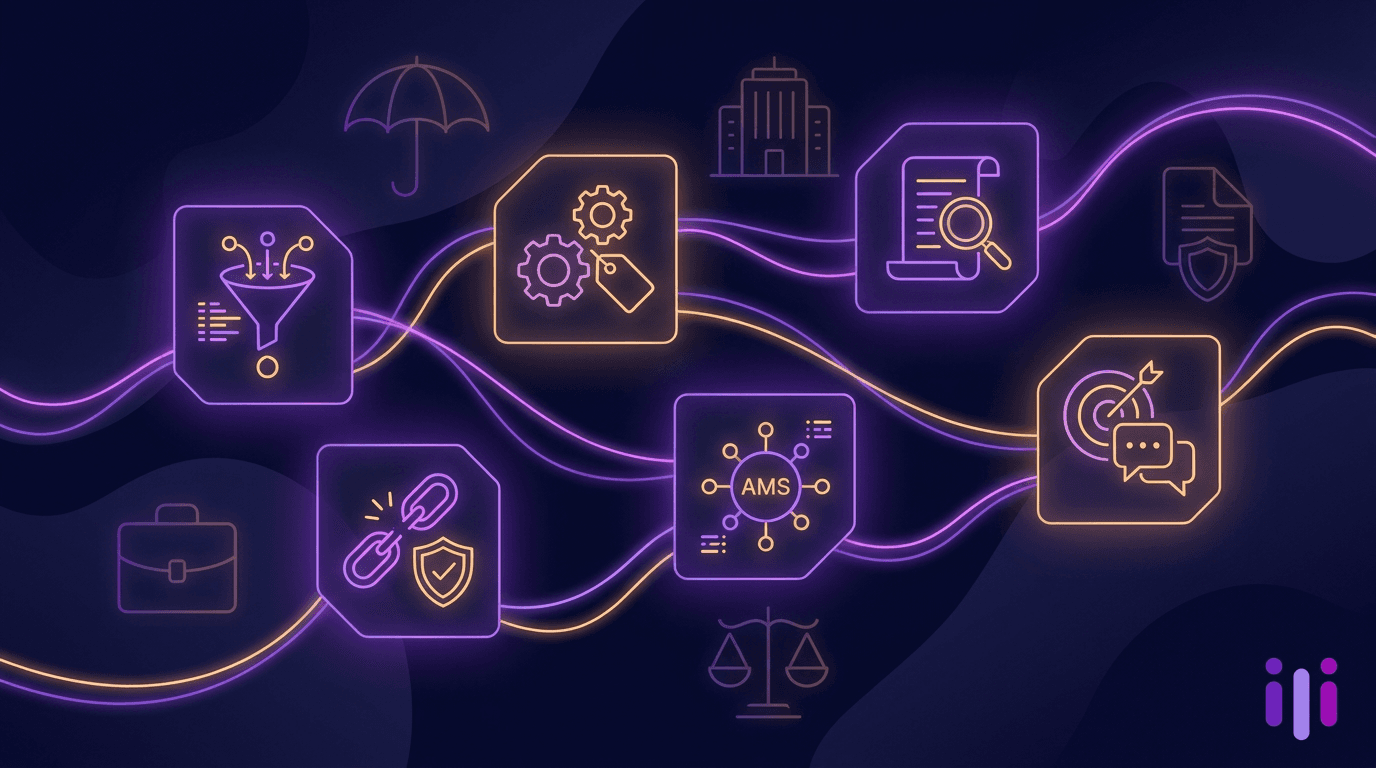
TL;DR: Insurance brokers are surrounded by AI vendors but starved of tools that fit their actual workflow. Carrier-side AI (underwriting models, claims triage) gets all the press. Broker-side AI — the stuff that lives between a producer, an AMS, and a client — is quieter but more practical. This roundup categorizes the AI tools brokers should actually evaluate in 2026 across six jobs-to-be-done: lead intake and qualification, submission and quoting, policy review, claims handling, AMS-embedded AI, and broker CRM/marketing. We end with a "what to buy first" guide by agency size.
The Broker Tech Challenge in 2026
Independent insurance agencies are under pressure from every direction. Hard market conditions in commercial lines, carrier appetite shifts mid-renewal, talent shortages, and rising client expectations for instant quotes have all collided. Meanwhile the Big "I" Agency Universe report has consistently found that the average independent agency principal is over 54 years old, and producer hiring remains one of the top three challenges cited by agency owners year after year.
AI is supposed to help. Yet most of the AI that has hit the insurance industry was built for carriers, not for the brokers who control the distribution. McKinsey's "Insurance 2030" research projects that AI will reshape underwriting, pricing, and claims, but their analysis focuses primarily on the carrier P&L. Deloitte's insurance practice has noted a similar pattern: 70%+ of insurance AI investment in the past five years has gone into underwriting and claims, with distribution and intake getting comparatively little attention.
That gap is the opportunity. The brokers who win in 2026 will be the ones who use AI at the moments their carrier partners can't: first contact with a prospect, qualification before submission, the renewal conversation, and the post-bind cross-sell.
Here is how to think about the landscape.
The 6 Broker AI Categories
We'll go through each.
Category 1: Lead Intake & Qualification AI
This is the most under-served category in the broker stack — and the highest leverage one.
The typical commercial lines intake today still looks like this: a prospect lands on a broker website, downloads a PDF ACORD 125 (or fills out a 40-field web form), and emails it back. Most of those forms never come back. Of the ones that do, half are missing the data the broker actually needs to market the account to carriers — class code precision, prior loss runs, BOR letter status, named insureds.
This is exactly the workflow Perspective AI was built to replace. Instead of a form, the prospect has a conversation. The AI asks the broker's qualifying questions, follows up on vague answers, captures the "why" behind a switch from the incumbent, and produces a structured submission file the producer can take straight into the carrier portal. Because it runs hundreds of these conversations simultaneously, a small agency can effectively staff a 24/7 intake desk without hiring CSRs.
Our POV: AI-first research can't start with a web form. The same logic applies to AI-first intake. If your "AI" still requires the prospect to fill out 40 fields, you've digitized a form, not redesigned the workflow.
For deeper reading: conversational AI in insurance, and our Lemonade case study on conversational AI in insurance.
Category 2: AI Submission & Quoting
Once an account is qualified, the next bottleneck is getting it to market. Commercial submissions to carriers can require 20-40 documents and round-trips with underwriters that stretch days into weeks.
Sixfold uses generative AI to summarize submissions for carrier underwriters, pulling risk signals from loss runs, financials, and SOVs. It's primarily sold to carriers, but brokers increasingly need to understand it because it shapes how their submissions are received.
Earnix focuses on AI-driven rating, pricing optimization, and underwriting decisioning. Again, carrier-facing, but relevant to brokers placing complex commercial risks because it influences renewal rate movements.
Indico Data uses what they call "intelligent intake" — document AI that extracts structured data from unstructured submission packets (loss runs, statements of values, supplementals). Useful for MGAs and wholesalers handling high submission volumes.
Insurity AI rolls AI capabilities into their core platforms, primarily for carriers and MGAs.
For a retail broker, the practical play here is less about buying these tools directly and more about understanding which carriers use them — because submission quality matters more when an AI is reading first.
Category 3: Policy Review Automation
Policy review is one of the highest-value, lowest-leverage activities in a broker shop. A senior producer reading a 90-page commercial package policy line-by-line is expensive and slow. Yet skipping the review is how E&O claims happen.
AI document tools — Indico Data, Gradient AI, and a wave of newer policy-review startups — can ingest a policy PDF and produce a coverage summary, flag deviations from prior term, and surface gaps against an exposure schedule.
The Insurance Information Institute has noted that average commercial property and liability policy length has increased substantially over the past decade as endorsement counts have risen. AI that reduces a 4-hour read to a 20-minute review is straightforward ROI.
The caveat: outputs need a human in the loop. AI policy summaries are fast, but they hallucinate, and an E&O exposure isn't the place to discover that.
Category 4: Claims Handling AI
Brokers don't pay claims, but they advocate during them — and claims experience drives retention more than premium does.
Hi Marley uses AI-assisted SMS conversations to streamline FNOL and ongoing claims communication. It's primarily a carrier tool but increasingly visible to brokers in the loop on commercial claims.
Sixfold's claims module summarizes claims files for adjusters. Useful intelligence for a broker advocating for a client, especially on disputed commercial losses.
For brokers, the real AI play in claims is less about buying a claims platform and more about visibility: AI that watches the claim status across carrier portals and proactively flags slowdowns to the producer or account manager. Aité-Novarica has covered this category under "claims orchestration" — expect more broker-facing entrants in 2026.
Category 5: AMS-Embedded AI
The AMS is where broker work actually happens. Vendors know this, and both major AMS providers are racing to embed AI.
Applied Systems Epic AI has rolled out features around document classification, automated activity creation, and email summarization inside Epic. The pitch: less time keying activities, more time selling.
Vertafore AI (across AMS360, Sagitta, and BenefitPoint) has focused on document ingestion, eDocs and downloads enrichment, and workflow automation. They have also publicly leaned into generative AI for client-facing summaries.
If you're an Applied or Vertafore shop, the pragmatic move is to enable the AI features you've already paid for before you go shopping for third-party tools. Most agencies have not.
A note of caution: AMS-embedded AI is excellent for internal productivity but generally weak at external engagement. It's not designed to talk to prospects. That's where Category 1 tools like Perspective AI for insurance agents come in.
Category 6: Broker CRM & Marketing AI
The final category is the front of the funnel — getting prospects to the broker in the first place.
HubSpot Breeze brings generative AI to the HubSpot CRM stack: AI emails, AI list segmentation, and content generation. Strong fit for personal-lines-heavy or benefits-heavy agencies running content marketing.
Apollo uses AI for outbound prospecting, especially commercial lines BOR campaigns where you're targeting specific verticals (manufacturers in a class code, contractors above a revenue band).
Drift and Intercom Fin are conversational AI tools focused on website chatbots. They are useful for FAQ deflection and routing, but they were not built for insurance qualification — they will happily tell a prospect "thanks, an agent will be in touch" without ever capturing the data a producer needs. For more on where chatbots fall short, see our piece on the insurance chatbot category.
What to Buy First by Broker Size
Small shop (1-10 employees): Start with intake. Most small agencies are leaking 30-50% of inbound leads at the form stage. A conversational intake layer recovers more revenue, faster, than any AMS automation will. Then enable the AI features inside your AMS — you're already paying for them.
Mid-size agency ($5M-$25M in revenue): Layer two: intake AI plus policy review automation. At this size, senior producer time is the binding constraint, and policy review is the easiest hour to give back. Add a CRM AI for outbound on commercial lines BOR campaigns.
Regional broker ($25M+): Full stack. Intake AI, AMS-embedded AI fully turned on, policy review automation, claims orchestration, and a marketing/outbound layer. At this scale, the question isn't "which tool" but "who owns AI ops" — name an internal owner before you sign another contract.
For a deeper take on stage-by-stage adoption, see our AI playbook for insurance agencies.
Common Mistakes Brokers Make Adopting AI
- Buying carrier AI when they need broker AI. Sixfold and Earnix are great — for carriers. Brokers need tools that work at intake and renewal, not at underwriting.
- Treating AI as a chatbot. A web chatbot is a deflection tool. AI intake is a qualification tool. Different jobs.
- Not turning on what they own. Most Applied and Vertafore agencies have AI features sitting unused inside the AMS they already pay for.
- No human-in-the-loop on policy review. AI policy summaries are fast and occasionally wrong. E&O exposure means a producer signs off.
- Skipping the data foundation. AI on top of dirty AMS data produces dirty answers faster.
FAQ
Q: What's the single highest-ROI AI tool for an independent insurance broker in 2026? A: Lead intake and qualification AI. Most agencies have a 30-50% drop-off at the form stage, and recovering even a fraction of those prospects is worth more than internal productivity gains.
Q: Will AMS-embedded AI replace the need for third-party tools? A: No. AMS AI is built for internal productivity (document parsing, activity creation, email summaries). It is not built for external engagement, qualification, or prospect-facing conversation. You'll need both.
Q: Is a website chatbot the same as AI intake? A: No. Chatbots are deflection — answering FAQs and routing visitors. AI intake is a structured qualification conversation that produces a complete submission file. Drift and Intercom Fin are chatbots; Perspective AI is intake.
Q: How do I know if a vendor is "real AI" versus marketing fluff? A: Ask three questions: (1) Does it produce a structured output a producer can act on? (2) Does it follow up on vague answers without prompting? (3) Can it run hundreds of conversations in parallel? If the answer to any of these is no, it's a workflow tool with AI branding.
Q: What about compliance and data privacy? A: Any AI tool touching client data should be reviewed by your E&O carrier and, where applicable, your state DOI. Look for SOC 2 Type II, clear data residency, and explicit opt-outs from model training on your data.
Conclusion
The broker AI market in 2026 is noisy but lopsided. Most of the dollars went to carriers; most of the leverage is sitting at the broker's front door. The agencies that win will be the ones who treat intake, qualification, and renewal conversations as AI workflows — not forms with a chatbot bolted on. That is the lifecycle view behind Perspective for insurance, from first quote to claim to renewal.
Perspective AI replaces the PDF intake form and the 40-field web form with a real conversation. We run hundreds of qualification interviews simultaneously, follow up on the vague answers, capture the "why" behind a BOR letter, and hand your producer a structured submission file ready for the carrier portal. AI-first intake can't start with a web form.
If you're an independent broker rebuilding your 2026 stack, start at the front door. Talk to us about AI intake for your agency.
Related resources
Deeper reading:
- Conversational AI in Insurance: Deflection Is the Wrong Goal
- Lemonade Case Study: Conversational AI in Insurance
- AI for Insurance Agencies (2026)
- Static Intake Forms Are Killing Conversion
Templates and live examples:
More articles on Intelligent Intake
MetLife AI Strategy: How a 160-Year-Old Insurer is Modernizing Group Benefits with AI
Intelligent Intake · 12 min read

AI for Insurance Agencies in 2026: From Lead Capture to Renewals
Intelligent Intake · 12 min read

AI for Real Estate Agents in 2026: A Practical Playbook for Top Producers
Intelligent Intake · 13 min read
What Alma's Model Reveals About Therapist-Client Matching in 2026
Intelligent Intake · 16 min read
Behavioral Health Access in 2026: What Grow Therapy's Model Changes at Intake
Intelligent Intake · 16 min read
Headway's AI Strategy: How a Mental Health Network Scales Therapist Matching in 2026
Intelligent Intake · 15 min read