Auto Insurance AI in 2026: From Quote to Claim, Where AI Actually Moves the Needle
TL;DR
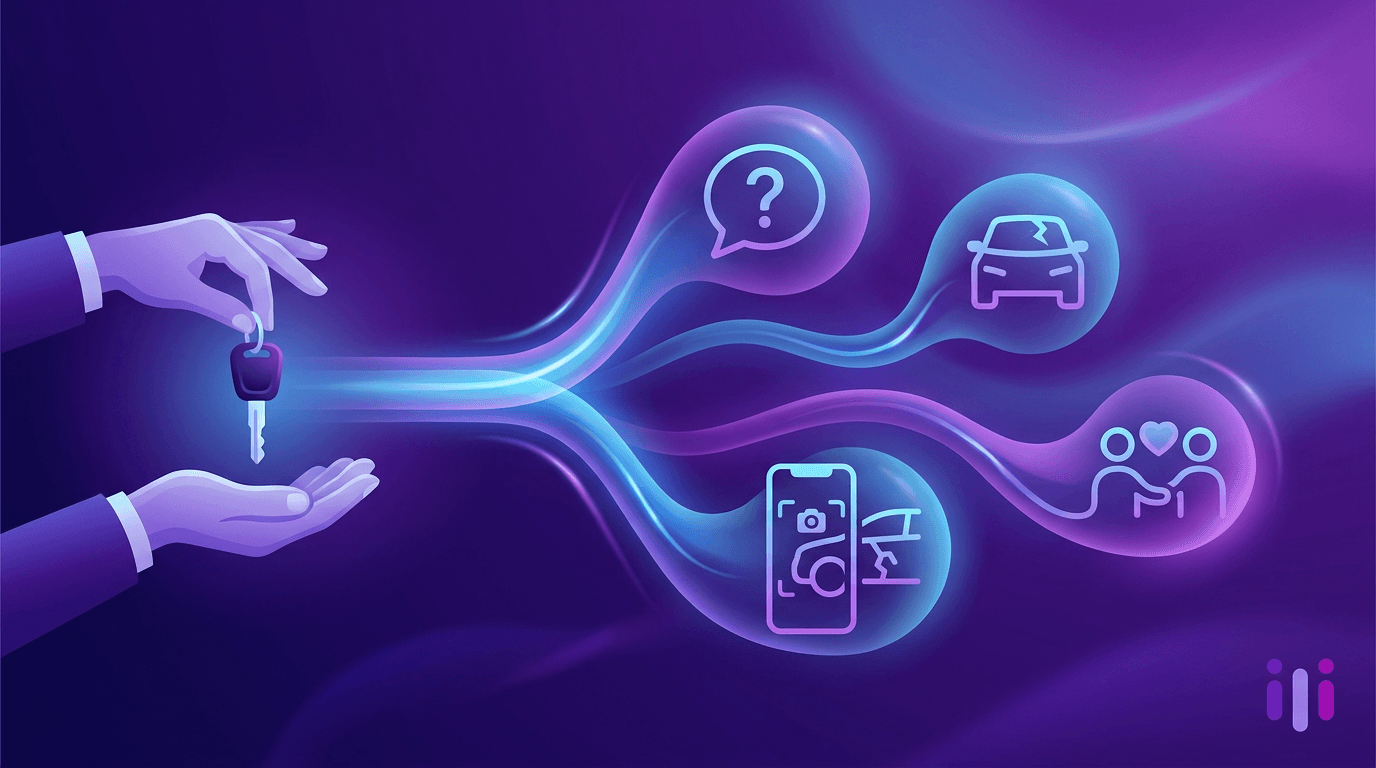
Auto insurance AI in 2026 is no longer a slide-deck promise — but it's also not "AI for everything." Carriers like GEICO, Progressive, Allstate, and Lemonade are deploying AI in four narrow places that actually move loss ratios and CSAT: instant quoting, First Notice of Loss (FNOL) intake, photo-based damage assessment, and retention conversations at renewal. Tractable's computer vision now powers same-day claim resolution for insurers like Beesafe, who issue immediate payouts after a few photos. Aspire General launched an AI FNOL voicebot called Nicole in March 2026 with partner Liberate. Progressive's chatbot Flo retrained its models more than 75 times in its first four months. Lemonade rolled out an Autonomous Car policy in January 2026 that cuts per-mile premiums by 50% during Tesla Full Self-Driving operation. The other 80% of "AI in auto insurance" pitches — algorithmic underwriting, AI lawyers, autonomous fraud detection — are either regulated, immature, or already commoditized. This guide covers the four payback zones, the carriers proving them out, and where the conversational layer actually fits.
What is auto insurance AI?
Auto insurance AI is the use of machine learning, computer vision, and conversational AI to automate or augment the four parts of the auto policy lifecycle where speed and accuracy compound: pre-bind quoting, claim intake (FNOL), damage assessment, and policyholder communication around renewal, mid-term changes, and cross-sell. It is not, in 2026, a meaningful replacement for licensed underwriters, claims adjusters on bodily-injury cases, or actuarial pricing teams — those roles still anchor the regulatory and legal scaffolding around every personal auto policy.
The U.S. National Association of Insurance Commissioners (NAIC) is rolling out an AI Systems Evaluation Tool across 12 pilot states in 2026, with nationwide rollout expected by November. That tool requires carriers to disclose the data fed into pricing and claims models. Translation: AI in auto insurance is a regulated activity now, and the carriers winning aren't the ones using AI everywhere — they're the ones using it surgically where the math works.
The 4 places auto insurance AI actually pays back
Auto insurance AI pays back in four specific workflows: instant quoting, FNOL intake, photo-based damage assessment, and retention conversations. The rest is research-mode. Below is a quick map of each, with the carriers and vendors leading 2026.
The rest of this guide unpacks each one, with what to copy, what to avoid, and the single hardest sub-problem inside each.
1. Instant quoting: AI as the front door
Instant quoting is where AI most visibly pays back in 2026 — and also where it's most commoditized. Every modern auto carrier and aggregator now uses AI somewhere in the quote flow, either to ingest data (parse a declarations page, pull a CLUE report, score a VIN) or to converse with the prospect.
Lemonade's quote experience is the cleanest pure-AI example. As Lemonade's own marketing makes explicit, "Lemonade relies on AI to provide quotes, chat with customers, and manage claims." A prospect lands on the auto page, an AI agent walks them through ZIP, vehicle, usage, and drivers, and the system returns monthly and semi-annual premium options. No human in the loop on the happy path.
Insurify takes a different shape — it's a comparison aggregator, not a carrier, but its 2026 product includes an AI-powered policy upload feature. Drop in a picture of your current declarations page, and the model extracts coverages, limits, and deductibles to seed comparison quotes from 120+ carriers. That removes the single biggest friction point in the shopping journey.
Progressive's chatbot Flo handles quoting alongside servicing tasks — bill date changes, claim filing, and quote intake. Per Emerj's profile, Progressive retrained Flo's models more than 75 times in the first four months after launch. That cadence is the actual lesson: AI quoting works when you treat the model like a perpetually iterated product, not a one-time integration.
What to avoid: marketing copy that promises "AI underwriting" when the carrier is really running standard rating algorithms with a chatbot UI on top. Underwriting in personal auto is governed by state filings, and AI's role inside the rating engine is narrow and heavily regulated. The chatbot is the experience layer; the rating engine is still the rating engine.
For more on what conversational quoting looks like outside of insurance — and how it generalizes across regulated industries — see our breakdown of conversational AI for business in 2026 and our take on why static intake forms are killing conversion rate.
2. FNOL intake: where AI saves real money
First Notice of Loss is the highest-impact workflow for AI in auto insurance, full stop. FNOL is the moment a customer calls or taps to report a loss, and it's the single most fragile customer-experience moment in the entire policy lifecycle. According to industry data, 68% of customers report FNOL impacts their satisfaction with their insurer, and roughly 30% of policyholders will switch insurers after a poor claims experience.
The 2026 reference implementation is non-standard auto insurer Aspire General Insurance's March 2026 launch with Liberate. Customers can call and speak with an AI voice agent named Nicole, or submit claim information through a digital FNOL form, with data automatically transferred into the claims system in real time. The agent triages by severity, captures structured loss details, and books an inspection or repair appointment in the same call.
Why this works:
- 24/7 capacity — losses don't happen during business hours. AI voice agents catch the 2 a.m. fender bender that a phone tree drops.
- Structured capture from the first touch — instead of a CSR taking unstructured notes, the AI fills the FNOL fields directly, eliminating downstream rework.
- Triage at intake — the AI routes total losses, glass-only claims, and bodily injury to different downstream paths immediately.
The result is what industry analysts now call "touchless" claims processing — for minor, clear-cut accidents, the entire claim from FNOL to final payment is handled with very little human involvement, in minutes or hours rather than days.
What to avoid: deploying FNOL voicebots without a clean handoff to a human for bodily injury, multi-vehicle accidents with disputes, or non-English-speaking callers. The wins are in clear-cut, single-vehicle, property-damage-only losses. Get those right before expanding scope.
For the broader insurance customer-communications picture, see our 2026 state of the industry report on AI customer communications in insurance and the deep dive on AI in customer communications for insurers: use cases, risks, and a 2026 adoption roadmap.
3. Photo-based damage assessment: computer vision earns its keep
Photo-based damage assessment is the part of the auto insurance AI stack that has gone from research project to production infrastructure. Tractable is the category leader, with computer vision models trained on millions of vehicle damage images that produce a damage assessment in seconds, often without further human review.
The mechanics: a policyholder uses a web app or mobile flow to upload photos of the damaged vehicle. Tractable's models classify the claim as total loss, repairable, or cash settlement. Every estimate ships with a certainty score factoring in image quality, visibility, and damage severity, so the carrier can route low-confidence cases to a human appraiser and auto-resolve high-confidence ones.
Real production results in 2026:
- Beesafe uses Tractable to make immediate payment offers when appropriate, allowing claims to resolve in minutes — often on the first interaction. The carrier expects the majority of cases to flow through this path.
- GEICO deploys computer vision and deep learning to reduce claims cycle times and improve fraud detection, with adjusters operating as exception handlers rather than primary appraisers.
- CCC Intelligent Solutions (the dominant data infrastructure layer for auto claims in North America) embeds AI estimating into the standard appraiser workflow, so most carriers get computer-vision damage models without building anything in-house.
The single hardest sub-problem: prior damage. A photo of a quarter-panel doesn't tell the model whether the dent is from this loss or last year's. Carriers solve this with VIN-anchored damage history, but it's a structural limitation of pure photo-based AI. Expect 2026–2027 to bring more longitudinal vehicle history into the assessment pipeline.
What to avoid: pitching photo-based AI as a replacement for inspections on total losses, structural damage, or claims with bodily injury. Computer vision is a triage and acceleration layer, not a verdict on cases with legal or safety stakes.
4. Retention conversations: the conversational layer carriers are missing
Retention is the workflow where most carriers still deploy zero AI — and where the loss is largest. Auto insurance lifetime value is measured in years of renewal premium, and a 1-point reduction in churn is worth more than almost any acquisition optimization. Yet the typical retention motion in 2026 is still a generic NPS survey, a renewal email, and a hope-and-pray price hold.
The reason this gap exists: traditional retention tooling is built around forms and surveys, which fail at the exact moment that matters most. When a policyholder is shopping or about to non-renew, their reasons are messy ("the rate jumped, but also my agent retired, and Geico's app is better"). A 1–10 NPS score flattens that into a number; a free-text comment captures it but can't follow up. We've made the broader argument for why AI-first customer research cannot start with a web form, and the logic applies hardest to insurance retention.
This is where the conversational layer matters. AI interviews — running at the moment of policy shopping, mid-term cancellation request, or post-claim — surface the actual reasons policyholders leave, follow up on vague answers, and capture the "why now." That data feeds:
- Save desks with real reason codes instead of guesses.
- Pricing teams with signal on which segments are most rate-sensitive this quarter.
- Product teams with insight into which app, agent, and claims experiences predict churn.
Perspective AI is the conversational layer carriers use to run these interviews at scale — running hundreds of policyholder conversations in parallel, each adapting in real time to what the person says. For a step-by-step on what these conversations look like in the broader insurance funnel, see AI for insurance agencies in 2026: from lead capture to renewals and Lemonade case study: conversational AI in insurance.
For the deeper methodology on running these interviews well — the listening, follow-up, and synthesis pattern — see our complete guide to voice of customer programs in 2026.
What about autonomous vehicles?
Autonomous vehicle insurance is the edge case 2026 made real. In January 2026, Lemonade launched Lemonade Autonomous Car insurance, a first-of-its-kind product specifically for self-driving cars, starting with Tesla FSD. The headline: per-mile rates for FSD-engaged driving are cut by approximately 50%, reflecting what telematics data shows to be significantly reduced risk during autonomous operation.
This is the leading edge of where auto insurance AI goes next: pricing tied to what the AI in the car is actually doing, mile by mile. It's still a rounding error in total premium volume, but every major carrier now has a roadmap to handle mixed-mode driving (human + Level 2/3 autonomy in the same trip) by 2027–2028. If you're building or buying a system today, make sure your data model can ingest per-mile mode signals, not just policy-period mileage.
Common pitfalls in auto insurance AI deployments
Five mistakes show up in nearly every failed auto insurance AI rollout:
- Deploying AI everywhere instead of where it pays back. Pick one of the four workflows above and ship it well before expanding.
- Treating the chatbot as the AI. The chatbot is the surface; the model is the underwriting/triage/scoring engine. They have different lifecycles.
- Skipping the human handoff design. AI handles the 80% happy path. The 20% — bodily injury, fraud signals, regulatory edge cases — needs explicit, low-friction escalation.
- Ignoring regulatory disclosure. With the NAIC AI Systems Evaluation Tool reaching nationwide scope in late 2026, carriers must document the data feeding any model that affects rates or claim outcomes.
- Letting forms back in through the side door. Survey tools, NPS micro-surveys, and renewal questionnaires reintroduce the form problem retention conversations are supposed to solve. Audit your own funnel for this.
Frequently Asked Questions
What is auto insurance AI?
Auto insurance AI is the use of machine learning, computer vision, and conversational AI across four parts of the auto policy lifecycle: pre-bind quoting, claim intake (FNOL), photo-based damage assessment, and retention or renewal conversations. It does not replace licensed underwriters, claims adjusters on injury cases, or actuarial pricing teams — those roles remain anchored by state regulation. The carriers leading in 2026 are using AI surgically in those four workflows, not blanketing it across everything.
Which auto insurance companies use AI the most?
Lemonade, GEICO, Progressive, and Allstate are the most visibly AI-forward U.S. auto carriers in 2026. Lemonade runs an AI agent for quoting and claims; GEICO uses Tractable computer vision and proprietary fraud models; Progressive's chatbot Flo handles quotes and servicing and was retrained more than 75 times in its first four months; Allstate now ties with GEICO for the top mobile insurance app and is expanding telematics-based accident detection. Non-standard carrier Aspire General also launched an AI voice FNOL system with Liberate in March 2026.
Does AI replace claims adjusters in auto insurance?
AI does not fully replace claims adjusters in auto insurance — it shifts what adjusters do. For low-severity, clear-cut auto physical damage claims, computer vision tools like Tractable can produce assessments in seconds and trigger payouts in minutes, with adjusters acting as exception handlers. For total losses, structural damage, multi-vehicle disputes, and any claim involving bodily injury, human adjusters still own the file end-to-end. Expect AI to absorb 60–80% of routine triage work by 2027 while injury and complex liability remain human-led.
What is FNOL automation in auto insurance?
FNOL automation is the use of AI voice or chat agents to capture First Notice of Loss details directly from the policyholder, structure them into the claims system, and triage by severity — without a human CSR taking the initial call. Aspire General's 2026 deployment with Liberate uses an AI voice agent named Nicole to handle 24/7 intake. Industry data shows FNOL impacts customer satisfaction for 68% of policyholders, making it the highest-leverage workflow for auto insurance AI investment.
How is AI used in auto insurance underwriting?
AI in auto insurance underwriting is narrower and more regulated than marketing copy suggests. Carriers use ML models to score driver risk from telematics, classify VINs and vehicle features, and detect application fraud — but the actual rating engine that produces the premium is governed by state filings and cannot be replaced wholesale by a model. The NAIC's AI Systems Evaluation Tool, expanding to nationwide scope by November 2026, requires carriers to disclose data inputs feeding any pricing-relevant model. Treat AI underwriting claims with skepticism unless the carrier can name the specific filed model.
Can AI handle insurance retention conversations?
AI handles insurance retention conversations more effectively than forms or surveys, because the moments that drive churn — rate shock, claims dissatisfaction, agent transitions — are messy and require follow-up. Static NPS scores or generic renewal emails flatten those reasons into noise. Conversational AI like Perspective AI runs structured interviews with policyholders mid-shopping, post-claim, or pre-renewal, capturing the actual "why" behind churn signals at a scale traditional voice-of-customer tooling can't match.
Conclusion
Auto insurance AI in 2026 is not a single technology — it's four discrete workflows where the math actually works: instant quoting, FNOL intake, photo-based damage assessment, and retention conversations. Lemonade, GEICO, Progressive, Allstate, Aspire, and Beesafe are the carriers proving it, with Tractable and Liberate as the dominant infrastructure vendors. Everything outside those four lanes — autonomous fraud, AI underwriting, AI legal — is either over-promised, regulated, or already commoditized.
The lane most carriers are still missing is retention. Pricing and claims AI are getting most of the budget, but the conversational layer that surfaces why policyholders are actually leaving is the unlock that compounds across every other AI investment. If you're a carrier, agency, or insurtech rethinking how you talk to policyholders in 2026, run a Perspective AI interview on a slice of your churning book and watch what the conversation surfaces that your dashboards never could. For the broader picture on conversational AI in insurance, start with our roundup on AI tools for customer experience in insurance support and the AI assistant for insurance buyer's guide.
More articles on Intelligent Intake
AI Insurance Fraud Detection in 2026: From Pattern Anomalies to Conversational Red Flags
Intelligent Intake · 17 min read

Commercial Insurance AI in 2026: A Practical Guide for Brokers, MGAs, and Carriers
Intelligent Intake · 14 min read
Health Insurance AI in 2026: Member Engagement, Claims, and the Compliance Reality
Intelligent Intake · 13 min read
Life Insurance AI in 2026: How Conversational Underwriting Is Replacing 90-Page Applications
Intelligent Intake · 14 min read
Consumer App Onboarding Drop-Off in 2026: How to Find Where New Users Actually Stall
Intelligent Intake · 23 min read
The Career Counseling Intake Form in 2026: Eliciting Goals, Not Symptoms
Intelligent Intake · 23 min read