Automated Customer Feedback in 2026: Beyond Surveys, Toward Conversations
TL;DR
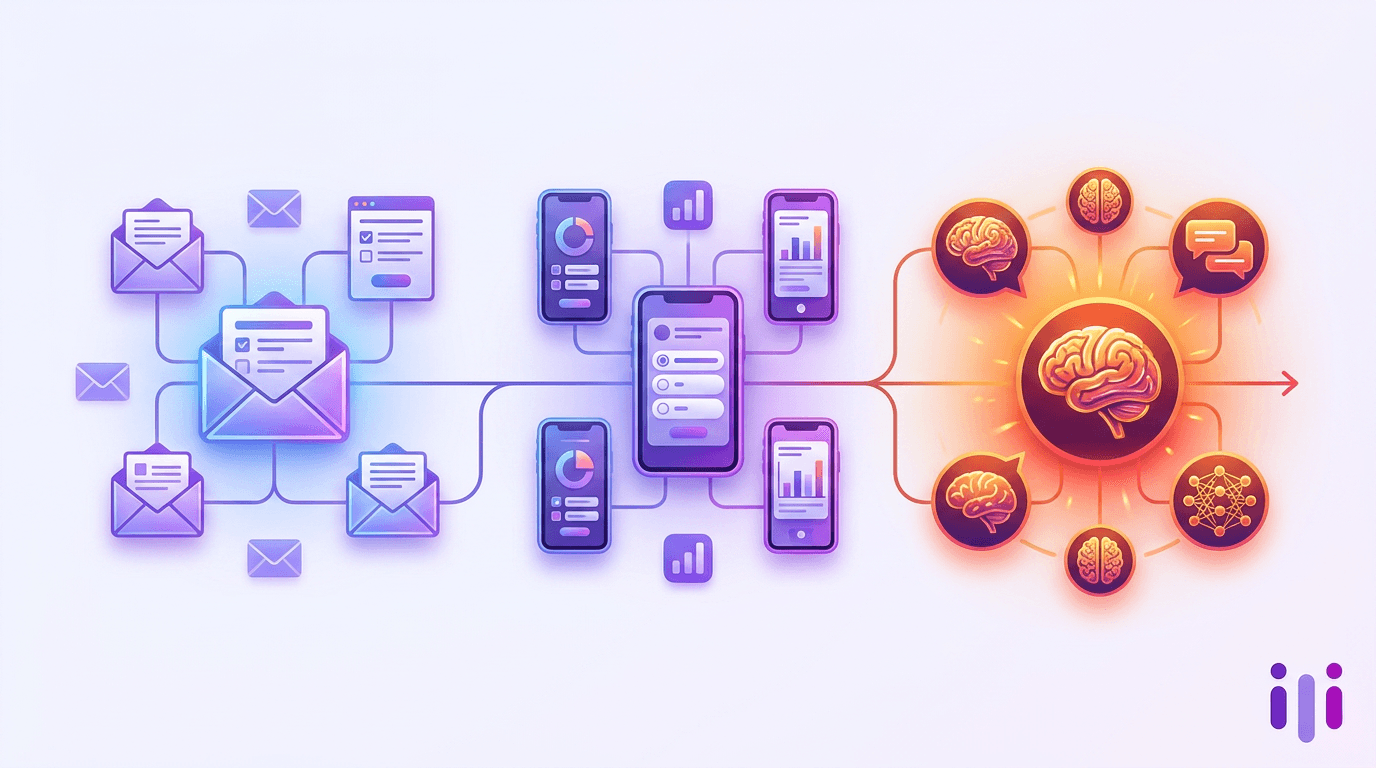
Automated customer feedback has moved through three distinct generations: email and SMS survey blasts (circa 2010), in-app polls and NPS triggers (circa 2017), and AI-led feedback conversations (the 2026 default). The first two generations optimized for volume of responses; the third optimizes for depth of understanding, because AI interviewers can follow up, probe, and capture the "why" that scaled surveys flatten away. The shift matters for a measurable reason: SurveyMonkey's own benchmark research puts external-survey response rates between 10 and 15 percent, while AI conversational tools like Perspective AI routinely report completion rates two to four times higher with richer transcripts. If your stack still routes feedback through a Typeform, a Qualtrics CX dashboard, or a Delighted NPS email, you are running a Generation 2 program in a Generation 3 market. This guide walks through each generation, the migration path from automated surveys to automated conversations, and the pitfalls (survey fatigue, sample bias, false precision) that every generation inherits unless you redesign for them.
Generation 1: Email and SMS Survey Automation
Generation 1 automated customer feedback meant scheduling an email or SMS survey to fire on a trigger — purchase, ticket close, 30-day mark — and pushing the responses into a spreadsheet or BI tool. SurveyMonkey, Constant Contact, Delighted, and Wufoo built businesses on this model from roughly 2008 onward, and most enterprise voice-of-customer programs still run on it.
The mechanics are simple. A CRM or e-commerce event fires a webhook, the survey tool sends a templated email with a link, the customer clicks (or, more often, doesn't), and a five-question form captures structured responses. Net Promoter Score, CSAT, and CES emerged as the dominant metrics here precisely because they survive the format — a 0–10 scale and a single open-text field is what you can reliably get out of an email.
What Generation 1 got right: it made customer feedback collection a regular, automated event rather than a one-off project. What it got wrong: it inherited every weakness of the survey form. Response rates collapsed as inboxes filled, sample bias skewed toward the most-satisfied and most-angry, and the "Why?" follow-up box produced four-word answers no analyst could act on. We unpack the broader pattern in Why Your VoC Program Isn't Telling You the Full Story and the structural break in NPS Is Broken.
Generation 2: In-App Polls and NPS Triggers
Generation 2 moved the survey out of the inbox and into the product, replacing scheduled email blasts with contextual in-app polls and behavior-triggered micro-surveys. Pendo, Sprig, Hotjar, and the in-product modules of Delighted and Qualtrics defined the era — circa 2017 to 2023 — and many product teams still treat this as the modern standard.
The pitch was real. Asking a customer how they feel right after they completed onboarding gets a more accurate answer than asking three days later via email. Response rates jumped because the form lived inside the workflow the customer was already in. NPS triggers tied to lifecycle events (activation, first value, renewal) gave Customer Success managers earlier signals than quarterly surveys ever could.
What Generation 2 still got wrong: the unit of feedback was still a form. A 1–5 star widget or a "How was your experience?" multi-select can't ask the second question. When a customer rates onboarding 3 of 5, the most valuable thing you can do is ask why — and a triggered poll has no mechanism to do that. The result is a higher volume of shallow data points. Product teams ended up with dashboards full of trends and almost no qualitative truth behind any of them, a pattern we documented in The Glasswing Principle.
Generation 3: AI-Led Feedback Conversations
Generation 3 automated customer feedback is conducted as an interview, not collected as a form. An AI interviewer agent receives the same trigger that used to fire a survey, but instead of presenting fields, it opens a conversation, asks an open-ended starter question, listens to the answer, and follows up based on what the customer actually said.
This is what changed mechanically:
- The unit of feedback is a transcript, not a row. Each automated conversation produces a structured transcript that you can summarize, cluster, and quote — not a single number locked into a star rating.
- Follow-up is automated, not skipped. Where Generation 2 ended at a star rating, Generation 3 probes: "You said the dashboard felt cluttered — which view were you in when that happened?"
- Sample size scales without a researcher. A single AI interviewer can run thousands of simultaneous conversations, which removes the headcount cap that capped traditional qualitative research at 8–15 interviews per study, as discussed in Customer Research at Scale.
- Analysis is part of the loop. Magic Summary–style automated synthesis turns hundreds of transcripts into a ranked list of themes in minutes, not the two-week analyst lag survey programs accept.
The category-level argument for this shift is in Replace Surveys with AI and the architectural test for a real Generation 3 tool is in The Architecture Test for AI-Native Engagement Tools.
What Changes When Feedback Becomes a Conversation
When automated feedback becomes a conversation, three things change about your customer-feedback program: the data, the cadence, and the role of the researcher.
The data gets denser per respondent. A 90-second AI-led conversation produces 8–12x the qualitative content of a 5-question star survey. According to Nielsen Norman Group research on qualitative methods, open-ended conversation captures categories of insight (motivation, prior alternatives, emotional context) that closed-ended surveys structurally cannot reach.
The cadence shifts from event to continuous. Because the cost of running an interview drops to near-zero per conversation, teams stop saving feedback for quarterly NPS pushes and start running always-on listening — a pattern we explore in Continuous Discovery Habits in 2026.
The researcher's role changes from interviewer to interview designer. Instead of conducting interviews one at a time, the researcher now designs the AI interviewer's outline, defines what counts as a high-quality follow-up, and reviews summaries. This is the democratization argument — see Every Customer Gets a Seat at the Table — and it's why product managers and CX leaders, not just researchers, are now running their own feedback programs through tools like the Perspective AI interviewer agent.
How to Migrate from Automated Surveys to Automated Conversations
Migration from Generation 2 to Generation 3 doesn't require ripping out your stack. It works in five steps.
Step 1: Inventory every automated survey trigger. List each existing trigger — onboarding day 7, post-ticket close, post-purchase, renewal at -30 days, NPS quarterly, churn-risk alert. Most VoC programs we've audited have 8–15 active triggers, half of which the team has forgotten about.
Step 2: Pick the highest-leverage trigger first. Onboarding completion and churn-risk are usually the two highest-leverage triggers — onboarding because it's the moment you can still fix the problem, and churn-risk because the cost of a missed signal is a logo. Both deserve a real conversation, not a star rating. The churn-trigger pattern is in How to Reduce Customer Churn in SaaS.
Step 3: Replace the form with an AI interviewer for that one trigger. Keep everything else running. Run the AI conversation in parallel for 2–4 weeks and compare completion rate, qualitative depth, and downstream action rate.
Step 4: Wire transcripts into your existing system of record. The transcript and Magic Summary should land where your CSMs and PMs already work — Salesforce, HubSpot, Notion, or your data warehouse. The goal is not a new tool to log into; it's better data flowing into the systems you already use.
Step 5: Expand to the next trigger only after step 4 is real. The most common migration failure is doing all five triggers at once, which means none of them get integrated and the AI feedback becomes another orphan dataset. One trigger fully integrated beats five triggers half-shipped. The broader playbook for this transition is in The Complete Guide to Voice of Customer Programs in 2026.
Pitfalls of Feedback Automation (Survey Fatigue, Sample Bias, False Precision)
Every generation of feedback automation inherits the same three pitfalls unless you actively redesign for them.
Survey fatigue. Customers receive an average of 5 customer-feedback requests per week from their B2B and B2C vendors, according to Forrester research on CX measurement. Generation 1 made fatigue worse by automating volume. Generation 2 reduced inbox fatigue but created in-app interruption fatigue. Generation 3 mitigates this only if you reduce frequency to compensate for depth — a 90-second conversation 4 times a year beats a 30-second poll every week.
Sample bias. Automated surveys over-sample the extremely satisfied and the extremely angry, missing the 60–70% middle that actually predicts retention. Conversational AI doesn't fix this automatically — you still have to invite a representative cross-section. The mistake we see most often is teams letting "whoever clicks the link" become the sample, which is the same bias problem dressed up in newer technology. The cross-section pattern is in Customer Research at Scale and the deeper issue with NPS-style scoring is in Real-Time Customer Feedback Analysis.
False precision. A dashboard that reports "NPS is 42, up from 38" implies a precision the underlying data doesn't support. Generation 3 tools risk a related failure: AI-summarized themes can read as authoritative even when the sample was thin. The fix is the same in both worlds — show the n, show the methodology, show representative quotes, and let humans judge whether the pattern is real. We unpack the same mistake at the program level in Why Do Customers Churn.
Frequently Asked Questions
What is automated customer feedback?
Automated customer feedback is any system that triggers, collects, and routes customer feedback without manual intervention from a researcher or CX manager. Historically that meant scheduled surveys; today it increasingly means AI-led interviews triggered by lifecycle events. The defining characteristic is that the system runs on its own — the team designs it once, then reviews insights rather than fielding individual studies.
How is automated feedback collection different from a regular survey?
Automated feedback collection is a survey program that runs on triggers and rules instead of manual fielding. A regular survey is sent on a calendar (e.g., quarterly NPS); an automated program fires on customer-state events (onboarding complete, ticket resolved, renewal approaching). The infrastructure is the same — what differs is who decides when to ask and how the response routes downstream.
Are AI feedback conversations more expensive than automated surveys?
AI feedback conversations are typically priced per-conversation rather than per-seat, which means cost scales with volume rather than headcount. For most mid-market teams, the per-conversation cost lands between standard SaaS survey pricing and dedicated user-research panel pricing. The ROI math usually shifts in AI's favor once you account for analyst time saved on synthesis, not just collection cost — explored further in How to Solve Customer Research Costs Without More Surveys.
Do automated AI conversations replace customer interviews?
Automated AI conversations replace the volume layer of customer interviews — the 200 onboarding interviews you'd never have time to run by hand — without replacing the strategic 1:1 interviews where a senior researcher needs to hear nuance directly. The right pattern is layered: AI for breadth, human researchers for the deepest 5–10 percent of strategic conversations, as detailed in AI-Moderated Interviews.
What metrics should I track for an automated feedback program?
Track completion rate, qualitative depth (average words per response or transcript length), action rate (percent of insights that produce a Jira ticket, CS save, or roadmap change), and time-to-insight (trigger fired to summary delivered). Avoid leading with NPS as the headline metric — it's a lagging score that flattens the underlying transcripts you actually need to read. Compare your numbers against the full benchmark set in The Complete Guide to Voice of Customer Programs in 2026.
Which automated feedback tools are best for a small team?
For a small team, the best automated feedback tool is the one your CX or product manager can configure without engineering help, that integrates with your CRM, and that captures qualitative depth, not just scores. Compare options in Customer Feedback Analysis Software in 2026 and Voice of Customer Tools in 2026. For typeform-style replacement specifically, see the best Typeform alternatives for 2026.
Choosing the Right Tool for Your Stage
The right automated customer feedback stack depends on which generation your program is actually operating in, not which generation your tooling claims.
If you're running fewer than 50 customer-facing emails per week and have no in-product surface, Generation 1 tools are still defensible — a well-designed email survey is better than no feedback program. If you have an active product with daily usage, Generation 2 in-app polls become the floor. And if you're a CX, product, or research team that needs to understand the why behind the score — and act on it inside a single sprint — Generation 3 AI conversations are the new default. The architecture test for whether a tool is genuinely Generation 3 (versus a survey tool with an AI veneer) is in Most AI-Native Onboarding Tools Aren't Native — Here's the Real Test, and the broader buyer framing is in the AI-enabled customer engagement software 2026 buyer's guide.
Automated customer feedback isn't going away — it's evolving from a row in a spreadsheet to a transcript with a follow-up question. The teams winning in 2026 are the ones who stopped treating feedback as a metric to report and started treating it as a conversation worth having. If you're ready to migrate one trigger from form to conversation, start a research project with Perspective AI or see how the Interviewer agent works — built for product, CX, and research teams who need depth at the volume automation makes possible.
More articles on AI Customer Interviews & Research
Post-Purchase Survey Questions That Actually Explain Returns (2026)
AI Customer Interviews & Research · 25 min read
Before You Renew Qualtrics: The Negotiation Levers Buyers Actually Have
AI Customer Interviews & Research · 19 min read
Customer Feedback Data: Retention, Privacy, and the Decisions CX Teams Must Make
AI Customer Interviews & Research · 22 min read
Getting Your Data Out of Qualtrics: Exports, Formats, and What Breaks
AI Customer Interviews & Research · 21 min read
Verbatim Analysis: What to Actually Do With 40,000 Open-Ended Responses
AI Customer Interviews & Research · 19 min read
Customer Sentiment Examples: What Customers' Words Signal
AI Customer Interviews & Research · 13 min read