AI Tools for Customer Experience in Insurance Support: A 2026 Roundup by Workflow
TL;DR
The best AI tools for customer experience in insurance support in 2026 are not a single platform — they are a stack of four workflow-stage-specific tools: a conversational intake agent for FNOL and policy questions, an AI triage layer for routing and severity scoring, an adjuster copilot for resolution, and an AI follow-up agent for renewal and post-claim NPS. Carriers that try to swap their entire support stack for one "AI CX platform" generally regret it within 12 months; carriers that adopt by stage report 30–55% deflection on Tier-1 questions and 18–24% faster claim cycle times within two quarters. Perspective AI sits in the intake and follow-up stages — replacing static forms and post-call surveys with conversational AI that captures the "why" behind each interaction. Legacy enterprise CXM suites like Qualtrics, Medallia, and InMoment still dominate enterprise survey deployments but lag on conversational intake. Pure support platforms like Zendesk, Salesforce Service Cloud, Intercom, Freshworks, Kustomer, Gladly, and Ada cover triage and resolution but treat intake as a contact form. The integration-vs-swap question matters more than the tool choice: most carriers should add AI at intake and follow-up first, leave the core CCaaS/CRM in place, and earn the right to consolidate later. This guide segments the market by stage so you can build the stack instead of buying the brochure.
How This Roundup Is Organized
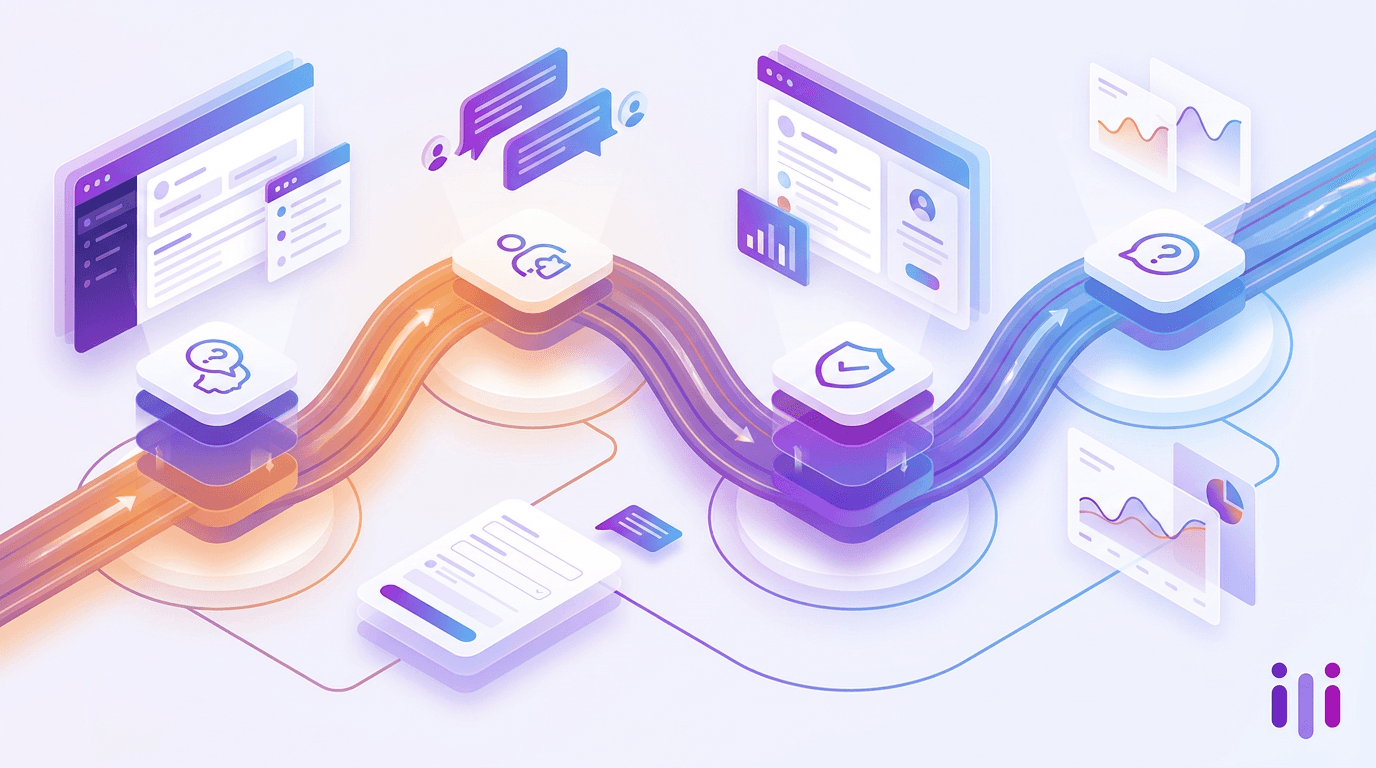
This roundup is organized by the four CX workflow stages a typical P&C, life, or health insurance support interaction passes through: intake → triage → resolution → follow-up. Each stage has a distinct AI tooling category, a distinct buyer (claims ops, contact center ops, adjuster enablement, retention/CS), and a distinct failure mode. Most carriers we talk to are evaluating "AI for support" as one decision — and that framing is exactly why pilots stall. The right question is not "which AI tool replaces our support stack" but "which AI tool fits which stage, and what stays put."
The stage model also reflects how AI value compounds. Better intake reduces triage volume. Better triage reduces resolution time. Better resolution increases retention at follow-up. A roundup organized by vendor — the format most lists default to — hides this dependency chain. A roundup organized by stage exposes it.
For deeper context on the carrier-side architecture decisions behind this stack, see the 2026 state of AI customer communications in insurance and our practical use-cases-and-risks roadmap for insurer AI adoption.
Stage 1: Intake — FNOL, Policy Questions, and Claim Initiation
Intake is the stage where AI tools for customer experience in insurance support deliver the highest measurable lift, because the legacy default — a web form or an IVR menu — is the worst possible interface for the moment a customer is filing a first notice of loss (FNOL) or asking why their premium changed. The customer is stressed, often confused about coverage terminology, and almost never has all the relevant information ready in the form's required fields.
Static forms fail intake for the same reason they fail every other research surface: they flatten messy human context into dropdowns and free-text boxes, with no follow-up when an answer is vague. A claimant who types "the other car came out of nowhere" gets no probe. A policyholder who selects "billing question" never gets asked which line item they're confused about. The full case for replacing this layer is documented in why AI-first cannot start with a web form and why static intake forms are killing your conversion rate.
The AI tooling category for this stage is conversational intake — an AI agent that conducts a structured but adaptive interview, follows up on incomplete answers, and produces a populated, validated case record before triage ever sees it. Perspective AI is built for this stage. So is the broader category — see the practical guide to conversational intake AI for 2026 and the ultimate guide to AI intake software for category-level coverage.
What carriers should look for at this stage:
- Voice and text parity. A claimant calling at 2am needs the same agent a claimant filling out a portal at 2pm gets. Voice agents matured significantly in 2024–2025 — see our voice conversations launch and our Product Hunt voice-agents launch for the underlying capability.
- Probing on incomplete answers. Insurance intake is full of "it depends" moments. The agent should ask the next clarifying question without forcing the customer to start over.
- Structured output for downstream systems. Conversational front-ends are useless if the back-end gets unstructured text. Lemonade's chatbot-as-FNOL approach — covered in our Lemonade case study on conversational AI in insurance — works because the AI produces a structured claim object, not a chat transcript.
A note on framing: deflection is the wrong primary KPI at this stage. We argued this in detail in why "deflection" is the wrong goal for conversational AI in insurance. Carriers that optimize for deflection over completion quality end up with higher first-call resolution failures downstream. Optimize for clean handoff, not for keeping the human out of the loop.
For the broader category landscape across industries, see our roundup of conversational AI for business in 2026 and the 2026 buyer's guide to AI-enabled customer engagement software.
Stage 2: Triage and Routing
Triage is the stage where AI assigns severity, complexity, and routing on the case object produced at intake. It is the least visible stage to the customer and the most operationally consequential for the carrier. A misrouted total-loss auto claim that ends up in a glass-only adjuster's queue costs roughly 4–6 days of cycle time and a measurable hit to the customer's NPS at follow-up.
The AI tooling category here is AI lead/case routing — model-driven scoring of the inbound case against adjuster skill, queue load, regulatory state, and claim severity. We covered the category architecture in how AI lead-routing software actually works, where it breaks, and how to pick one in 2026.
Major support platforms — Zendesk, Salesforce Service Cloud, Intercom, Freshworks, Kustomer, Gladly, HubSpot Service Hub — all ship AI triage as a first-class feature in 2026. They route based on intent classification (good), conversation embeddings (better), and a prior-interaction graph (best). Specialized players like Ada and Forethought push further on intent classification specifically, but rarely cover the full carrier ops graph.
What insurance support orgs should look for at this stage:
- State and line-of-business awareness. A bodily injury claim in NY is not the same case as a bodily injury claim in TX. Triage must understand regulatory rails, not just topic.
- Severity scoring on the conversational record. If intake produced a structured case (Stage 1), triage should be reading evidence, not guessing from a subject line.
- Override and audit. Adjuster supervisors need to override routing decisions and see why the model assigned what it assigned. Black-box routing fails compliance review the first time it routes a regulated case wrong.
The honest read: most carriers should not swap their existing CCaaS or CRM triage layer in 2026. The AI in those platforms is good enough, the integrations are already built, and the switching cost is enormous. The leverage at this stage comes from feeding triage a better case object — which means investing at Stage 1, not at Stage 2.
For the broader pattern of how AI is restructuring support routing across industries, see the evolution of customer engagement toward AI-driven conversations.
Stage 3: Resolution and Adjuster Support
Resolution is the stage where the adjuster, customer service rep, or licensed agent is actively working the case. The AI tooling category here is agent copilot / adjuster copilot — real-time suggestions on next-best-action, policy-language retrieval, regulatory checks, and draft response generation.
This is the stage where the major support platforms genuinely lead. Salesforce's Service Cloud and Einstein/Agentforce, Zendesk's AI Agents, Intercom's Fin, Freshworks' Freddy AI, Kustomer's KIQ, Gladly's Sidekick, ServiceNow's Now Assist, and Glean's enterprise-search-as-copilot all do real work here. They retrieve policy language, draft responses, summarize prior interactions, and check tone. For most carriers, this layer should be your CCaaS or CRM vendor's native AI, not a third-party bolt-on. The integration tax is too high otherwise.
What carriers should look for at this stage:
- Grounding on policy language and SOPs. A copilot that hallucinates coverage limits is a regulatory incident waiting to happen. Insist on retrieval-augmented generation grounded in your specific policy library and state-by-state rules.
- Confidence calibration. The copilot should say "I'm not sure" rather than fabricate. The 2024 Air Canada chatbot ruling — where the airline was held liable for a chatbot's hallucinated bereavement policy — is the precedent every carrier counsel cites now.
- Audit trail. Every AI-generated suggestion that influenced an adjuster decision needs to be logged for E&O and regulatory review.
For the broader category context on what "AI assistant for insurance" actually means in practice across carrier, broker, and agent contexts, see our breakdown of AI assistants for insurance — what carriers, brokers, and agents should expect in 2026 and our IVR-and-FAQ replacement piece on AI for insurance policy inquiries.
A practical pattern emerging in 2026: carriers are adopting copilot inside their existing CRM (Salesforce, Guidewire ClaimCenter, Duck Creek) rather than introducing a parallel agent surface. Two surfaces is two contexts and two audit trails. Pick one.
Stage 4: Follow-up and Renewal Motion
Follow-up is the stage where the post-resolution survey, the renewal-period check-in, and the at-risk-policyholder save play happen. It is the stage where most carriers leak retention dollars — not because they don't ask for feedback, but because they ask for it through static NPS surveys that produce a number with no context.
The AI tooling category here is conversational follow-up and voice-of-customer — AI agents that conduct a real post-resolution interview, probe on dissatisfaction, surface churn signal in the policyholder's own words, and feed both the CS team and the underwriting/product team. This is the second stage where Perspective AI sits, and it is the stage where most carrier CX programs get the worst ROI today.
The case for replacing static NPS surveys at this stage is detailed in why NPS is broken, why your VoC program isn't telling you the full story, and the 2026 buyer's guide to voice-of-customer software. The category-level roundup of VoC tools by capability tier is in the 2026 VoC tools roundup. Enterprise CXM platforms — Qualtrics, Medallia, InMoment, Forsta, Confirmit, and the surviving Momentive surfaces — still dominate enterprise survey deployments but treat the conversation itself as out of scope. They give you a great dashboard on a thin signal.
What carriers should look for at this stage:
- Why behind the score. A 6 on NPS is unusable; a 6 plus a transcript explaining "the adjuster was responsive but the rental car authorization took five days" is actionable. See real-time customer feedback analysis and the 2026 state of automated customer feedback.
- Churn signal extraction. Renewal-period interviews should feed a churn signal pipeline, not a sentiment dashboard. See our SaaS churn-reduction playbook and why customers actually churn — the real reasons your dashboards miss.
- Continuous, not annual. Annual customer-experience surveys belong to the 2010s. The carriers winning on retention are running continuous lightweight conversational follow-up tied to lifecycle events. See continuous discovery habits in 2026 for the operating model.
For CS-org-level adoption patterns specifically, see the 2026 digital-touch customer success playbook and why scaled CS orgs are wrong to add headcount in 2026.
Comparison Table — AI Tools by Workflow Stage
The table is organized by stage on purpose: a vendor that appears in row 2 and row 3 is doing two different jobs, and a buyer evaluating "AI CX platform" without that frame ends up paying for overlap.
How to Integrate vs Swap — A Decision Framework for Incremental Adoption
The most consequential decision in this stack is not which vendor to pick at each stage — it's which stages to swap and which to integrate. A four-stage swap is a 24-month program with a 50%+ failure rate, per a McKinsey 2024 study on AI implementation in financial services. A staged adoption is 90 days per stage with measurable ROI at each gate.
The framework we recommend:
- Start at Stage 1 (intake) or Stage 4 (follow-up). These are the stages where existing tooling is weakest (static forms, static surveys) and where conversational AI's lift is largest. The integration surface is also smallest — intake feeds your existing claims system; follow-up feeds your existing VoC dashboard.
- Leave Stage 2 (triage) and Stage 3 (resolution) on your existing CCaaS / CRM in year one. The AI in Salesforce, Zendesk, Intercom, Freshworks, Kustomer, Gladly, and Ada is good enough, the integrations are built, and the switching cost is large. The leverage at Stage 2 comes from feeding a better case object from Stage 1, not from swapping the routing engine.
- Earn the right to consolidate at Stage 3 in year two. Once Stage 1 and Stage 4 are working, you'll have a much clearer signal on where copilot is actually moving cycle time vs. where it's noise. That's when you re-evaluate.
- Track outcomes per stage, not in aggregate. "AI saved us 20%" is a useless number. "AI intake reduced FNOL-to-first-touch from 6 hours to 9 minutes, and AI follow-up surfaced a $3.2M annual churn signal previously buried" is a budget conversation.
For the broader operating model behind this approach, see the practical guide to AI-enabled customer engagement for CX and product teams, the AI-native architecture test for customer engagement tools, and the complete guide to AI-powered customer experience from first touch to renewal. For the broader trend backdrop on AI conversations as a category, see the 2026 state of the AI conversations category.
What Forward-Looking Carriers Are Piloting in 2026
Three pilots are showing up across our carrier conversations more than any others:
- Conversational FNOL with structured handoff to claims systems. The Lemonade pattern, but at incumbent carriers — replacing the FNOL form with a voice or text agent that fills the claims object. Reported lift: 30–55% reduction in adjuster back-and-forth cycles, consistent with NAIC-tracked claim cycle benchmarks.
- Renewal-period conversational save motion. A 60-day-pre-renewal AI-conducted interview with at-risk policyholders, feeding both retention save plays and underwriting input. The pattern is working in auto and home; it's earlier in commercial lines.
- Adjuster copilot grounded on state-specific regulatory rails. Not the generic Salesforce/Zendesk copilot — a carrier-tuned retrieval layer over state-specific compliance documents and the carrier's own SOPs. Most are building this in-house on top of the CCaaS-native copilot rather than buying a third-party.
What is not working in 2026: trying to deploy a general-purpose support chatbot as a "do-everything CX AI." The carriers that tried this in 2023–2024 are now unwinding it stage by stage and rebuilding around the workflow model.
Frequently Asked Questions
What are the best AI tools for customer experience in insurance support in 2026?
The best AI tools for customer experience in insurance support in 2026 are workflow-stage-specific, not general-purpose. For intake (FNOL, policy questions), conversational AI agents like Perspective AI replace static forms. For triage and routing, the AI inside major CCaaS/CRM platforms (Salesforce, Zendesk, Intercom, Freshworks, Kustomer, Gladly, Ada) handles intent classification and queue assignment. For resolution, agent copilots from those same platforms draft responses and retrieve policy language. For follow-up, conversational VoC tools replace static NPS surveys with interviews that capture the "why" behind each score.
Should a carrier replace its existing support stack with one AI CX platform?
No, not in 2026. A four-stage swap of your support stack is a 24-month program with a 50%+ failure rate per most enterprise AI implementation data. The high-leverage move is to add AI at intake and follow-up first, leave the core CCaaS and CRM triage and copilot layers in place, track outcomes per stage, and earn the right to consolidate later. The carriers that tried "one AI platform for support" in 2023–2024 are now unwinding those deployments.
What's the difference between AI triage and AI resolution copilots?
AI triage assigns the case to the right queue or adjuster; AI resolution copilots help the adjuster work the case once it's assigned. Triage is upstream — it scores severity, classifies intent, checks state and line-of-business, and routes. Resolution copilots are downstream — they draft responses, retrieve policy language, summarize prior interactions, and run regulatory checks. Most major support platforms ship both, but they are operationally different products with different buyers (contact center ops vs. adjuster enablement).
Why is conversational intake better than a web form for FNOL?
Conversational intake captures context that forms structurally cannot. A claimant filing FNOL is stressed and rarely has all the form's required fields ready, so static forms produce incomplete records that downstream triage and resolution have to chase. A conversational AI agent asks follow-up questions, probes on vague answers, handles "it depends" moments, and produces a structured, validated case object before triage ever sees it. The result is shorter cycle times, higher first-call resolution, and a measurable lift in customer satisfaction at follow-up.
How should carriers measure AI ROI at each workflow stage?
Carriers should track stage-specific outcome metrics, not aggregate "AI savings." At intake, measure FNOL-to-first-touch time and case-object completeness. At triage, measure misrouting rate and time-to-correct-queue. At resolution, measure first-call resolution rate, average handle time, and adjuster override rate on copilot suggestions. At follow-up, measure response rate on conversational follow-up vs. static NPS, churn-signal volume surfaced, and save-motion conversion. Aggregate "AI saved 20%" claims are budget killers in carrier finance reviews.
Where does Perspective AI fit in the insurance support stack?
Perspective AI fits at Stage 1 (intake) and Stage 4 (follow-up) — the two stages where static forms and surveys are the weakest and where conversational AI delivers the largest measurable lift. At intake, Perspective AI replaces FNOL forms and policy-question contact forms with a conversational agent that produces a structured case object for downstream triage. At follow-up, it replaces static post-resolution NPS surveys with conversational interviews that capture the "why" behind each score and surface churn signal that dashboards miss.
Putting It Together
The AI tools for customer experience in insurance support that actually move retention, cycle time, and CSAT in 2026 are not a single platform — they are a stack of four workflow-stage-specific tools, adopted incrementally, with the largest near-term leverage at intake and follow-up. The carriers winning on AI CX are the ones that mapped their stack to the workflow stages first and shopped vendors second. The ones still pitching board decks on "one AI CX platform" are the ones whose 2024 pilots quietly got shelved.
If you're evaluating where to start, the highest-ROI first move for most carriers is replacing the FNOL form and the post-resolution NPS survey with conversational AI — the two stages where existing tooling is structurally weakest and where Perspective AI for insurance is built to operate. Start a research project on getperspective.ai, see how it compares against the field, or read the Lemonade case study for a concrete picture of what conversational insurance support looks like in production.
More articles on Intelligent Intake
Best Customer Feedback Software for Insurance Carriers in 2026
Intelligent Intake · 15 min read
Best Healthcare Market Research Tools & Companies in 2026
Intelligent Intake · 15 min read
Best Patient Experience Software in 2026
Intelligent Intake · 16 min read
Best Resident Feedback & Survey Software for Property Managers in 2026
Intelligent Intake · 16 min read
Best Mobile App Onboarding Software in 2026: 9 Platforms Ranked by What They Learn About the User
Intelligent Intake · 24 min read
Best Client Intake Software for Therapists in 2026: 8 Tools Compared
Intelligent Intake · 16 min read