AI Medical Intake in 2026: How Practices Are Replacing Clipboards with Conversational Forms
TL;DR
AI medical intake replaces the clipboard-and-PDF intake process with a conversational interview a patient completes on their phone before the appointment. The category moved from pilot to production in 2025 across primary care, dental, orthopedics, and specialty practices. Real outcomes: 60–80% reduction in front-desk minutes per patient, 30%+ reduction in no-shows when appointment-prep questions are integrated, and meaningfully cleaner clinical-history capture. HIPAA compliance is achievable but non-negotiable: a vendor's BAA, encryption at rest and in transit, audit logging, and minimum-necessary data design are table stakes. The leading specialties for AI medical intake adoption in 2026 are dental, orthopedics, dermatology, behavioral health, and concierge primary care. Practices that adopt early report measurable improvements in patient satisfaction (HCAHPS or vendor-equivalent), staff retention (front-desk burnout drops), and clean-claim rates.
What is AI medical intake?
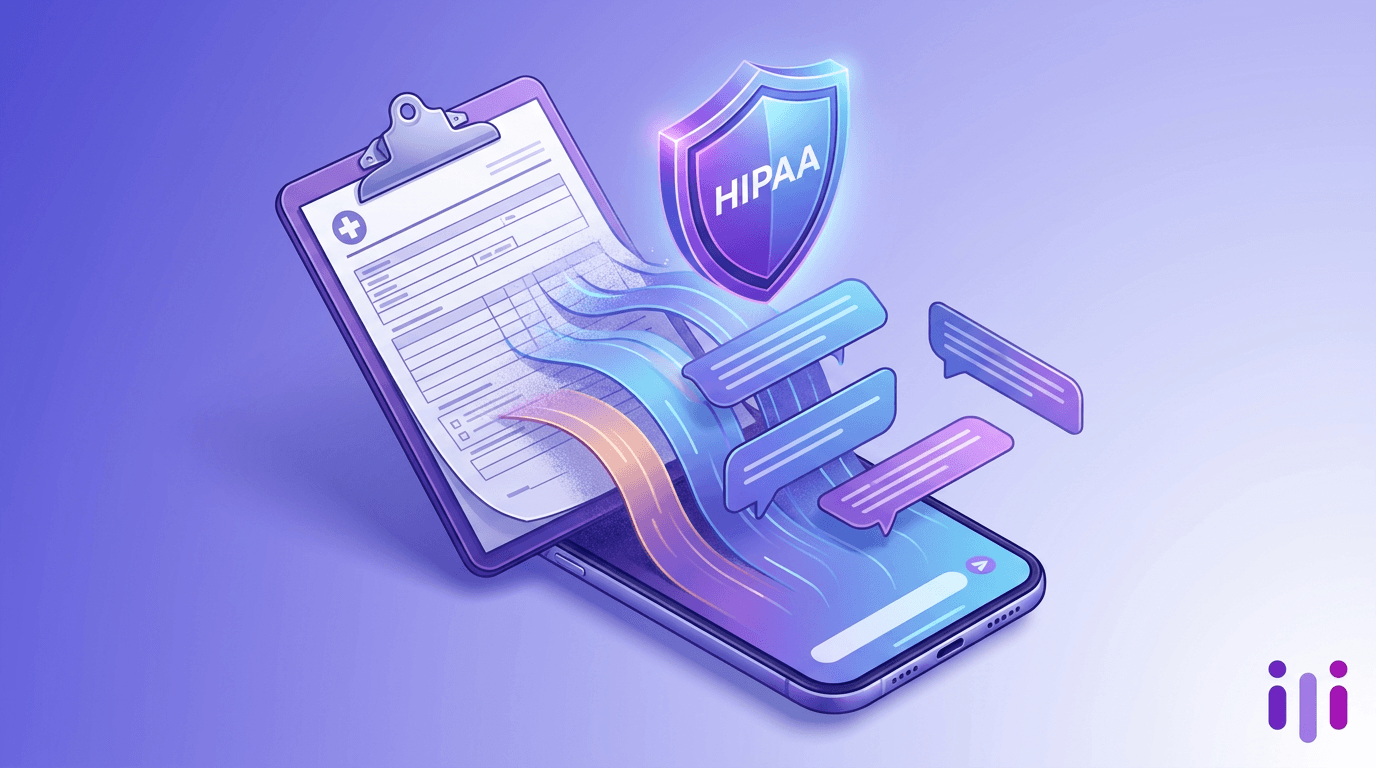
AI medical intake is a conversational data-capture system that conducts the patient intake interview — collecting demographic, insurance, clinical history, and visit-specific information — through an AI agent rather than paper forms or static digital portals. The patient interacts via chat or voice on a mobile device or kiosk; the agent asks follow-up questions when an answer is incomplete or flags something clinically relevant. The output flows directly into the practice's EHR or practice-management system.
This is materially different from "patient portal forms." A patient portal form is a digital version of the clipboard. AI medical intake is a different product: it adapts to the patient's responses, captures structured and free-text data simultaneously, and pre-flags issues for the clinical staff to review.
Why practices are replacing clipboards in 2026
Three pressures combined to make 2025–2026 the inflection year. First, front-desk staffing is the most-quit role in healthcare; the American Medical Association reports administrative burden as the top driver of clinician and staff burnout in primary care. Replacing 20 minutes of clipboard-shuffling per patient with 2 minutes of clinical review of an AI-collected intake is the single highest-ROI workflow change available to most practices.
Second, patient experience expectations shifted. Patients accustomed to conversational interfaces in banking, insurance, and customer support find the paper clipboard jarring. Net Promoter scores for digital-first practices consistently outperform paper-first peers in J.D. Power's healthcare patient experience studies.
Third, the AI capability finally crossed the threshold for production use in healthcare. Up through 2023, the typical "AI intake" product was a chatbot with hard-coded conditional logic. Modern AI agents can hold a multi-turn intake conversation, capture clean clinical-history data, and escalate ambiguous cases to staff before the visit.
What HIPAA compliance actually requires
HIPAA compliance for AI medical intake is achievable, but the bar is concrete. A practice deploying AI intake needs:
- A signed Business Associate Agreement (BAA) with the vendor — non-negotiable.
- End-to-end encryption in transit (TLS 1.2+) and at rest (AES-256 minimum).
- Audit logging of who accessed what PHI, when, and from where, retained per HIPAA's 6-year requirement.
- Minimum-necessary data design — the agent only collects what's needed for the visit, not everything that might be useful.
- Clear identity verification — typically date-of-birth + phone or email match against EHR record.
- Patient consent capture for AI processing, separate from general HIPAA acknowledgment.
- Vendor sub-processor disclosure — if the AI vendor uses a foundation-model provider, that relationship must be disclosed and BAA'd.
Most practices we've worked with handle this by adopting a vendor with a pre-built BAA, security review packet, and HITRUST or SOC 2 Type II attestation. Going custom is feasible but ~6 months of legal and security work — not the right path unless the practice is large enough to absorb it.
For practices currently running form-based intake, the AI patient intake guide covers the cutover playbook in operational detail.
Specialty-specific patterns
AI medical intake plays differently across specialties.
Primary care is the highest-volume use case. The intake covers reason-for-visit, medication reconciliation, insurance verification, and a brief symptom history. AI excels here because the question set is broad but each question is shallow.
Dental practices were among the earliest adopters. Dental intake captures medication history (critical for anesthesia), prior dental work, and visit-specific concerns. AI conversation handles the medical-history depth dental needs without overwhelming the patient. Dental software vendors have shipped AI intake integrations for the major practice-management platforms.
Orthopedics uses intake for both visit prep and pre-surgical screening. Conversational AI handles the long-form pain history (location, duration, triggers, prior treatments) far better than a paper form, which patients tend to skip past with "see notes."
Dermatology intake centers on visit-specific concerns and prior treatments. AI intake handles the photo-attachment + history-narrative combination cleanly.
Behavioral health intake is the highest-stakes specialty. The intake includes screening tools (PHQ-9, GAD-7, suicide-risk screening) that must be administered with clinical fidelity. AI agents can administer these in conversation form, but the design must be locked-down — no free-form deviations from validated instrument wording. Practices in this specialty typically use AI intake for the demographic and history layer and human-administered instruments for the screening layer.
Concierge primary care uses AI intake as a differentiator: 20-minute phone-based intake conversation before each visit, with the practice physician reviewing the synthesis before the patient arrives. This pattern explicitly trades AI breadth for human depth — the AI-moderated interview pattern applied to clinical intake.
The conversational intake architecture
A working AI medical intake system has four components: the AI agent that conducts the conversation, an EHR/PMS integration that pushes structured fields back into the patient record, an escalation rule set that flags clinically relevant issues for staff review, and a patient-facing notification flow that gets the patient into the conversation at the right moment (usually a text 2–3 days before the appointment, with a kiosk fallback at check-in).
Most failures in AI medical intake deployments trace to weak EHR integration. If the intake captures clean data but staff have to hand-key it into the EHR, you've replaced one form with another and added work. The integration is the unlock; budget for 4–8 weeks of vendor integration work for the major EHRs (Epic, Cerner/Oracle Health, athenahealth, eClinicalWorks).
How AI medical intake reduces no-shows
Practices integrating appointment-prep questions into the intake flow report 20–35% reduction in no-show rates. The mechanism is simple: a patient who has already invested 4 minutes describing their symptoms is more committed than a patient who hasn't. The intake also surfaces logistical issues (transportation, time conflicts, prior auth concerns) early enough to reschedule rather than absorb the no-show. The conversational intake guide covers this no-show effect across vertical contexts.
How to evaluate an AI medical intake vendor
Five questions to ask any vendor.
1. Show me the BAA, security review packet, and HITRUST attestation. No documentation = no deal. This is the disqualifying first filter.
2. Walk me through the EHR integration for [my system]. Generic "we integrate with anything" answers are red flags. The vendor should show a specific integration spec for your EHR with examples.
3. Show me the intake conversation experience on mobile. Patients use phones, not tablets. Mobile UX is non-negotiable.
4. What's the escalation rule set? A good vendor has clinical-staff-vetted rules for what gets flagged (e.g., "patient reports chest pain at rest" → urgent flag) and what doesn't.
5. What's the typical adoption curve in [my specialty]? Vendors should quote real benchmarks: completion rate, average duration, staff time saved, no-show reduction.
For a broader vendor framework, see the law firm intake software comparison — different vertical, same evaluation logic.
Common deployment mistakes
The first mistake is launching too broad. Practices that try to convert all intake (insurance + history + visit-specific + consents) on day one tend to fail. Start with one component — usually visit-specific symptom history — and add others as the staff develops confidence.
The second mistake is under-investing in the intake flow's tone. Patients perceive the AI's voice as the practice's voice. A cold or clinical AI intake hurts patient satisfaction even if it captures data perfectly.
The third mistake is skipping the kiosk fallback. Some patients don't engage with pre-visit text intake — elderly patients, patients without smartphones, patients with low digital comfort. A check-in-time kiosk completes the intake for those patients without forcing staff to hand-key paper forms.
Frequently Asked Questions
Is AI medical intake HIPAA compliant out of the box?
No vendor is HIPAA compliant out of the box — HIPAA compliance is a property of the practice's deployment, not the software. A compliant deployment requires a signed BAA with the vendor, proper access controls, audit logging, encryption, and staff training. The vendor provides the technical building blocks; the practice is responsible for proper configuration and operational use.
How long does AI medical intake take a patient to complete?
Typical completion times are 4–8 minutes for primary care and 8–15 minutes for specialties with deeper history needs (orthopedics, behavioral health). Completion rates run 70–85% when patients receive the intake link 2–3 days before the appointment.
What happens if the patient won't or can't complete AI intake?
A working AI medical intake deployment includes fallbacks: a check-in kiosk for patients without smartphones, paper-form availability for patients who explicitly prefer it, and staff-assisted intake for patients with accessibility needs. Forcing AI intake creates equity problems and patient dissatisfaction; offering it as the default with fallbacks does not.
Does AI medical intake replace front-desk staff?
No. It changes what front-desk staff do. The role shifts from typing paper forms into the EHR to handling exceptions, supporting patients who need help, and managing the parts of the visit the AI cannot — payment exceptions, complex insurance issues, scheduling conflicts. Front-desk teams typically report higher job satisfaction after AI intake deployment because the work becomes less repetitive.
How does AI medical intake handle non-English-speaking patients?
Modern AI intake agents support 30+ languages out of the box, with translations vetted by clinical translators. The conversation completes in the patient's preferred language; the EHR record is normalized to English for clinical staff. This is a meaningful patient-experience improvement over paper forms, which most practices print only in English plus one or two local languages.
What's the typical ROI timeline?
Most practices we've seen reach payback in 3–6 months. The biggest savings are front-desk hours (typically 60–80% reduction per patient on intake-related work) and no-show reduction (20–35% improvement when appointment-prep is integrated). For a 5,000-visit-per-year practice, that's typically $40,000–$80,000 of annualized savings against $20,000–$40,000 of annualized vendor cost.
The bottom line on AI medical intake
AI medical intake is past the experimental phase. The 2026 question is not "should we adopt this" but "which specialty workflows do we adopt first." Start with visit-specific symptom history, prove the deployment, expand from there. The compliance bar is real but achievable; the ROI is real and measurable.
If you're evaluating a conversational intake layer for your practice, Perspective AI's intelligent intake is built on the same conversational architecture that's working in legal and insurance intake — adapted to healthcare's compliance and clinical requirements. Start a study to see what conversational intake produces for a typical patient visit in your specialty.
More articles on Intelligent Intake

AI Legal Intake Automation in 2026: From PDF Forms to Conversational Triage
Intelligent Intake · 10 min read
Consumer App Onboarding Drop-Off in 2026: How to Find Where New Users Actually Stall
Intelligent Intake · 23 min read
The Career Counseling Intake Form in 2026: Eliciting Goals, Not Symptoms
Intelligent Intake · 23 min read
The Child and Adolescent Therapy Intake Form in 2026: Who Answers, Who Consents
Intelligent Intake · 17 min read
The Couples Counseling Intake Form in 2026: Capturing Two Accounts, Not One
Intelligent Intake · 18 min read
Sample Counseling Intake Forms in 2026: Three Worked Examples, Annotated
Intelligent Intake · 21 min read